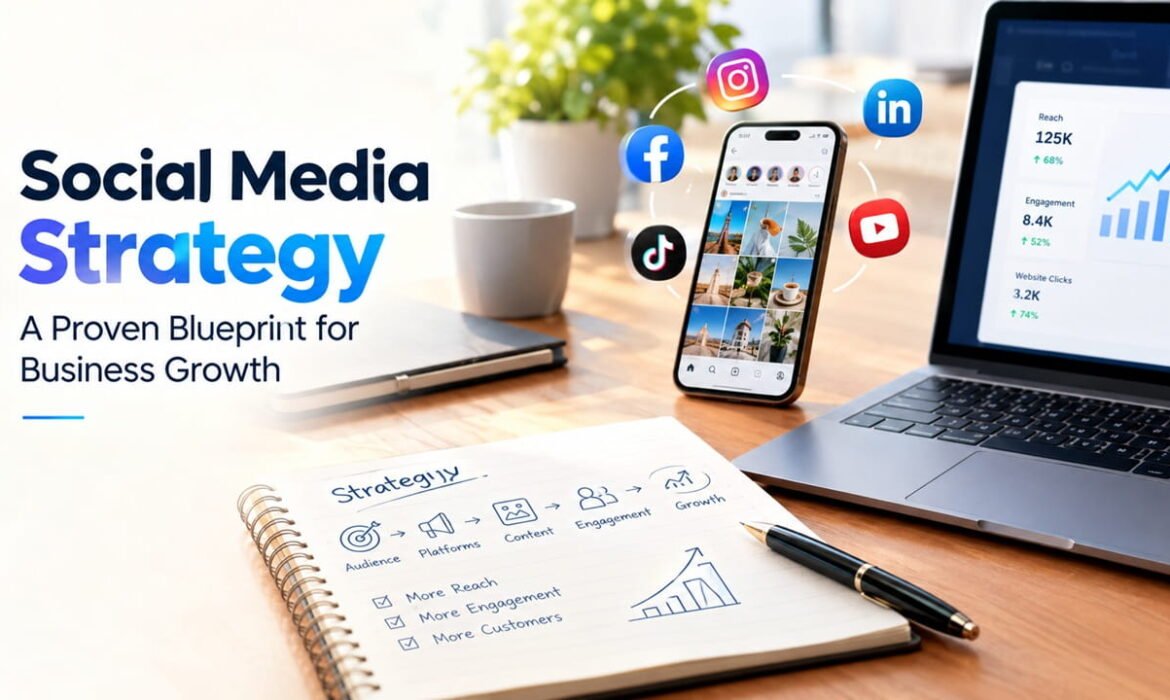
Social Media Strategy: A Proven Blueprint for Business Growth
You post on Instagram on Monday. Nothing on Tuesday or Wednesday. Then a reel on Thursday because someone told you reels work. By Friday, you’re not sure why you’re even posting anymore.
This is how most small businesses use social media, posting whenever they remember to, with no real plan behind it. And then they wonder why followers aren’t turning into customers.
The businesses that actually grow through social media aren’t posting more often. They’re posting with a plan. That plan is what’s called a social media strategy, and it’s the difference between social media being a time-waster and it actually bringing in business.
This guide walks you through what a social media marketing strategy actually means and how to build one that fits your business, step by step.
What Is a Social Media Strategy?
A social media Marketing strategy is simply a structured plan for how you use social platforms to reach specific, measurable business goals, more enquiries, more sales, more brand awareness, instead of posting randomly and hoping something works.
It answers a few basic questions before you post a single thing.
- Who are you trying to reach?
- Which platforms are they actually on?
- What do you want them to do after seeing your content?
Without answers to these, posting becomes guesswork.
Why Random Posting Doesn’t Work
Posting without a plan usually looks busy but produces very little. You might get likes and views, but likes don’t pay your bills.
A proper social media strategy framework connects your content to an actual business goal. Every post either builds brand awareness, moves someone further along your marketing funnel, or directly asks them to take an action. If a post isn’t doing at least one of these, it’s just noise.
Step 1: Start With Audience Research
Before deciding what to post, you need to know who you’re posting for. Audience research means understanding your customer’s age group, interests, problems, and the kind of content they actually stop scrolling for.
A B2B business selling to other companies behaves very differently online compared to a fashion brand selling directly to young shoppers. Your audience strategy should reflect that difference, not copy whatever a competitor in a completely different industry is doing.
Step 2: Choose the Right Platforms
Not every business needs to be on every platform. This is where platform strategy comes in, picking where your actual audience spends time, instead of trying to be everywhere at once.
- Still useful for local businesses and slightly older audiences who actively use groups and community pages.
- Works well for visual businesses, fashion, food, real estate, home decor, where photos and reels do the heavy lifting.
- The go-to platform for B2B businesses, recruitment, and building a professional brand presence.
- Best when you have something worth explaining in detail, tutorials, demos, or behind-the-scenes content.
Most brands don’t need to build a huge presence everywhere. Meta alone, through Facebook and Instagram, covers a large part of most businesses’ audience needs, especially when starting out.
Step 3: Plan Your Content, Don’t Wing It
Once you know your audience and platform, content planning comes next. This means deciding, ahead of time, what kind of posts you’ll create and when, instead of scrambling for an idea the morning you’re supposed to post.
A simple content strategy usually mixes a few types of posts, something educational, something that builds trust like a testimonial or behind-the-scenes look, and something that clearly promotes what you sell. Planning even a week or two in advance removes most of the last-minute pressure that leads to inconsistent posting.
Step 4: Build Consistent Brand Awareness
People need to see your brand more than once before they trust it enough to buy. This is where brand strategy and online branding matter, your colours, your tone, and your message should feel the same whether someone sees your Instagram post, your website, or your LinkedIn page.
Inconsistent branding, sounding professional on LinkedIn and overly casual on Instagram in a way that feels like two different companies, quietly confuses people and slows down trust.
Step 5: Focus on Real Engagement, Not Just Views
A social growth strategy isn’t only about follower count. It’s about real interaction, comments, shares, replies to your stories, people tagging their friends.
This is your engagement strategy at work. Replying to comments, asking questions in your captions, and responding to DMs all build community growth over time. A page with fifty highly engaged followers who actually message you is often more valuable than one with five thousand silent ones.

Step 6: Connect Social Media to Your Bigger Marketing Funnel
Social media rarely closes a sale by itself. It usually plays an earlier role in the customer journey, someone sees your reel, checks your profile, visits your website later, and then reaches out.
This is why your social media roadmap should connect to the rest of your marketing strategy, your website, your WhatsApp, your email list, instead of existing as a separate, disconnected activity. Every platform should gently guide people to the next step, not leave them stuck at just ‘liking’ your content forever.
Common Social Media Strategy Mistakes
- Posting without a goal. If you can’t say what a post is meant to achieve, it’s probably not worth posting.
- Copying competitors blindly. What works for one brand’s audience may not work at all for yours.
- Chasing every trend. Jumping on every trending reel format usually dilutes your actual brand message.
- Never checking the numbers. Without reviewing what’s actually working, you keep repeating the same mistakes.
Frequently Asked Questions
Q1. What is a social media strategy in simple words?
It's a clear plan for who you're trying to reach on social media, which platforms to use, and what you want people to do after seeing your content.
Q2. Do I need to be active on every social media platform?
No. It's usually better to be consistent on two or three platforms where your actual audience spends time than to spread thin across all of them.
Q3. How often should a business post on social media?
There's no fixed number that works for everyone. Being consistent, even three well-planned posts a week, works better than posting daily with no plan and then disappearing for weeks.
Q4. Can a small business handle social media strategy on its own?
Yes, especially in the beginning. As the business grows and platforms multiply, many owners bring in outside help to keep things consistent and properly planned.
Q5. How do I know if my social media strategy is actually working?
Look beyond likes. Check whether it's bringing in enquiries, website visits, or actual conversations with potential customers.
Bringing It All Together
A social media strategy isn’t about posting more. It’s about posting with a clear reason behind every piece of content, built around your actual audience and business goals.
Start small. Understand your audience, pick two or three platforms that actually make sense for your business, and plan your content instead of creating it under pressure at the last minute.
If your social media currently feels more like a chore than a growth channel, Arihant Global can help you build a social media strategy that’s actually tied to real business goals, not just likes and follower counts. And if you’d simply like a second opinion on your current approach, Arihant Global is happy to take a look and point out where the gaps are.
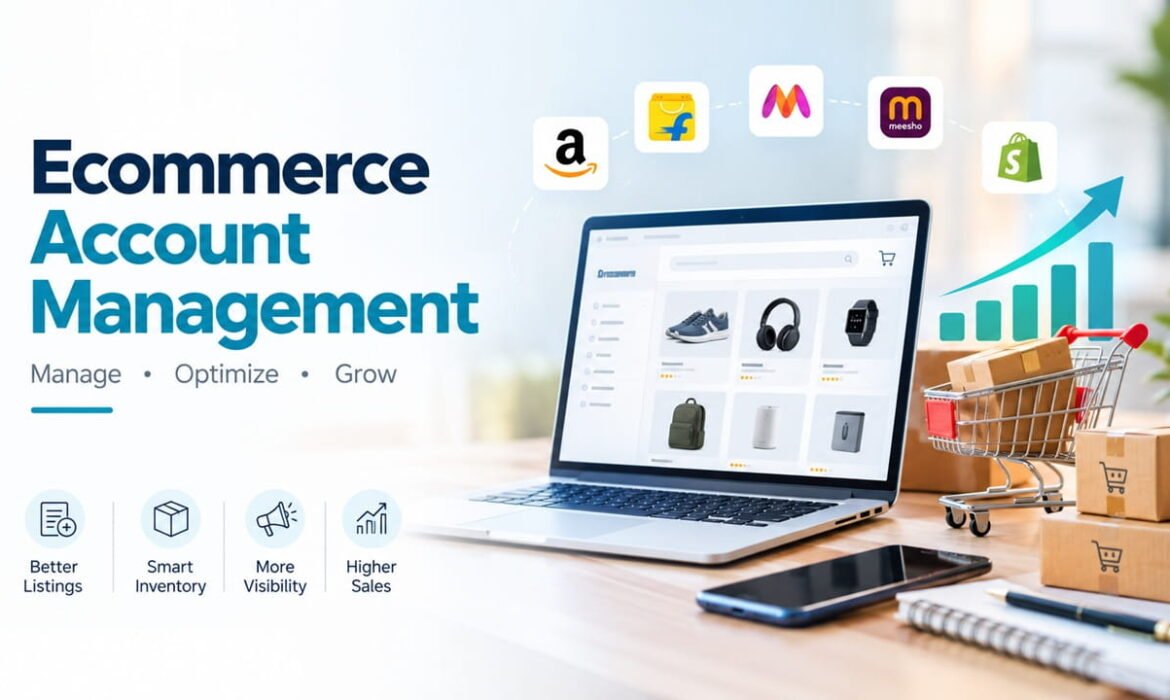
Ecommerce Account Management: How to Manage, Optimize & Grow Your Online Store
Imagine this, You list your products on Amazon, Flipkart, or your own online store. The photos look sharp. The prices are competitive. You hit publish and wait for the orders to roll in.
Then… nothing.
Or maybe it’s worse. Sales start strong, then slowly fade. Your best-selling listing quietly drops from page one to page five. Your ratings dip. One morning you log into your seller dashboard and find a policy warning you didn’t even know existed.
Sound familiar?
That’s not bad luck. That’s what happens when nobody is actively managing the account behind your store.
Here’s the truth most new sellers don’t realize: launching a product is the easy part. Keeping it visible, profitable, and in good standing that’s the real work. And that work has a name Ecommerce account management.
In this guide, we’ll break down exactly what ecommerce account management means, how it actually works day to day, what a good account manager does, and how you can use it to grow your store whether you handle it yourself or bring in help.
No jargon. No fluff. Just what you need to know.
What Is Ecommerce Account Management?
Ecommerce account management is the ongoing work of running, monitoring, and improving your online store or marketplace seller account so it keeps selling and keeps making money.
Think of it as everything that happens after you hit “publish.”
That includes:
- Keeping your product listings accurate, optimized, and appealing
- Managing stock so you never oversell or run out
- Processing and tracking orders
- Responding to customer questions and reviews
- Running ads and promotions to get seen
- Watching pricing and competitors
- Staying compliant with marketplace rules
- Reviewing your numbers and fixing what’s not working
If your store or seller account needs looking after, it falls under ecommerce account management.
It applies whether you sell on one marketplace like Amazon, across several (Amazon, Flipkart, Myntra, Meesho, Etsy), or through your own website on Shopify or WooCommerce. The tools change. The core job doesn’t.
Why Ecommerce Account Management Matters More Than Ever
A few years ago, listing a product and leaving it alone might have worked. Not anymore.
Here’s why.
1. Your visibility runs on an algorithm, not luck
Marketplaces decide which products to show first based on factors like sales history, reviews, pricing, and listing quality. If those factors slip, so does your ranking quietly, without warning.
2. Small mistakes can freeze your entire account
Late shipments, inaccurate listings, or policy violations can lead to suspended listings or even a suspended account. And a suspended account means zero sales, not just slower sales.
3. Customers decide in seconds
A blurry image, a vague title, or a handful of bad reviews is often all it takes for a shopper to click away to a competitor.
4. Your competitors aren’t sitting still
While your listing stays the same, competitors are testing prices, running ads, and collecting reviews. Standing still is the same as falling behind.
Put simply: ecommerce account management isn’t an optional extra. It’s what keeps a store from quietly losing money without anyone noticing.
Building an Ecommerce Account Management Strategy That Works
Before jumping into daily tasks, it helps to have a plan. That plan is your ecommerce account management strategy the framework that decides what gets done, how often, and why.
A workable strategy usually answers four questions:
- Which marketplaces matter most for your products? Not every channel suits every business. A handmade jewelry brand might do best on Etsy and Instagram. A consumer electronics seller might rely on Amazon and Flipkart.
- What does “good performance” look like for your account? This could mean a target conversion rate, a minimum rating, or a specific order defect rate.
- Who’s responsible for what? Listings, ads, customer service, and compliance often need different skills. Decide early who owns each piece.
- How often will you review performance? Daily order checks, weekly listing reviews, and monthly deep-dive reports each serve a different purpose.
Get these four answers right, and the day-to-day tasks become much easier to manage because you’re no longer reacting to problems. You’re following a plan.
How Does Ecommerce Account Management Work?
In practice, ecommerce account management works as a cycle, not a one-time setup. You set things up, monitor performance, fix what’s slipping, and repeat.
Here’s a quick breakdown of what each area actually covers:
| Area | What It Covers |
| Listing Management | Titles, descriptions, images, and keywords so products get found and get clicked |
| Inventory & Order Management | Accurate stock counts, order processing, and shipping coordination |
| Advertising & Promotions | Sponsored ads, deals, and coupons that drive visibility and sales |
| Pricing & Competitor Monitoring | Keeping prices competitive without eating into margins |
| Customer Service & Reviews | Answering questions, handling returns, and managing your reputation |
| Compliance & Policy Management | Following marketplace rules so your account stays in good standing |
| Performance Reporting | Tracking sales, conversion rate, ad spend, and profit over time |
No single task on this list will fix your store on its own. It’s the combination done consistently that moves the needle.
What Does an Ecommerce Account Manager Do?
If you’ve ever wondered what an ecommerce account manager actually does all day, here’s the honest answer: a bit of everything.
A typical day might include:
- Checking overnight orders and resolving any shipping delays
- Reviewing account health metrics for warnings or policy flags
- Updating a listing that’s underperforming new images, a better title, updated keywords
- Responding to customer questions and recent reviews
- Adjusting a bid or budget on an underperforming ad campaign
- Comparing prices against two or three competitors
- Pulling last week’s sales report to spot what’s working and what isn’t
It’s part data analysis, part customer service, part marketing, and part troubleshooting. The goal behind all of it is the same: keep the account healthy and keep sales moving in the right direction.
Some businesses hire one person to do all of this. Others split it across a small team, or outsource it entirely more on that later.
The Ecommerce Account Management Process, Step by Step
Wondering how to actually manage an ecommerce account from scratch? Here’s the process, broken into stages.
Step 1: Audit Your Store or Ecommerce Seller Account
Start by reviewing where things currently stand. Check your account health score, listing quality, current rankings, reviews, and any outstanding policy issues. You can’t fix what you haven’t measured.
Step 2: Optimize Your Listings
Rewrite titles so they include the terms customers actually search for. Improve product images. Fill out bullet points and descriptions with real, useful details not filler. A well-optimized listing does more selling on its own than any ad campaign can.
Step 3: Manage Inventory and Orders
Set up stock alerts so you never oversell a product you don’t have. Keep order processing times fast and consistent marketplaces track this closely, and slow fulfillment quietly hurts your ranking.

Step 4: Run Ads and Promotions
Use sponsored ads to get new listings in front of shoppers while organic ranking catches up. Layer in deals or coupons during high-traffic periods to boost conversion.
Step 5: Handle Customer Service and Reviews
Reply to questions quickly. Resolve complaints before they turn into bad reviews. Politely follow up with happy customers to encourage a review reviews are often the single biggest factor in whether a shopper trusts your listing.
Step 6: Monitor Compliance
Stay current on each marketplace’s policies. A single mistake a restricted keyword, a missing certification, a late shipment streak can trigger a suspension that’s far more costly than the fix would have been.
Step 7: Track Performance and Report
Review your numbers regularly: sales, conversion rate, ad spend, return rate, and profit margin. Use what you find to decide what to fix next. This step feeds straight back into Step 1 which is exactly why account management is a cycle, not a checklist you finish once.
Key Areas of Ecommerce Account Optimization
Optimization is where account management turns into actual growth. A few areas tend to matter the most.
- Listing quality. Clear titles, sharp images, and complete product information directly affect both your search ranking and your conversion rate.
- Pricing strategy. Price too high and you lose the sale. Price too low and you lose margin. Regular competitor checks help you find the range that works.
- Reviews and ratings. A product with 50 reviews at 4.5 stars will usually outsell an identical product with 3 reviews at 4.5 stars. Reviews build trust and trust drives clicks.
- Advertising efficiency. It’s not about spending more on ads. It’s about spending on the right keywords and products, and cutting spend on what isn’t converting.
- Account health. Order defect rate, late shipment rate, and cancellation rate all quietly influence how much visibility your entire account gets not just one listing.
Improving any one of these helps. Improving all five, consistently, is what separates a store that grows from one that stalls.
Ecommerce Marketplace Account Management: Handling Multiple Channels
Many sellers don’t stick to one platform. They sell across Amazon, Flipkart, Myntra, Meesho, and their own website all at once. That’s where ecommerce marketplace account management gets more complex.
Each marketplace has its own:
- Search algorithm and ranking factors
- Listing format and image requirements
- Fee structure and payout schedule
- Policy rules and account health metrics
- Customer expectations and return policies
Managing all of this by hand across multiple channels can get messy fast a price change on one platform, an inventory update missed on another, and suddenly you’re overselling a product you no longer have.
That’s why many multi-channel sellers rely on centralized inventory tools and a consistent process across every account, rather than treating each marketplace as a separate project. The goal isn’t to treat every channel identically it’s to make sure nothing falls through the cracks between them.
Ecommerce Seller Account Management Best Practices
Whether you’re managing your own account or overseeing someone else who does, a few best practices consistently separate the accounts that grow from the ones that stall.
- Check account health daily, not weekly. Small issues are easy to fix early and expensive to fix late.
- Never let a listing go stale. Revisit titles, images, and keywords every few months what worked last year may not work now.
- Respond to customers fast. Response time affects both customer satisfaction and, on some platforms, your account metrics.
- Track your numbers, not your feelings. Decide what to change based on data, not a hunch that something “should” be working.
- Keep a policy checklist handy. Marketplace rules change often. What was fine last quarter might not be fine now.
- Don’t chase every trend. A new feature or ad format isn’t worth adopting unless it fits your actual products and audience.
None of these are complicated. They’re just easy to skip when you’re busy which is exactly when they matter most.
How to Manage an Ecommerce Account: A Simple Checklist
If you’re managing an account yourself, here’s a practical rhythm to follow.
Daily:
- Check and process new orders
- Respond to customer messages
- Scan for account health alerts or policy warnings
Weekly:
- Review ad campaign performance and adjust budgets
- Check top listings for ranking changes
- Read and respond to new reviews
Monthly:
- Audit your best and worst-performing listings
- Compare pricing against competitors
- Pull a full performance report: sales, conversion, returns, profit
This rhythm keeps small issues from turning into big ones and gives you a clear picture of what’s actually driving results.
How to Improve Ecommerce Account Performance
If your account feels stuck, these are the levers most likely to move it.
- Fix underperforming listings first. Don’t spread effort evenly across every product. Find your top 10-20% of listings by traffic and fix what’s holding them back a weak image, a vague title, a missing keyword.
- Reduce your return and cancellation rate. Accurate product descriptions and honest images prevent most returns before they happen. Fewer returns also means better account health and better ranking.
- Get more reviews, honestly. Follow up with buyers after delivery. Never buy or fake reviews most marketplaces detect this, and the penalty is far worse than a few missing stars.
- Reallocate ad spend toward what converts. Cut budget from keywords and products that aren’t converting, and put it behind the ones that are.
- Watch your competitors, not just your own numbers. A price or listing change on your side can look fine in isolation and still lose to a competitor who moved first.
Performance rarely improves from one big change. It improves from several small, consistent ones.
Common Ecommerce Account Management Mistakes That Hurt Sales
Even experienced sellers fall into these traps.
- Setting up listings once and forgetting them. Search algorithms and customer expectations shift. A listing that ranked well a year ago may need a refresh today.
- Ignoring account health metrics until there’s a problem. By the time a suspension notice arrives, the underlying issue has usually been building for weeks.
- Treating every marketplace the same way. Copy-pasting a listing across platforms without adjusting for each one’s format and audience usually underperforms everywhere.
- Chasing sales volume while ignoring margin. A steady stream of orders that lose money on every sale isn’t growth it’s a slow leak.
- Reacting to reviews instead of preventing them. Responding well to a bad review helps. Fixing the reason it happened in the first place helps more.
Avoiding these mistakes often does more for your store than any single optimization tactic.
What to Look for in an Ecommerce Account Management Company
If you decide to outsource, look for a partner that offers:
- Proven experience with your specific marketplaces
- Clear, regular reporting not vague “we’re working on it” updates
- A defined process for listings, ads, and compliance
- Transparent pricing without hidden fees
- Case studies or references from similar businesses
A good ecommerce marketplace management agency should feel like an extension of your team, not a black box you hand your account to and hope for the best.
Frequently Asked Questions About Ecommerce Account Management
Q1. What is ecommerce account management?
It's the ongoing process of running and improving an online store or marketplace seller account covering listings, inventory, orders, ads, customer service, compliance, and performance tracking.
Q2. How does ecommerce account management work?
It works as a continuous cycle: audit the account, optimize listings and pricing, manage inventory and orders, run ads, handle customer service, monitor compliance, and review performance then repeat.
Q3. What does an ecommerce account manager do on a daily basis?
They check orders, monitor account health, update listings, respond to customers, adjust ad campaigns, track competitor pricing, and review sales data.
Q4. How much do ecommerce account management services cost?
Pricing varies widely based on the number of marketplaces, order volume, and scope of work from a flat monthly fee to a percentage of sales. Ecommerce account management services in India are often more affordable than hiring in-house or working with agencies in other regions, without sacrificing expertise.
Q5. Should I manage my ecommerce account myself or outsource it?
If you're on one or two marketplaces with manageable order volume, doing it yourself is often fine. If you're scaling across channels or spending more time firefighting than growing, outsourcing to an ecommerce account management agency is usually worth the cost.
Final Thoughts: Turning Account Management Into Growth
Ecommerce account management isn’t the exciting part of running an online store. It’s not launching a new product or hitting a big sales day.
It’s the daily, unglamorous work of keeping listings sharp, orders moving, customers happy, and your account in good standing.
But here’s the thing that unglamorous work is exactly what separates stores that grow steadily from stores that spike and fade.
Start small if you need to. Pick one area your worst-performing listing, your slowest response time, your most-ignored account health metric and fix it this week. Then build the habit from there.
Because a store that’s actively managed doesn’t just survive the algorithm.
It grows because of it. Arihant Global helps businesses manage and strengthen their digital presence with practical ecommerce and digital marketing solutions. When the basics are managed well, sustainable growth becomes much easier to achieve.
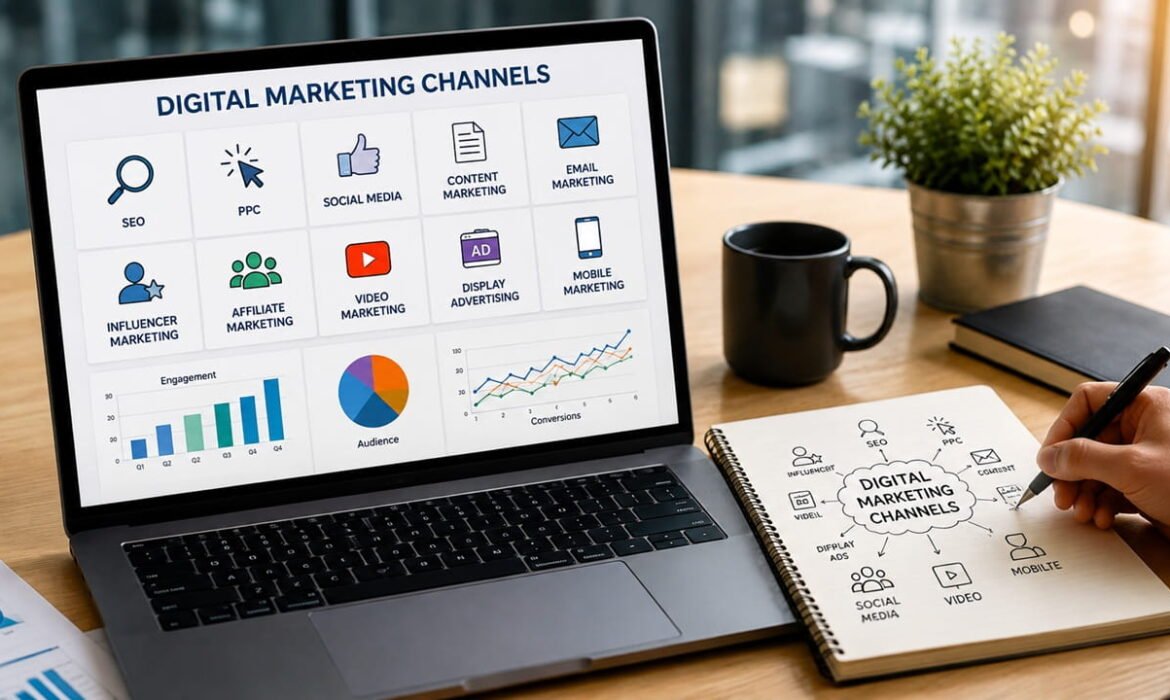
Digital Marketing Channels: The Complete Guide to Choosing the Right Ones for Your Business
You have a website. You run ads. You post on Instagram almost every day. You even send emails to your customer list.
And leads are still not coming in the way you hoped.
A business can have a great product and a real marketing budget, and still struggle for one simple reason it is spending time and money on the wrong digital marketing channels.
Here is the tricky part. Your competitor might be getting great results from Instagram, Google Ads, or SEO. That does not mean the same channel will work for you. Every business and every audience behaves differently online.
So how do you know which digital marketing channels are actually worth your time and money?
That is what this guide will help you figure out what each channel actually does, how to pick the right mix for your business, and why AI search is starting to change how people find businesses online.
What Is a Digital Marketing Channel?
A digital marketing channel is simply any online platform or method a business uses to reach, engage, or convert its audience.
Some channels you own, like your website and your email list. Some you pay for, like Google Ads or Instagram ads. And some you earn, like organic Google rankings, shares, or reviews.
The biggest advantage digital channels have over old-style advertising is control. You decide who you reach and when you reach them, and you can measure exactly how each channel performs clicks, leads, sales, and return on investment.
But no single channel does everything. Search is great at capturing people who are already looking for what you sell. Social media and video are better at creating awareness among people who have not heard of you yet. Email and WhatsApp Marketing work best for staying in touch with people you have already reached.
That is why the real question is never “which channel is best?” It is “which combination of channels fits my business and my customers?”
Why Choosing the Right Digital Marketing Channels Matters More Now
Digital marketing has changed. People still use Google, scroll social media, and open emails. But there is a new layer between businesses and customers now AI-powered search.
Tools like Google’s AI Overviews and chat-based search increasingly give people direct answers instead of a list of websites to click through. That means your brand needs to show up not just in search results, but inside the answer itself.
Digital ad spending keeps growing every year, and email marketing and SEO remain two of the best channels for return on investment when they are done properly. The lesson: digital channels are not going away, they are becoming more specialized which makes picking the right ones even more important.
How to Choose the Right Digital Marketing Channels for Your Business
Most businesses make the same mistake. They start by picking a platform: “Should we be on Instagram? Should we run Google Ads?” Instead, start with your customer, and ask yourself these five questions.
- Where does your audience actually spend time? A platform with a billion users means nothing if your customer is not one of them. A B2B company may get far more value from LinkedIn and Google than from Instagram.
- What part of the buying journey are you targeting? Social media and video build awareness. SEO and content build consideration. PPC and retargeting help close the deal. Email and WhatsApp help retain customers. One channel cannot do all four jobs well.
- How fast do you need results? Paid ads bring traffic quickly but stop the moment you stop paying. SEO and content take longer to build, but keep working long after you have stopped actively promoting them. Most businesses do best using both together.
- Are you visible to AI search too? Your content now needs to show up in regular search results, featured snippets, and AI-generated answers which means writing genuinely useful content, not just content stuffed with keywords.
- Can you actually measure it? Before putting money into a channel, decide what success looks like leads, cost per lead, sales, or return on ad spend. Likes and impressions are not revenue.
The Core Digital Marketing Channels, Explained Simply
- SEO (Search Engine Optimization) gets your business found when people search for what you offer. It takes longer than ads to show results, but once it works, it keeps bringing visitors without paying for every click. Best for long-term, high-intent traffic.
- PPC (Pay-Per-Click Advertising) puts you at the top of search results right away, in exchange for a fee per click. You get full control over budget and targeting, but the traffic stops the day you stop paying. Best for fast leads and sales.
- Social Media Marketing builds awareness among people who do not know your business yet. Platforms like Instagram, LinkedIn, and YouTube help you build a community, show off your product, and stay visible.
- Content Marketing is not really a separate channel it is the fuel behind all the others. One good blog post can turn into a LinkedIn post, an email, a video script, and an SEO asset.
- Email Marketing is one of the few channels you fully own. Once someone joins your list, no algorithm can stop them from seeing your message. Best for nurturing leads and bringing customers back.
- Influencer Marketing borrows trust from people who already have an audience. It works well for consumer brands where recommendations and demonstrations matter look for relevance, not just follower count.
- Affiliate Marketing pays partners only when they deliver a result, a sale or a lead. It needs good tracking and strong partner relationships, but it can scale well once set up properly.
- Video Marketing combines visuals, sound, and storytelling, which makes it useful at almost every stage from explaining your product to answering common questions to closing a sale.
- Display Advertising shows visual ads across websites and apps. It works especially well for retargeting reminding someone who visited your website but did not buy, so they come back and complete the purchase.
- Mobile Marketing reaches customers through push notifications, SMS, and mobile-friendly experiences. The goal is not to send more messages. It is to send the right message at the right time.

AIO, GEO, and SXO: The New Layer Behind Digital Marketing
If you have done SEO for a while, you have probably noticed that search does not look the same anymore.
AIO (AI Optimization) means structuring your content so AI tools can understand and use it clear, well-organised, and genuinely useful.
GEO (Generative Engine Optimization) is about becoming a source that AI systems trust enough to mention, not just a page that ranks.
SXO (Search Experience Optimization) combines SEO with what happens after someone lands on your page. A good ranking means little if your page is slow, confusing, or hard to use on mobile.
Together, these three ideas make sure your content works for both search engines and the humans reading it.
How These Digital Marketing Channels Work Together
A customer might discover you through a social media video, search your brand on Google later, read a blog post, sign up for your email list, and finally buy after a follow-up email. Several channels played a part in that, not just one.
That is why the strongest strategies connect channels instead of treating each one as separate:
Social Media → Website → Email → Sale
PPC → Landing Page → Email Nurturing → Sale.
How Many Channels Should a Small Business Actually Use?
More channels do not mean more results. Trying to manage ten platforms at once usually means doing all of them poorly.
Most small businesses do well starting with three to five channels for example, SEO and content for long-term growth, one paid channel like PPC or paid social for quicker leads, and email or WhatsApp Marketing for retention. The right mix depends on your industry, budget, and how your customers actually buy.
Common Digital Marketing Channel Mistakes That Waste Budget
- Picking a channel because it’s trending, without checking if your customers are actually there.
- Trying to do everything at once, which usually means nothing gets done well.
- Running channels in silos instead of letting content flow between SEO, social, email, and ads.
- Skipping tracking, so you cannot tell which channel is actually bringing in leads and sales.
- Ignoring AI search, while still relying only on traditional rankings.
Frequently Asked Questions – Digital Marketing Channels
Q1. How many digital marketing channels should a small business use?
Most small businesses do best starting with three to four well-executed channels rather than spreading thin across ten. A common mix is one organic channel like SEO for long-term growth, one paid channel for quick leads, and one retention channel like email.
Q2. Which digital marketing channel has the best ROI?
There is no single winner for every business. Email marketing and SEO are usually named among the strongest performers, but actual returns depend on your execution, industry, and audience.
Q3. Should I start with paid or organic digital marketing channels?
If you need results quickly and have the budget, start with paid channels. But build organic channels like SEO and content alongside them, since these take time to grow but keep paying off long after you stop actively investing.
Q4. What is the difference between paid, owned, and earned channels?
Paid channels are ones you pay for, like ads. Owned channels are ones you control, like your website and email list. Earned channels are visibility you gain through others, like organic rankings, reviews, and shares.
Q5. Do I need a different strategy for every digital marketing channel?
Yes, but not a completely separate one. Each channel has its own format and audience behaviour, but they should all support the same business goal instead of working like disconnected departments.
Choosing the Right Digital Marketing Channels Doesn’t Have to Be a Guessing Game
The digital space keeps getting more crowded more platforms, more content, more ads, and now, more AI-generated answers. The answer is not to add another channel to your plate. It is to get more deliberate about the ones you already use.
Start with your audience. Understand how they buy. Find where demand already exists, and where you need to create it. Then build a focused mix of channels around that, and make them work together instead of competing for attention.
If you are not sure where to start, Arihant Global can help you map out the right digital marketing channels for your business, based on your audience, budget, and goals.
Get in touch for a free audit to see where your current strategy stands.
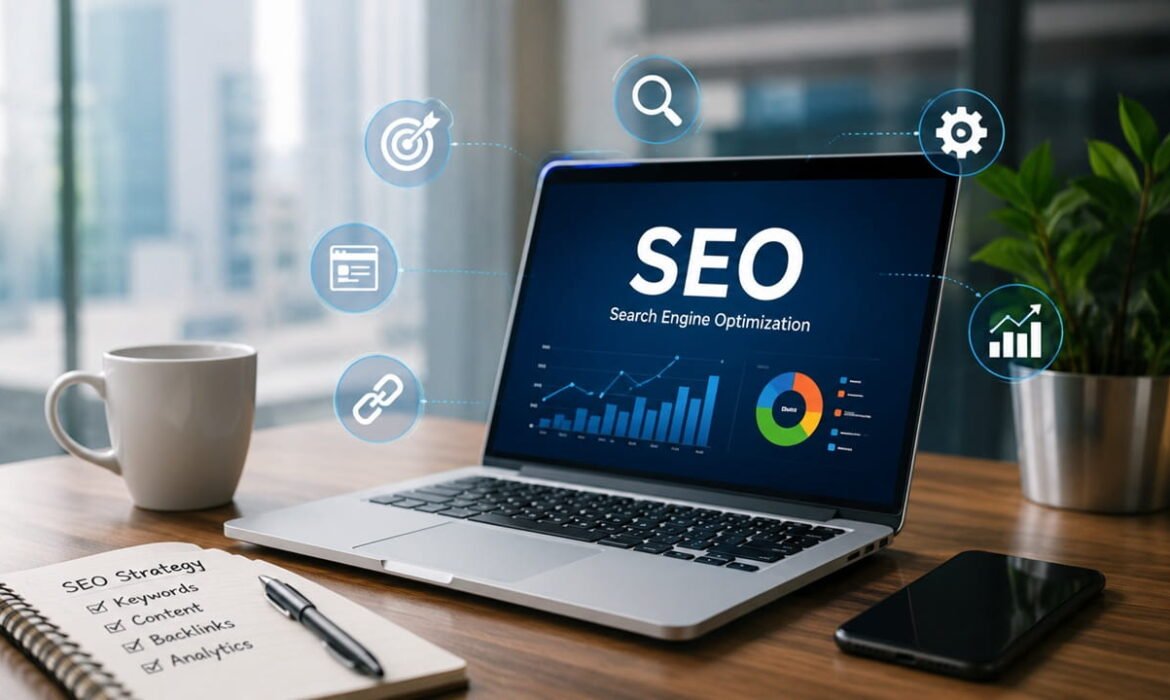
SEO Services: Complete Guide to Search Engine Optimization Strategies for Higher Rankings & Business Growth
Every day, thousands of businesses in India type the same three words into Google:
- “SEO services near me.”
- “Best SEO company for small business in India.”
- “How to rank higher on Google.”
Now here’s the interesting part.
Most of them sign up with an agency, get a monthly report full of green arrows and “rankings improved” and six months later, still can’t say whether it actually made them any money.
Meanwhile, a few of their competitors quietly keep showing up at the top of Google, month after month, taking the exact customers everyone else was chasing.
So what’s the real difference between SEO that just looks good on paper and SEO that actually grows a business?
The answer is SEO services done the right way, built around real business results, not just rankings.
In this guide, you’ll learn what SEO services actually include, how Google’s AI-powered search has changed the rules, and the proven steps to rank higher and turn that visibility into real customers in 2026.
What Are SEO Services?
SEO services are the specific actions a business, agency, or expert takes to help a website show up higher in Google’s search results. This includes keyword research, writing better content, fixing technical issues on the website, building links from other sites, and increasingly in 2026 writing content in a way that AI tools like Google’s AI Overviews and ChatGPT can pick up and mention directly.
Unlike paid ads, SEO doesn’t buy your spot on Google you earn it. That’s why the results usually take longer to show up, but they keep working long after you stop paying for the work.
SEO services usually fall into three connected areas: on-page SEO, technical SEO, and off-page SEO plus a fourth area that’s become very important in 2026: AI and answer-engine Optimization, which decides whether AI tools mention your business at all.
Why Search Engine Optimization Still Matters Even With AI Answers Everywhere
It’s a fair question in 2026: with AI answering search questions directly, is SEO still worth paying for?
The data says yes, clearly the shape of the win has simply changed.
- Organic search still brings in roughly half of all trackable website traffic more than any single paid or social channel. For business-to-business (B2B) sites, that number is even higher.
- SEO gives a median return of around 748% over three years, according to 2026 industry data making it one of the highest-return marketing investments available, even for small budgets.
- SEO’s return is usually 5 to 8 times higher than paid search, mostly because your cost per customer keeps falling as your rankings improve, instead of resetting every time your ad budget stops.
- Yes, search behaviour is shifting a large share of Google searches now end without a single click, and AI answer boxes can cut the click rate of the top result by more than half in some cases. But businesses that get mentioned inside those AI answers are getting seen by more people than competitors who are invisible to AI entirely.
- India’s digital marketing market crossed roughly ₹560 crore in 2025, and SEO remains one of the biggest parts of that spend, because Indian businesses have realized paid ads alone don’t build long-term visibility.
The honest takeaway:
Search Engine Optimization isn’t shrinking. It’s splitting into two connected goals ranking in the normal search results, and getting mentioned inside the AI-written answer sitting above them.
SEO Strategy That Actually Drive Ranking
A strong SEO strategy isn’t a checklist of small tasks. It’s a decision about where your website actually has the best chance to compete, given your budget, competition, and timeline.
1. Build topical authority, not just single keywords
Google no longer looks at one page alone it looks at how well your whole website covers a topic. Websites organized into connected clusters of content tend to get more traffic and hold their rankings for much longer than single, disconnected articles.
2. Match search intent, not just keywords
If your page targets a keyword but doesn’t actually deliver what the top-ranking pages already deliver, Google pushes it down no matter how technically perfect the page is.
3. Build real E-E-A-T (Experience, Expertise, Authority, Trust)
Google’s own guidelines treat this as a major ranking factor. AI tools are also starting to check who wrote the SEO content, and whether the business is a real, trustworthy source, before deciding whether to mention it.
4. Fix the technical basics first
No amount of great content ranks on a website that’s slow, hard to crawl, or breaks on mobile. Site speed and mobile performance are non-negotiable, not extras.
5. Structure content for AI mentions
Ranking well in normal search and getting mentioned inside an AI answer both need the same basic thing: clear, well-organized, genuinely useful content just written so both a human reader and an AI tool can quickly understand it.
SEO Services Explained: What Each One Actually Gives You
“SEO services” is a broad term. Here’s what you’re actually paying for when an SEO agency lists each one:
|
Service |
What It Actually Gives You |
|
On-page SEO |
Optimizing individual pages titles, headings, content to match what people are searching for |
|
Off-page SEO |
Building your site’s authority through backlinks and mentions from other websites |
|
Technical SEO |
Fixing site speed, mobile issues, and crawl problems that are quietly blocking rankings |
|
Local SEO |
Optimizing your Google Business Profile and local listings for “near me” searches |
|
Optimizing product and category pages for online stores |
|
|
Enterprise SEO |
Managing SEO across large websites with thousands of pages and multiple teams |
|
International SEO |
Setting up your site to target multiple countries or languages correctly |
|
SEO content services |
Writing blogs, guides, and landing pages built around real search intent |
|
SEO audit services |
A full check-up of your technical setup, content, and backlinks usually the right first step |
| SEO consulting | Strategy and guidance without full execution good for teams that already have in-house staff |
A good SEO company won’t try to sell you all ten of these at once. A proper audit usually comes first, and it should tell you which two or three will actually move the needle for your specific website.
The Core Building Blocks of SEO
1. Keyword Research & Search Intent
This is where every Search Engine Optimization project starts figuring out not just what people search for, but why they’re searching for it. A keyword with high search volume but the wrong Search intent will never convert, no matter how well it ranks.
2. On-Page SEO & Content Optimization
This covers titles, headings, internal links, and most importantly in 2026 how deeply your content actually covers a topic. Pages that fully answer a question, including the related questions a reader naturally has next, usually beat thinner competing pages, even when those pages are technically well set up.
3. Technical SEO: Site Speed & Mobile Performance
If Google can’t easily reach and read your pages, nothing else matters. Site speed alone directly affects sales for Indian websites specifically, a one-second improvement in mobile load time can raise conversions by roughly 8 to 12%, since most Indian shoppers browse on mobile data, not fast home Wi-Fi.
4. Off-Page SEO & Link Building
Backlinks are still a trust signal, but in 2026, quality and relevance matter far more than the total number of links. A handful of genuine links from trusted, relevant websites beats hundreds of low-quality directory links.
5. Structured Data & Schema Markup
Schema doesn’t directly boost your rankings, but it helps Google and AI tools understand your content clearly. Websites with clean, correct schema markup are more likely to get pulled into AI-generated answers.
6. Conversion Rate Optimization (CRO)
Traffic without sales is a vanity number. The best SEO programs also test and improve the website itself, because doubling your conversion rate has the same revenue effect as doubling your traffic at a much lower cost.
Semantic SEO, Entity SEO & the Rise of AEO/GEO
This is the part most older SEO guides simply don’t cover and it’s the biggest shift reshaping SEO right now.
1. Semantic SEO
Semantic SEO means writing for meaning, not just repeating a keyword. Google now understands the relationship between topics a page stuffed with a keyword but shallow on real information performs worse than one that explains the subject properly, using natural, varied language.
2. Entity SEO
Entity SEO treats your business, products, and content writers as “known things” inside Google’s system, not just blocks of text. Consistent naming, a properly detailed About page, and structured data all feed this and it’s becoming just as important as backlinks for many types of searches.
3. Answer Engine Optimization (AEO)
Answer engine optimization structures your content so a clear, short answer can be picked up directly by voice assistants, Google’s featured snippets, and AI answer boxes usually a tight 40 to 60 word answer placed right where the question is asked, not buried three paragraphs down.
4. Generative Engine Optimization (GEO)
Generative engine optimization goes one step further Optimizing specifically to get mentioned inside AI-written answers on tools like Google’s AI Mode, ChatGPT, and Perplexity, which tend to pull from genuinely detailed, trustworthy sources rather than the page with the most keywords.
5. Topical authority
Topical Authority ties all of this together. Websites that build out 25 to 30 genuinely thorough, connected articles around one topic tend to see their rankings improve up to three times faster than websites just chasing backlinks alone.
The practical question to ask any SEO provider in India in 2026: are they still selling you the old-style “keywords and backlinks” package, or are they actually building entity clarity, topic depth, and AI-readiness into your plan from day one?
How to Choose an SEO Company
Before signing anything, get clear answers on:
- Do they run an audit before pitching you a package? A real check-up should always come before a proposed plan.
- Is their reporting tied to rankings, traffic, or revenue? Rankings and traffic are early signs revenue is the number that actually matters.
- Do they mention AI search visibility at all? If AI Overviews and answer engines don’t come up in their pitch, their strategy is already a year behind.
- What’s realistic in 90 days versus 12 months? Be careful of anyone promising page-one rankings in a few weeks but expect a clear, honest timeline instead of vague “SEO takes time” answers.
- Is your content written by someone who actually understands the topic, or handed to random, unchecked writers? Both readers and AI tools increasingly check for genuine expertise.
Common SEO Mistakes That Waste Money
Avoid these common SEO mistakes to build stronger search visibility, attract relevant organic traffic, improve website authority, and achieve sustainable business growth.
- Chasing keywords with high search volume but the wrong intent ranking for traffic that was never going to buy anything.
- Treating link building as a numbers game instead of a relevance game quality now matters far more than quantity.
- Ignoring technical SEO while spending money on content that a slow, poorly built site will never let rank.
- Publishing thin, copy-paste content exactly the kind of page AI tools skip over completely.
- No tracking set up, so “rankings improved” gets reported as a win even when it brought in zero actual sales.
- Ignoring AI search completely most businesses today still don’t track whether they’re being mentioned in AI-generated answers at all.
Frequently Asked Questions – SEO Services
Q1. How long does SEO take to show results?
Most SEO work starts showing real movement within three to six months, with the strongest results usually building up between month six and month twelve. Local SEO and smaller, less competitive markets can move faster.
Q2. How much do SEO services cost in India?
Small and mid-sized businesses in India generally spend somewhere between ₹15,000 and ₹1,50,000 per month, depending on how competitive their industry is. Larger enterprise SEO programs can cost much more. The right number depends more on your competition than any fixed rule.
Q3. Is SEO better than paid ads (PPC)?
They solve different problems. PPC brings faster traffic that stops the moment you stop paying. SEO builds slower, but it keeps bringing traffic long after the initial work is done. Most growing businesses eventually use both together.
Q4. Do I need separate technical, on-page, and off-page SEO services, or one package?
For most small to mid-sized websites, one connected program covering all three usually works better than buying pieces separately, since technical problems can quietly limit how well your content and links perform.
Q5. What's the difference between normal SEO and AEO/GEO?
Normal SEO focuses on ranking position in Google's results. AEO and GEO focus on getting mentioned as the source when an AI tool generates a direct answer. In 2026, a strong SEO plan aims for both at the same time.
Q6. Can a small business really compete with bigger competitors in SEO?
Yes especially through local SEO and focusing deeply on one specific topic or area, where real depth often beats a bigger competitor's wider, shallower content.
Where to Go From Here
SEO services in 2026 aren’t about following a checklist that worked five years ago. They’re about building real topic authority, a technically sound website, and clear entity signals that perform in both normal Google rankings and the AI-written answers now sitting above them. The businesses winning aren’t always spending the most they’re the ones whose SEO is actually built around revenue, not just rankings on a report.
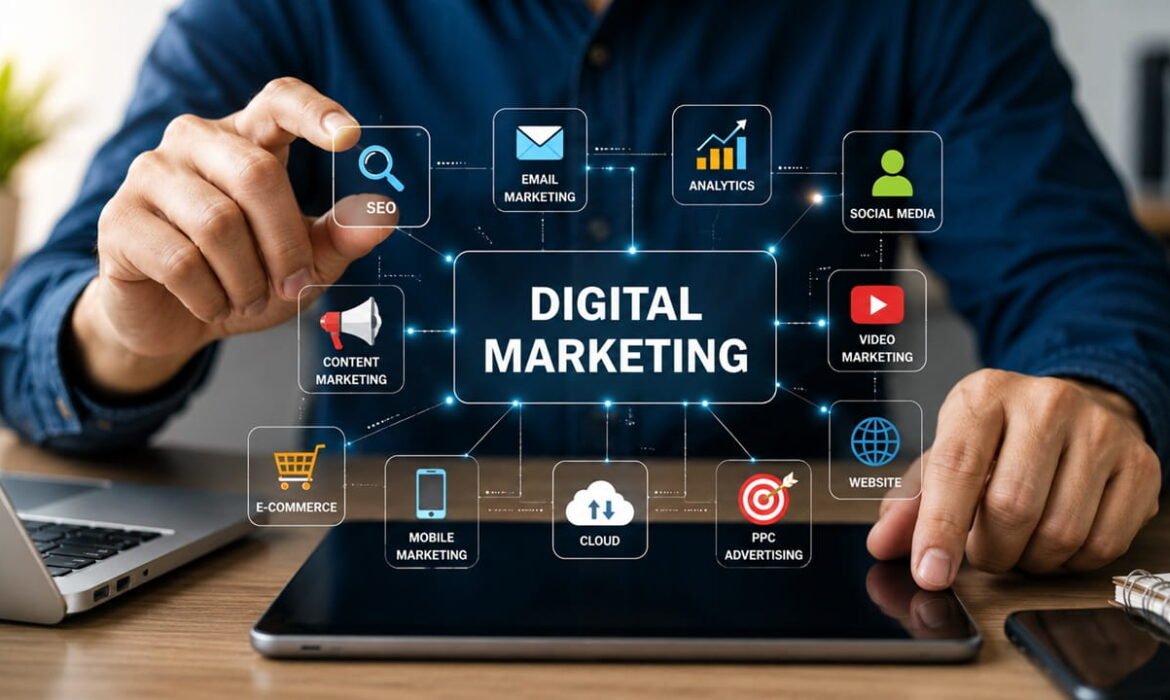
Digital Marketing: The Complete Guide to Strategies, Services, Channels, Tools & Growth Framework
Every day, thousands of business owners type the same kind of thing into Google:
- “How to get more customers online.”
- “Best marketing strategy for small business in India.”
- “Why is my website not getting any traffic?”
Now here’s the interesting part. Some of the businesses asking these questions are growing every month. More leads, more sales, more visibility. Others are spending money on ads, social media, and SEO at the same time, with almost nothing to show for it by the end of the month. Same budget. Same effort. Completely different results. So what actually separates the businesses that grow from the ones that just spend? The answer is digital marketing done as one connected system, not as random, disconnected tactics. In this guide, you’ll learn what digital marketing really means, the strategies, services, channels, and tools that actually work, and how to build a simple plan that turns your marketing budget into real sales.
What Exactly Is Digital Marketing, And What Do Digital Marketing Services Actually Include?
Strip away the jargon, and digital marketing is simply using the internet to find customers and get them to buy from you through search engines, social media, email, WhatsApp, and paid ads, instead of TV, newspapers, or hoardings. Most digital marketing services fall into a handful of buckets: SEO, paid ads, social media, content, and email or WhatsApp marketing. Agencies package them differently, but every service exists to do one thing customer acquisition you can actually measure. Some people call this online marketing, others call it digital marketing same idea, different name. The one thing that makes it genuinely different from old-style marketing isn’t the internet part. It’s that you can see what’s working. You know exactly which ad, post, or message led to a sale, and you can put more money behind that, and stop wasting money on what doesn’t. That’s it. No mystery, no magic formula. Just marketing you can actually measure.
Why Digital Marketing Isn’t Optional Anymore
Here’s a number worth sitting with: India now has over 900 million internet users, the second-largest online population on the planet. Your customers aren’t “sometimes online” they’re online right now, comparing options, reading reviews, and deciding who to buy from. If your business isn’t visible in that moment, you’re not losing to a better competitor. You’re losing to one who simply showed up. A few more numbers that explain why the shift has happened so fast:
- India’s digital marketing market reached approximately $6.71 billion in 2025 and is projected to grow at a CAGR of around 30.2%.
- Businesses that do this properly typically see around ₹5 back for every ₹1 spent.
- WhatsApp alone has over 550 million users in India, and business messages on it get opened far more than emails ever do.
It isn’t only about today’s sale, either. Every ranked search result, every WhatsApp reply, every ad someone scrolls past is quietly building brand awareness, so the next time that person needs what you sell, your name is already familiar. None of this means you need a huge budget. It means the businesses ignoring digital marketing are quietly handing customers to the ones who aren’t.
The Digital Marketing Channels You Actually Need to Know
There are dozens of digital marketing channels out there, and most guides throw all of them at you at once exactly how business owners end up overwhelmed and doing none of them well. Here are the ones that actually move the needle.
Search Engine Optimization (SEO)
SEO is Getting your business to show up when someone searches Google for what you sell, without paying for every click. Slower to build than ads, but once you rank, traffic keeps coming without an ongoing cost. Behind the scenes, this means tracking rankings through Google Search Console, and studying competitors with tools like Semrush or Ahrefs.
Social Media Marketing
Building a presence on Instagram, Facebook, YouTube, and LinkedIn to stay visible and build trust. Instagram and Facebook sit under Meta, so targeting and ad tools carry across both. Split into organic (unpaid posts) and paid (targeted ads) you generally need both, since organic traffic alone doesn’t reach many people anymore.
Paid Search & Social Ads (PPC)
Paying to appear at the top of Google through Google Ads, or in someone’s Instagram feed through Meta Ads. This kind of paid advertising is fast, precisely targeted, and particularly effective for lead generation but the traffic stops the moment you stop paying.
Email & WhatsApp Marketing
Sending offers, updates, and follow-ups to people who’ve already shown interest. This is the one channel you fully own no algorithm can take your list away, which is why it usually delivers the highest return of any single channel.
Content Marketing
Blogs, videos, and guides that answer real questions your customers are asking. This is the fuel behind both your SEO and your social media without it, the other channels run out of material fast. Tools like ChatGPT and Gemini can speed up research and first drafts, but the local context and final judgement still need to come from someone who knows your customers. None of these channels work alone. A customer might discover you through an Instagram ad, search your name on Google a week later, then buy after a WhatsApp follow-up. That’s the customer journey in real life different channels doing different jobs at different points in the marketing funnel. Google Analytics ties this picture together, showing what actually happens after someone lands on your website. Which brings us to the question every business owner is really asking.
How Digital Marketing Works: The Journey From Stranger to Loyal Customer
Every customer who buys from you today started out as a stranger who didn’t know you existed. Digital marketing funnel is really just about moving people through five stages, one at a time this is the customer journey, and understanding it is what separates businesses that grow from ones that just spend.
Awareness
This is the moment someone first discovers you an Instagram ad, a Google search that surfaces your website, or a WhatsApp forward from a friend. The heavy lifting here is done by social media (Instagram, Facebook, YouTube), SEO, and paid advertising.
Consideration
Now they know you exist, but they’re not sure yet. They’re comparing you to competitors, reading reviews, watching your content. Content marketing, YouTube videos, and a well-ranked website the kind SEO and a strong Google presence build earn the trust needed for the next step.
Conversion
This is the sale itself. A fast landing page, a clear offer, and a simple way to buy or a WhatsApp Business number to close the deal directly is where paid ads and conversion optimization matter most. 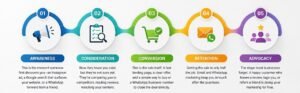
Retention
Getting the sale is only half the job. Email and WhatsApp marketing keep you in touch after the purchase, whether that’s a follow-up message, a reorder reminder, or a support update. Businesses that skip this stage end up paying to acquire the same customer twice.
Advocacy
The stage most businesses forget. A happy customer who leaves a Google review, tags you on Instagram, or refers a friend on WhatsApp is doing your marketing for free this is brand awareness compounding on itself.
This is the marketing funnel in plain terms wide at the top, narrow at the bottom. Track a customer through all five stages with Google Analytics and Google Search Console, and you’ll usually find one stage where people are quietly dropping off. That’s where your next rupee of budget should go, not into a random new channel.
Do Digital Marketing Campaigns Actually Deliver ROI?
Short answer: yes, when it’s done as a connected plan, not scattered spending. Here’s the honest comparison. Traditional advertising a hoarding, a newspaper ad asks you to spend money and hope it works, and you’ll never really know how many customers it brought in. Internet marketing services removes that guesswork: you see, in real numbers, exactly what a campaign returned, and adjust within days instead of finding out months later that it didn’t work. That’s what real ROI looks like a number you can point to, not a guess dressed up as a strategy. It’s also more fair to small businesses than traditional advertising ever was. A big brand’s hoarding budget doesn’t automatically beat a small business’s well-targeted Instagram ad. With the right targeting, a modest budget spent well can outperform a large one spent carelessly something that was almost never true with old-style advertising.
How to Build a Digital Marketing Strategy From Scratch
Most businesses skip straight to “let’s run some ads” without ever answering the questions that actually decide whether those ads will work. Here’s the order that actually matters:
- Decide what success looks like. More leads? More sales? More people walking into your shop? Pick one clear goal for this quarter, not five vague ones.
- Know exactly who you’re talking to. Not just “everyone who might buy” their age, their city, what problem they actually have, and where they sit in the customer journey. A B2B company chasing decision-makers belongs on LinkedIn, not spending its whole budget on Instagram Reels.
- Pick two channels, not eight. Match channels to your goal and audience. Trying to do SEO, ads, social media, and email all at once, on a small budget, usually means doing all four badly.
- Decide how you’ll know if it’s working. Before you spend a rupee, decide what number you’ll track cost per lead, conversion rate, whatever matches step one. Google Analytics and Google Search Console together give you most of this for free.
- Actually launch it. Get the content, ads, and people organized, with a realistic timeline instead of an open-ended “let’s see.”
- Watch the numbers, not your gut feeling. Check what’s happening after a few weeks which ad, post, or page is doing the work.
- Adjust and double down. Cut what isn’t working, and put more budget behind what is the biggest advantage digital marketing campaigns have over old-style advertising is that you’re allowed to change your mind fast.
How Much Should You Actually Spend?
There’s no universal “right” number, but here’s a realistic way to think about it, instead of picking a figure out of thin air. Start by auditing what you’re already spending most businesses have marketing money going out in scattered ways, a boosted post here, a listing fee there, with no one adding it up. Then match your budget to your strategy, not the other way around: spreading a small budget across five channels rarely works, but spending that same amount on one or two channels, properly, usually gets real results. Measure before you scale. Test small, see what a rupee actually returns on each channel, and grow the budget for whatever’s proving itself. If a channel has run for a couple of months with nothing to show for it, cut it without guilt that budget belongs somewhere else. For most small businesses in India, this means starting with a few thousand rupees a month, tracked closely, and scaling up only once there’s real proof of what’s working.
Should You Hire a Digital Marketing Agency, or Build an In-House Team?
Both work. The right choice depends on where your business is right now. An in-house team understands your business deeply and moves fast without needing to be briefed every time this makes sense once you have steady, predictable marketing needs and the budget to hire properly. A digital marketing agency brings in specialized skills someone who’s already solved the exact SEO or ad problem you’re facing, instead of learning it for the first time on your budget. This makes more sense early on, or when you need results across several channels without hiring five different specialists. A lot of growing Indian businesses land somewhere in between an in-house person handling day-to-day content and social media, with an outside expert handling the technical work like SEO or paid ads. There’s no shame in that mix; it’s often the smartest one.
What’s Changing: The Trends Already Reshaping Digital Marketing
Search results now come with AI-written answers
A growing share of Google searches end without a click, because the answer already appears in an AI-generated box, or the customer simply asked ChatGPT or Gemini instead. Businesses mentioned inside those AI answers get seen by people who’d never scroll down to the normal results.
Automation is doing the repetitive work
Scheduling posts, follow-up emails, replying to common WhatsApp questions marketing teams now automate this, freeing up time for work that needs human judgement.
AI is helping plan, not just execute
Beyond writing content faster, tools like ChatGPT and Gemini now spot patterns in what’s working and personalize messages to different customers automatically, instead of sending the same message to everyone. None of this replaces strategy. The businesses getting real value from AI are using it to move faster on a plan they’ve already thought through not as a replacement for having one.
The Mistakes That Quietly Waste Marketing Budgets
- Running five channels with no shared goal the ads team chasing clicks while sales wants actual leads.
- Treating SEO like a one-time job, then wondering why results faded after a few months.
- Ignoring email and WhatsApp while chasing whatever social platform is trending this month.
- No real tracking not even a basic Google Analytics or Search Console setup so nobody can say which channel brought in the sale.
- Sending traffic to a slow, confusing website, which cancels out every rupee spent getting people there.
- Buying tools before building a strategy the tool never fixes a plan that doesn’t exist yet.
How Arihant Global Does Digital Marketing Differently
We don’t start with a generic package. We start with an honest audit pulling real numbers from Google Analytics, Google Search Console, and tools like Semrush or Ahrefs to see where your traffic is coming from today, what’s converting, and what’s quietly burning budget. From there, we build a plan around two or three channels that genuinely fit your business, not a template sold to every client the same way. Every campaign we run gets tied back to a real number, so you always know what your marketing is actually doing not just how it looks on a slide.
Digital Marketing Frequently Asked questions
Q1. How to get more customers online?
Start with the three things that bring in customers already looking for you: a Google Business Profile, basic SEO on your website, and a WhatsApp Business number for quick replies. Most businesses jump to ads before fixing these basics, and end up paying for traffic their own website then loses.
Q2. Best digital marketing strategy for small business in India?
Pick one channel that matches your budget and stick with it for at least 90 days usually local SEO plus WhatsApp for a local business, or paid social plus a landing page for an online product. Spreading a small budget across five channels at once is the biggest reason results don’t show up.
Q3. Why is my website not getting any traffic?
Usually one of three reasons: the site isn’t set up for basic SEO, it’s too slow on mobile, or there’s no consistent content bringing new visitors in. A quick technical and SEO check usually reveals which one it is.
Q4. My ads are running but I’m not getting any sales why?
This is almost never an “ad isn’t working” problem it’s usually a “traffic isn’t converting” problem. Check your landing page speed, whether the offer matches what the ad promised, and whether there’s a clear next step for the visitor the basics of conversion optimization.
Q5. How much money do I need to start digital marketing?
There’s no fixed number, but many small businesses in India start meaningfully with a few thousand rupees a month. What matters more is tracking where every rupee goes, so you can put more into what’s working.
Q6. How long will it take to see results?
Paid ads bring visible results within days. SEO and content usually take three to six months to build up but they keep working long after, at a much lower ongoing cost.
Q7. Can I do digital marketing myself, or do I need an agency?
Yes, especially early on many small businesses run their own Google Business Profile, social media, and small ad campaigns. As the budget grows, a digital marketing agency helps you move faster and skip the expensive trial and error.
Q8. Is digital marketing really worth it for a small business, or just big companies?
It’s a bigger advantage for small businesses, because it’s measurable start small, see what’s working, and grow your budget only once there’s proof. A well-run small budget can outperform a poorly-run big one.
The Bottom Line
Digital marketing isn’t about picking one channel and hoping it works. It’s a system one clear goal, two or three channels chosen on purpose, honest tracking, and the willingness to cut what isn’t working and double down on what is. The businesses still guessing a year from now will be the ones who skipped the plan and went straight to spending. Want a digital marketing plan built around your business, not a generic template? Talk to Arihant Global and get a free audit of where your marketing stands today.
Disclaimer
The information, statistics, and figures presented herein are for general informational purposes only and do not constitute a guarantee. Marketing outcomes vary by business, industry, budget, and execution strategy.
Author Bio
A digital marketing and SEO professional specializing in SEO, content strategy, and online growth. With a focus on data-driven strategies and search trends, they help businesses build stronger visibility, authority, and sustainable organic growth.

Instagram Marketing Strategy: A Practical Framework That Actually Grows Your Account in 2026
Most people don’t sit down to build an Instagram marketing strategy on a good day. They sit down because growth has stalled, engagement has quietly dropped, and the last ten posts got roughly the same handful of likes from the same handful of people. Sound familiar? That’s not really an Instagram problem. It’s usually a strategy problem or the lack of one.
Instagram hasn’t gotten harder to use. It’s gotten harder to win on autopilot. Posting “when you remember to” used to be enough back when feeds were less crowded and the algorithm was simpler. Now it rewards consistency, real engagement, and content that gives people a reason to stop scrolling. Everything else just sort of disappears into the feed.
What Is an Instagram Marketing Strategy?
A real Instagram marketing strategy isn’t a content calendar with some Instagram hashtags bolted on. It’s the whole system working together what you post, when you post it, how you talk to people in the comments and DMs, and how (or whether) you’re spending money on ads to speed up the parts that are already working organically.
Here’s a simple way to check where an account actually stands: look at the last 15 posts. Is there a clear theme? Does the bio tell a stranger what this account is even about within three seconds? Is the highlight reel doing any work, or just sitting there from 2022? Small gaps like these are usually why an otherwise solid brand looks unfinished the moment someone new lands on the profile.
There’s also a practical reason to treat Instagram as a system instead of a stream of posts: Instagram Insights hands over real data on what’s already working which Reels held attention, which carousel got saved, which caption actually drove profile visits. Ignoring that and guessing at what to post next is leaving free research on the table.
How to Build an Effective Instagram Content Strategy
This is the part people usually think of first, and it’s still the foundation everything else sits on. An Instagram content strategy isn’t about posting more it’s about posting on purpose.
A few things that tend to separate accounts that grow from ones that plateau:
- Building around 3–4 content pillars instead of posting whatever comes to mind that day (education, behind-the-scenes, product/service, community or User generated content tends to cover most brands well)
- Leaning into Reels for reach, since that’s still where Instagram pushes new-audience discovery hardest
- Using carousels for anything that needs a bit more explanation they tend to hold attention longer and get saved more than single images
- Writing captions that open with something worth reading, not a caption that starts with the brand name and a period
- Keeping a loose content calendar so posting doesn’t depend on someone “having an idea” that morning
None of this needs to be complicated. It just needs to happen on a schedule instead of in bursts.
How to Grow Your Instagram Followers Organically
Growth is where a lot of the misplaced effort happens. Buying followers, mass-following and unfollowing, chasing follow-for-follow none of that builds an audience that actually buys anything or shows up when it matters. It just inflates a number.
An Instagram growth strategy that actually holds up usually rests on a few things instead:
| Growth Lever | What It Actually Does |
| Reels with strong hooks in the first 2 seconds | Drives non-follower reach, which is where most new followers come from |
| Hashtag strategy (mix of broad + niche) | Helps discovery without over-relying on any single tag |
| Collaborations with adjacent creators or brands | Borrows trust from an audience that already exists |
| Consistent posting cadence | Signals an active account to both people and the algorithm |
| Strong bio + link-in-bio setup | Converts a profile visit into a follow or a click |
A niche audience of 5,000 people who actually care about the brand is worth more than 50,000 followers who scrolled past a giveaway once and never came back.
Instagram Engagement Strategy: Turn Followers Into Customers
Followers who don’t engage are close to a vanity metric. Instagram’s algorithm pays attention to saves, shares, comments, and watch time far more than raw follower count which means an Instagram engagement strategy matters just as much as the growth side, maybe more.
A few things worth actually doing here, not just knowing about:
- Reply to comments like a person, not a brand account reading from a script
- Use Instagram Stories polls, questions, and quizzes they’re built specifically to invite a reply
- Post at times when the actual audience is online, not when it’s convenient to post
- Encourage saves directly (“save this for later”) for anything genuinely useful captions that ask get noticeably more saves
- Don’t leave DMs sitting unanswered for days; a slow reply on Instagram often reads as a business that’s checked out
Community management is unglamorous, and it’s also the part that quietly compounds. An account that replies fast and sounds human tends to get repeat engagement from the same people, and that pattern is exactly what pushes content further into the feed.
Instagram Ads Strategy: When and How to Scale
Organic growth has a ceiling, and that’s fine that’s what an Instagram ads strategy is for. The mistake is skipping organic entirely and throwing budget at an account with no content history, no proof of engagement, and nothing for a new visitor to actually look at once the ad gets the click.
Once there’s something worth promoting, ads tend to work best layered like this:
- Boosted Reels or posts that are already performing organically proven content, extended reach
- Instagram Shopping ads for ecommerce brands, pulling straight from the product catalog
- Retargeting ads aimed at people who’ve already engaged, visited the profile, or checked out a product page
- Lookalike audiences built from existing customers or high-engagement followers, not broad interest targeting
Ads amplify what’s already working. They rarely fix content that isn’t landing in the first place.
Common Instagram Marketing Mistakes Businesses Make
Same patterns, over and over, across most underperforming accounts:
- Posting inconsistently, then wondering why reach dropped
- No clear niche the account tries to be everything to everyone
- Ignoring comments and DMs for days at a time
- Using the same 30 hashtags on every single post regardless of relevance
- Treating Reels like a chore instead of the format Instagram is actively pushing hardest
- Running ads before there’s any organic proof the content actually resonates
Industries That Benefit Most from Instagram Marketing
Instagram isn’t equally useful everywhere, but it holds up well across a wide range of sectors:
- Ecommerce
- Fashion & Beauty
- Fitness & Wellness
- Food & Hospitality
- Real Estate
- Travel
- Education
- Personal Brands & Coaches
- Local Businesses
Visual-first industries tend to see the fastest wins, but even B2B and service-based businesses get real traction once the content strategy actually matches the audience instead of copying whatever a consumer brand is doing.
How Arihant Global Delivers Better Instagram Marketing Results
At Arihant Global, nothing gets scaled until the account has a clear foundation bio, highlights, content pillars, and a working posting rhythm. That’s the unglamorous first step, and it gets skipped a lot elsewhere, but no amount of clever ad targeting fixes an account that looks abandoned the moment someone actually visits it. Once the foundation is solid, campaigns move into real testing content formats, hashtags, audiences, ad creative before serious budget goes anywhere near a single direction. It’s a slower start than a lot of businesses expect walking in, but it means the growth that follows is based on what’s actually proven, not what looked promising in a planning meeting.
Our Instagram Marketing Process
- Business Discovery
- Audience Research
- Competitor Analysis
- Content Pillar & Calendar Planning
- Creative Development (Reels, Carousels, Static)
- Caption & Copywriting
- Community Management Setup
- Campaign Launch (Organic + Paid)
- Optimization
- Weekly Reporting
Frequently Asked Questions – Instagram Marketing Strategy
Q1. What is an Instagram marketing strategy?
It's a coordinated plan covering content, posting consistency, engagement, and (often) paid ads all working toward a specific goal like follower growth, sales, or brand awareness, rather than posting without a clear direction.
Q2. Is Instagram still worth investing in for 2026?
Yes, especially for accounts that stay active and lean into Reels. Organic reach has gotten harder across every platform, but consistent, well-targeted content still performs it's inactive or generic accounts that struggle most.
Q3. How often should a business post on Instagram?
Most brands see solid results posting 3–5 times a week combined with daily Stories. Consistency matters more than volume five posts a week done well tend to beat daily posting done carelessly.
Q4. What's the fastest way to grow on Instagram?
Reels with strong hooks, paired with a clear niche and consistent posting. There's no real shortcut beyond that combination working together over time.
Q5. Do hashtags still matter?
Somewhat, but less than a few years ago. A small mix of relevant, specific hashtags still helps discovery stuffing 30 generic ones onto every post does very little at this point.
Q6. How do I know if my content strategy is working?
Watch saves, shares, and profile visits more than likes. Those three tend to correlate much more closely with actual algorithm reach and real interest than like counts do.
Q7. Should ads come before or after organic growth?
After, generally. Ads work best amplifying content that's already proven itself organically, rather than trying to force traction onto an account with no track record yet.
Conclusion
If your Instagram account has plateaued, or never really got moving in the first place, it’s usually more fixable than it feels. Arihant Global works with businesses across ecommerce, fashion, fitness, and local services to build Instagram strategies on a solid content and data foundation from day one. Reach out Arihant global and let’s talk through where things actually stand right now and what a more focused approach could look like from here.
Disclaimer
This blog is for educational purposes only and should not be considered professional marketing, financial, or legal advice. Every Instagram strategy should be tailored to your business goals, audience, and industry.

Instagram Hashtag Strategy 2026: Getting Found by People Who Aren’t Following You Yet
Ask ten business owners how they pick their hashtags, and honestly, seven of them are probably just guessing. Grab whatever’s trending that week, lift a competitor’s tag list, throw in #instagood because why not then hope something happens. Sometimes it does, a little. Mostly it doesn’t. Hashtags haven’t worked as some magic discovery button in years, and Instagram just isn’t set up to reward that kind of scattershot approach anymore.
A real Instagram hashtag strategy has nothing to do with volume or luck. It comes down to actually knowing who you’re trying to reach, what they’d realistically type into a search bar or scroll past, and then picking tags that put you in front of exactly those people. Not the biggest possible audience the right one. Get that part right and hashtags turn into a slow, steady stream of discovery. Get it wrong and they’re just filler sitting under a caption, doing nothing for anybody.
What Is an Instagram Hashtag Strategy?
An Instagram hashtag strategy is a deliberate system for choosing which searchable #keywords you attach to each post picked by relevance and audience fit rather than grabbed at random. so Instagram’s algorithm can correctly categorize your content and show it to people who’d actually care about it.
Here’s a decent gut-check: look at where your last ten posts actually got their reach from not how many hashtags you piled on, but where the views came from. If barely any of it traces back to hashtag or Explore placement, those tags probably aren’t earning their spot in the caption.
Types of Instagram Hashtag You Should Use
Not every hashtag is pulling the same weight, and that’s usually where strategies quietly go wrong people treat them all as interchangeable.
1. Branded hashtags
yours alone, mostly there to track your own content and give customers something to tag you with.
2. Community hashtags
tied to a niche conversation rather than any single brand, the kind of tag people genuinely scroll and engage with.
3. Broad, high-volume hashtags
massive reach on paper, brutal competition in practice, and your post is gone from that feed within minutes.
4. Niche or mid-size hashtags
a smaller crowd, sure, but a real shot at actually staying visible in that tag’s top or recent posts for more than a few minutes.
5. Location hashtags
worth their weight for anything local, since they tend to catch people specifically browsing a city or neighborhood.
Most tag lists that actually pull results lean heavily on the niche and mid-size stuff, with maybe one broad tag thrown in not the reverse, which is what most people default to.
How to do Right Instagram Hashtag Research?
Choosing hashtags without doing any Instagram Hashtag research is basically the same move as picking website keywords out of thin air and hoping for traffic. Might land occasionally. There’s no real logic holding it up though.
A few things worth doing before you settle on a list:
- Look at what similar accounts in your space are actually using not to copy word for word, but to see what’s genuinely getting traction in that corner of Instagram.
- Check the post count under a hashtag before you commit to it. Millions of posts basically means your content vanishes in minutes; a few thousand to a few hundred thousand gives you an actual chance at being seen.
- Search the tag yourself and scroll through what’s ranking. If the same handful of much bigger accounts dominate the top posts every time, that tag’s probably out of reach for now.
- Look back at your own best-performing posts and notice what tags they used that’s often a stronger signal than anything you’d guess cold.
How Many Hashtags Should You Use on Instagram?
| Approach | What It Tends to Do |
| 3–5 highly relevant tags | Cleaner captions, sharper targeting, usually better engagement per tag |
| 15–20 mixed tags | Casts a wider net, but often dilutes relevance and can start looking a bit spammy |
| Hashtags in a comment vs. caption | Reach is pretty similar either way comes down to how tidy you want the caption itself |
| Reusing the same set every post | Tends to lose steam over time, and can read as lazy or automated to the algorithm |
There’s no single number that’s right for everyone, but most strategies that actually hold up favor a smaller, deliberate set over a long scattergun list.
Where Should You Place Instagram Hashtags?
Where the hashtags physically sit matters less than people think. Whether you’re actually testing them matters a lot more than most accounts bother with.
Worth building into a habit:
- Rotating a few different sets across similar posts instead of pasting the same block underneath everything.
- Actually checking post insights to see which posts pull real reach from hashtags specifically, rather than assuming it’s working because tags are there.
- Refreshing the list every few months, since trends shift and some tags get more crowded over time nothing here should be treated as permanent.
- Keeping tags genuinely tied to what’s actually in the post, instead of copy-pasting a generic set no matter what you’re posting that day.
Common Instagram Hashtag Mistakes to Avoid
- Maxing out the hashtag limit on every single post regardless of whether they’re relevant, just because more feels like it ought to help.
- Leaning only on giant, oversaturated tags where the post disappears within minutes anyway.
- Lifting a competitor’s exact hashtag list without checking whether it even fits your own content or audience.
- Never rotating or testing anything, so the same underperforming set just keeps getting reused forever.
- Treating hashtags like the whole strategy, when really they’re one small piece propping up good content not a stand-in for it.
Industries That Benefit Most
- Fashion & Apparel
- Food & Beverage
- Fitness & Wellness
- Travel & Hospitality
- Handmade & Local Businesses
- Beauty & Personal Care
- Real Estate
Visual, community-driven niches tend to feel the benefit fastest, but honestly, any business posting consistently can use a sharper hashtag approach to reach people who’d never have stumbled onto them otherwise.
How Arihant Global Builds Instagram Hashtag Strategy
At Arihant Global, this never starts with some generic hashtag list pulled off a blog somewhere. It starts with actually figuring out who the audience is and how they browse what they’d realistically search for, follow, scroll past before a single tag gets chosen. From there it’s a mix of digging into genuinely relevant niche and community tags, testing a handful of different sets across content, and actually watching the reach numbers closely enough to know what’s earning its place versus what’s just sitting there. And the list gets revisited regularly, because what worked six months ago usually needs a refresh once trends and competition move on.
Our Instagram Hashtag Strategy Process
- Audience & Niche Hashtag Research
- Competitor & Community Hashtags Analysis
- Hashtag Set Development (branded hashtags, niche hashtags, community hashtag, location Hashtags)
- Testing Across Content Types
- Reach & Engagement Review
- Ongoing Refresh & Optimization
Frequently Asked Questions – Instagram Hashtag Strategy
Q1. What is an Instagram Hashtag Strategy?
Really, it's just the deliberate process of choosing, testing, and adjusting which hashtags you use so they consistently reach the right people instead of tossing on whatever's trending and hoping it does something.
Q2. How many hashtags should I actually use?
No universal magic number here, but most approaches that actually work over time lean toward a smaller set of genuinely relevant tags rather than maxing out the limit every time. Quality tends to beat quantity.
Q3. Should hashtags go in the caption or the first comment?
Reach ends up fairly similar either way it's mostly a call on whether you want a cleaner-looking caption or don't mind the tags sitting right there.
Q4. Do popular, high-volume hashtags actually help?
Less than people assume. Sure, the reach numbers look huge on paper, but the competition's so fierce your post is usually gone within minutes. Niche and mid-size tags tend to keep you visible longer.
Q5. How often should hashtags be changed?
Every few months is a reasonable rhythm trends shift, tags get more saturated, and reusing the same list forever tends to stop working eventually.
Q6. Can hashtags alone grow an Instagram account?
No, and that's worth saying plainly. They help with discovery, but they can't carry weak content. Even the most carefully researched hashtag set won't save a post nobody actually wants to engage with.
Q7. Is it okay to copy a competitor's hashtags?
Looking at what's working for similar accounts as a starting point is fine. Copying the list outright usually misses, though, since it may not reflect your specific audience or content at all.
Conclusion
If your hashtags feel like they’re just sitting there under your captions doing nothing, that’s usually a research-and-testing gap not a lost cause. Arihant Global can help build a strategy that’s actually grounded in who you’re trying to reach, tested against real performance, and refreshed as things shift, instead of a list of whatever happens to be popular this week. Reach out and let’s figure out what that looks like for your account.
Disclaimer
This blog is for informational purposes only. Instagram features and hashtag trends may evolve over time. Results vary based on content quality, audience engagement, consistency, and platform algorithm updates.
Conversion Rate Optimization Services: Increase Sales Without More Traffic In 2026
Most businesses obsess over traffic. More ads, more SEO, more social posts pour more people into the funnel and hope some of them buy. But here’s the uncomfortable truth that most digital agencies won’t say out loud: if your website is broken, more traffic just means more wasted money.
That’s exactly where Conversion Rate Optimization steps in.
CRO isn’t a buzzword. It’s a disciplined, data-driven methodology that examines why visitors leave without buying, signing up, or calling and then systematically fixes those friction points. When done right, Conversion Rate Optimization Services can double or even triple your revenue without increasing your ad spend by a single rupee.
At Arihant Global Services, we’ve been running CRO campaigns for businesses across India since 2013 ecommerce brands in Delhi, SaaS companies in Bangalore, real estate portals in Jaipur, healthcare providers in Mumbai. The patterns we’ve seen across thousands of hours of session recordings and A/B tests are consistent. most Indian websites are leaving 60–80% of their potential revenue sitting on the table.
This guide covers exactly how we fix that.
What Is Conversion Rate Optimization? (And Why Your Business Needs It Now)
| Conversion Rate Optimization (CRO) is the systematic process of increasing the percentage of website visitors who complete a desired action a purchase, form submission, phone call, or sign-up without increasing traffic. It combines qualitative research (user interviews, session recordings, heatmap analysis) with quantitative testing (A/B testing, split testing, conversion analytics) to identify and eliminate friction from the customer journey. Formula: Conversion Rate = (Total Conversions ÷ Total Visitors) × 100 |
In India, most online shopping sites convert only about 1–2% of their users into buyers. This is slightly less than the worldwide average, and the reasons are well-known: customers favor cash on delivery, many sales fail due to a high return rate and a cumbersome mobile checkout process. All of these problems make it more difficult for online retailers to convert potential customers into real ones.
A mid-size Indian ecommerce brand doing ₹50 lakhs in monthly revenue at a 2% conversion rate, with 25,000 monthly visitors, would add ₹25 lakhs per month in additional revenue just by reaching 3%. No new ad campaigns. No new products. Just fixing what’s already broken.
That’s the core premise of Conversion Optimization, your existing traffic is worth more than you think. The job of a CRO agency is to extract that value systematically.
Website Conversion Optimization covers every surface a visitor touches the homepage, category pages, product pages, landing pages, checkout flow, forms, and the micro-interactions in between. Each of these is a potential leakage point in your conversion funnel, and each one can be tested, measured, and improved.
How Our CRO Services Work The Arihant Global 4-Phase Framework
We don’t run CRO campaigns on gut feeling. Every engagement starts with a structured four-phase framework built around data, hypotheses, experimentation, and iteration. Here’s what that looks like in practice.
| 01 | Conversion Audit & Funnel Mapping
Deep dive into 90 days of behavioral data, heatmap analysis, session recordings, and funnel drop-off rates to identify exactly where visitors are leaving and why. |
| 02 | Research & Hypothesis Building
Qualitative research exit surveys, customer interviews, cohort analysis translated into a prioritized, evidence-backed hypothesis backlog. Every test idea is documented with expected impact and rationale. |
| 03 | A/B Testing & Split Testing Execution
Controlled experiments with pre-determined sample sizes and statistical significance thresholds. Mobile conversion optimization runs as its own dedicated test stream. |
| 04 | Analysis, Learning & Iteration
Segmented conversion analytics, cross-channel reporting, and systematic knowledge capture that feeds the next hypothesis cycle. |
What We Optimize A Complete Breakdown of Conversion Rate Optimization Services
Website Conversion Optimization
Structurally, website conversion optimization covers the entire visitor journey, built and tested one stage at a time, with changes flowing from actual behavior data, not guesswork.
Here’s roughly how it plays out:
- Top of the funnel (landing): Message match, page speed, and first-impression clarity
- Middle of the funnel (browsing): Navigation, internal linking, product or service page clarity
- Bottom of the funnel (checkout/form): Field reduction, trust signals, and removing last-step surprises
None of this works if heatmaps and session recordings aren’t actually being watched without that, “optimization” is just three disconnected design opinions pretending to be a strategy. Getting the tracking and data collection right isn’t the fun part of website conversion optimization, not even close, but literally everything else depends on it.
Landing Page Optimization
Landing pages are the highest-leverage surfaces in your entire funnel. A visitor who clicks your Google Ad has declared intent they’re looking for exactly what you sell. Landing Page Optimization ensures that intent is met with a frictionless, persuasive experience that converts.
We optimize landing pages across five dimensions: message match (does the page headline match the ad copy?), value proposition clarity, trust signal placement, form design, and page load speed. Our landing page tests consistently show that reducing form fields from seven to four and adding a single trust badge above the fold can improve Lead Conversion Optimization rates by 25–40%. For clients running paid media, Landing Page Conversion improvements compound with ad performance a better Quality Score means lower CPCs and better placement across Google’s auction.
Ecommerce Conversion Rate Optimization
The checkout and product pages the actual point of ecommerce conversion rate optimization are where most of the real work happens, because small tweaks here have outsized effects on revenue.
A few levers that consistently move the needle:
- Upfront shipping costs, shown early instead of sprung on people at the last step
- Fewer checkout fields, cut down to only what’s genuinely needed
- Guest checkout, used honestly, so first-time buyers aren’t forced into account creation
- Reviews and size guides placed right where hesitation naturally shows up on the product page
Cart abandonment tends to matter most at this stage not just how many people add to cart, but what’s actually stopping them from finishing. A store losing seven out of ten carts isn’t really “converting slowly.” It’s just leaking revenue every single day the leak goes unfixed.
Lead Generation Optimization
For B2B and service businesses, the conversion event is a lead, not a purchase. Lead Generation Optimization requires a distinct set of hypotheses form length, field type, the offer (demo vs. free trial vs. consultation), placement within content, and the trust signals that make a visitor willing to hand over their contact information.
We’ve found that for Indian B2B audiences, WhatsApp-based lead capture often outperforms traditional web forms by 40–60%. Integrating a WhatsApp CTA alongside a standard form and testing which attracts higher-quality leads is now a standard component of our Lead Conversion Optimization playbook across verticals.
Call-to-Action Optimization
Call-to-Action Optimization isn’t just about button color, though color contrast and size matter for accessibility and visibility. It’s about the verb: “Submit” converts worse than “Get My Free Audit.” Urgency-framed CTAs convert better in some contexts and worse in others. We test CTA copy, placement, size, color, proximity to trust signals, and repetition frequency throughout scroll depth treating each CTA as a micro-conversion event with its own funnel.
Heatmap Analysis & Session Recording
Before running a single test, we need to understand how real visitors actually use your site not how you think they do. Heatmap Analysis reveals where users click, how far they scroll, and which content captures attention. Session Recording shows individual visitor journeys, including rage-clicks (a strong signal of frustration), dead clicks, and form abandonment behavior.
These tools we use Hotjar, Microsoft Clarity, and Lucky Orange depending on client scale and privacy requirements provide the qualitative evidence that makes every A/B test hypothesis credible rather than arbitrary.
CRO Metrics That Actually Matter
Key Conversion Rate Optimization Metrics
| • Overall Conversion Rate primary KPI (purchases, leads, calls) |
| • Revenue Per Visitor (RPV) most holistic CRO metric |
| • Bounce Rate Reduction percentage of single-page sessions |
| • Click Through Rate Optimization CTR on CTAs and internal links |
| • Average Order Value (AOV) revenue per conversion event |
| • Cost Per Acquisition (CPA) ad spend ÷ conversions |
| • Form Completion Rate form starters who submit |
| • Cart Abandonment Rate ecommerce funnel leak metric |
| • Conversion Analytics by device, source, and geography |
| • Customer Acquisition Optimization cost trends over test cycles |
We report on a weekly cadence during active test cycles and monthly for ongoing optimizations. Every report includes a test registry (what’s live, completed, in the backlog), statistical significance levels for completed tests, revenue impact attribution, and next-steps recommendations.
One metric we emphasize with every client Revenue Per Visitor. Unlike conversion rate alone, RPV captures both the volume and the value of conversions which means a test that slightly reduces conversion rate but attracts higher-value customers can still win on the metric that matters most to your bottom line.
Why Choose Arihant Global as Your Conversion Rate Optimization Agency?
There’s no shortage of agencies offering Conversion Rate Optimization Services in India. Most of them run a handful of color-change tests, declare a 10% improvement in CTR, and invoice you for “CRO.” That’s not what we do.
Arihant Global has been a full-service digital marketing and CPaaS agency since 2013. We hold ISO 9001:2015 certification for quality management and ISO 27001:2022 certification for information security which matters when we’re embedded in your analytics stack and have direct visibility into revenue data.
Our CRO agency team has worked across ecommerce, real estate, healthcare, education, SaaS, and financial services verticals across markets in Jaipur, Delhi, Mumbai, Bangalore, and Hyderabad. That breadth means our hypothesis library is genuinely informed by what works in Indian markets, not just recycled learnings from Western case studies applied without localization.
We operate as a true CRO Agency with a dedicated conversion practice not a design shop that runs tests on the side, and not a media agency trying to justify retainer value with optimization theatre.
Frequently Asked Questions About Conversion Rate Optimization Services
Q1. How long does it take to see results from Conversion Rate Optimization?
Most clients see statistically significant test results within 4–6 weeks of the audit phase completing. However, the real compounding impact of CRO where wins stack on top of each other typically shows up at the 3–6 month mark. CRO is not a one-time project; it's an ongoing engagement that compounds in value over time.
Q2 : What is a good conversion rate for an Indian website?
Benchmarks vary significantly by industry. Ecommerce averages 1.5–3%. B2B lead generation sites typically run 2–5% on well-optimized landing pages. SaaS free trial pages can reach 8–15% when properly optimized. Rather than chasing a benchmark, we focus on your specific baseline and build a roadmap to improve it measurably quarter over quarter.
Q3: What traffic volume do I need for CRO to work?
A/B testing requires minimum traffic to achieve statistical significance. As a rough guide, you need at least 1,000 monthly visitors per page being tested to run meaningful experiments. For lower-traffic sites, we use a qualitative-first approach deep user research, expert review, and best-practice implementation before layering in testing as traffic grows.
Q4. How is CRO different from SEO?
SEO increases the quantity and quality of traffic arriving at your site. CRO increases what happens after they arrive. The two are complementary better-converting pages also tend to have lower bounce rates and higher engagement metrics, which are indirect SEO signals. A combined SEO + CRO strategy consistently outperforms either discipline alone.
Q5: Do you offer CRO Services for mobile apps?
Yes. Mobile Conversion Optimization covers both mobile web experiences and native app onboarding and purchase flows. App CRO typically involves Firebase A/B testing integration and focuses on onboarding completion rates, in-app purchase flows, and notification opt-in optimization for Android and iOS.
Ready to Stop Leaving Revenue on the Table?
Every visitor who lands on your website and leaves without converting represents money you’ve already spent to acquire through ads, through SEO effort, through content that returned nothing.
Conversion Rate Optimization is the discipline that recovers that value. It’s not glamorous. It’s not the sort of thing that makes for exciting pitch decks. But it is, consistently, the highest-ROI investment a business with existing digital traffic can make and the results compound in a way that paid media spend simply cannot replicate.
If you’re ready to stop leaving revenue on the table, our Conversion Rate Optimization Agency is ready to start with a free audit of your highest-traffic pages.
| Get Your Free CRO Audit
Identify your top 3 conversion leaks free, no obligation. |
Disclaimer
The insights and examples in this article are based on industry experience and best practices. Individual outcomes may differ depending on website quality, user behavior, implementation, and market conditions.

Social Media Branding: Look Like the Same Business on Every Platform
Most businesses don’t go looking for help with social media branding because their profiles are empty. They go looking because their profiles are active but inconsistent a different tone on Instagram than LinkedIn, a logo that’s slightly off across platforms, captions that read like three different people wrote them. Usually that’s not a content problem. It’s that nobody defined what the brand should actually look and sound like before posting started.
Why Businesses Still Need Deliberate Social Media Branding
Posting regularly has become the easy part. Posting in a way that consistently reinforces the same brand, regardless of which platform or which team member is behind the account that week, is the part most businesses skip past. A profile with a slightly different logo crop, inconsistent colors, and a tone that swings from formal to casual post to post doesn’t look broken from the inside every individual post might be fine. But across a feed, that inconsistency quietly erodes the recognition and trust a strong brand presence is supposed to build.
Social media branding exists to prevent that drift a defined visual identity and voice applied consistently across every platform and every post, so the brand is instantly recognizable regardless of where someone encounters it. Without that consistency, the usual symptom is a business that posts often but never quite builds the recognition that consistent branding compounds into over time.
What Is Social Media Branding?
Social media branding is the strategic practice of building a consistent, recognizable identity for a business or individual across social platforms using unified visuals, tone of voice, messaging, and content to shape how audiences perceive and connect with the brand.
Consistent social media branding increases brand recognition by up to 3.5×, reduce cost per lead, and is a direct ranking signal for AI-powered discovery on platforms like Google SGE, Perplexity, and ChatGPT Search.
A few things that separate branding that actually builds recognition from branding that exists only on paper:
- A defined visual system colors, fonts, logo usage documented once and applied the same way across every platform
- A consistent tone of voice, whether that’s formal, playful, or somewhere between, used the same way regardless of who’s writing
- Content pillars that reflect what the brand actually stands for, not just whatever’s easy to post that week
- Profile elements bio, profile photo, cover image kept aligned and updated together, not drifting out of sync over time
Skipping any of these tends to surface slowly, as a brand that’s been posting for years but still doesn’t feel instantly recognizable compared to competitors with a tighter, more consistent presence.
Brand Identity on Social Media Beyond Just a Logo
A logo alone isn’t a brand identity it’s one piece of a larger system. Brand identity on social media covers everything that signals who a business is at a glance, before someone even reads a single caption.
This is where the visual and strategic groundwork lives:
- A color palette used consistently across graphics, templates, and highlight covers, not varied post to post
- Typography choices that stay consistent across platforms, reinforcing recognition even without a logo visible
- A defined brand personality approachable, authoritative, playful that shapes every decision from caption tone to imagery style
- Consistent profile elements across platforms, so a follower moving from Instagram to LinkedIn still recognizes the same business immediately
Without this groundwork, a brand can post high-quality content and still fail to build the kind of instant recognition that comes from consistent, repeated exposure to the same identity.
The Social Media Branding Management Table
| Task | Frequency | Why It Actually Matters |
| Brand consistency audit | Monthly | Catches drift in visuals or tone before it spreads across more posts |
| Engagement and recall review | Monthly | Flags whether branding is actually building recognition, not just activity |
| Competitor branding review | Quarterly | Surfaces where a brand’s presence blends in versus stands out |
| Content pillar refresh | Quarterly | Keeps pillars aligned with what the brand and audience actually need |
| Brand guideline update | Quarterly | Ensures guidelines reflect any evolution in visual identity or voice |
| Reporting & strategy call | Monthly | Keeps branding efforts tied to actual recognition and engagement data |
Social Media Visual Branding That Holds Up Across Every Platform
Each platform has different dimensions, formats, and audience expectations, which makes social media visual branding genuinely harder to maintain than it looks. A visual identity that works on Instagram doesn’t automatically translate cleanly to LinkedIn or Facebook without deliberate adaptation.
The elements that need to stay consistent while adapting to each platform:
1. Templates built per platform
same color and font system, adjusted for each platform’s actual dimensions and format norms
2. Consistent imagery style
whether that’s photography, illustration, or a specific filter treatment, applied the same way everywhere
3. Highlight covers and pinned content
small details that reinforce identity for anyone browsing a profile rather than just scrolling a feed
4. Video branding elements
intro frames, lower thirds, or consistent caption styling carried across Reels, Shorts, and other video formats
A brand that only maintains visual consistency on its primary platform tends to look noticeably less polished the moment a follower checks a secondary one.
Social Media Brand Voice: Sounding Like One Business, Not Several
Visual consistency gets most of the attention, but social media brand voice matters just as much for recognition and it’s often the first thing to slip when multiple people manage an account. A defined tone of voice keeps captions, replies, and comments sounding like the same business, regardless of who’s typing.
- A documented tone guide covering formality level, humor use, and preferred phrasing, so new team members can match it quickly
- Consistency in how the brand responds to comments and messages, not just in original posts
- A voice that adjusts slightly by platform context LinkedIn typically more formal than Instagram while staying recognizably the same brand underneath
- Regular review of captions against the tone guide, catching drift before it becomes the new normal
Why Social Media Branding Services Delivers Stronger ROI Than Inconsistent Posting
Posting without consistent branding still builds some engagement, but it rarely builds recognition the kind where someone can identify a post as belonging to a specific business before reading the caption. Consistent branding compounds that recognition over time, which tends to lower the effort needed to convert engagement into actual trust and, eventually, sales.
Common Social Media Branding Mistakes Businesses Make
The same handful of issues, across nearly every profile that feels inconsistent:
- No documented brand guidelines, leaving visual and tone decisions up to whoever’s posting that day
- Logo, colors, or fonts that vary slightly across platforms or even across posts on the same platform
- Tone of voice that shifts dramatically between formal and casual with no clear reasoning
- Content pillars that don’t reflect what the brand actually wants to be known for
- Profile elements bio, cover image, highlights left outdated after a rebrand or repositioning
- Treating branding as a one-time setup instead of something audited and refreshed periodically
Industries That Benefit Most
Social media branding holds up across a wide range of sectors, though the specific visual and tone approach shifts by industry:
- Ecommerce
- Hospitality & Travel
- Healthcare & Wellness
- Real Estate
- Professional Services
- Fashion & Beauty
- Fitness
- Education
- Food & Beverage
- SaaS
Ecommerce and fashion tend to lean heavily on strong visual identity systems, while professional services and healthcare lean more on consistent tone and trust-building voice.
Social Media Branding Agency That Cover Identity Through Execution
For businesses that want this handled end-to-end, not just designed once and left alone, that’s the scope of proper social media branding agency support:
1. Brand identity development
visual system, tone of voice, and content pillars defined and documented before any posting strategy begins
2. Platform-specific application
templates and guidelines adapted for each platform while keeping the identity consistent across all of them
3. Ongoing management
consistency audits, guideline updates, and refreshes as the brand or platforms evolve
A provider that only delivers a one-time brand guide and steps away leaves a business to enforce that consistency alone, which is often exactly where the drift started in the first place.
How Arihant Global Delivers Better Social Media Branding Results
At Arihant Global, no content goes out before a documented visual identity and tone guide are in place. That groundwork gets skipped often elsewhere, and it’s usually the reason a brand’s social presence feels active but forgettable. Once that foundation is solid, platform-specific templates and content get built around it, not designed fresh and inconsistently for each new post.
Our Social Media Branding Strategy Process
- Brand Discovery & Positioning Review
- Visual Identity System Development
- Tone of Voice Guideline Creation
- Content Pillar Definition
- Platform-Specific Template Design
- Profile Optimization Across Channels
- Team Guideline Handoff & Training
- Launch & Consistency Monitoring
- Ongoing Content Support
- Quarterly Brand Audit
Frequently Asked Questions – social media branding
Q1. What's the difference between social media branding and social media marketing?
social media Branding focuses on consistent visual identity and voice across platforms, while social media marketing focuses more on campaigns, ads, and driving specific actions strong marketing tends to underperform without solid branding behind it.
Q2. How long does it take to build a social media brand identity?
Typically two to four weeks for the initial visual system and tone guide, with platform-specific templates following shortly after.
Q3. Does social media branding require a full company rebrand?
No social media branding can be built around an existing brand identity, adapting it specifically for social platforms without changing the core brand itself.
Q4. How is social media branding consistency measured?
Through regular audits comparing posts against the documented guidelines, along with engagement and brand recall metrics over time.
Q5. Does brand voice need to be identical across every platform?
Not identical, but recognizably consistent tone can adjust slightly for platform context while staying unmistakably the same brand underneath.
Q6. Which industries benefit most from strong social media branding?
Ecommerce, hospitality, and fashion tend to see the strongest visual impact, while professional services and healthcare see more benefit from consistent tone and trust-building.
Conclusion
If your social profiles feel active but inconsistent from platform to platform, that’s a common and fixable place to be. Arihant Global works with ecommerce, hospitality, and professional services to build branding Strategy that’s consistent, recognizable, and built to compound trust over time. Reach out and let’s map out what your brand should look and sound like everywhere it shows up.
Disclaimer
The information shared in this article is intended for general educational and informational purposes only. Branding strategies, social media platforms, algorithms, and best practices evolve over time, so results may vary depending on your industry, audience, competition, and implementation.

Customer Acquisition Cost: The Real Cost of Getting a New Customer in 2026 (And How to Bring It Down)
At some point, almost every business owner has the same slightly annoying realization: getting a new customer used to cost less than it does now. Same product, same offer, sometimes even the exact same ad but the number at the bottom keeps creeping up anyway. That number has a name, and actually understanding it is the first real step toward fixing it. It’s called Customer Acquisition Cost, or CAC, and it’s quietly one of the most important numbers in any business whether anyone’s actually tracking it properly or not.
What is Customer Acquisition Cost(CAC)?
Customer Acquisition Cost is pretty much what it sounds like the average amount of money a business spends to win one new paying customer. Simple concept, genuinely. But here’s the catch: most businesses either don’t calculate it at all, or they calculate it wrong, usually because they only count ad spend and quietly ignore everything else that actually went into landing that customer.
And that matters more than it sounds like it should. A business can look like it’s growing revenue’s up, orders are up and still be bleeding money underneath, if the cost to get each new customer keeps rising faster than what that customer’s actually worth. Growth without profitability isn’t really growth. It’s just spending wearing a nicer outfit. CAC is the number that stops that disguise from working.
People throw around a few related terms alongside CAC, and honestly, it’s worth untangling them, because businesses mix these up all the time:
- CAC (Customer Acquisition Cost): The full cost to acquire one paying customer marketing and sales combined
- CPA (Cost Per Acquisition): Often used interchangeably with CAC, though sometimes it refers to just one conversion event, not necessarily a paying customer
- CPL (Cost Per Lead): What it costs to generate a single lead, before that lead has become a customer at all
- CPC (Cost Per Click): Cost per click on an ad a much earlier, narrower number
A business that’s only watching CPC or CPL is really only seeing a slice of the picture. Clicks are cheap. Leads can look great sitting in a dashboard. Neither one tells you whether you’re actually making money on the customers you’re bringing in. CAC is the number that closes that gap and forces some honesty into the conversation.
Customer Acquisition Cost Formula
The basic Customer Acquisition Cost formula is pretty straightforward:
CAC = Total Sales & Marketing Costs ÷ Number of New Customers Acquired
That’s the quick version, and it’s a fine place to start. But if you want a number you can actually trust, it needs to include more than just what got spent on ads. A proper CAC calculation should fold in:
| Cost Category | What It Includes |
| Ad Spend | Google Ads, Meta Ads, LinkedIn Ads, and any other paid channels |
| Marketing Salaries | Time and salary of the marketing team working on acquisition |
| Sales Salaries | Time and salary of the sales team closing new customers |
| Tools & Software | CRM, ad platforms, analytics tools, landing page builders |
| Agency Fees | Any external agency or freelancer cost tied to acquisition |
| Content & Creative | Production cost of ads, videos, landing pages, and copy |
Example calculation:
Say a business spent ₹5,00,000 in a month ad spend, marketing salaries, a slice of the sales team’s time and acquired 100 new customers in that same stretch.
CAC = ₹5,00,000 ÷ 100 = ₹5,000 per customer
On its own, that number doesn’t really tell you much yet. It only starts to mean something once you weigh it against what that customer is actually worth over time which is exactly why nobody really talks about CAC without LTV showing up in the same sentence sooner or later.
One thing that trips people up constantly: calculating CAC using this month’s new customers against this month’s ad spend, without accounting for the lag between spending the money and actually closing the sale. For businesses with a longer sales cycle, this can make CAC look weirdly high or low depending on the month you happen to check. A rolling average over 3-6 months almost always gives a more honest number than any single month on its own.
How to Reduce Customer Acquisition Cost
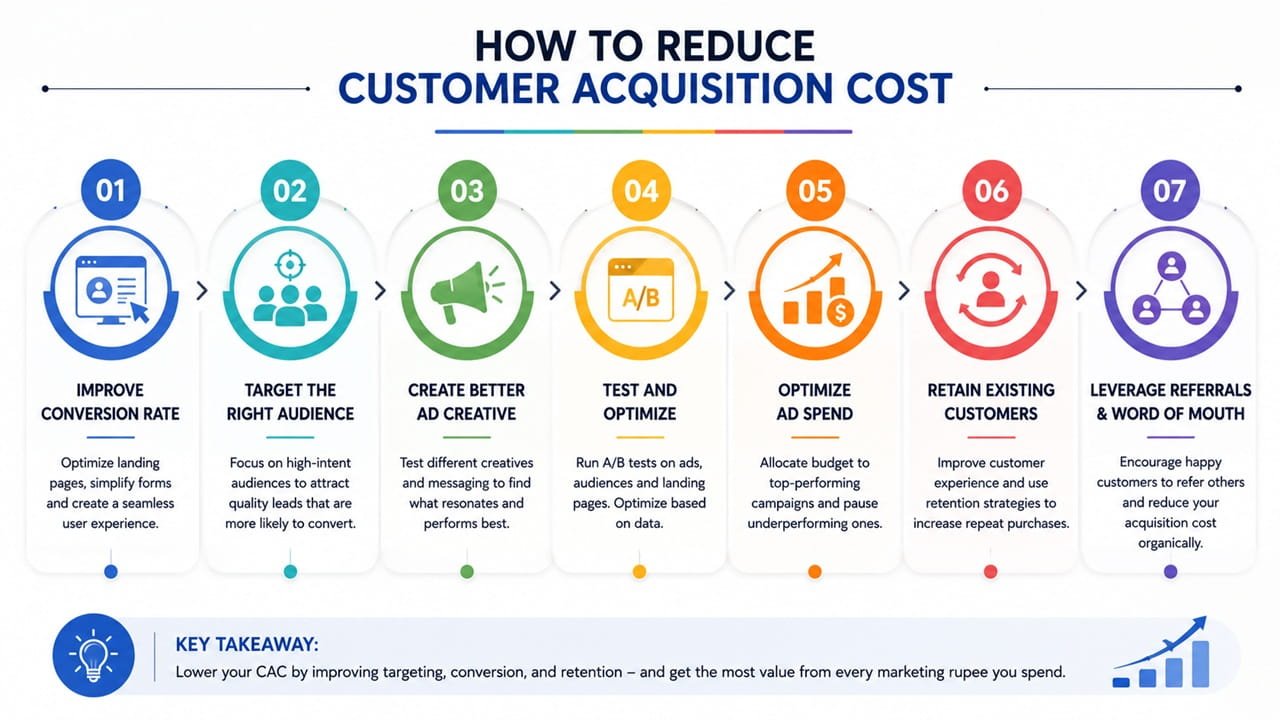
This is really the part everyone actually cares about not just knowing the number, but bringing it down without wrecking the quality or volume of customers coming through the door. A few things consistently move the needle:
1. Fix conversion rate before you touch the ad budget
Most businesses respond to rising CAC by spending more on ads, which almost always makes things worse, not better. If a landing page converts at 1% and gets fixed to convert at 2%, CAC effectively gets cut in half without spending one extra rupee on traffic. It’s usually the fastest, cheapest lever sitting right there, and it’s the one most businesses skip in favor of just throwing more budget at the top of the funnel.
2. Chase lead quality, not just lead volume
A campaign pumping out cheap leads that never actually convert isn’t cheap at all the cost just moves further down the funnel where it’s harder to spot. Tightening targeting, adjusting the ad messaging so it pre-qualifies interest, being more specific about who the offer is even for this usually pushes CPL up slightly while dropping CAC significantly, because far fewer of those leads go nowhere.
3. Build organic channels alongside the paid ones
SEO, content, and organic social all cost something upfront, sure, but they don’t scale linearly with volume the way paid ads do. A blog post or a piece of ranking content keeps quietly generating leads for years after it’s published, pulling the blended CAC down over time while paid spend just sits flat.
4. Fix the sales handoff, not only the marketing
Sometimes the real leak isn’t in the ads at all it’s in how slowly, or how badly, leads get followed up with once marketing hands them off. A lead sitting untouched for two days is basically a lead that’s already gone cold, and that lost sale quietly inflates CAC even though marketing technically did its job.
5. Retarget instead of endlessly chasing cold traffic
Cold audiences convert at a fraction of what warm ones do. Retargeting people who’ve already shown some interest is almost always cheaper per conversion than constantly finding brand-new cold traffic yet a lot of budgets stay stubbornly weighted toward the top of the funnel out of habit more than strategy.
6. Let automation carry some of the manual work
Automated email sequences, chatbot qualification, CRM-triggered follow-ups all of it reduces the human hours needed per conversion, which quietly lowers the labor side of CAC. It’s a part businesses forget to even count in the first place.
7. Compare channels properly, not in isolation
A channel that looks expensive on CPC alone might actually have a lower CAC than a “cheap” channel once conversion rate and customer quality get factored in. Judging channels purely on cost-per-click or cost-per-lead, without following the number all the way through to CAC, is one of the easiest ways to accidentally pour money into the wrong place.
Customer Acquisition Cost vs Customer Lifetime Value
CAC on its own only tells half the story. The other half is Customer Lifetime Value (LTV) basically, the total revenue you can expect from one customer across the entire time they stick around, not just their first purchase.
The relationship between the two is really what tells you whether a business is healthy or quietly in trouble:
| Scenario | CAC | LTV | What It Means |
| Healthy | ₹5,000 | ₹20,000 | Strong 4:1 ratio, sustainable growth |
| Break-even | ₹5,000 | ₹5,500 | Barely profitable, no room for error |
| Unsustainable | ₹5,000 | ₹3,000 | Losing money on every new customer |
Most growth-focused businesses aim for an LTV to CAC ratio of at least 3:1 meaning a customer is worth at least three times what it cost to bring them in. Fall below that and something’s off pricing, retention, or just inefficient spending on acquisition. Go well above 5:1, and some would argue you’re actually under-investing in growth, since each customer’s clearly profitable enough to justify spending more to get more of them.
Here’s the part that gets missed a lot, though: you can win by lowering CAC, or you can win by raising LTV both move the ratio in the right direction. A business that’s really struggling to bring down its acquisition cost might get further, faster, by focusing on retention or repeat purchases instead of fighting the ad platforms for slightly cheaper clicks. Sometimes the smarter move isn’t spending less to get a customer in the door it’s making them worth more once they’re already there.
Customer Acquisition Cost Optimization
Customer Acquisition Cost optimization isn’t really a one-time fix you do and forget. It’s more of an ongoing habit watching where the money’s going, what it’s actually producing, and adjusting continuously instead of setting a budget once a year and hoping it holds up.
A structured approach to CAC optimization usually looks something like this:
- Channel-level tracking, so you actually know which specific platform, campaign, or even ad creative is producing customers at the lowest cost instead of looking at CAC as one blended average that quietly hides where the waste really is
- Attribution modeling, since a customer often touches several channels before they convert, and giving all the credit to the last click badly distorts which channels are doing the actual work
- Ongoing CRO work on landing pages and checkout, since conversion improvements compound across every channel at once instead of needing to be fixed one channel at a time
- Retention and reactivation efforts, which quietly lift LTV and improve the overall ratio without touching the acquisition side at all
- Constant A/B testing of offers, creative, and targeting, since whatever worked to bring in cheap customers six months ago tends to stop working as audiences saturate or competitors adjust their own bidding
The businesses that actually keep CAC under control long-term treat it like any other core financial number reviewed monthly, broken down channel by channel, tied straight back to profitability. Not something tracked once in a spreadsheet and never opened again.
Factors That Increase Customer Acquisition Cost
- A handful of things quietly push CAC up, often without anyone noticing until the number’s already uncomfortable:
- More competitors bidding on the same keywords or audiences, pushing ad costs up across the board
- A weak landing page or clunky checkout, wasting traffic that was already paid for
- Loose targeting, generating clicks or leads that were never going to convert in the first place Slow or inconsistent sales follow-up,
- letting warm leads go cold before anyone closes them Leaning too hard on one paid channel,
- with no organic layer or retargeting to bring the blended cost down Seasonal dips in demand, where the exact same ad spend just produces fewer customers for a stretch
Common Customer Acquisition Cost Mistakes
Same handful of issues, over and over, across most businesses whose CAC keeps quietly climbing:
- Only counting ad spend in the formula and forgetting salaries, tools, and agency fees.
- Chasing more traffic before ever fixing conversion rate.
- Never checking CAC against LTV, so there’s no real sense of whether the number’s even a problem.
- Treating every channel’s CAC as identical instead of breaking things down channel by channel.
- Letting leads sit too long before follow-up, wasting money that was already spent to generate them.
- Just raising the budget when costs go up, instead of figuring out what’s actually broken underneath.
Customer Acquisition Cost by Industry
CAC swings quite a bit depending on the business model, the sales cycle, and how much an average order is actually worth:
| Industry | Typical CAC Range | Why |
| Ecommerce | Lower to Moderate | Shorter sales cycle, impulse-driven purchases |
| SaaS | Moderate to High | Longer sales cycle, trials and demos before conversion |
| Healthcare | High | Compliance requirements, longer decision-making |
| Real Estate | High | High-ticket, long consideration period |
| Education | Moderate | Seasonal demand, longer research phase |
| B2B Services | High | Multiple decision-makers, longer sales cycles |
A Customer Acquisition Cost for ecommerce business tends to sit lower simply because the buying decision happens fast and price points are usually smaller. A Customer Acquisition Cost for SaaS or B2B business is almost always higher, since the sales cycle drags in more touchpoints, more convincing, often a real human sales conversation before anyone actually signs. Neither is “better” on its own a high CAC is perfectly fine as long as LTV is strong enough to carry it.
How Arihant Global Helps Businesses Lower CAC
At Arihant Global, CAC never gets treated as one lonely number sitting on a dashboard somewhere it’s treated as the end result of everything else working, or not working, correctly. Targeting, landing page conversion, how fast a lead actually gets a follow-up call all of it feeds into that final number. Tracking comes first, always, because a CAC calculation built on shaky data is really just a guess wearing a metric’s clothes. From there, it’s ongoing work breaking CAC down channel by channel, testing landing pages and offers, tightening up targeting wherever quality’s weak, and making sure retention and repeat purchases are pulling their weight on the LTV side too, instead of leaving acquisition to carry the entire load alone.
Our Customer Acquisition Cost Optimization Process
- Business & Cost Structure Discovery
- Current CAC & LTV Baseline Calculation
- Channel-Level Performance Audit
- Landing Page & Conversion Rate Review
- Audience & Targeting Refinement
- Attribution Model Setup
- Retention & LTV Strategy Alignment
- Campaign & Creative Testing
- Sales Follow-Up Process Review
- Ongoing Monitoring & Monthly Reporting
Metrics Worth Tracking Alongside CAC
| Metric | What It Reveals |
| LTV | Total revenue potential per customer over time |
| LTV:CAC Ratio | Whether acquisition spend is actually sustainable |
| Conversion Rate | Whether traffic is turning into customers efficiently |
| Payback Period | How long it takes to recover the cost of getting that customer |
| Channel-Level CAC | Which specific channels are producing customers most efficiently |
Real Case
A Jaipur-based SaaS business came to Arihant Global with a CAC that had quietly crept up to around ₹18,000 per customer over six months, against an LTV of roughly ₹42,000 technically above the 2:1 mark, but uncomfortably close to unsustainable for their margins. Digging into the numbers, a channel audit showed nearly 40% of ad spend was going toward broad, loosely targeted campaigns generating leads that almost never converted. Narrowing the targeting, rebuilding the demo request landing page for clarity, and tightening the sales follow-up window from three days down to same-day brought CAC down to ₹11,200 within twelve weeks pushing the LTV:CAC ratio up to a much healthier 3.7:1, without cutting ad spend at all. Just spending it more carefully.
Frequently Asked Questions – Customer Acquisition Cost
Q1. What is Customer Acquisition Cost (CAC)?
It's the average amount a business spends, across both marketing and sales, to bring in one new paying customer.
Q2. Why is Customer Acquisition Cost important?
Because it tells you whether growth is actually profitable. A business can be steadily adding new customers and still be losing money if CAC is too high compared to what each customer's actually worth.
Q3. How do you calculate Customer Acquisition Cost?
Add up total sales and marketing costs ad spend, salaries, tools, agency fees, all of it and divide by the number of new customers acquired in that same period.
Q4. What is a good Customer Acquisition Cost?
There's no single "good" number, honestly it depends heavily on your industry and price point. What matters more is the ratio between CAC and LTV, with most healthy businesses aiming for at least 3:1.
Q5. What is the difference between CAC and CPA?
CAC usually covers the full cost of acquiring a paying customer, sales and overhead included. CPA tends to be narrower the cost of a single conversion event, which may or may not turn into a paying customer.
Q6. How does CAC compare with Customer Lifetime Value (LTV)?
CAC tells you what it costs to get a customer. LTV tells you what that customer's actually worth over time. Put them side by side and you know whether your acquisition spend is sustainable or not.
Q7. How can businesses reduce Customer Acquisition Cost?
Fix conversion rate before adding more ad spend, tighten targeting to improve lead quality, speed up sales follow-up, and lean into organic channels that lower the blended cost over time.
Q8. Which marketing channels typically have the lowest CAC?
Organic search, retargeting, and referral or repeat-customer channels usually come in lower than cold paid acquisition, since they're working with existing interest or trust instead of starting from zero.
Q9. Should businesses focus on lowering CAC or increasing LTV?
Either one moves the ratio in a healthier direction. A business that's stuck trying to lower acquisition cost directly often makes more progress by improving retention and repeat purchases instead.
Q10. What tools help measure Customer Acquisition Cost?
Google Analytics 4, CRM platforms like HubSpot or Zoho, and reporting straight from Google Ads and Meta Ads are usually used together to track CAC accurately across channels.
Conclusion
If your Customer Acquisition Cost has been quietly climbing and you’re not totally sure why, the answer usually isn’t “spend more” it’s understanding exactly where that money’s actually going and fixing it at the source. Arihant Global helps businesses calculate, track, and steadily bring down CAC across SEO, PPC, social media marketing, and conversion optimization. Reach out and let’s figure out exactly where your acquisition spend is working and where it really isn’t.
Lower your Customer Acquisition Cost without sacrificing growth. Arihant Global helps businesses optimize SEO, PPC, CRO, and analytics to acquire more profitable customers while maximizing every marketing rupee.
Get your free consultation today.