Elevate Your Digital Presence With a Precision-Driven Topical Authority SEO Framework
Let’s be honest. If your website isn’t ranking in 2026, it’s not because you didn’t publish enough blogs.
It’s because search engines don’t trust your expertise.
You can post four articles a week, target high-volume keywords, even build High authority backlinks—but if your content feels disconnected, shallow, or generic, it won’t move the needle.
That’s where most businesses get stuck.
Meanwhile, a smaller competitor with fewer resources quietly dominates search results. Not because they’re spending more—but because their content feels complete, structured, and authoritative.
That’s what topical authority in SEO actually is.
And once you understand how it works, rankings stop feeling random.
What is Topical Authority in SEO?
Topical authority in SEO is what happens when your website becomes the most reliable, complete source of information on a specific subject.
Instead of answering one question, you cover the entire journey:
- From basic understanding
- To comparisons and decisions
- To real-world execution
Search engines don’t just evaluate single pages anymore. They evaluate how well your entire website understands a topic.
When everything connects, your site starts to feel like an expert—not just another blog.
Topical Authority SEO Framework
|
Element |
What It Means |
|
Topic Focus |
Clear niche you dominate |
|
Content Depth |
Cover beginner to advanced queries |
|
Structure |
Pillar + Topic cluster model |
|
Linking |
Contextual internal connections |
| Trust |
Real experience + proof |
The Shift to Entity-Based SEO
Search engines don’t read content like they used to.
They don’t scan for keywords and match phrases. They try to understand meaning.
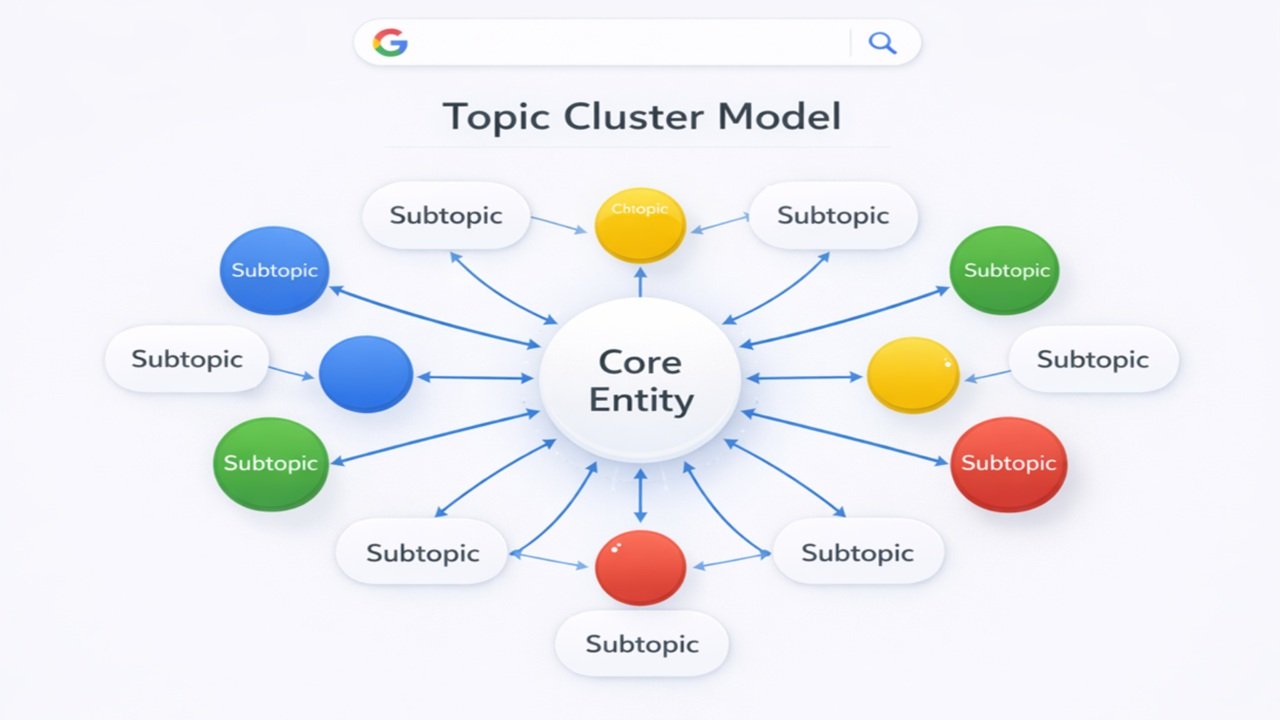
That’s where entities come in.
An Entity SEO is any clearly defined concept—like a service, location, or idea. Instead of focusing on keywords, modern Entity-Based SEO Strategy focuses on how well you connect these concepts.
For example, if your website talks about WhatsApp API solutions, it should naturally cover:
- Broadcast limits
- Green tick verification
- Automation workflows
- Compliance challenges
If those connections are missing, your content feels incomplete.
And this is exactly where most websites lose the game—they never go beyond surface-level coverage.
A Real-World Example: Topical Authority vs Backlinks
A Jaipur-based dental clinic approached us after losing rankings to large national directories.
They had:
- More backlinks
- Better branding Strategy
- Active marketing Campaigns
But only one page on “dental implants Jaipur.”
That was the problem.
Instead of building more links, we focused on structure.
We created:
- One detailed pillar page
- 15 supporting articles covering cost, procedure, recovery, materials, and comparisons
Within four months:
- Organic traffic tripled
- Rankings expanded across hundreds of long-tail queries
- Lead quality improved significantly
This is exactly how structured content drives SEO results for local businesses, even in highly competitive markets.
The big directories had authority.
But the clinic built relevance.
And relevance wins. here
Topical Authority Growth Model (2026)
This is how Topical authority builds in real scenarios:
Phase 1: Base (0–30 Days)
- Define your topic clearly
- Publish a strong pillar page
Phase 2: Expansion (30–60 Days)
- Add 10–20 supporting articles
- Connect them with internal links
Phase 3: Authority (60–90 Days)
- Rankings spread across related queries
- Traffic starts compounding
This is the point where most sites begin to see real traction.
Step-by-Step Framework to Build Topical Authority
Step 1: Define a Clear Topic Scope
Don’t try to cover everything.
Pick a focused niche and own it.
Instead of “real estate in India,” focus on something like:
“commercial office leasing in Jaipur”
This gives your content direction and makes your expertise easier to recognize.
Step 2: Map Search Intent (Not Just Keywords)
Search volume alone doesn’t build Topical authority.
You need to understand:
- What people are trying to learn
- What they compare
- What they’re ready to buy
Group your topics based on intent:
- Informational
- Commercial
- Transactional
This creates a complete journey.
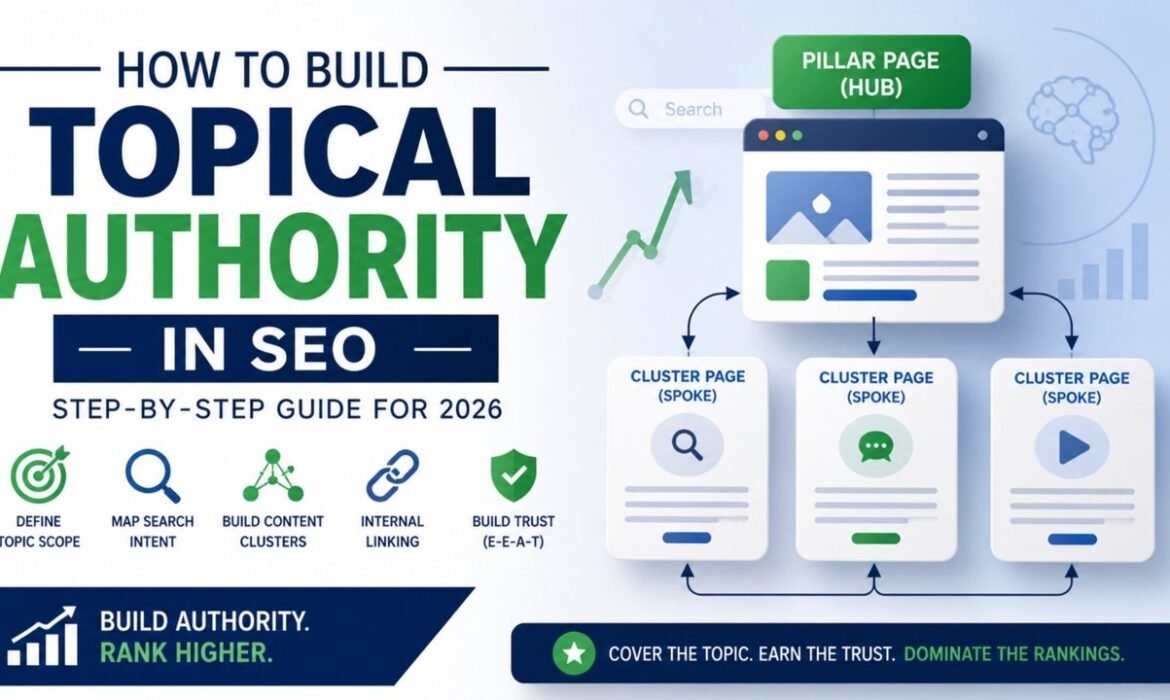
Step 3: Build a Content Cluster
This is where structure comes in. Instead of random posts,
Build a Content Cluster Strategy:
- One pillar page (broad topic)
- Multiple supporting pages (specific subtopics)
Example:
| Pillar Page | Supporting Content | Anchor Example |
| Paid Ads Guide | Google Ads vs Meta Ads | choosing the right paid platform |
| Cost Per Click Optimization | improving PPC ROI | |
| Retargeting Strategy | local retargeting setup |
For example, your main Paid Ads Guide should internally link to Google Ads vs Meta Ads, cost-per-click optimization, and retargeting strategies to build clear topical relationships.
If your content isn’t structured like this, rankings will always feel unpredictable.
Step 4: Semantic SEO Optimization
Once your structure is mapped, you need to actually write the pages. This is where most local businesses fail. They simply look at the top-ranking competitors and rewrite their content. In 2026, this is called “copycat content,” and it gets ignored.
To increase organic traffic, you must focus on Semantic Search SEO Strategy. Information gain measures what unique value, experience, or data your article provides that no other page on the internet has.
Ask yourself:
- Does this post include original data from my business?
- Am I sharing a unique case study?
- Does my search intent optimization truly solve the user’s problem faster than the current #1 result?
Adding real-world micro-depth—like sharing the exact cost reduction a client saw after implementing a specific topical authority strategy—is the ultimate content depth SEO play.
Step 5: Connect Everything with Internal Linking
Content without links is invisible.
Every page should:
- Link back to the main topic
- Connect to related subtopics
This builds a clear structure that search engines can understand.
Step 6: Focus on Information Gain
This is where most content fails.
If you’re just repeating what already exists, your content adds no value.
Ask yourself:
- Does this include real data?
- Am I sharing actual experience?
- Is this better than what’s already ranking?
For example, instead of saying “reduce CPC” show actual before-and-after results from a real campaign.
That’s what makes content stand out.
Step 7: Strengthen E-E-A-T Signals
Search engines look for proof of expertise.
You can’t fake this.
Add:
- Real author profiles
- Case studies
- Clear business information
If your content feels like it comes from real experience, it builds trust naturally.
Step 8: Expand Consistently
Topical authority isn’t built in one week.
Once you cover one area completely:
- Expand to related topics
- Update old content
- Remove weak pages
Over time, your site becomes a complete resource.
Common Mistakes That Ruin Topical Authority
- Posting random blog articles without any topic
- Using high-traffic keywords rather than focusing on topics
- Poor internal linking strategy
- Copying competitor content without contributing new value
- Lack of practical examples
Topical Authority Checklist
- Define a clear topic and scope
- Map content based on search intent
- Create one strong pillar page
- Publish 10–20 supporting articles
- Link everything logically
- Add real experience and data
- Keep updating and expanding
FAQs
1. What is topical authority in SEO?
Topical authority in SEO is the level of trust and expertise search engines assign to a website based on how comprehensively it covers a specific subject. It is built by creating in-depth, structured content that answers every stage of a user’s journey.
2. How do you build topical authority quickly?
To build topical authority quickly, choose a narrow niche, create a detailed pillar page, and publish 10–20 supporting articles covering all related subtopics. Connect them with internal links and focus on real experience, data, and information gain.
3. Why does entity-based SEO improve rankings?
Entity-based SEO improves rankings by helping search engines understand the relationships between concepts instead of just matching keywords. Covering related entities and subtopics increases relevance and allows pages to rank for multiple long-tail queries.
4. What is the difference between topical authority and backlinks?
Backlinks signal popularity and trust from other websites, while topical authority proves expertise and relevance on a subject. Strong rankings require both, but topical authority drives deeper visibility across multiple related keywords.
5. How do AI Overviews impact SEO strategy?
AI Overviews prioritize structured, clear, and authoritative content. To appear in them, your content must directly answer questions, follow logical formatting, and demonstrate deep topical coverage that AI systems can easily understand.
6. What is a pillar page in SEO?
A pillar page is a comprehensive guide on a broad topic that connects to multiple supporting articles covering specific subtopics. This structure helps search engines understand content relationships and builds strong topical authority.
7. How long does it take to build topical authority in SEO?
Topical authority typically starts showing results within 60 to 90 days if you publish structured content clusters consistently. However, stronger authority and competitive rankings may take several months depending on competition and content depth.
8. How many articles are needed to build topical authority?
Most websites need one comprehensive pillar page supported by 10 to 20 high-quality articles covering related subtopics. The exact number depends on how competitive the niche is and how deeply topics are covered.
9. How do AI Overviews SEO impact my content strategy?
AI Overviews summarize search results directly at the top of Google. To appear in them, your content must be structured cleanly with clear headings, direct answers, and deep topical coverage that an AI can easily parse and trust.
Stop Guessing, Start Structuring
Digital dominance is not a creative exercise. it is an organizational one. Search engines want to rank the absolute best answer to a user’s question. By organizing your website into logical SEO Content clusters, proving your real-world experience, and answering the questions your competitors ignore, you leave algorithms with no choice but to rank you first.
At Arihant Global, we have spent the last 12+ years building predictable digital revenue systems for over 2,000 clients across India. We know that publishing random blog posts doesn’t generate leads. Structuring your expertise does.
Disclaimer
The information provided in this article by Arihant Global is for educational and informational purposes only. While every effort has been made to ensure accuracy, SEO outcomes may vary based on industry competition, website condition, and implementation quality. This content does not constitute guaranteed results or professional advice tailored to your specific business.