At some point, almost every business owner has the same slightly annoying realization: getting a new customer used to cost less than it does now. Same product, same offer, sometimes even the exact same ad but the number at the bottom keeps creeping up anyway. That number has a name, and actually understanding it is the first real step toward fixing it. It’s called Customer Acquisition Cost, or CAC, and it’s quietly one of the most important numbers in any business whether anyone’s actually tracking it properly or not.
What is Customer Acquisition Cost(CAC)?
Customer Acquisition Cost is pretty much what it sounds like the average amount of money a business spends to win one new paying customer. Simple concept, genuinely. But here’s the catch: most businesses either don’t calculate it at all, or they calculate it wrong, usually because they only count ad spend and quietly ignore everything else that actually went into landing that customer.
And that matters more than it sounds like it should. A business can look like it’s growing revenue’s up, orders are up and still be bleeding money underneath, if the cost to get each new customer keeps rising faster than what that customer’s actually worth. Growth without profitability isn’t really growth. It’s just spending wearing a nicer outfit. CAC is the number that stops that disguise from working.
People throw around a few related terms alongside CAC, and honestly, it’s worth untangling them, because businesses mix these up all the time:
- CAC (Customer Acquisition Cost): The full cost to acquire one paying customer marketing and sales combined
- CPA (Cost Per Acquisition): Often used interchangeably with CAC, though sometimes it refers to just one conversion event, not necessarily a paying customer
- CPL (Cost Per Lead): What it costs to generate a single lead, before that lead has become a customer at all
- CPC (Cost Per Click): Cost per click on an ad a much earlier, narrower number
A business that’s only watching CPC or CPL is really only seeing a slice of the picture. Clicks are cheap. Leads can look great sitting in a dashboard. Neither one tells you whether you’re actually making money on the customers you’re bringing in. CAC is the number that closes that gap and forces some honesty into the conversation.
Customer Acquisition Cost Formula
The basic Customer Acquisition Cost formula is pretty straightforward:
CAC = Total Sales & Marketing Costs ÷ Number of New Customers Acquired
That’s the quick version, and it’s a fine place to start. But if you want a number you can actually trust, it needs to include more than just what got spent on ads. A proper CAC calculation should fold in:
| Cost Category | What It Includes |
| Ad Spend | Google Ads, Meta Ads, LinkedIn Ads, and any other paid channels |
| Marketing Salaries | Time and salary of the marketing team working on acquisition |
| Sales Salaries | Time and salary of the sales team closing new customers |
| Tools & Software | CRM, ad platforms, analytics tools, landing page builders |
| Agency Fees | Any external agency or freelancer cost tied to acquisition |
| Content & Creative | Production cost of ads, videos, landing pages, and copy |
Example calculation:
Say a business spent ₹5,00,000 in a month ad spend, marketing salaries, a slice of the sales team’s time and acquired 100 new customers in that same stretch.
CAC = ₹5,00,000 ÷ 100 = ₹5,000 per customer
On its own, that number doesn’t really tell you much yet. It only starts to mean something once you weigh it against what that customer is actually worth over time which is exactly why nobody really talks about CAC without LTV showing up in the same sentence sooner or later.
One thing that trips people up constantly: calculating CAC using this month’s new customers against this month’s ad spend, without accounting for the lag between spending the money and actually closing the sale. For businesses with a longer sales cycle, this can make CAC look weirdly high or low depending on the month you happen to check. A rolling average over 3-6 months almost always gives a more honest number than any single month on its own.
How to Reduce Customer Acquisition Cost
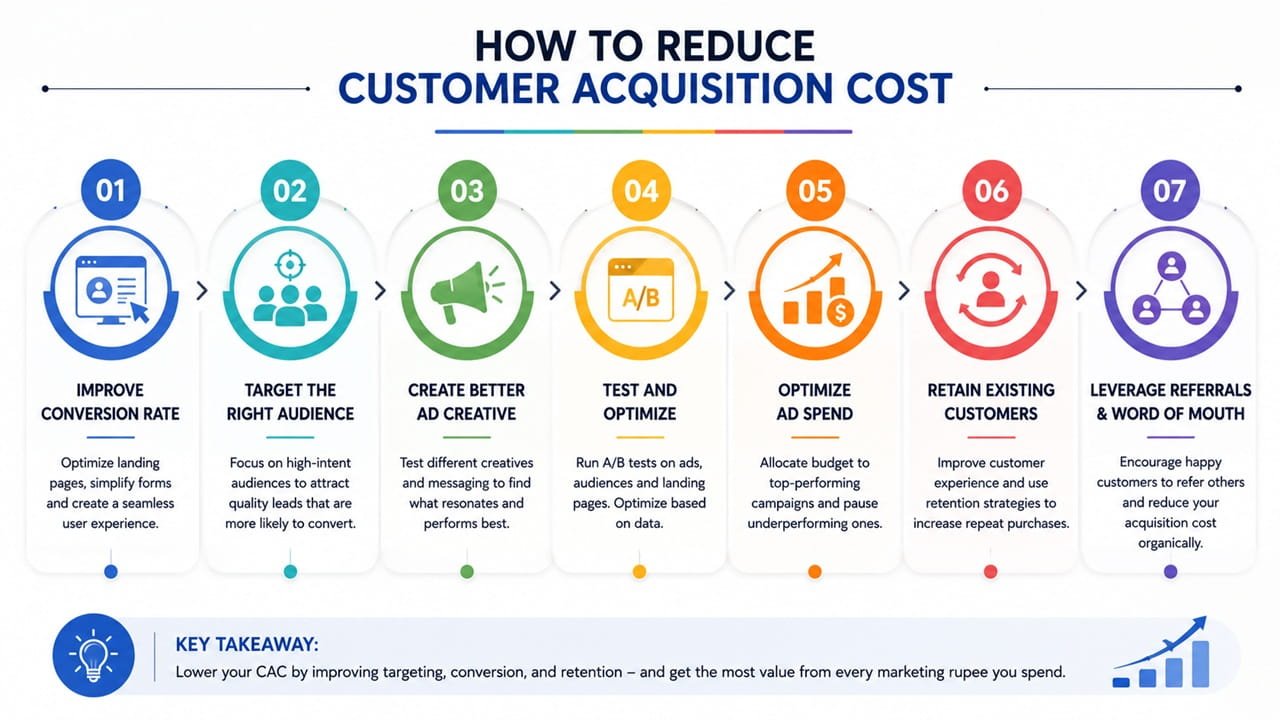
This is really the part everyone actually cares about not just knowing the number, but bringing it down without wrecking the quality or volume of customers coming through the door. A few things consistently move the needle:
1. Fix conversion rate before you touch the ad budget
Most businesses respond to rising CAC by spending more on ads, which almost always makes things worse, not better. If a landing page converts at 1% and gets fixed to convert at 2%, CAC effectively gets cut in half without spending one extra rupee on traffic. It’s usually the fastest, cheapest lever sitting right there, and it’s the one most businesses skip in favor of just throwing more budget at the top of the funnel.
2. Chase lead quality, not just lead volume
A campaign pumping out cheap leads that never actually convert isn’t cheap at all the cost just moves further down the funnel where it’s harder to spot. Tightening targeting, adjusting the ad messaging so it pre-qualifies interest, being more specific about who the offer is even for this usually pushes CPL up slightly while dropping CAC significantly, because far fewer of those leads go nowhere.
3. Build organic channels alongside the paid ones
SEO, content, and organic social all cost something upfront, sure, but they don’t scale linearly with volume the way paid ads do. A blog post or a piece of ranking content keeps quietly generating leads for years after it’s published, pulling the blended CAC down over time while paid spend just sits flat.
4. Fix the sales handoff, not only the marketing
Sometimes the real leak isn’t in the ads at all it’s in how slowly, or how badly, leads get followed up with once marketing hands them off. A lead sitting untouched for two days is basically a lead that’s already gone cold, and that lost sale quietly inflates CAC even though marketing technically did its job.
5. Retarget instead of endlessly chasing cold traffic
Cold audiences convert at a fraction of what warm ones do. Retargeting people who’ve already shown some interest is almost always cheaper per conversion than constantly finding brand-new cold traffic yet a lot of budgets stay stubbornly weighted toward the top of the funnel out of habit more than strategy.
6. Let automation carry some of the manual work
Automated email sequences, chatbot qualification, CRM-triggered follow-ups all of it reduces the human hours needed per conversion, which quietly lowers the labor side of CAC. It’s a part businesses forget to even count in the first place.
7. Compare channels properly, not in isolation
A channel that looks expensive on CPC alone might actually have a lower CAC than a “cheap” channel once conversion rate and customer quality get factored in. Judging channels purely on cost-per-click or cost-per-lead, without following the number all the way through to CAC, is one of the easiest ways to accidentally pour money into the wrong place.
Customer Acquisition Cost vs Customer Lifetime Value
CAC on its own only tells half the story. The other half is Customer Lifetime Value (LTV) basically, the total revenue you can expect from one customer across the entire time they stick around, not just their first purchase.
The relationship between the two is really what tells you whether a business is healthy or quietly in trouble:
| Scenario | CAC | LTV | What It Means |
| Healthy | ₹5,000 | ₹20,000 | Strong 4:1 ratio, sustainable growth |
| Break-even | ₹5,000 | ₹5,500 | Barely profitable, no room for error |
| Unsustainable | ₹5,000 | ₹3,000 | Losing money on every new customer |
Most growth-focused businesses aim for an LTV to CAC ratio of at least 3:1 meaning a customer is worth at least three times what it cost to bring them in. Fall below that and something’s off pricing, retention, or just inefficient spending on acquisition. Go well above 5:1, and some would argue you’re actually under-investing in growth, since each customer’s clearly profitable enough to justify spending more to get more of them.
Here’s the part that gets missed a lot, though: you can win by lowering CAC, or you can win by raising LTV both move the ratio in the right direction. A business that’s really struggling to bring down its acquisition cost might get further, faster, by focusing on retention or repeat purchases instead of fighting the ad platforms for slightly cheaper clicks. Sometimes the smarter move isn’t spending less to get a customer in the door it’s making them worth more once they’re already there.
Customer Acquisition Cost Optimization
Customer Acquisition Cost optimization isn’t really a one-time fix you do and forget. It’s more of an ongoing habit watching where the money’s going, what it’s actually producing, and adjusting continuously instead of setting a budget once a year and hoping it holds up.
A structured approach to CAC optimization usually looks something like this:
- Channel-level tracking, so you actually know which specific platform, campaign, or even ad creative is producing customers at the lowest cost instead of looking at CAC as one blended average that quietly hides where the waste really is
- Attribution modeling, since a customer often touches several channels before they convert, and giving all the credit to the last click badly distorts which channels are doing the actual work
- Ongoing CRO work on landing pages and checkout, since conversion improvements compound across every channel at once instead of needing to be fixed one channel at a time
- Retention and reactivation efforts, which quietly lift LTV and improve the overall ratio without touching the acquisition side at all
- Constant A/B testing of offers, creative, and targeting, since whatever worked to bring in cheap customers six months ago tends to stop working as audiences saturate or competitors adjust their own bidding
The businesses that actually keep CAC under control long-term treat it like any other core financial number reviewed monthly, broken down channel by channel, tied straight back to profitability. Not something tracked once in a spreadsheet and never opened again.
Factors That Increase Customer Acquisition Cost
- A handful of things quietly push CAC up, often without anyone noticing until the number’s already uncomfortable:
- More competitors bidding on the same keywords or audiences, pushing ad costs up across the board
- A weak landing page or clunky checkout, wasting traffic that was already paid for
- Loose targeting, generating clicks or leads that were never going to convert in the first place Slow or inconsistent sales follow-up,
- letting warm leads go cold before anyone closes them Leaning too hard on one paid channel,
- with no organic layer or retargeting to bring the blended cost down Seasonal dips in demand, where the exact same ad spend just produces fewer customers for a stretch
Common Customer Acquisition Cost Mistakes
Same handful of issues, over and over, across most businesses whose CAC keeps quietly climbing:
- Only counting ad spend in the formula and forgetting salaries, tools, and agency fees.
- Chasing more traffic before ever fixing conversion rate.
- Never checking CAC against LTV, so there’s no real sense of whether the number’s even a problem.
- Treating every channel’s CAC as identical instead of breaking things down channel by channel.
- Letting leads sit too long before follow-up, wasting money that was already spent to generate them.
- Just raising the budget when costs go up, instead of figuring out what’s actually broken underneath.
Customer Acquisition Cost by Industry
CAC swings quite a bit depending on the business model, the sales cycle, and how much an average order is actually worth:
| Industry | Typical CAC Range | Why |
| Ecommerce | Lower to Moderate | Shorter sales cycle, impulse-driven purchases |
| SaaS | Moderate to High | Longer sales cycle, trials and demos before conversion |
| Healthcare | High | Compliance requirements, longer decision-making |
| Real Estate | High | High-ticket, long consideration period |
| Education | Moderate | Seasonal demand, longer research phase |
| B2B Services | High | Multiple decision-makers, longer sales cycles |
A Customer Acquisition Cost for ecommerce business tends to sit lower simply because the buying decision happens fast and price points are usually smaller. A Customer Acquisition Cost for SaaS or B2B business is almost always higher, since the sales cycle drags in more touchpoints, more convincing, often a real human sales conversation before anyone actually signs. Neither is “better” on its own a high CAC is perfectly fine as long as LTV is strong enough to carry it.
How Arihant Global Helps Businesses Lower CAC
At Arihant Global, CAC never gets treated as one lonely number sitting on a dashboard somewhere it’s treated as the end result of everything else working, or not working, correctly. Targeting, landing page conversion, how fast a lead actually gets a follow-up call all of it feeds into that final number. Tracking comes first, always, because a CAC calculation built on shaky data is really just a guess wearing a metric’s clothes. From there, it’s ongoing work breaking CAC down channel by channel, testing landing pages and offers, tightening up targeting wherever quality’s weak, and making sure retention and repeat purchases are pulling their weight on the LTV side too, instead of leaving acquisition to carry the entire load alone.
Our Customer Acquisition Cost Optimization Process
- Business & Cost Structure Discovery
- Current CAC & LTV Baseline Calculation
- Channel-Level Performance Audit
- Landing Page & Conversion Rate Review
- Audience & Targeting Refinement
- Attribution Model Setup
- Retention & LTV Strategy Alignment
- Campaign & Creative Testing
- Sales Follow-Up Process Review
- Ongoing Monitoring & Monthly Reporting
Metrics Worth Tracking Alongside CAC
| Metric | What It Reveals |
| LTV | Total revenue potential per customer over time |
| LTV:CAC Ratio | Whether acquisition spend is actually sustainable |
| Conversion Rate | Whether traffic is turning into customers efficiently |
| Payback Period | How long it takes to recover the cost of getting that customer |
| Channel-Level CAC | Which specific channels are producing customers most efficiently |
Real Case
A Jaipur-based SaaS business came to Arihant Global with a CAC that had quietly crept up to around ₹18,000 per customer over six months, against an LTV of roughly ₹42,000 technically above the 2:1 mark, but uncomfortably close to unsustainable for their margins. Digging into the numbers, a channel audit showed nearly 40% of ad spend was going toward broad, loosely targeted campaigns generating leads that almost never converted. Narrowing the targeting, rebuilding the demo request landing page for clarity, and tightening the sales follow-up window from three days down to same-day brought CAC down to ₹11,200 within twelve weeks pushing the LTV:CAC ratio up to a much healthier 3.7:1, without cutting ad spend at all. Just spending it more carefully.
Frequently Asked Questions – Customer Acquisition Cost
Q1. What is Customer Acquisition Cost (CAC)?
It's the average amount a business spends, across both marketing and sales, to bring in one new paying customer.
Q2. Why is Customer Acquisition Cost important?
Because it tells you whether growth is actually profitable. A business can be steadily adding new customers and still be losing money if CAC is too high compared to what each customer's actually worth.
Q3. How do you calculate Customer Acquisition Cost?
Add up total sales and marketing costs ad spend, salaries, tools, agency fees, all of it and divide by the number of new customers acquired in that same period.
Q4. What is a good Customer Acquisition Cost?
There's no single "good" number, honestly it depends heavily on your industry and price point. What matters more is the ratio between CAC and LTV, with most healthy businesses aiming for at least 3:1.
Q5. What is the difference between CAC and CPA?
CAC usually covers the full cost of acquiring a paying customer, sales and overhead included. CPA tends to be narrower the cost of a single conversion event, which may or may not turn into a paying customer.
Q6. How does CAC compare with Customer Lifetime Value (LTV)?
CAC tells you what it costs to get a customer. LTV tells you what that customer's actually worth over time. Put them side by side and you know whether your acquisition spend is sustainable or not.
Q7. How can businesses reduce Customer Acquisition Cost?
Fix conversion rate before adding more ad spend, tighten targeting to improve lead quality, speed up sales follow-up, and lean into organic channels that lower the blended cost over time.
Q8. Which marketing channels typically have the lowest CAC?
Organic search, retargeting, and referral or repeat-customer channels usually come in lower than cold paid acquisition, since they're working with existing interest or trust instead of starting from zero.
Q9. Should businesses focus on lowering CAC or increasing LTV?
Either one moves the ratio in a healthier direction. A business that's stuck trying to lower acquisition cost directly often makes more progress by improving retention and repeat purchases instead.
Q10. What tools help measure Customer Acquisition Cost?
Google Analytics 4, CRM platforms like HubSpot or Zoho, and reporting straight from Google Ads and Meta Ads are usually used together to track CAC accurately across channels.
Conclusion
If your Customer Acquisition Cost has been quietly climbing and you’re not totally sure why, the answer usually isn’t “spend more” it’s understanding exactly where that money’s actually going and fixing it at the source. Arihant Global helps businesses calculate, track, and steadily bring down CAC across SEO, PPC, social media marketing, and conversion optimization. Reach out and let’s figure out exactly where your acquisition spend is working and where it really isn’t.
Lower your Customer Acquisition Cost without sacrificing growth. Arihant Global helps businesses optimize SEO, PPC, CRO, and analytics to acquire more profitable customers while maximizing every marketing rupee.
Get your free consultation today.