Most businesses obsess over traffic. More ads, more SEO, more social posts pour more people into the funnel and hope some of them buy. But here’s the uncomfortable truth that most digital agencies won’t say out loud: if your website is broken, more traffic just means more wasted money.
That’s exactly where Conversion Rate Optimization steps in.
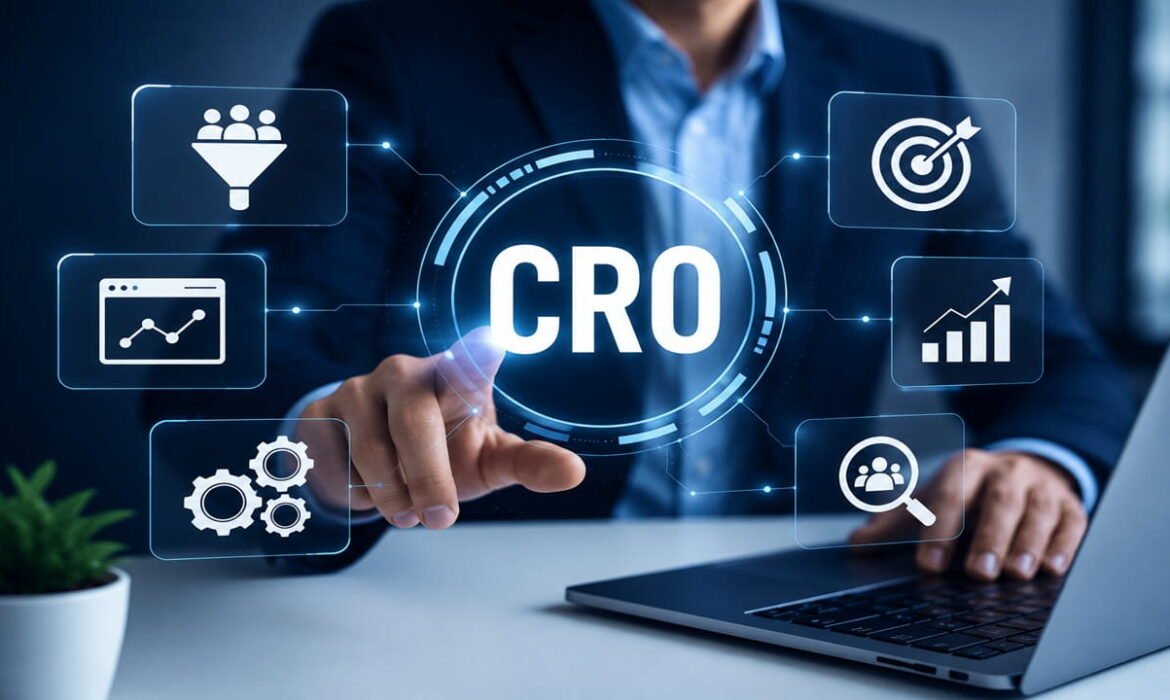
CRO isn’t a buzzword. It’s a disciplined, data-driven methodology that examines why visitors leave without buying, signing up, or calling and then systematically fixes those friction points. When done right, Conversion Rate Optimization Services can double or even triple your revenue without increasing your ad spend by a single rupee.
At Arihant Global Services, we’ve been running CRO campaigns for businesses across India since 2013 ecommerce brands in Delhi, SaaS companies in Bangalore, real estate portals in Jaipur, healthcare providers in Mumbai. The patterns we’ve seen across thousands of hours of session recordings and A/B tests are consistent. most Indian websites are leaving 60–80% of their potential revenue sitting on the table.
This guide covers exactly how we fix that.
What Is Conversion Rate Optimization? (And Why Your Business Needs It Now)
| Conversion Rate Optimization (CRO) is the systematic process of increasing the percentage of website visitors who complete a desired action a purchase, form submission, phone call, or sign-up without increasing traffic. It combines qualitative research (user interviews, session recordings, heatmap analysis) with quantitative testing (A/B testing, split testing, conversion analytics) to identify and eliminate friction from the customer journey. Formula: Conversion Rate = (Total Conversions ÷ Total Visitors) × 100 |
In India, most online shopping sites convert only about 1–2% of their users into buyers. This is slightly less than the worldwide average, and the reasons are well-known: customers favor cash on delivery, many sales fail due to a high return rate and a cumbersome mobile checkout process. All of these problems make it more difficult for online retailers to convert potential customers into real ones.
A mid-size Indian ecommerce brand doing ₹50 lakhs in monthly revenue at a 2% conversion rate, with 25,000 monthly visitors, would add ₹25 lakhs per month in additional revenue just by reaching 3%. No new ad campaigns. No new products. Just fixing what’s already broken.
That’s the core premise of Conversion Optimization, your existing traffic is worth more than you think. The job of a CRO agency is to extract that value systematically.
Website Conversion Optimization covers every surface a visitor touches the homepage, category pages, product pages, landing pages, checkout flow, forms, and the micro-interactions in between. Each of these is a potential leakage point in your conversion funnel, and each one can be tested, measured, and improved.
How Our CRO Services Work The Arihant Global 4-Phase Framework
We don’t run CRO campaigns on gut feeling. Every engagement starts with a structured four-phase framework built around data, hypotheses, experimentation, and iteration. Here’s what that looks like in practice.
| 01 | Conversion Audit & Funnel Mapping
Deep dive into 90 days of behavioral data, heatmap analysis, session recordings, and funnel drop-off rates to identify exactly where visitors are leaving and why. |
| 02 | Research & Hypothesis Building
Qualitative research exit surveys, customer interviews, cohort analysis translated into a prioritized, evidence-backed hypothesis backlog. Every test idea is documented with expected impact and rationale. |
| 03 | A/B Testing & Split Testing Execution
Controlled experiments with pre-determined sample sizes and statistical significance thresholds. Mobile conversion optimization runs as its own dedicated test stream. |
| 04 | Analysis, Learning & Iteration
Segmented conversion analytics, cross-channel reporting, and systematic knowledge capture that feeds the next hypothesis cycle. |
What We Optimize A Complete Breakdown of Conversion Rate Optimization Services
Website Conversion Optimization
Structurally, website conversion optimization covers the entire visitor journey, built and tested one stage at a time, with changes flowing from actual behavior data, not guesswork.
Here’s roughly how it plays out:
- Top of the funnel (landing): Message match, page speed, and first-impression clarity
- Middle of the funnel (browsing): Navigation, internal linking, product or service page clarity
- Bottom of the funnel (checkout/form): Field reduction, trust signals, and removing last-step surprises
None of this works if heatmaps and session recordings aren’t actually being watched without that, “optimization” is just three disconnected design opinions pretending to be a strategy. Getting the tracking and data collection right isn’t the fun part of website conversion optimization, not even close, but literally everything else depends on it.
Landing Page Optimization
Landing pages are the highest-leverage surfaces in your entire funnel. A visitor who clicks your Google Ad has declared intent they’re looking for exactly what you sell. Landing Page Optimization ensures that intent is met with a frictionless, persuasive experience that converts.
We optimize landing pages across five dimensions: message match (does the page headline match the ad copy?), value proposition clarity, trust signal placement, form design, and page load speed. Our landing page tests consistently show that reducing form fields from seven to four and adding a single trust badge above the fold can improve Lead Conversion Optimization rates by 25–40%. For clients running paid media, Landing Page Conversion improvements compound with ad performance a better Quality Score means lower CPCs and better placement across Google’s auction.
Ecommerce Conversion Rate Optimization
The checkout and product pages the actual point of ecommerce conversion rate optimization are where most of the real work happens, because small tweaks here have outsized effects on revenue.
A few levers that consistently move the needle:
- Upfront shipping costs, shown early instead of sprung on people at the last step
- Fewer checkout fields, cut down to only what’s genuinely needed
- Guest checkout, used honestly, so first-time buyers aren’t forced into account creation
- Reviews and size guides placed right where hesitation naturally shows up on the product page
Cart abandonment tends to matter most at this stage not just how many people add to cart, but what’s actually stopping them from finishing. A store losing seven out of ten carts isn’t really “converting slowly.” It’s just leaking revenue every single day the leak goes unfixed.
Lead Generation Optimization
For B2B and service businesses, the conversion event is a lead, not a purchase. Lead Generation Optimization requires a distinct set of hypotheses form length, field type, the offer (demo vs. free trial vs. consultation), placement within content, and the trust signals that make a visitor willing to hand over their contact information.
We’ve found that for Indian B2B audiences, WhatsApp-based lead capture often outperforms traditional web forms by 40–60%. Integrating a WhatsApp CTA alongside a standard form and testing which attracts higher-quality leads is now a standard component of our Lead Conversion Optimization playbook across verticals.
Call-to-Action Optimization
Call-to-Action Optimization isn’t just about button color, though color contrast and size matter for accessibility and visibility. It’s about the verb: “Submit” converts worse than “Get My Free Audit.” Urgency-framed CTAs convert better in some contexts and worse in others. We test CTA copy, placement, size, color, proximity to trust signals, and repetition frequency throughout scroll depth treating each CTA as a micro-conversion event with its own funnel.
Heatmap Analysis & Session Recording
Before running a single test, we need to understand how real visitors actually use your site not how you think they do. Heatmap Analysis reveals where users click, how far they scroll, and which content captures attention. Session Recording shows individual visitor journeys, including rage-clicks (a strong signal of frustration), dead clicks, and form abandonment behavior.
These tools we use Hotjar, Microsoft Clarity, and Lucky Orange depending on client scale and privacy requirements provide the qualitative evidence that makes every A/B test hypothesis credible rather than arbitrary.
CRO Metrics That Actually Matter
Key Conversion Rate Optimization Metrics
| • Overall Conversion Rate primary KPI (purchases, leads, calls) |
| • Revenue Per Visitor (RPV) most holistic CRO metric |
| • Bounce Rate Reduction percentage of single-page sessions |
| • Click Through Rate Optimization CTR on CTAs and internal links |
| • Average Order Value (AOV) revenue per conversion event |
| • Cost Per Acquisition (CPA) ad spend ÷ conversions |
| • Form Completion Rate form starters who submit |
| • Cart Abandonment Rate ecommerce funnel leak metric |
| • Conversion Analytics by device, source, and geography |
| • Customer Acquisition Optimization cost trends over test cycles |
We report on a weekly cadence during active test cycles and monthly for ongoing optimizations. Every report includes a test registry (what’s live, completed, in the backlog), statistical significance levels for completed tests, revenue impact attribution, and next-steps recommendations.
One metric we emphasize with every client Revenue Per Visitor. Unlike conversion rate alone, RPV captures both the volume and the value of conversions which means a test that slightly reduces conversion rate but attracts higher-value customers can still win on the metric that matters most to your bottom line.
Why Choose Arihant Global as Your Conversion Rate Optimization Agency?
There’s no shortage of agencies offering Conversion Rate Optimization Services in India. Most of them run a handful of color-change tests, declare a 10% improvement in CTR, and invoice you for “CRO.” That’s not what we do.
Arihant Global has been a full-service digital marketing and CPaaS agency since 2013. We hold ISO 9001:2015 certification for quality management and ISO 27001:2022 certification for information security which matters when we’re embedded in your analytics stack and have direct visibility into revenue data.
Our CRO agency team has worked across ecommerce, real estate, healthcare, education, SaaS, and financial services verticals across markets in Jaipur, Delhi, Mumbai, Bangalore, and Hyderabad. That breadth means our hypothesis library is genuinely informed by what works in Indian markets, not just recycled learnings from Western case studies applied without localization.
We operate as a true CRO Agency with a dedicated conversion practice not a design shop that runs tests on the side, and not a media agency trying to justify retainer value with optimization theatre.
Frequently Asked Questions About Conversion Rate Optimization Services
Q1. How long does it take to see results from Conversion Rate Optimization?
Most clients see statistically significant test results within 4–6 weeks of the audit phase completing. However, the real compounding impact of CRO where wins stack on top of each other typically shows up at the 3–6 month mark. CRO is not a one-time project; it's an ongoing engagement that compounds in value over time.
Q2 : What is a good conversion rate for an Indian website?
Benchmarks vary significantly by industry. Ecommerce averages 1.5–3%. B2B lead generation sites typically run 2–5% on well-optimized landing pages. SaaS free trial pages can reach 8–15% when properly optimized. Rather than chasing a benchmark, we focus on your specific baseline and build a roadmap to improve it measurably quarter over quarter.
Q3: What traffic volume do I need for CRO to work?
A/B testing requires minimum traffic to achieve statistical significance. As a rough guide, you need at least 1,000 monthly visitors per page being tested to run meaningful experiments. For lower-traffic sites, we use a qualitative-first approach deep user research, expert review, and best-practice implementation before layering in testing as traffic grows.
Q4. How is CRO different from SEO?
SEO increases the quantity and quality of traffic arriving at your site. CRO increases what happens after they arrive. The two are complementary better-converting pages also tend to have lower bounce rates and higher engagement metrics, which are indirect SEO signals. A combined SEO + CRO strategy consistently outperforms either discipline alone.
Q5: Do you offer CRO Services for mobile apps?
Yes. Mobile Conversion Optimization covers both mobile web experiences and native app onboarding and purchase flows. App CRO typically involves Firebase A/B testing integration and focuses on onboarding completion rates, in-app purchase flows, and notification opt-in optimization for Android and iOS.
Ready to Stop Leaving Revenue on the Table?
Every visitor who lands on your website and leaves without converting represents money you’ve already spent to acquire through ads, through SEO effort, through content that returned nothing.
Conversion Rate Optimization is the discipline that recovers that value. It’s not glamorous. It’s not the sort of thing that makes for exciting pitch decks. But it is, consistently, the highest-ROI investment a business with existing digital traffic can make and the results compound in a way that paid media spend simply cannot replicate.
If you’re ready to stop leaving revenue on the table, our Conversion Rate Optimization Agency is ready to start with a free audit of your highest-traffic pages.
| Get Your Free CRO Audit
Identify your top 3 conversion leaks free, no obligation. |
Disclaimer
The insights and examples in this article are based on industry experience and best practices. Individual outcomes may differ depending on website quality, user behavior, implementation, and market conditions.