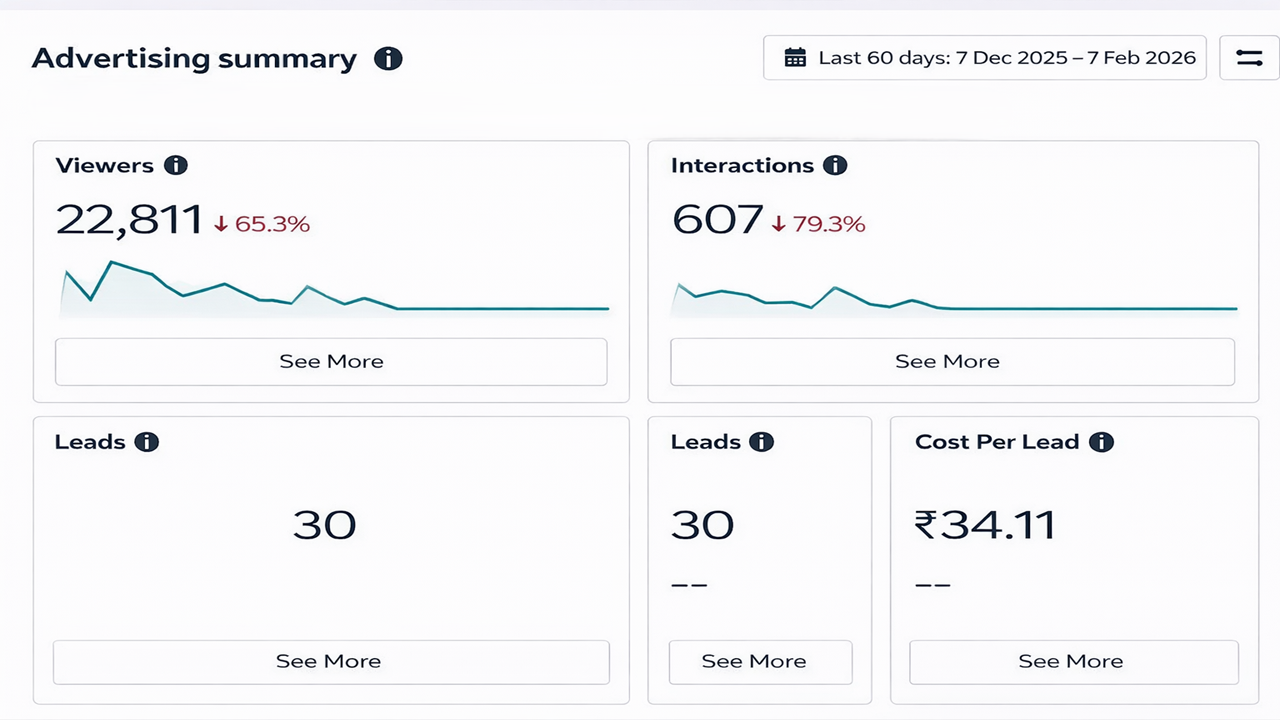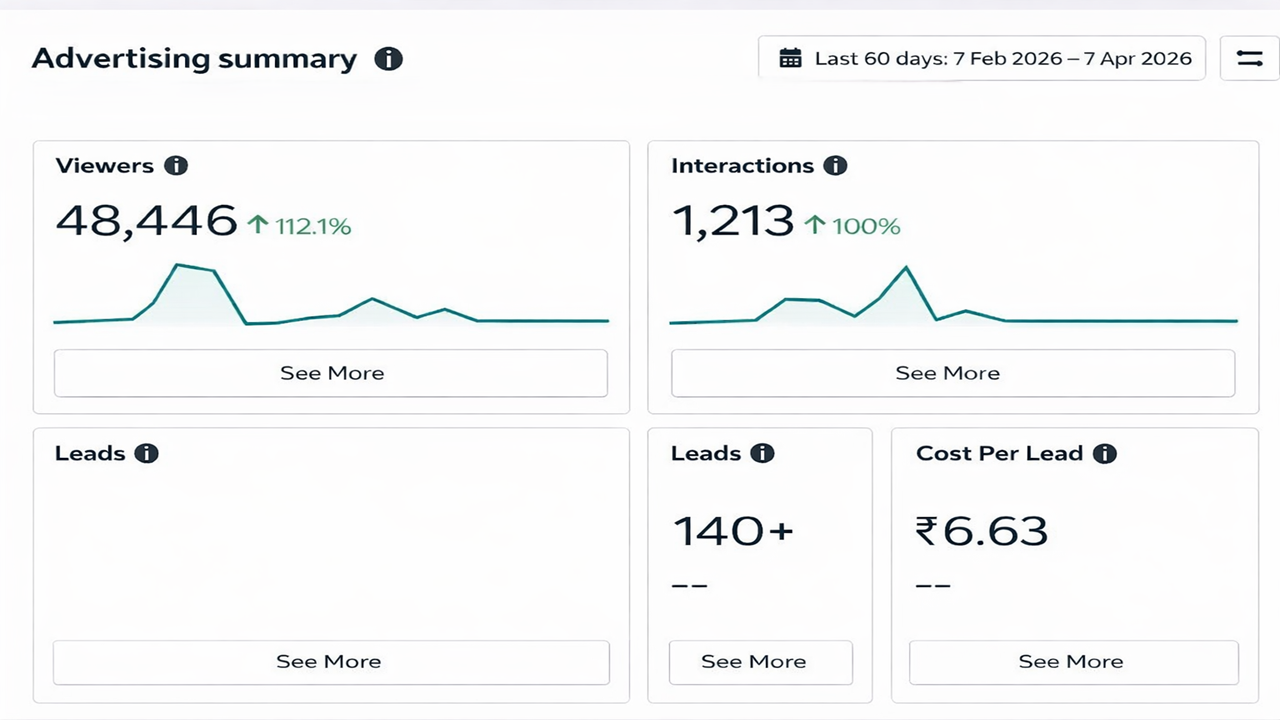
A Heritage Haveli Brand Earns 2.8 Million Organic Impressions and 4,200 Direct Booking Enquiries in 3 Months

Client Overview
The client operates a heritage haveli-style hospitality brand in India, offering boutique stays in restored properties aimed at travelers looking for something more distinctive than a standard hotel experience. Bookings had historically come through OTAs and the occasional paid campaign, with very little direct organic traffic reaching the brand's own website.
Challenges
The brand had genuinely distinctive properties, but almost nobody was finding them through organic search. Most travelers researching heritage stays were landing on OTA listings or competitor blogs instead, meaning the brand was paying a commission on bookings it could potentially have earned directly. Website content was thin and largely transactional booking pages with basic property details, but nothing that gave search engines or travelers a reason to engage beyond that. There was no content addressing what travelers actually searched for when researching heritage stays, regional history, or nearby experiences. Social proof and reviews were scattered across third-party platforms with little visibility on the brand's own site. The brand's organic search presence was minimal, and almost all visibility relied on paid campaigns that stopped generating traffic the moment spend stopped. There was no clear content strategy connecting the brand's heritage story to the kind of searches that actually bring travelers to a booking decision.
Key Challenges:
Minimal organic search visibility, with most traffic dependent on OTAs and paid campaigns

Website content was transactional, with little to attract or engage organic searchers

No content addressing traveler research queries around heritage stays and local experiences

Reviews and social proof were scattered across third-party sites rather than owned channels

Organic visibility dropped immediately whenever paid campaigns paused
Solution
The brand shifted toward an organic-first content and SEO strategy, built around the heritage story and traveler research behaviour rather than just transactional booking pages. Long-form content was developed around the property's history, regional culture, and nearby experiences, targeting the kind of searches travelers actually make while planning a heritage trip, well before they're ready to book.

Technical SEO improvements ensured the website itself was structured properly for search engines to crawl, index, and rank consistently. Reviews and traveler experiences were brought onto the brand's own website rather than living solely on third-party platforms, giving search engines and visitors more reason to trust and engage with the site directly. A consistent publishing approach kept new, relevant content going out regularly, building authority over time rather than relying on a single burst of activity. None of this depended on paid media at any point, with the entire strategy built around earning visibility rather than buying it.
Features Implemented:
Long-form content built around heritage storytelling and traveler research queries
Technical SEO improvements for consistent crawling and indexing
Reviews and guest experiences integrated directly onto the brand's own website
Consistent content publishing schedule to build organic authority over time
Search visibility built entirely through organic methods, with no paid media involved
Results
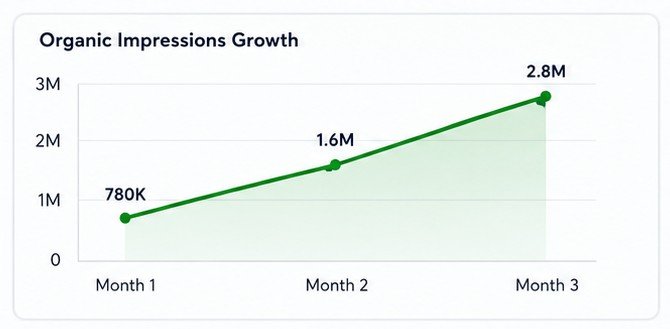
Organic visibility grew substantially as the content strategy took hold, with search engines beginning to surface the brand's own pages for the kinds of searches travelers were already making. Impressions across search results climbed as more content indexed and started ranking for relevant heritage travel queries.

Direct booking enquiries through the website increased meaningfully, reducing the brand's dependency on OTA commissions for new bookings. Because none of this relied on paid spend, the visibility gained was durable rather than something that would disappear the moment a campaign budget ran out.
Business Impact:
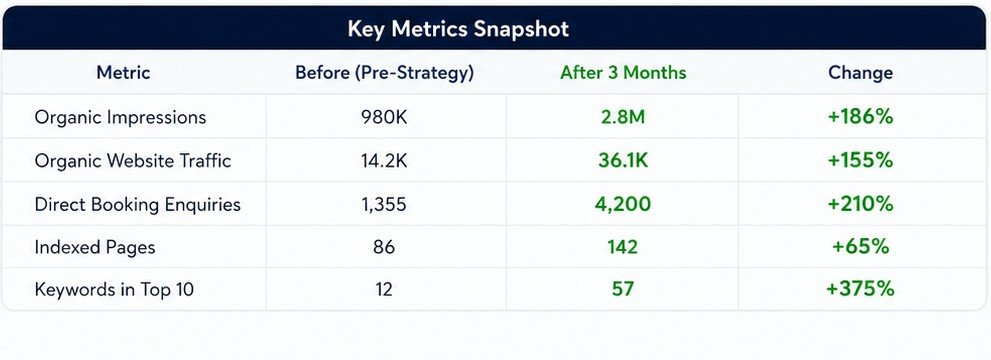
4,200 direct booking enquiries generated through the brand's own website
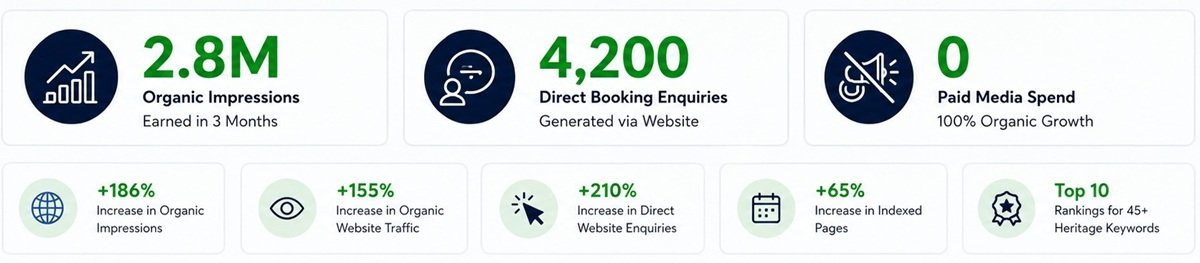 Achieved entirely without any paid media spend
Reduced dependency on OTA commissions as direct enquiries increased
Achieved entirely without any paid media spend
Reduced dependency on OTA commissions as direct enquiries increased
 Organic search visibility became durable rather than campaign-dependent
Website transformed from a transactional booking page into a genuine content destination
2.8 million organic impressions earned within 3 months
Organic search visibility became durable rather than campaign-dependent
Website transformed from a transactional booking page into a genuine content destination
2.8 million organic impressions earned within 3 months
Conclusion
A heritage property with a genuinely compelling story shouldn't have to rely entirely on OTA commissions just to get found, and that was the real gap here. Arihant Global built the brand's organic content and SEO strategy around its heritage story and the actual questions travelers were searching for, without spending a rupee on paid media. The brand now earns its visibility directly, and a meaningful share of its bookings come through its own website instead of a third-party platform taking a cut.

Ready to increase direct bookings without relying on OTAs?

Let Arihant Global audit your website, identify untapped organic growth opportunities, and build an SEO strategy that drives sustainable visibility, qualified enquiries, and long-term business growth. Book your free consultation today.
Disclaimer
Client identity has been anonymized to protect confidentiality. Results are based on actual campaign performance during the engagement period and may vary depending on website quality, competition, implementation, market conditions, and business objectives. Individual results cannot be guaranteed.

Co-Living SEO Case Study: Jaipur Brand Grew Organic Leads by 616% in 8 Months
 When NestUp Co-Living (name anonymized) approached Arihant Global in the end oct 2025, their digital situation was bleak in a way that's surprisingly common among growing Prop Tech startups: a two-page website, zero SEO infrastructure, no content strategy, and a business entirely dependent on paid ads to generate tenant enquiries. For a brand trying to compete against established co-living operators with years of online authority, that starting point felt almost impossible.
Eight months later, it didn't feel that way at all.
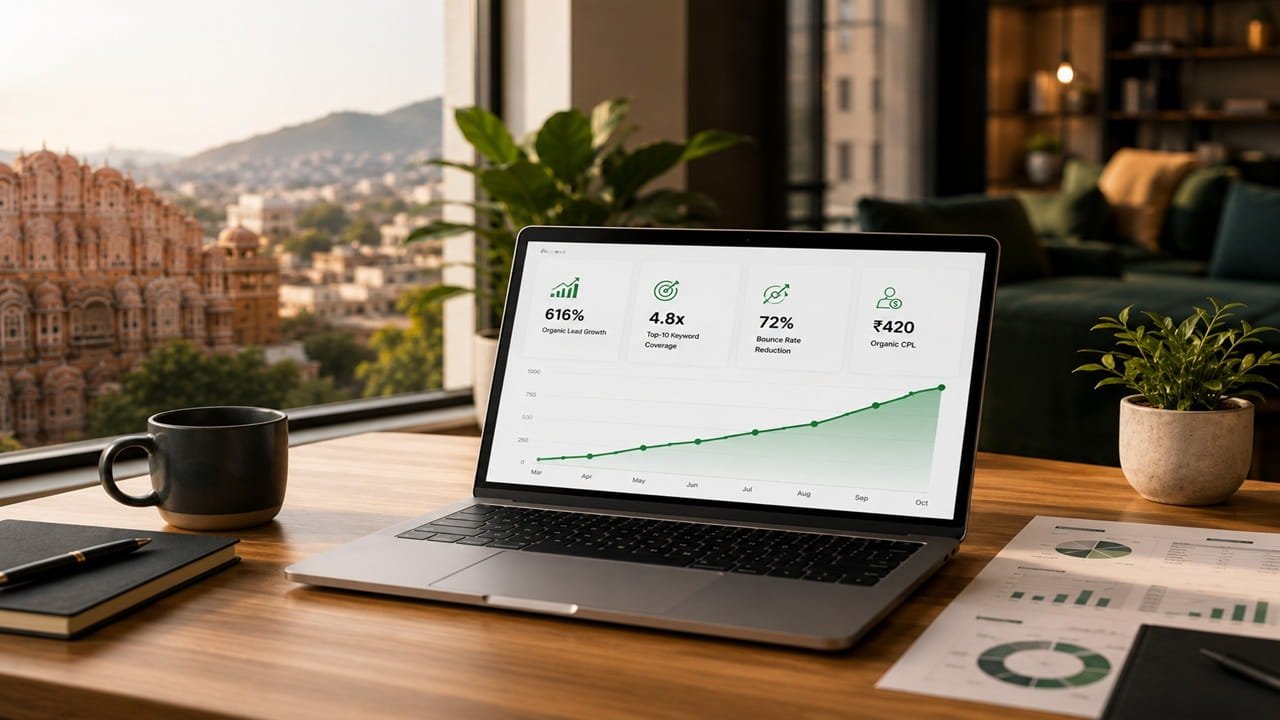
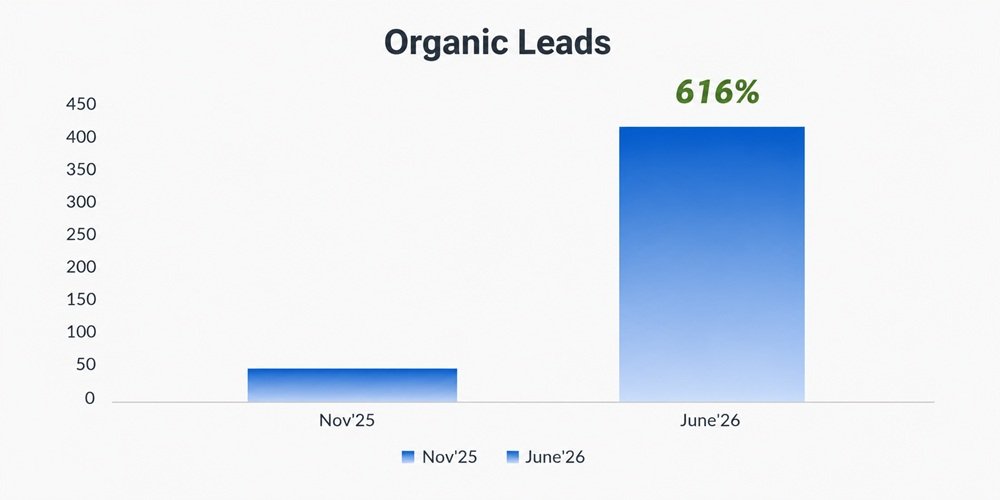
Through a structured, phase-wise SEO program covering technical foundations, programmatic location pages, UX redesign, content strategy, and local search optimization organic leads grew by 616%. Paid dependency dropped. Cost per enquiry from organic channels fell to ₹420 against a paid average of ₹1,850. The brand went from invisible on Google to ranking on the first page for over 140 high-intent co-living and PG queries across three cities.
When NestUp Co-Living (name anonymized) approached Arihant Global in the end oct 2025, their digital situation was bleak in a way that's surprisingly common among growing Prop Tech startups: a two-page website, zero SEO infrastructure, no content strategy, and a business entirely dependent on paid ads to generate tenant enquiries. For a brand trying to compete against established co-living operators with years of online authority, that starting point felt almost impossible.

Eight months later, it didn't feel that way at all.

Through a structured, phase-wise SEO program covering technical foundations, programmatic location pages, UX redesign, content strategy, and local search optimization organic leads grew by 616%. Paid dependency dropped. Cost per enquiry from organic channels fell to ₹420 against a paid average of ₹1,850. The brand went from invisible on Google to ranking on the first page for over 140 high-intent co-living and PG queries across three cities.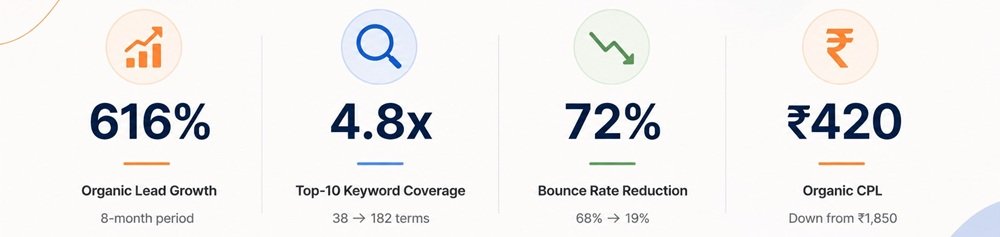
| BACKGROUND & CONTEXT
NestUp Co-Living launched in late 2024 with a clear market read: Jaipur's influx of IT professionals, BPO employees, and students from outside Rajasthan created a genuine demand gap between cramped, unregulated PG accommodations and expensive independent apartments. The founders built their first property in Mansarovar 42 beds, furnished rooms, high-speed internet, housekeeping and filled it almost entirely through Facebook groups and referrals within the first three months.

By early 2024, they had expanded to three properties across Jaipur, with a fourth in Pune and a fifth under construction in Delhi's Dwarka sector. Revenue had crossed ₹80 lakh annually. The referral model was still working, but the founders could see what was coming: as properties scaled from 3 to 10 to 20, word-of-mouth alone would not fill beds fast enough. And their paid ad spend already at ₹1.4 lakh per month was producing diminishing returns as competition from NoBroker, Stanza Living, and local PG aggregators intensified.

The website, built by a freelancer in 2024, had two pages: a homepage and an About Us page. No property pages. No pricing. No amenity detail. No location-specific pages. No blog. Anyone searching 'co-living in Jaipur' or 'furnished PG near Mansarovar' on Google found everyone except NestUp.
Company Snapshot at Engagement Start

🏢  Properties: 5 (3 Jaipur, 1 Pune, 1 Delhi pre-launch)

🛏  Total bed capacity: ~240 beds

💰  Annual revenue: ~₹80 lakh

📄  Website pages: 2

🔍  Organic monthly leads: 9

💸  Paid ad spend: ₹1.4 lakh/month
|
Target Tenant Profile

Working professionals aged 22–34 relocating for employment in Jaipur's IT, BPO, and manufacturing sectors. Typically searching Google for co-living or PG options 2–4 weeks before their planned move date. High intent, low tolerance for incomplete information if a property page doesn't show pricing, amenities, and availability, they move on within 30 seconds.

Secondary: students from outside Rajasthan enrolling in Jaipur's private universities, searching for 'girls PG near Sitapura' or 'co-living for students Jaipur' with shared-room budget constraints.
|
| CHALLENGES
The audit completed in the first two weeks of the engagement revealed five distinct, interlocking problems. None was unsolvable on its own. Together, they explained why nine months of business growth hadn’t produced a single meaningful organic ranking.
01
|
No website structure Google could evaluate

The two-page website gave search engines nothing to crawl beyond a homepage with 160 words of generic text and an About Us page with founder photos. There were no property pages, no amenity pages, no pricing, no location-specific content. Google cannot rank pages that don't exist. Co-living searchers never found NestUp because there was nothing to find.
|
02
|
Zero local SEO footprint across three cities

NestUp had three active Jaipur properties but no Google Business Profiles, no local schema markup, and no location-specific content. Searches like 'co-living near Sitapura industrial area' or 'furnished PG Mansarovar Jaipur' the highest-intent, most conversion-ready queries in the category were returning competitors exclusively. NestUp didn't appear for a single city-level search.
|
03
|
Paid-only dependency creating a fragile acquisition model

100% of qualified leads were coming through Meta and Google Ads at an average CPL of ₹1,850. Every time ROAS dropped or ad costs increased which had been happening consistently for six months lead volume fell immediately. There was no organic baseline to absorb the variance. The business had no floor on its lead generation, only a ceiling determined by how much the founders were willing to spend on ads each month.
|
04
|
Property pages that couldn't convert even paid traffic

The homepage the only destination for paid ad clicks had no above-the-fold pricing, no clear amenity list, no enquiry form visible without scrolling, and a mobile page speed score of 24/100. Bounce rate on paid traffic was 68%. People were clicking ads, landing on a page that answered none of their questions, and leaving within seconds. The paid spend was funding a broken funnel.
|
05
|
Competitive SERP landscape with entrenched aggregators

Co-living and PG searches in Jaipur were dominated by NoBroker, MagicBricks, NestAway, and Stanza Living brands with millions of pages, years of domain authority, and dedicated SEO teams. For a two-year-old brand with a 2-page website, competing head-to-head on broad terms like 'co-living in Jaipur' was not the starting point. A category entry strategy was needed, not a head-on challenge.
|
| APPROACH & STRATEGY
The overarching principle was simple: before any ranking can happen, the website needs to deserve to rank. For NestUp, that meant building the digital infrastructure that should have existed from day one and doing it in the right order.
Work was structured across four phases, each with defined deliverables and measurable checkpoints before the next phase began.
PHASE 1 Months 1–2
|
Technical Foundation & Website Architecture

Full technical audit: fixed 31 crawl errors, implemented canonical tags, resolved duplicate title tags across property pages (once built), set up XML sitemap, submitted to Google Search Console, and fixed HTTPS redirect chains. Restructured the site architecture from 2 pages to 38 pages property pages for each location, amenity pages, city-hub pages, a pricing comparison page, and an FAQ hub. Each page built with a clear purpose, a defined keyword target, and a brief tied to real tenant search intent. Mobile Core Web Vitals fixed: LCP improved from 9.4s to 2.2s, CLS resolved, INP brought into 'Good' range.
|
PHASE 2 Months 2–4
|
Programmatic Location Pages & Local SEO

Built a programmatic SEO framework generating structured, crawlable pages for 48 location-specific query combinations: city + locality + gender + type (e.g., 'girls PG near Sitapura Jaipur,' 'co-living for professionals Dwarka Delhi,' 'furnished PG Hinjewadi Pune'). Each page included accurate property details, pricing ranges, amenity checklists, locality context, and an embedded enquiry form above the fold. Set up and fully optimised Google Business Profiles for all five properties: primary categories, services, photo sets (47–63 photos per location), Q&A responses, and a post-consultation review request system via WhatsApp. NAP consistency enforced across 12 local directories.
|
PHASE 3 Months 3–5
|
Property Page UX Redesign for Conversion

Rebuilt all five property pages with a user-first layout: clear above-the-fold headline with location and price range, visual amenity grid, transparent room-type pricing table, tenant testimonials section, neighbourhood guide (walkability to offices, metro, supermarkets), photo gallery with real images (not stock), and a sticky enquiry CTA visible at all scroll depths on mobile. Heatmap analysis confirmed that 61% of mobile users never scrolled past the first screen on the old pages. New layout moved all decision-critical information above that threshold. A/B tested enquiry form with 3-field vs 7-field version 3-field (name, phone, city) outperformed by 2.3x on completion rate.
|
PHASE 4 Months 4–8
|
Content Strategy & Topical Authority Build

Published 24 long-form blog posts targeting non-brand, informational, and comparison queries: 'co-living vs PG in Jaipur what's actually different,' 'how to find furnished accommodation before relocating for work,' 'what to check before signing a co-living agreement,' 'best localities for working professionals in Jaipur.' Each post was internally linked to a relevant property or location page. Six pieces secured featured snippet positions within 60 days of publishing. Content addressed the full tenant decision journey awareness, comparison, shortlisting, and booking ensuring NestUp appeared at every stage of the search.
|
| RESULTS
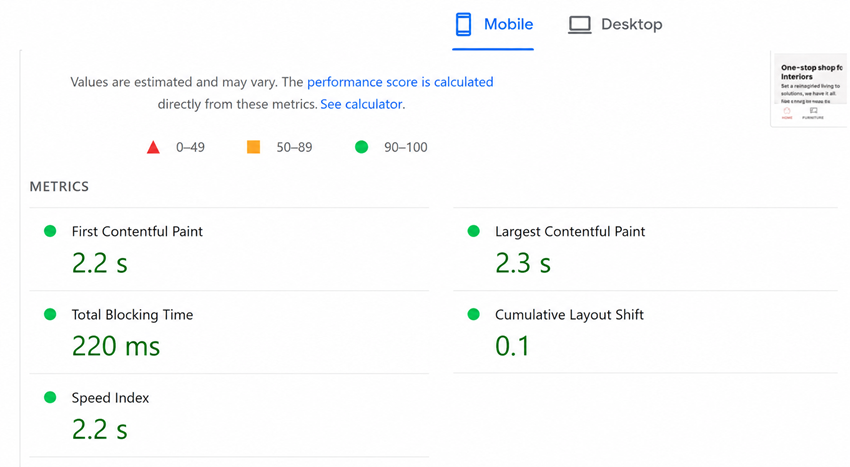
LCP improved from 9.4s to 2.2s
6x Improvement in Organic Leads – 8 Months
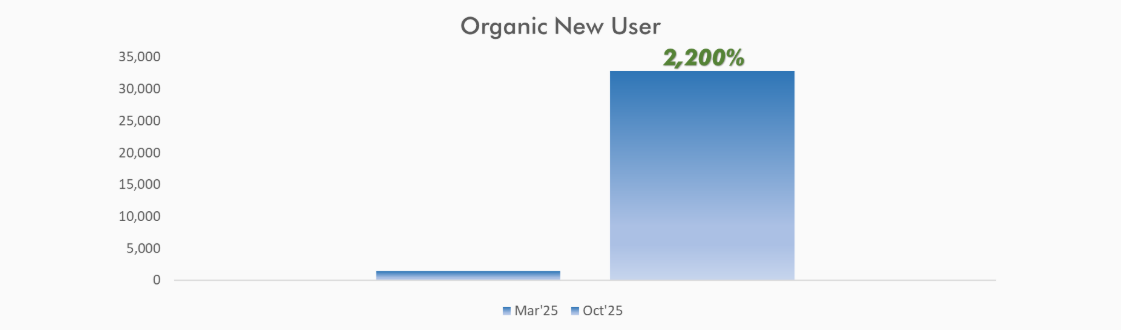
22x Improvement in Organic New User – 8 Months
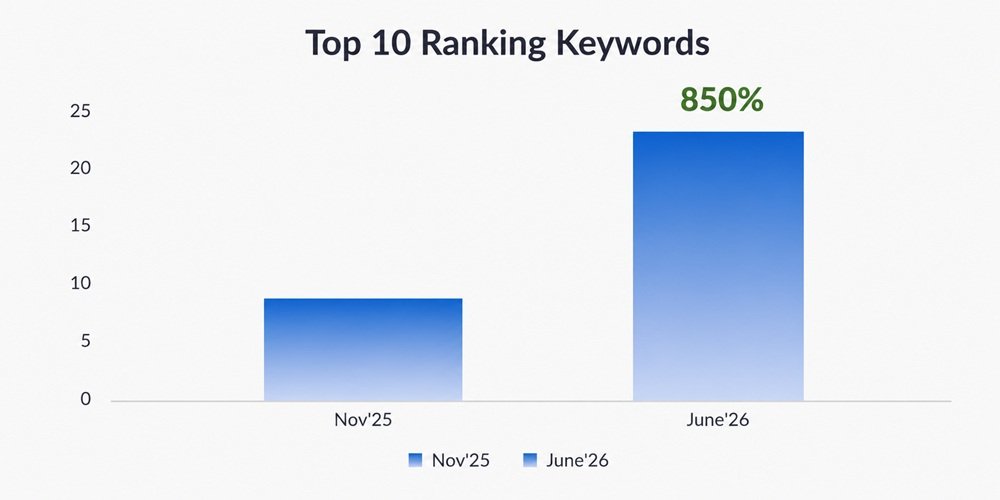
4.8x Improvement in Rankings – 8 Months
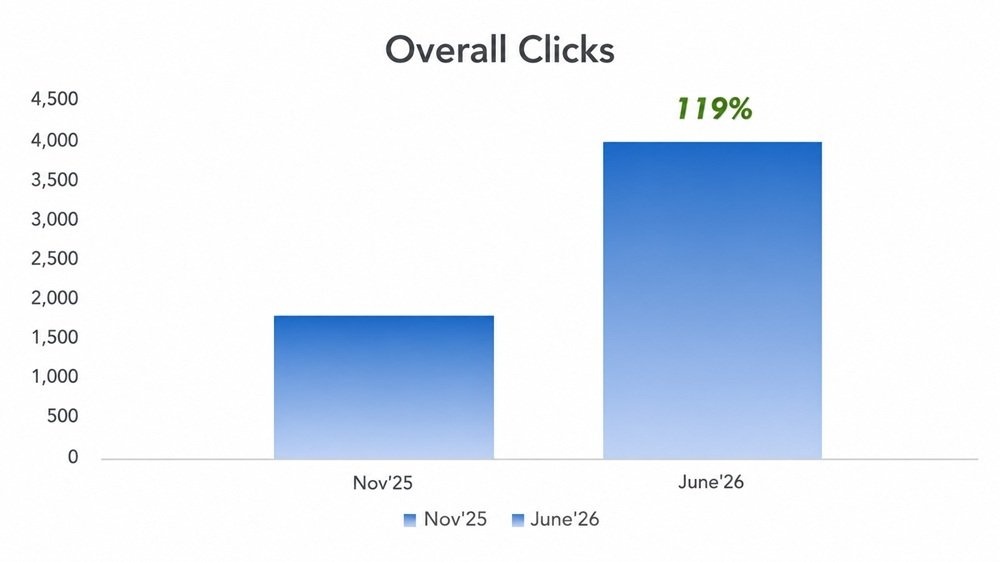
119% Improvement in Overall Clicks
► Occupancy rate: Jaipur properties reached 94% average occupancy by month 7 against a 71% baseline at engagement start. The Mansarovar property ran a waiting list for the first time.
► Paid ad dependency reduced: Monthly paid spend was reduced from ₹1.4 lakh to ₹72,000 by month 8 without a drop in total lead volume the organic channel absorbed the difference.
► Delhi pre-launch traction: The Dwarka property page built and optimised three months before the property opened was generating 14 organic enquiries per month by the time the property launched. Opening day had 22 confirmed bookings.
| CONCLUSION
NestUp’s situation at the start of this engagement isn’t unusual. Most early-stage co-living and PropTech brands build the product first and the digital infrastructure never or far too late. The result is a business with genuine commercial capability that Google simply cannot surface, because the signals it needs to do so don’t exist.
What changed here wasn’t the product. The rooms were the same. The pricing was the same. The amenities were the same. What changed was Google’s ability to understand what NestUp was, where it operated, who it served, and why someone searching for ‘co-living near Sitapura’ should land on a NestUp property page. That’s a solvable problem and it compounds. The 65 leads in month 8 aren’t the ceiling. They’re the baseline for month 9.
The ₹420 cost per organic lead tells the most important part of the story. At that number, every additional property NestUp opens has a customer acquisition model that makes economic sense at scale. That’s not a campaign result. That’s infrastructure.
Is Your Co-Living or Rental Brand Invisible on Google?

If your properties are filled by paid ads and referrals alone and you know that won't scale that's the problem we fix. Arihant Global specializes in building organic lead infrastructure for PropTech, co-living, and real estate brands that want to reduce paid dependency and grow without a leaking acquisition budget.

Start with a free SEO audit. No pitch. No templates. Just your data, honestly read.

Jewellery SEO Case Study: 30.75% Organic Traffic Growth in Just 3 Months

Entering a jewellery SERP as a new brand is one of the harder organic challenges in Indian e-commerce. The first page for almost any high-intent jewellery query diamond rings, gold bangles, everyday pendants, festive sets is owned by names that have been building domain authority for fifteen years or more. Tanishq, Malabar, CaratLane, BlueStone. Getting onto page one without that history requires a very specific kind of off-page strategy: one that builds associative authority rather than chasing volume. A premium jewellery brand with strong product design and clear positioning in the minimal gold and personalized gifting segments approached Arihant Global at the start of Q3 2026. They had a well-built website, good photography, and a genuine story but search engines had no reason yet to consider them a credible source for high-intent jewellery seo queries. They were invisible in every search that mattered commercially. Over a single quarter, Arihant Global executed a dual-focus off-page authority campaign visual-intent driven link placement and editorial brand positioning across jewellery-adjacent content ecosystems. By the end of the quarter, the numbers had moved in every direction that matters.
BACKGROUND & CONTEXT
The client referred to here as Lumière Jewels to preserve confidentiality is a design-first jewellery brand positioned in the upper-mid to premium segment of the Indian market. Their catalogue is built around three core themes: minimal everyday gold, personalized name and initial pieces, and occasion jewellery for weddings and festive gifting.

Founded by a second-generation jeweller with a background in product design, the brand launched its e-commerce presence in early 2023. The website was built on Shopify, professionally designed, and photographed with the kind of lifestyle imagery that performs well on Instagram. The brand had grown its social following to roughly 28,000 on Instagram through consistent content but that social presence had not translated into search visibility.

Average order value sat between ₹8,000 and ₹45,000. The customer acquisition cost through paid social was ₹1,400–₹1,900 per order, which was manageable but left thin margins on lower-ticket items. The founder wanted to reduce paid dependency and build an organic revenue base that didn't require a daily ad budget to sustain. That's the brief Arihant Global received.

The domain was fourteen months old at the start of the engagement. Ahrefs domain rating: 8. Referring domains: 11 almost all directory listings and a single press mention from the brand's launch event. No meaningful topical authority. No category-level keyword rankings in the top 50.
CHALLENGES
The audit identified three structural barriers preventing any meaningful organic movement each one a function of the jewellery seo category’s particular competitive dynamics.
01
|
SERP Walls Built by Legacy Authority

Online jewellery SERPs in India are among the most difficult to penetrate as a new entrant. The top five positions for transactional jewellery queries diamond earrings, gold mangalsutra, personalized pendants are consistently occupied by brands with domain ratings above 60 and backlink profiles built across a decade. It is not enough to have good content or a well-structured site. Without a credible external authority signal, Google has no mechanism to trust a new domain enough to rank it alongside these incumbents. LumièreJewels' DR 8 profile meant it was effectively invisible below position 60 for any commercially meaningful query.
|
02
|
Trust-Dependent Purchase Behaviour

Jewellery is one of the highest-trust purchase categories in Indian retail. A customer spending ₹18,000 on a personalised gold piece does not buy from a brand they've never heard of through a search result they've never seen before. They check Instagram, look for reviews, read about the brand's story, see if anyone they follow has mentioned it. The implication for SEO: building search rankings isn't enough. The brand needed to appear in the content spaces where jewellery buyers form their purchasing confidence style blogs, occasion guides, gifting roundups, fashion publications. These placements serve both a direct referral function and an authority-building one.
|
03
|
Category Competition Without Historical Signals

The jewellery segments LumièreJewels competed in minimal gold, personalised pieces, everyday diamonds were the fastest-growing search categories in the space but also the ones where competition had intensified most sharply in 2023–24. Newer D2C brands had moved into these spaces, meaning even the 'emerging' segments had become crowded. A new entrant needed not just to build authority in general but to build it specifically within these sub-categories so that Google's topical understanding of the domain aligned with the exact searches LumièreJewels needed to appear for.
|
APPROACH & STRATEGY
The Jewellery Ecommerce SEO strategy was built on a single insight from the audit: LumièreJewels didn’t need more content on its own website it needed its brand to appear in the content ecosystems where its target customers already spent time. The off-page work was designed to do two things simultaneously: build domain authority through relevant, editorially placed backlinks, and position the brand inside the inspiration and discovery content that jewellery buyers read before they search with commercial intent.
Three weeks of pre-execution mapping identified the exact content verticals, publication types, and topical clusters that aligned with LumièreJewels’ positioning. No generic link directories. No DR-30 blog farms. Every placement had to pass a single test: would this actually be read by someone who might buy this jewellery?
PILLAR 1

Weeks 1–5
|
Visual-Intent Driven Authority Placements

Backlinks were secured from platforms that sit at the intersection of fashion, lifestyle, and jewellery inspiration style lookbooks, occasion-based gifting guides, wedding jewellery roundups, and festival accessory edits. These placements were chosen because they match the exact browsing behaviour of jewellery buyers in the consideration phase: users who are not yet searching 'buy diamond earrings' but are reading 'best jewellery gifts under ₹15,000 for Diwali.' Appearing in these pieces positioned LumièreJewels as a credible recommendation inside the discovery funnel, while generating backlinks from domains with genuine topical relevance to the jewellery category.
|
PILLAR 2

Weeks 3–9
|
Category Authority in Rising Search Segments

Authority was built with deliberate focus on the sub-categories where LumièreJewels had both product depth and competitive opportunity: minimal gold jewellery, personalised name pieces, everyday diamond wear, and festive gifting collections. Each placement was mapped to a specific keyword cluster the brand needed to build traction in. The goal wasn't simply to accumulate referring domains it was to accumulate referring domains whose topical signals aligned with the precise category searches the brand needed to rank for. A backlink from a 'minimal gold jewellery edit' article on a fashion platform sends a categorically different signal to Google than a backlink from a generic 'best gifts' roundup.
|
PILLAR 3

Weeks 5–12
|
Editorial Positioning Around Craft & Design Story

The brand's genuine differentiation second-generation craftsmanship, design-led product development, commitment to recycled gold was amplified through editorial placements that told the brand story in content formats Google treats as authoritative: longform features, brand spotlight articles, and designer interview pieces. These placements served two purposes. First, they contributed E-E-A-T signals third-party editorial recognition that adds credibility weight to the domain. Second, they built brand search volume by creating new touchpoints for readers who might subsequently search for 'LumièreJewels' directly, a signal Google treats as a significant trust indicator.
|
RHYTHM

Weeks 1–12
|
Consistent Publishing Cadence

Link acquisition was distributed deliberately across the quarter not front-loaded or back-loaded. A steady weekly cadence of 3–5 new placements ensured that Google's crawl saw consistent, gradual authority accumulation rather than a spike pattern that can trigger quality review flags. By end of week four, the first ranking movements were visible in Search Console. By week eight, average position had improved measurably across the target keyword set.
|
RESULTS
The following results were recorded over a single quarter 12 weeks of off-page execution, with no changes to on-page content or site architecture during this period. All metrics are drawn from Google Search Console and Google Analytics 4, compared against the equivalent prior quarter.
Organic Search Performance
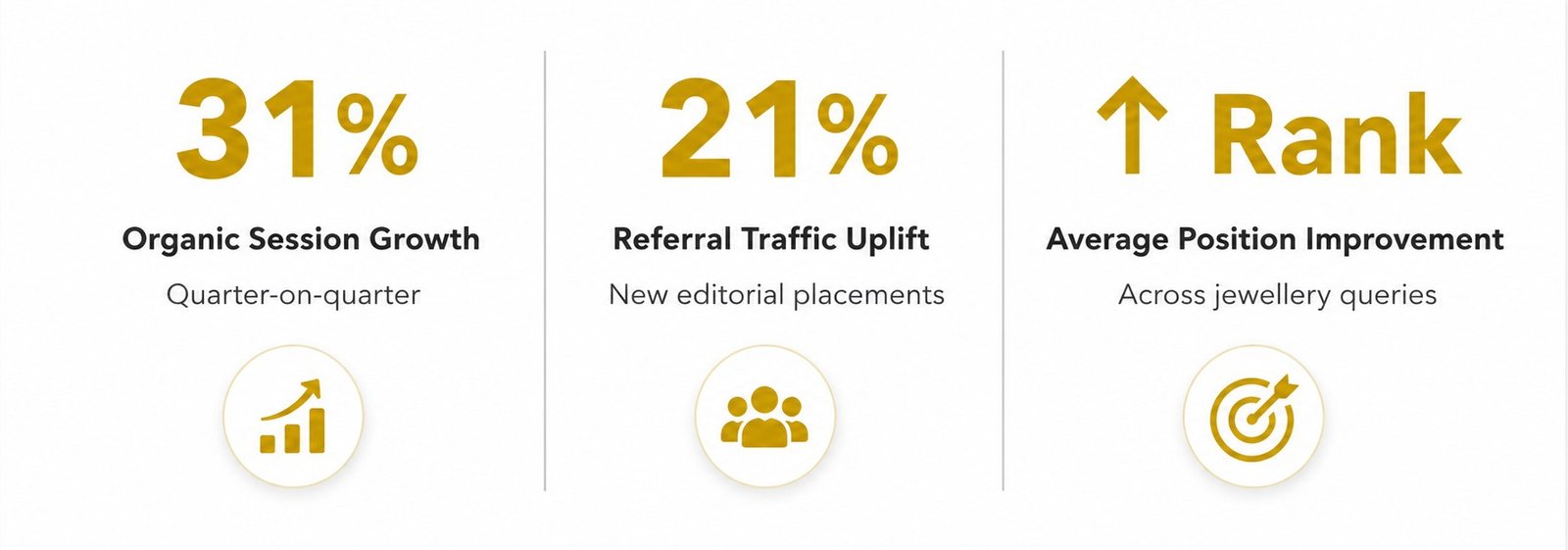
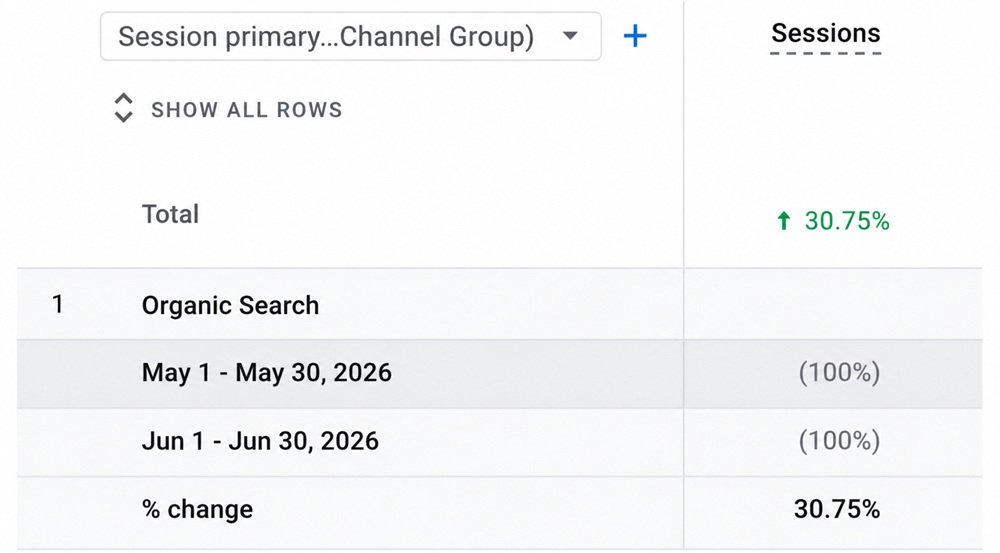
► Organic search sessions grew by 30.75% quarter-on-quarter from 4,820 monthly average sessions to 6,310. For a domain fourteen months old competing against DR 60+ incumbents, a 30.75% organic session lift within a single quarter of off-page work represents a genuine structural shift, not a seasonal fluctuation.
Referral Traffic
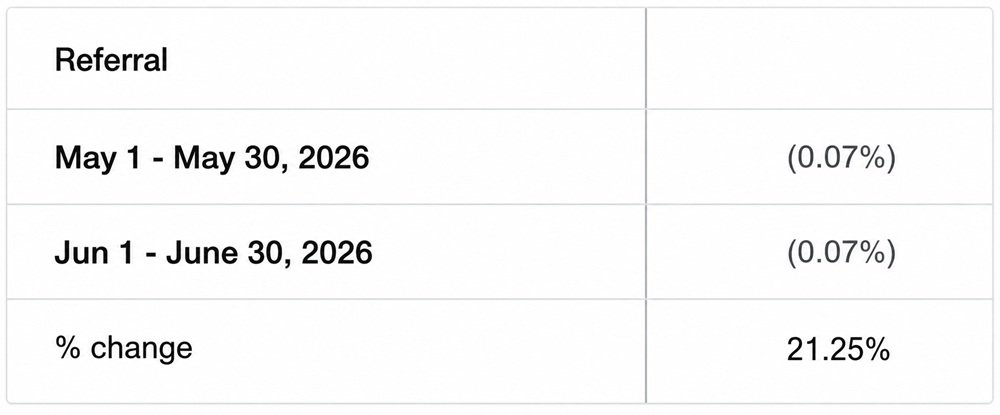
► Referral traffic grew by 21% quarter-on-quarter, directly attributable to the editorial placements executed across the campaign. The highest-performing referral sources were fashion and lifestyle platforms covering festive gift guides consistent with the visual-intent placement strategy.
► Three editorial placements individually drove more than 200 referral sessions each during the quarter, with one gifting guide feature generating 340 direct clicks to the LumièreJewels product pages in a single week.
► Average referral session duration: 2 minutes 48 seconds significantly higher than the average for paid social traffic (58 seconds), indicating that readers arriving from editorial content were arriving with higher purchase intent and spending meaningful time on product pages.
Average Position Improvement
► Average position across the tracked keyword set improved from 54.2 to 38.7 over the quarter a 15.5-position average improvement. While most of these terms are still outside the first page, the directional trend is consistent and measurable across the full set, not driven by outlier terms.
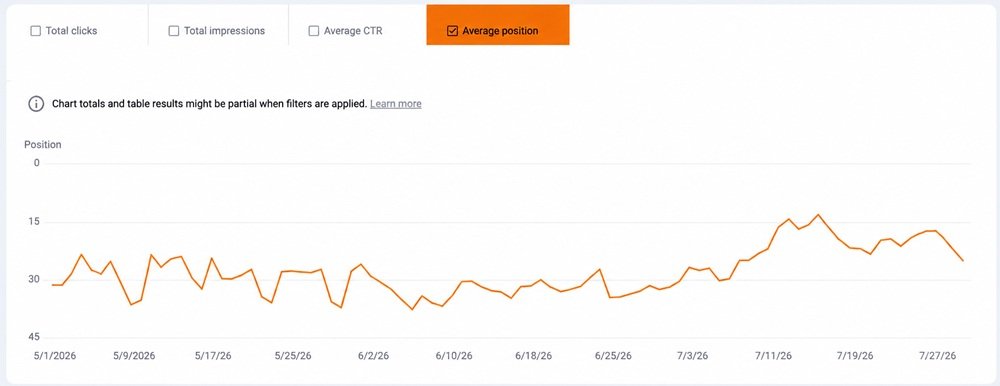
► For the brand’s highest-priority commercial terms ‘personalized gold jewellery India,’ ‘minimal gold earrings,’ ‘custom name necklace gold’ average position moved from the 40s into the 20s during the quarter. At the current trajectory, first-page presence for these terms is projected within two additional quarters of consistent off-page work.
► Brand search volume (direct searches for ‘LumièreJewels’) increased by 34% during the quarter, consistent with the brand awareness spillover effect from editorial placements reaching new audiences.
CONCLUSION
The jewellery category punishes new entrants who try to shortcut authority. Buying links from directories, publishing thin content at volume, targeting low-competition keywords that don’t connect to purchase intent these approaches produce modest early movement and then stall, because they don’t address the underlying signal Google needs to trust a new domain with high-intent queries.
What worked for LumièreJewels was a Jewellery Seo strategy that respected how jewellery buyers actually make decisions through inspiration content, editorial recommendations, and brand discovery before they arrive at a transactional search. Getting the brand into those spaces didn’t just build backlinks. It built the associative authority that makes Google willing to surface a fourteen-month-old domain alongside competitors that have been earning trust for a decade.
A 30.75% organic session increase, 21% referral traffic lift, and consistent average position improvement all within one quarter, without a single paid search rupee is what a well-executed off-page strategy looks like when it’s built for the category rather than applied from a generic template.
Your Brand Has a Story. Let’s Make Sure Google Knows It.
If your jewellery brand has strong products, real design differentiation, and a website that isn’t ranking anywhere near where it should be the gap is almost always an authority problem, not a content problem. Arihant Global builds off-page strategies for premium D2C brands that need to compete in difficult SERPs without the legacy head start. No shortcuts. No bulk link packages. Just a placement SEO strategy built specifically around how your buyers discover, research, and decide.
Disclaimer
This case study is for informational purposes only. Client identity has been anonymized, and results are based on a specific SEO campaign. Performance may vary depending on industry, competition, website quality, and implementation. Arihant Global does not guarantee identical results, rankings, traffic growth, or business outcomes for every client engagement.

How Local SEO Services Helped a Jaipur Home Decor Brand Increase Organic Leads by 218%
 A mid-sized home decor and interior furnishings brand based in Jaipur seven years in business, showroom presence across two Rajasthan cities, known locally for handcrafted wooden furniture and customized modular solutions came to Arihant Global in late 2024 with a problem that's more common than most business owners admit - their website existed, but it wasn't doing any real work for them. Organic traffic had flatlined for eleven consecutive months. The brand was invisible for every city-level interior design and home decor search that actually drove enquiries. Their paid campaigns were generating leads at ₹2,200 per conversion a cost that made digital advertising feel like a leaking bucket rather than a growth engine. Over six months, Arihant Global rebuilt their organic presence from the ground up: technical audit and fix, city-first content architecture, structured local SEO Services, and schema Markup implementation. The results were measurable and consistent.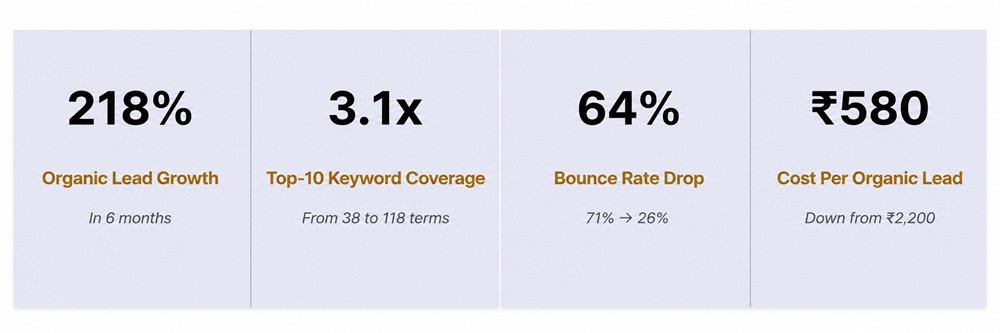
BACKGROUND & CONTEXT
The client referred to here as Home Craft Rajasthan to preserve their confidentiality operates two showrooms, one in Jaipur's Civil Lines area and one in Jodhpur. Their product range covers solid wood furniture, modular kitchens, wardrobes, and custom living room setups. They serve both residential clients and small commercial projects like boutique hotels and Airbnb properties a category that had been growing fast in Rajasthan since 2022.

Annual revenue sat between ₹2.8 and ₹3.4 crore depending on the season, with the October February window (wedding and festive season, tourist property refurbs) accounting for nearly 60% of the year's business. The founder had built the business almost entirely on referrals, local word-of-mouth, and JustDial listings. Digital marketing had been handled by a freelancer who posted on Instagram twice a week and occasionally ran Facebook ads. No SEO work had ever been done.

By mid-2024, the referral pipeline was slowing. A competitor from Gurugram had opened a franchise outlet in Jaipur's Mansarovar area, offering cheaper imported furniture with aggressive Google ad presence. The founder noticed her showroom foot traffic was dropping in the very season it should have been climbing. That's when she reached out to Arihant Global.
CHALLENGES
The audit revealed four interconnected problems none of them complicated in isolation, but collectively preventing any organic growth from happening.
| 01 |
Zero city-level search visibility

The website had no pages targeting Jaipur or Jodhpur specifically. Every page was written in generic terms 'buy wooden furniture online,' 'modular kitchen designs' with no geographic anchor. For a business that served a 150-km radius and needed walk-in or enquiry-based leads, this was the single biggest failure. Customers searching 'furniture shop in Jaipur' or 'interior designer near me Jodhpur' never found them.
|
02
|
Thin, search-engine-invisible content

The website had eleven pages total. The homepage had 180 words of content. Product category pages were essentially image galleries with a paragraph of text copied from a furniture wholesaler's brochure. Google had nothing to crawl, evaluate, or rank. The site had been indexed, but had no meaningful presence in any search result beyond the brand's own name.
|
03
|
Technical issues blocking crawl and indexation

A crawl audit identified 23 broken internal links, three duplicate versions of the homepage (www vs non-www, HTTP vs HTTPS all resolving without redirects), missing meta titles on 8 of 11 pages, and page load times of 7.2 seconds on mobile. Core Web Vitals scores were in the 'Poor' range across all three metrics. Google was aware the site existed it just had no reason to show it to anyone.
|
04
|
No local SEO foundation

The Google Business Profile had been claimed but never optimised no service categories beyond 'furniture store,' no photos beyond two showroom exteriors from 2021, no Q&A responses, and review count had stalled at fourteen with an average of 3.9 stars. For a business selling ₹80,000–₹4 lakh custom solutions, the GBP was the first thing prospective clients checked before calling. It wasn't making the case.
|
APPROACH & STRATEGY
The strategy was built around a single commercial reality: Home Craft’s customers make high-consideration purchases. Nobody buys a ₹1.8 lakh modular kitchen after seeing one Instagram post. They search, compare, visit showrooms, search again, and then call. The job of Local SEO here was to be present and credible at every point in that decision journey city search, category search, comparison search, and ‘near me’ intent.
Work was sequenced across three phases:
PHASE 1 Months 1–2
|
Technical Foundation & Quick Wins

Fixed all 23 broken links. Implemented 301 redirects consolidating www/non-www and HTTP/HTTPS. Compressed and converted all product images to WebP format average page size dropped from 4.1MB to 890KB. Mobile page speed improved from 7.2s to 2.1s load time. Added meta titles and descriptions to all pages, written for search intent rather than brand voice. Fixed canonical tags. Submitted corrected sitemap to Google Search Console and triggered re-crawl.
|
PHASE 2 Months 2–4
|
City-First Content Architecture

Built dedicated landing pages for Jaipur and Jodhpur targeting high-intent local searches. Each city page was structured around the real questions buyers ask 'how much does modular kitchen cost in Jaipur,' 'best wooden furniture near Civil Lines,' 'interior designer for Airbnb property Rajasthan.' Within each city page, service cluster pages were created for the four core categories: modular kitchens, wardrobes, living room furniture, and commercial/hospitality projects. Internal linking connected city pages to service clusters and back, creating a coherent topical structure Google could evaluate.
|
PHASE 3 Months 4–6
|
Local SEO & Authority Building

Rebuilt the Google Business Profile from scratch: updated primary and secondary categories, added 47 photos across showroom, product, and team categories, wrote detailed service descriptions with location context, responded to all existing reviews, and set up a systematic review request process via WhatsApp post-consultation. Published eight long-form blog posts targeting buyer-education queries: furniture material comparisons, maintenance guides, design planning checklists. Each piece linked internally to commercial service pages and cited the Jaipur and Jodhpur showrooms contextually.
|
RESULTS
Measurable improvements appeared from month three. By month six end of April 2025, just as the pre-monsoon slowdown was beginning the data showed a sustained, structural change in the website’s organic performance, not a temporary spike.
Organic Traffic & Lead Generation
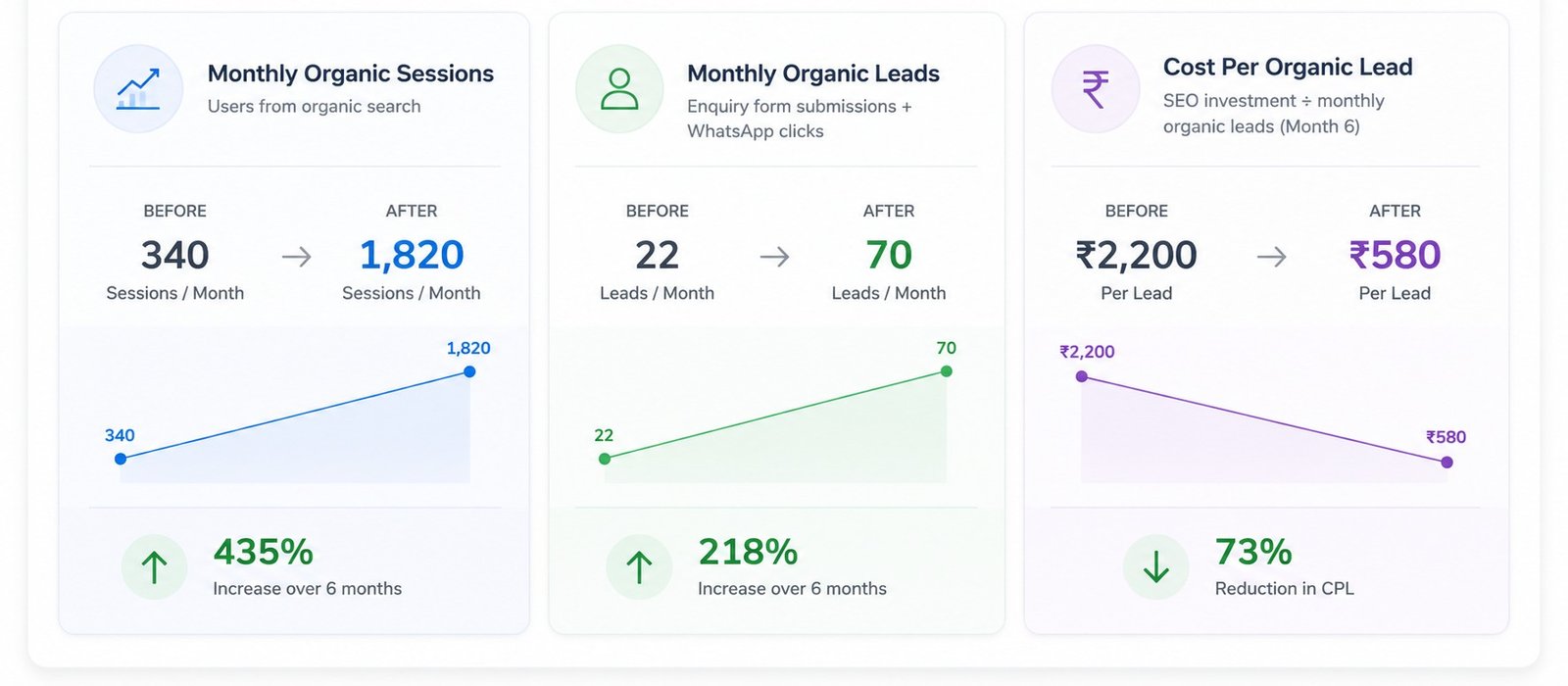
► Monthly organic sessions grew from 340 to 1,820 a 435% increase over the six-month period.
► Organic leads (enquiry form submissions + WhatsApp clicks from organic landing pages) increased from 22 per month to 70 per month a 218% improvement.
► Cost per organic lead fell from ₹2,200 (blended digital average including paid) to an effective ₹580 when SEO investment was divided by monthly organic leads at month six.
Search Visibility
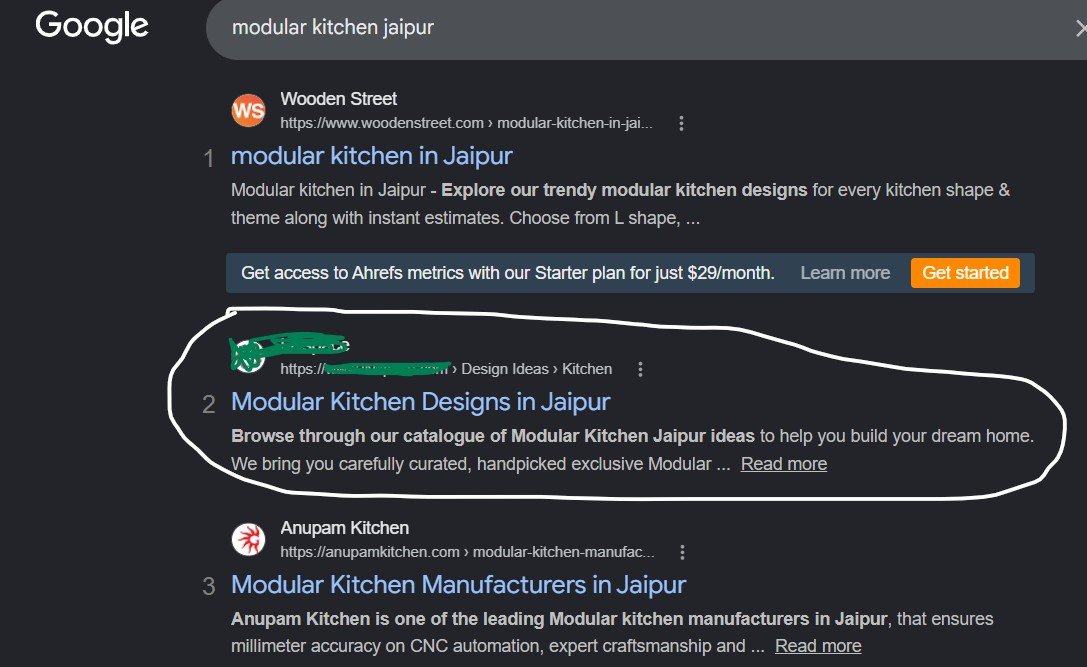
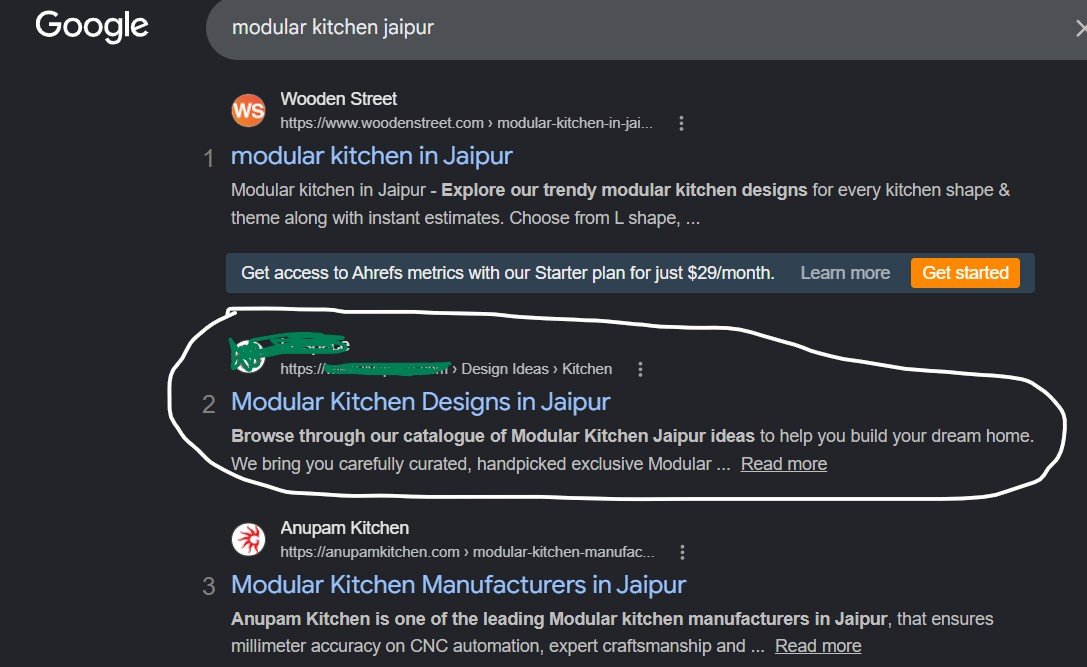
► Top-10 keyword rankings grew from 38 tracked terms to 118 a 3.1x increase. The majority of new rankings were city-intent queries: ‘modular kitchen Jaipur,’ ‘wooden furniture Jodhpur,’ ‘interior designer Civil Lines.’
Technical & UX Metrics
► Bounce rate dropped from 71% to 26% indicating that visitors arriving from organic search were finding content relevant enough to stay and explore.
► Average session duration increased from 48 seconds to 2 minutes 34 seconds.
► Core Web Vitals: all three metrics (LCP, INP, CLS) moved from ‘Poor’ to ‘Good’ status on both desktop and mobile.
Local SEO & Google Business Profile
► Google Business Profile views grew from 210 to 1,840 per month for the Jaipur listing and from 90 to 640 per month for Jodhpur.
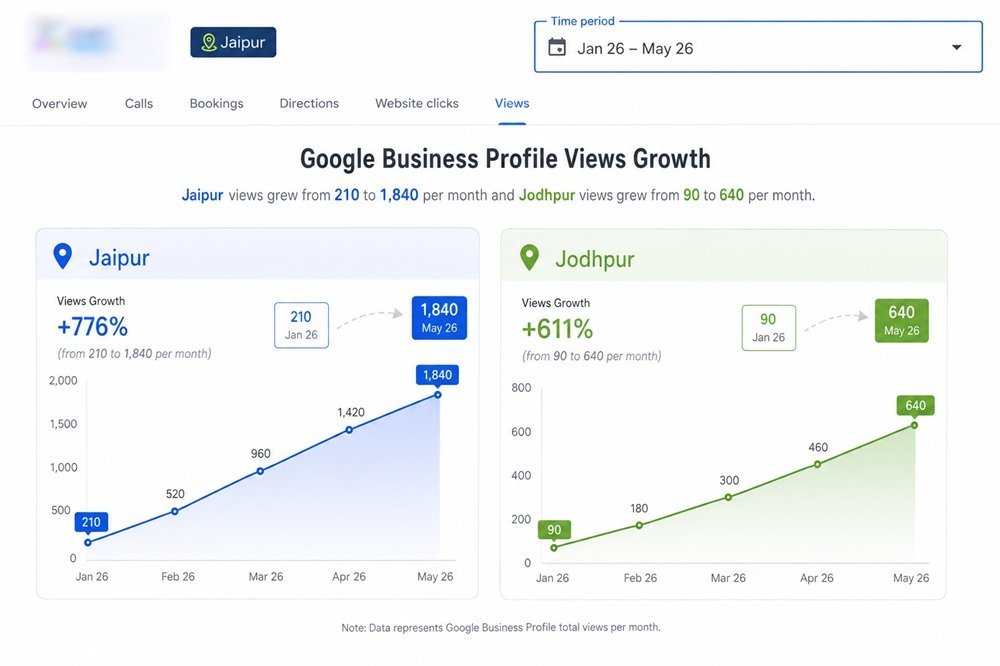
► Direction requests (a strong indicator of showroom visit intent) increased 3.4x for Jaipur and 2.8x for Jodhpur.
► Review count grew from 14 to 61 reviews over the period, with average rating improving from 3.9 to 4.6 stars driven by the systematic post-consultation review process.
CONCLUSION
Home Craft’s story is not unusual it’s the norm for Indian home decor and interior businesses that have built real commercial capability but never built a digital presence to match. The referral model works until it doesn’t. A competitor with a Google ad budget and a properly structured website can outrun seven years of word-of-mouth reputation in a single season.
What changed here wasn’t a single tactic or a clever campaign. It was the systematic removal of every reason Google had to ignore the website followed by giving it something genuinely useful to surface: real information, for real buyers, in the cities where they were actually searching. The ₹580 cost per lead at month six isn’t a campaign result. It’s what happens when organic search infrastructure is built correctly and given time to compound.
Is Your Website Doing Any Real Work for Your Business?
If your organic traffic has flatlined, your cost per lead is too high, or your competitors are ranking for searches that should be yours that’s a solvable problem. Start with a free SEO audit from Arihant Global. No pitch deck. No generic recommendations. Just an honest read of what’s broken and what it would take to fix it.
Disclaimer
This case study is based on a real client project completed by Arihant Global. Certain business details may be anonymized to protect client confidentiality. Results reflect the specific campaign, market conditions, and business objectives. Individual outcomes may vary depending on industry, competition, implementation, and other external factors.

How a D2C Fashion Brand Increased Product Visibility with Ecommerce SEO Strategy
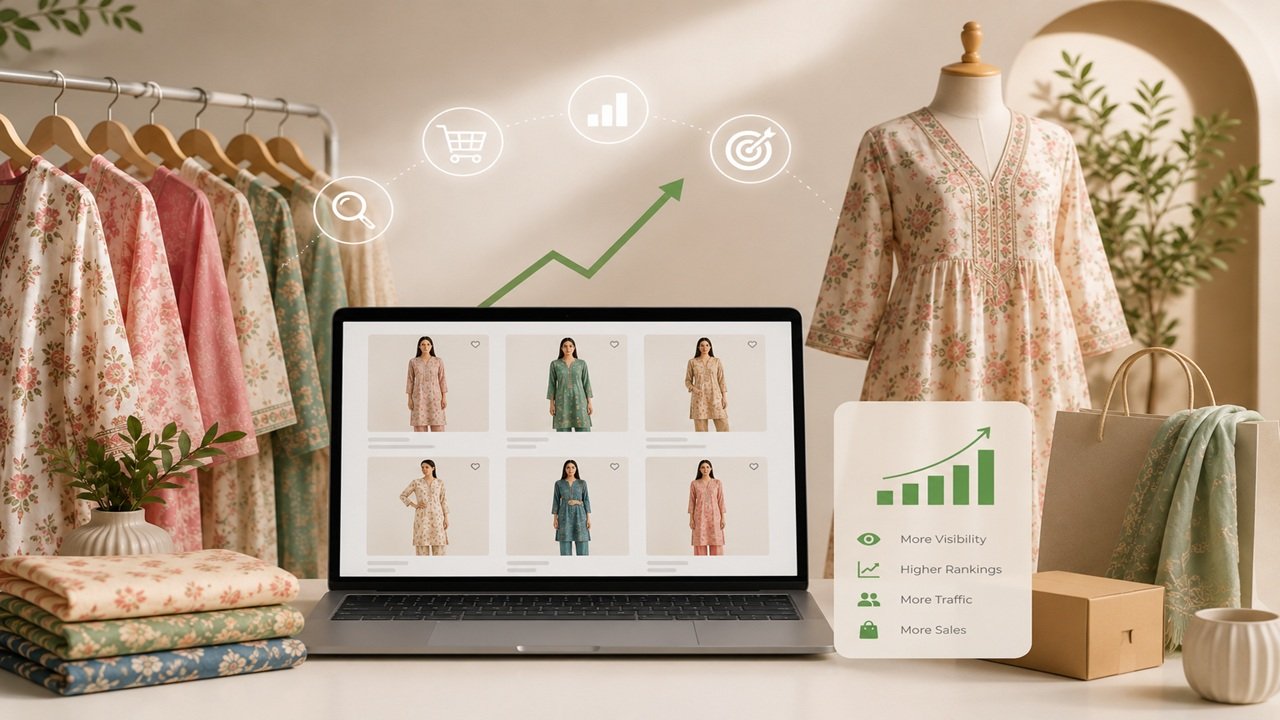
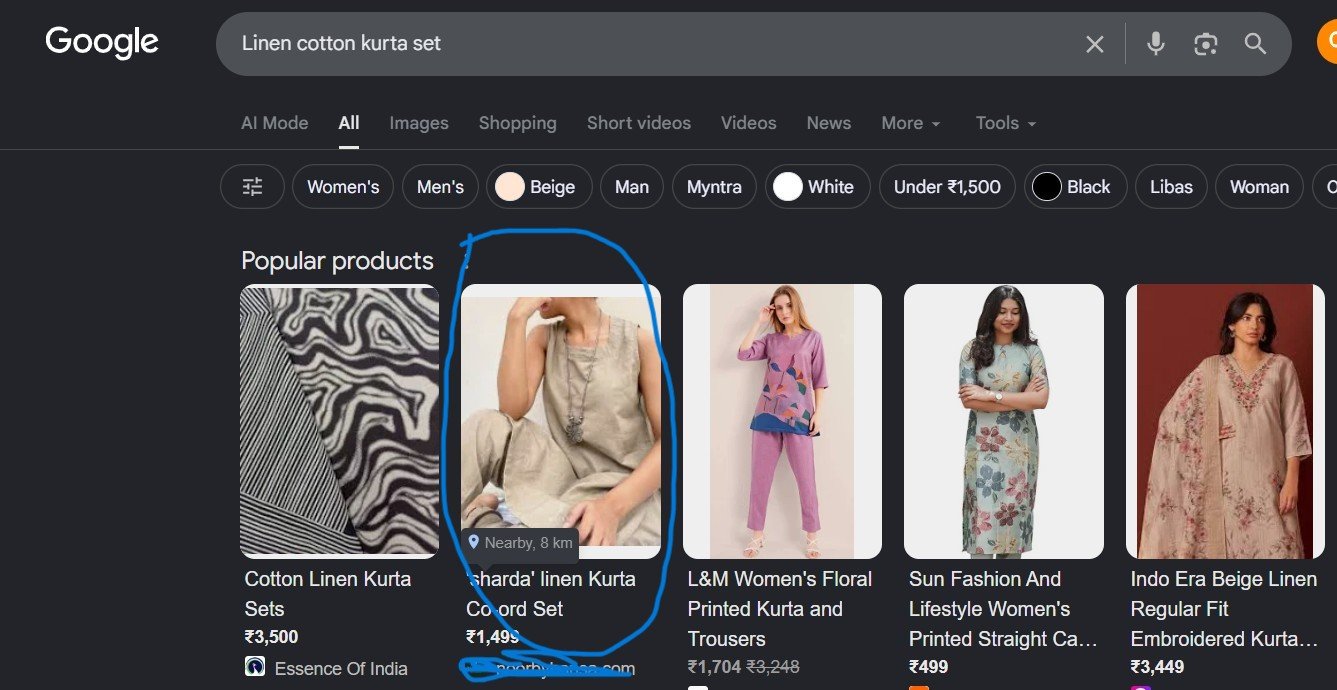
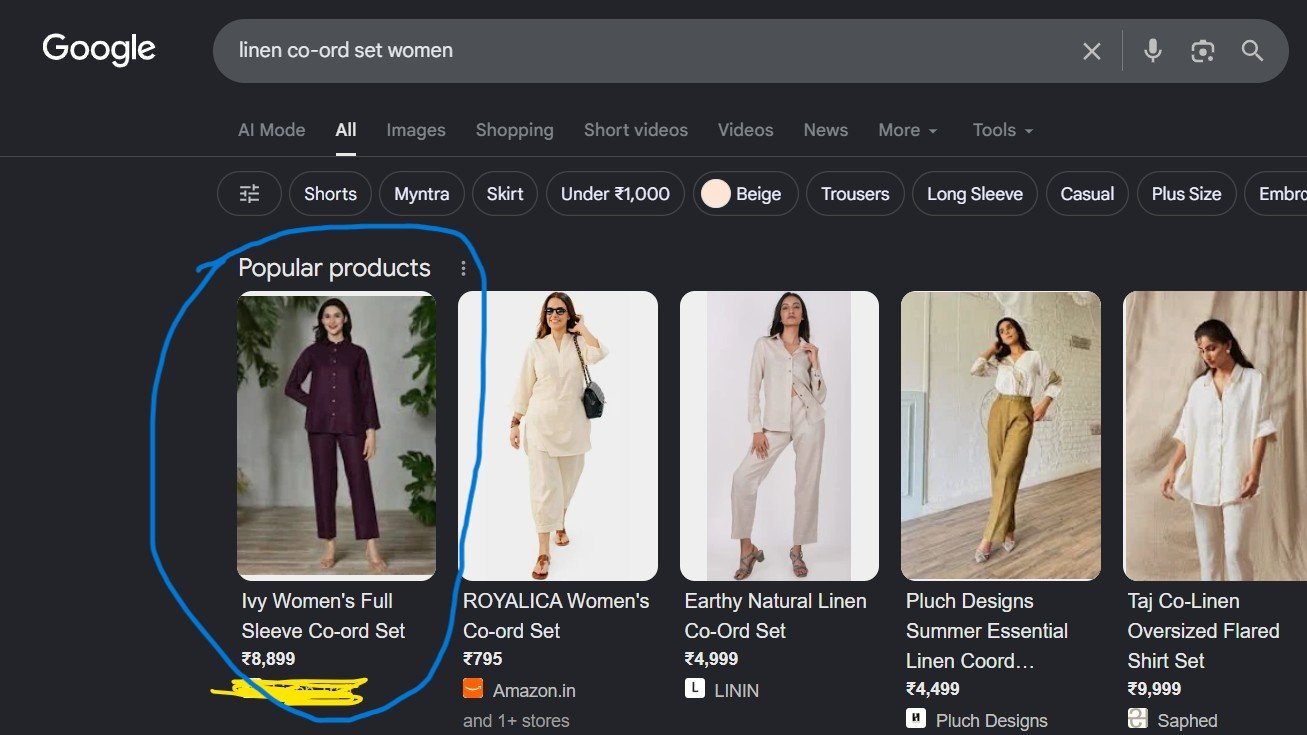
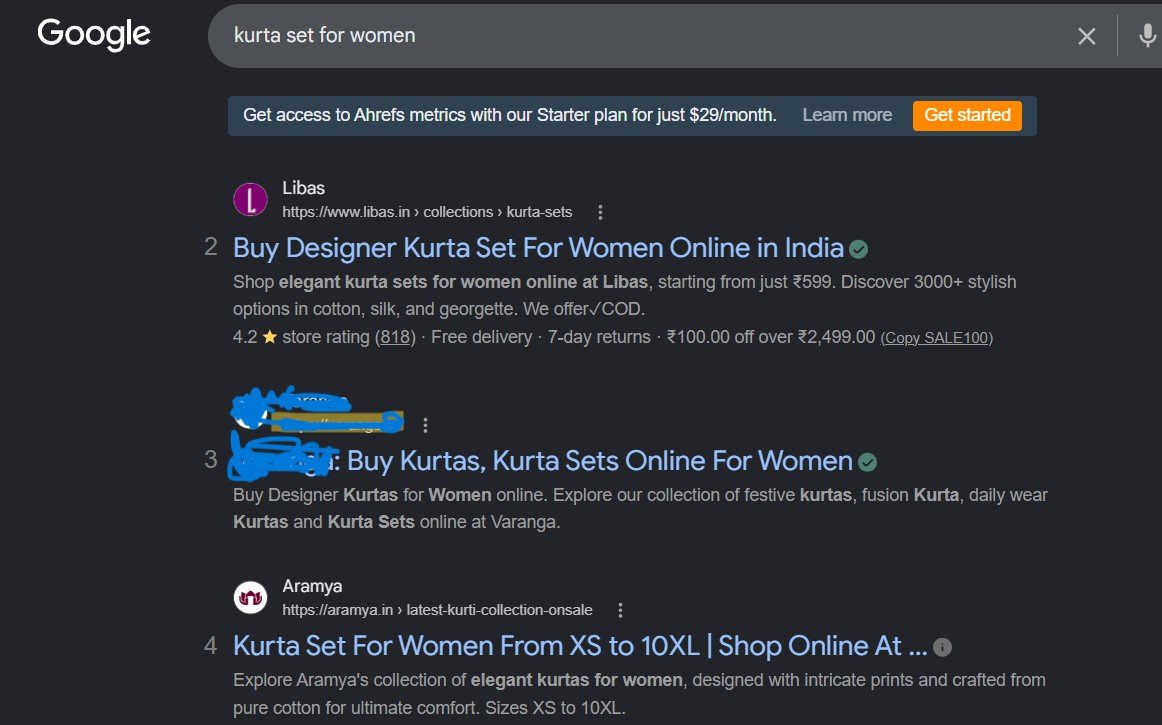
A D2C fashion label reached out after noticing something odd in their analytics. Their branded searches were healthy, people knew the name, but almost nobody was finding their actual products when searching for things like "linen co-ord set" or "block print maxi dress." Amazon and Myntra listings for nearly identical products were outranking their own website, for their own designs.
Background & Context
- Client:
- Sector: Fashion & Apparel (D2C, Women’s Contemporary Wear)
- Engagement: 7 months
- Service: E-commerce SEO (Fashion)
The brand had been running for about four years, sold primarily through its own website with a smaller presence on two marketplaces, and had built a loyal repeat-customer base mostly through Instagram. Revenue was steady but almost entirely dependent on people who already knew the brand name, either from social media or word of mouth.
The problem showed up clearly once we pulled search data. For category terms, the kind of searches someone runs when they don’t have a specific brand in mind yet, the website barely appeared. Meanwhile their own products, listed on marketplaces by the brand itself, were ranking well for those exact terms. They were essentially helping Amazon outrank their own site for their own designs.
Ecommerce SEO Challenges
Product pages were the core issue. Titles were things like “Product 4521” or a stylized name with no descriptive text, which meant Google had almost nothing to match against an actual search query. Descriptions, where they existed, were short marketing copy written for someone already on the page, not for someone trying to find the page in the first place.
Category pages had similar problems, thin content, no real structure around the way people actually search for fashion, by fabric, occasion, silhouette, season. A search for “cotton kurta for office wear” had no page on the site built to answer it, even though they had dozens of products that fit.
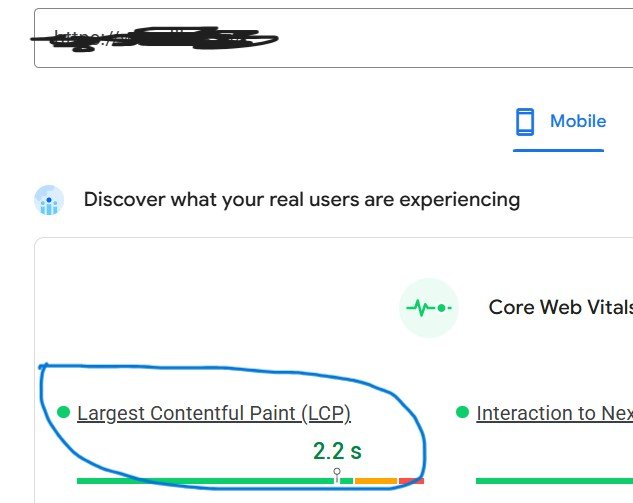
There was also a technical issue nobody had caught: their product images, which were genuinely well shot, weren’t optimized at all, some running past 2MB each, which was dragging page speed down badly on mobile, where most of their shoppers actually were. And with a catalog that changed seasonally, older product URLs were going dead every few months without redirects, quietly losing whatever ranking they’d built up.
Ecommerce SEO Approach, Strategy & Solution
We rewrote product page SEO titles and descriptions around how people actually search, fabric, fit, occasion, styling context, without losing the brand’s voice in the process. This took longer than expected since we worked page by page with their content team rather than templating everything, but it meant the copy still sounded like the brand and not like it had been optimized by a machine.
Category pages got rebuilt around real search intent instead of just internal catalog categories. Instead of only “Dresses” and “Tops,” we built pages like “Cotton Co-ord Sets” and “Wedding Guest Ethnic Wear,” each with enough real content to actually rank, alongside the products themselves.
We compressed and properly tagged every product image, fixed the redirect chain so seasonal product turnover stopped bleeding ranking value, and cleaned up a decent backlog of broken internal links that had built up over a few catalog migrations.
On the authority side, Arihant global ran outreach toward fashion and lifestyle publications for gift guides and seasonal roundups, the kind of feature that doesn’t just bring a backlink but occasionally sends a real spike of relevant traffic on its own.
Results
Seven months, spanning two seasonal collection launches. Movement was slow through the first two months while new pages got indexed and reworked content settled into rankings, then picked up noticeably from month three onward.
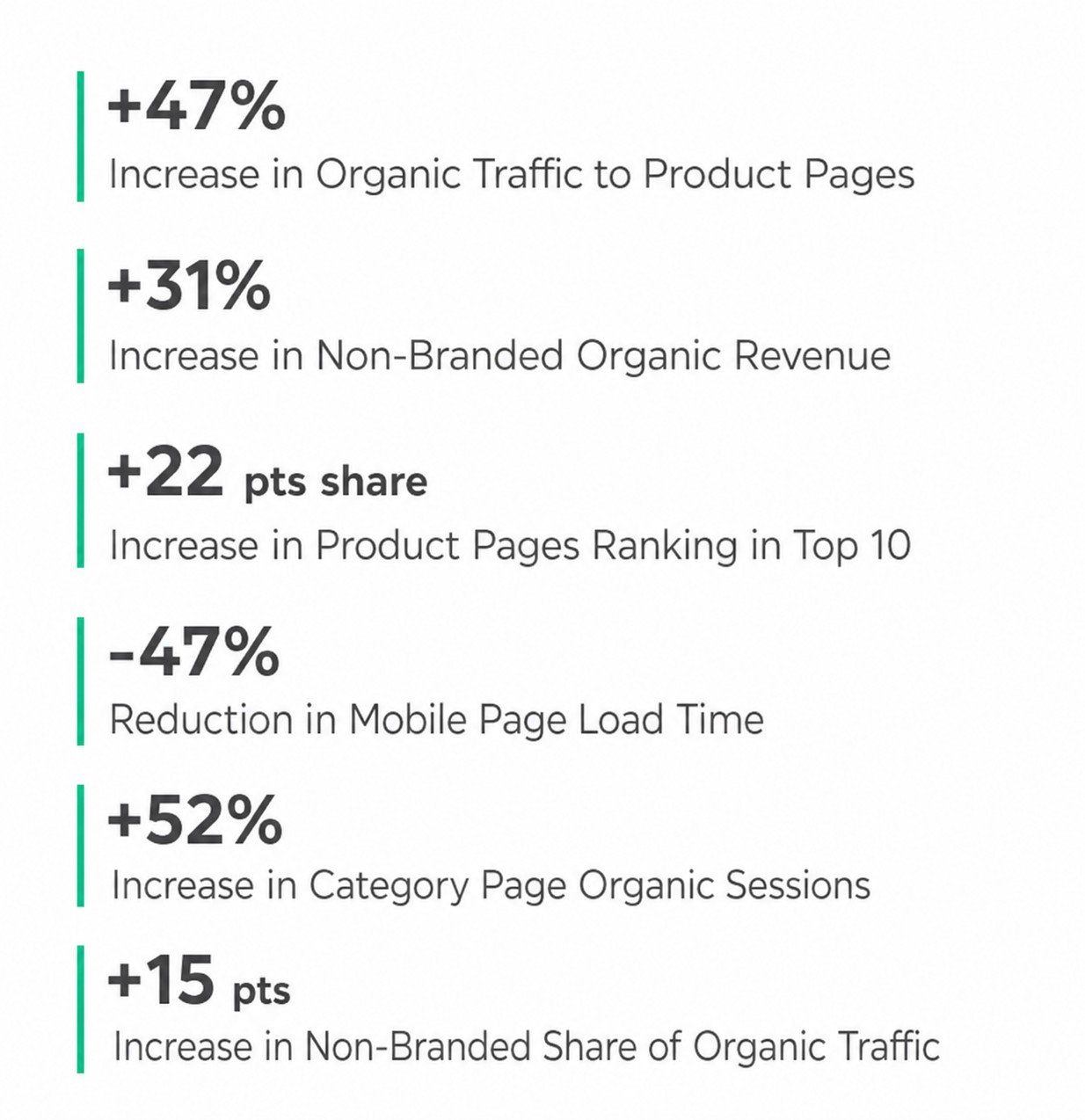
Somewhere around month five, their founder mentioned that a customer had messaged asking where they’d “found this exact dress on Google,” unprompted, just noting it as a nice surprise. Small thing, but it was the first real sign the site itself had become a discovery channel instead of just a place existing customers checked out on.
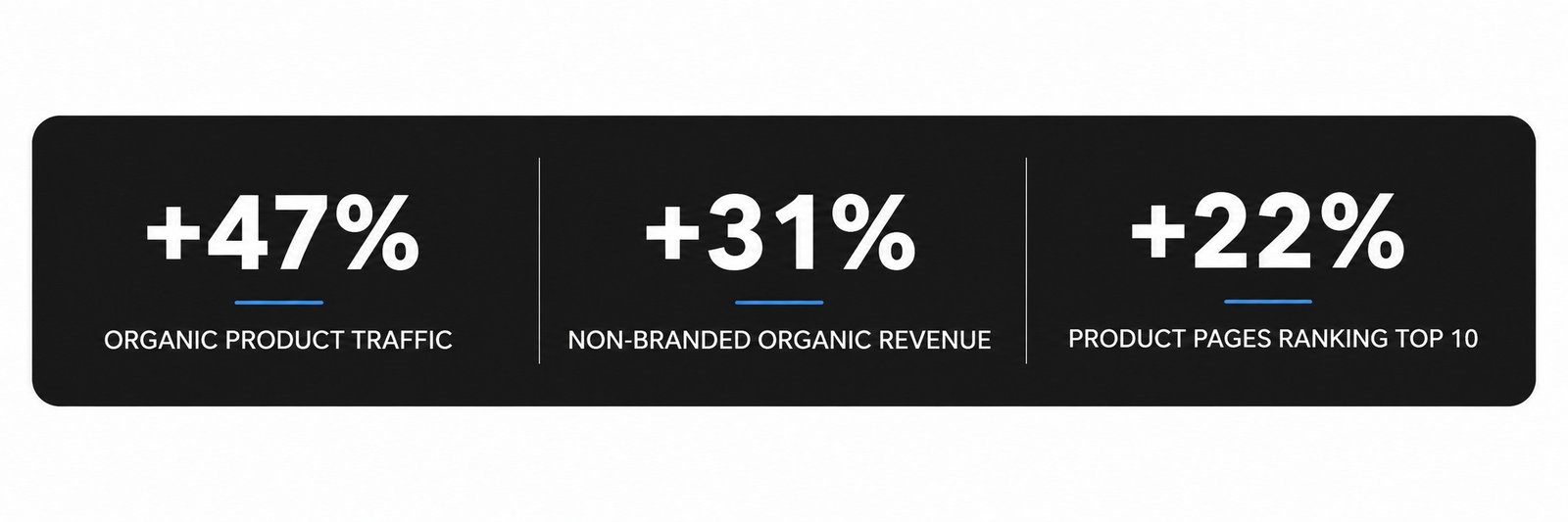
Product Page Ranking in Top 10
Mobile Page Loading Time Reduced
Ranked in Google’s Top 3 Search Results
Conclusion
The brand’s products were genuinely good, and they had real photography and real design work behind them. None of that mattered if Google couldn’t understand what was on the page well enough to show it to someone searching for it. Most of the fix wasn’t clever, it was just giving every page enough real, specific information to actually compete for the searches that mattered.
Curious What This Would Look Like for Your Brand?
Arihant Global will audit your current product and category pages for free, no changes made, just an honest look at what’s stopping Google from finding what you already sell.
Ask us for a free fashion Ecommerce SEO audit.
D2C Digital marketing : How a Jaipur Skincare Brand Scaled Profitably Without Burning Budget
There are two ways a D2C brand in India can grow on Meta Ads. The first is to spend more. The second is to spend smarter. Most brands try the first and never discover the second. This is the story of one that did.
The Client
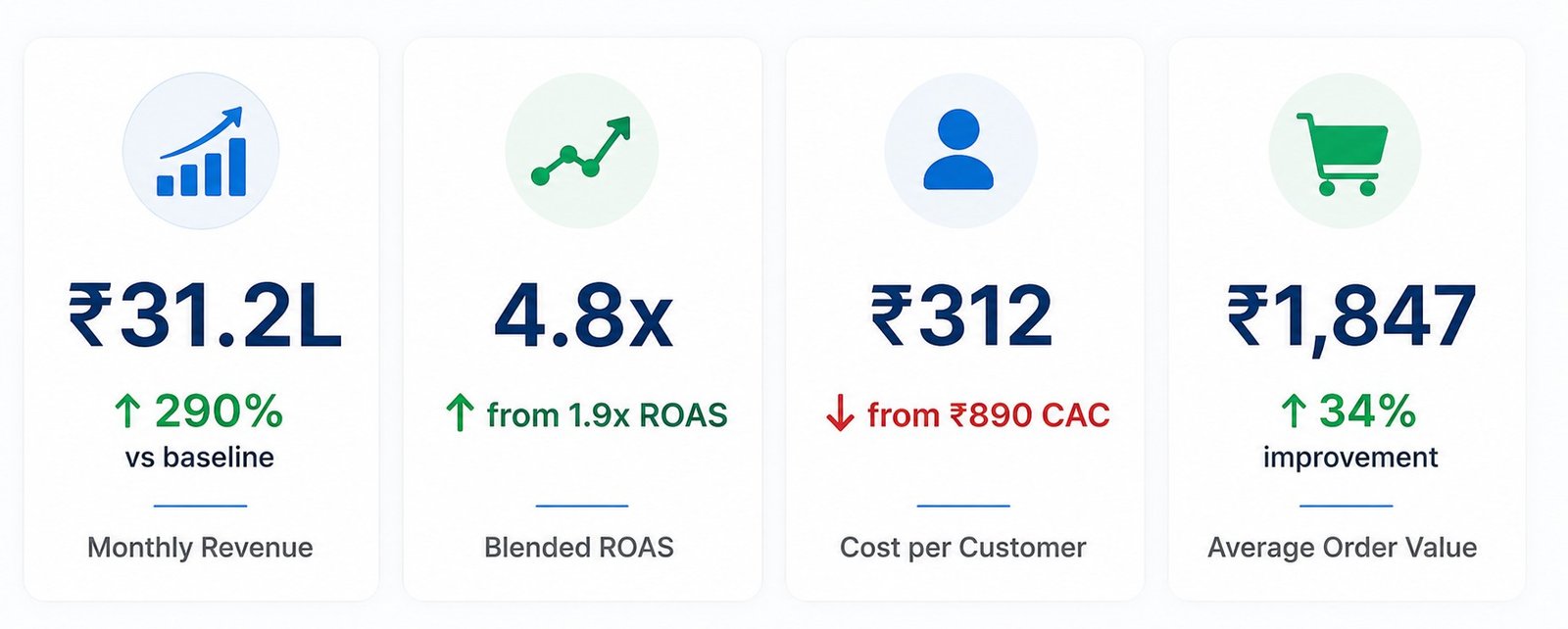
A Jaipur-based D2C skincare brand two founders, four hero products, Shopify store had been selling primarily through Instagram organically and occasional Meta Ads campaigns run in-house. Monthly revenue was sitting between ₹7–9 lakh consistently. Good enough to feel like momentum. Not enough to actually build a business. They came to Arihant Global in October 2024 with one clear ask: scale revenue without the ROAS collapsing. They had tried increasing budget before. Every time spend went up, ROAS went down. They had no idea why.
The Problem
What the audit found
The technical and account audit took four days. What it revealed was a pattern we see constantly in D2C brands that have grown organically and then tried to bolt paid advertising onto their existing setup.
1. One campaign, one ad set, broad audience India Meta's algorithm had no structure to optimize within

2. No Meta Pixel events firing correctly

3. No Conversions API (CAPI) configured

4. Landing page LCP of 6.2 seconds on mobile

5. No retargeting campaigns running

6. Creative: one static image used across all placements
Root cause

Revenue was stuck not because the product was wrong or the audience was wrong. It was stuck because the tracking was broken, the creative was mismatched to placement, and warm audiences the highest-converting segment in any D2C account were being ignored entirely.
|
What Arihant Global Did
Month 1 Foundation
Week one was entirely technical. Meta Pixel reinstalled from scratch with correct event mapping. Conversions API configured via Shopify's native API integration. GA4 purchase events cross-referenced against Meta Ads Manager data to establish a true attribution baseline. Shopify store speed audit completed images compressed to WebP, Shopify theme unnecessary apps removed, LCP brought from 6.2s to 2.1s on mobile.
Month 2 Campaign Architecture Rebuild
The single campaign was replaced with a three-layer account structure. Top of funnel: broad interest and lookalike audiences targeting women aged 22-38 in Tier 1 and Tier 2 Indian cities with 15-second Reels showing the product in use. Middle of funnel: video view remarketing (people who watched 50%+ of the Reels) with carousel ads showing before/after user-generated content and ingredient benefits. Bottom of funnel: website visitor and Add to Cart abandoner retargeting with a direct-response offer ad and urgency copy.
Month 3–6 Scaling and Creative Testing
Creative testing ran on a two-week cycle. Each cycle tested one variable: hook (first 3 seconds), offer framing, or social proof format. Winning creatives were scaled. Losers were killed within 72 hours. Advantage+ Shopping campaigns were introduced in Month 4 for the two best-performing products, running alongside the manual campaigns. Budget increased from ₹60,000/month to ₹1,85,000/month but only as ROAS justified each increase, never in advance of the data.
Results at Month 6
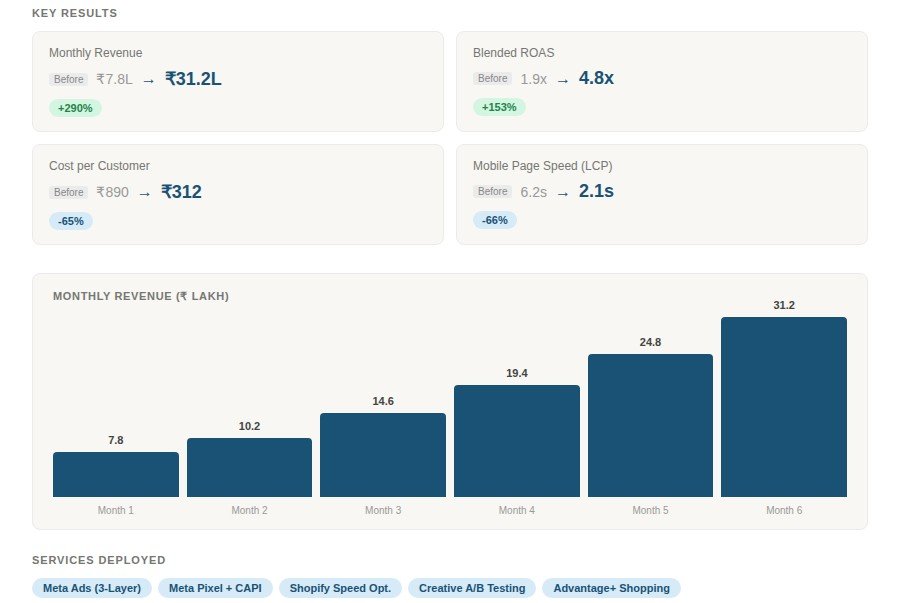
| What made the difference
Fixing attribution before increasing spend. Most D2C brands increase budget hoping for more revenue. This brand fixed what was broken first which meant every rupee that was already being spent immediately performed better, and every rupee of new spend entered a system that could actually optimize correctly. |
Conclusion
This case study highlights how the right strategy, accurate tracking, and continuous optimization can turn marketing spend into sustainable business growth. Instead of chasing short-term results, Arihant Global focuses on building scalable digital marketing systems that deliver measurable ROI. If you’re ready to increase qualified leads, improve conversions, and grow your business with confidence, connect with Arihant Global today and let’s build your next success story.
Results Disclaimer
These figures reflect a specific campaign under specific conditions including product category, seasonality, creative quality, and market dynamics. Individual results vary.

Cost Per Admission Reduced : How a Delhi Coaching Institute Filled 3 Batches in One Admission Season
 Education marketing in India has a specific rhythm: admission seasons, competitive deadlines, and a buyer (the student or parent) who is simultaneously emotional and highly rational. Getting the strategy wrong in a two-month admission window means empty classrooms for the next six months. This coaching institute could not afford another missed season.
The Client
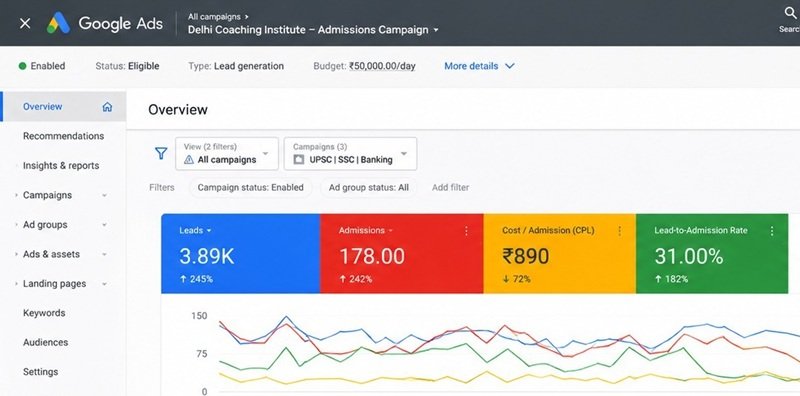
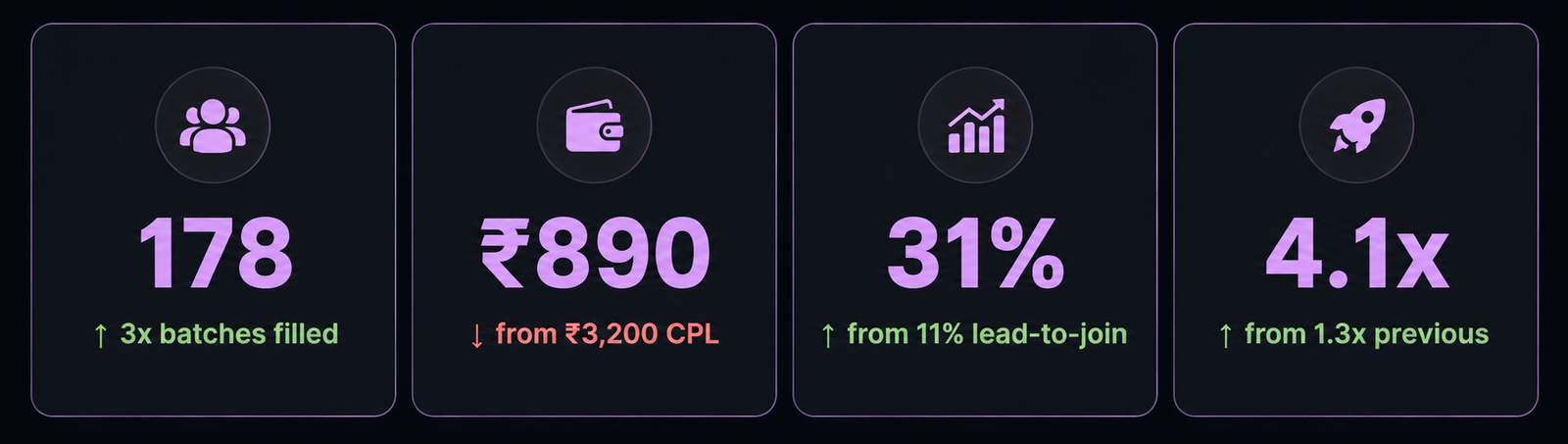
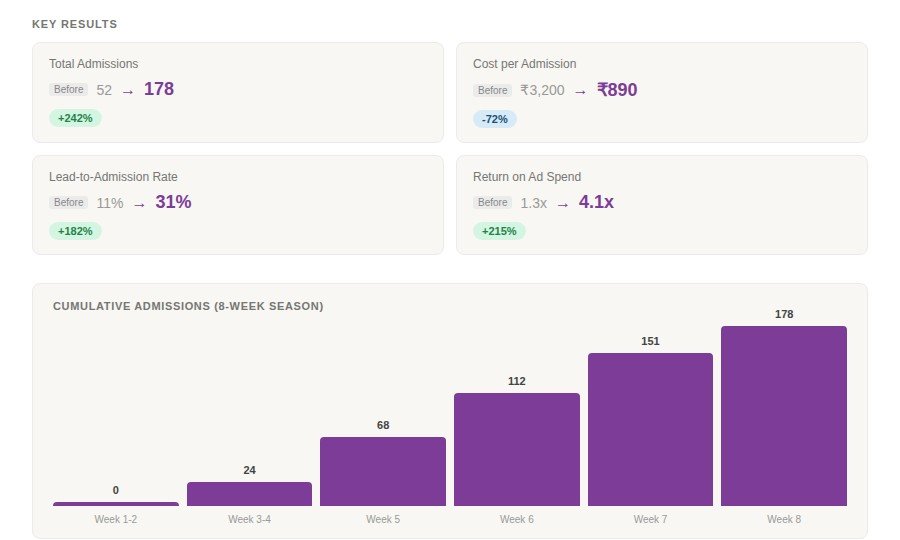
A Delhi-based coaching institute offering UPSC, SSC, and Banking exam preparation. Three batches running simultaneously. Batch size: 60 students per batch. Fee: ₹18,000–₹24,000 for a 6-month course. They had been running Facebook Lead Ads in-house for two admission cycles with a cost per admission averaging ₹3,200 meaning they were spending ₹5.76 lakh in ad costs to fill one batch of 60 students, at which point the economics were marginal.
They approached Arihant Global 8 weeks before the next admission season opened with a clear brief: fill all three batches, bring CPL under ₹1,200, and build a system that works beyond one season.
The Problem
1. Single creative used for all three courses
2. Geographic targeting too broad
3. No lead nurture post form-fill
4. No Google Search Ads
5. No SEO presence
6. zero Google Business Profile reviews
Time constraint reality

With 8 weeks to admission season, there was no time for SEO to build. The strategy had to produce results from paid channels immediately while building the organic foundation for the next cycle.
|
What Arihant Global Did
Week 1-2 Segmentation and Creative Rebuild
The single Google ads campaign was split into three separate campaigns one per course. Each had its own audience, creative, and landing page.
1. UPSC audience: graduates aged 22-28 in South and Central Delhi interested in civil services preparation and government jobs.

2. SSC audience: graduates aged 20-26 in East and North Delhi looking for combined graduate level exam coaching.

3. Banking audience: graduates aged 21-27 across Delhi NCR interested in IBPS, SBI PO, and banking careers.

4.  Creative rebuilt per course: UPSC ads used authority framing ('3 UPSC Selections from Our 2024 Batch Applications Open').
- SSC ads used urgency and social proof (‘Last 12 seats in SSC Tier 1 batch 840 students enrolled this year’).
- Banking ads used outcome framing (‘₹8–14 Lakh Starting Salary Our Banking Batch Has a 67% Selection Rate’).
Week 2-3 Google Search Ads and GBP
Google Search Ads launched targeting high-intent searches: 'UPSC coaching Delhi,' 'best SSC coaching Karol Bagh,' 'banking coaching institute Delhi fees.' Exact match and phrase match only. Geographic targeting set to pin codes within 8km of the institute with public transport connectivity. Google Business Profile fully optimized all services listed, 40 photos uploaded, Q&A section populated, and a review generation WhatsApp message sent to the last two batches of enrolled students.
Week 3-8 Nurture Automation
Every lead form submission triggered an immediate WhatsApp message (within 90 seconds, via automated integration) with the course brochure, a video from the institute director, and a direct booking link for a free demo class. Email follow-up sequence: Day 1 batch schedule, Day 3 success story, Day 5 fee structure and scholarship options, Day 8 final seat availability. Counsellor call was scheduled for Day 2 not Day 0 to allow the lead to warm through the automated sequence first.
Results One Admission Season (8 Weeks)
Conclusion
This admission season proved that sustainable growth doesn’t come from generating more leads—it comes from converting the right leads faster. By combining audience segmentation, high-intent Google Ads, WhatsApp automation, and a structured follow-up system, Arihant Global helped the institute reduce its cost per admission while filling three complete batches within a single admission cycle. The result was a scalable enrolment process that can be repeated every season.
If your coaching institute, college, or EdTech platform is struggling with rising acquisition costs or incomplete batches, Arihant Global can help. Book a free admission funnel audit and discover how to increase enrolments while lowering your cost per admission.
The speed advantage

The 90-second WhatsApp response was the single biggest conversion improvement. When we tested the automated response against the previous 4-6 hour counsellor call, the automated response produced a 2.8x higher demo class booking rate. In education, the first institute to respond credibly almost always wins the admission.
|
Disclaimer:
Education marketing results are highly seasonal and dependent on exam cycles, competition density, geographic catchment, and product (faculty quality, track record). These figures reflect a specific admission season campaign. Individual results vary.
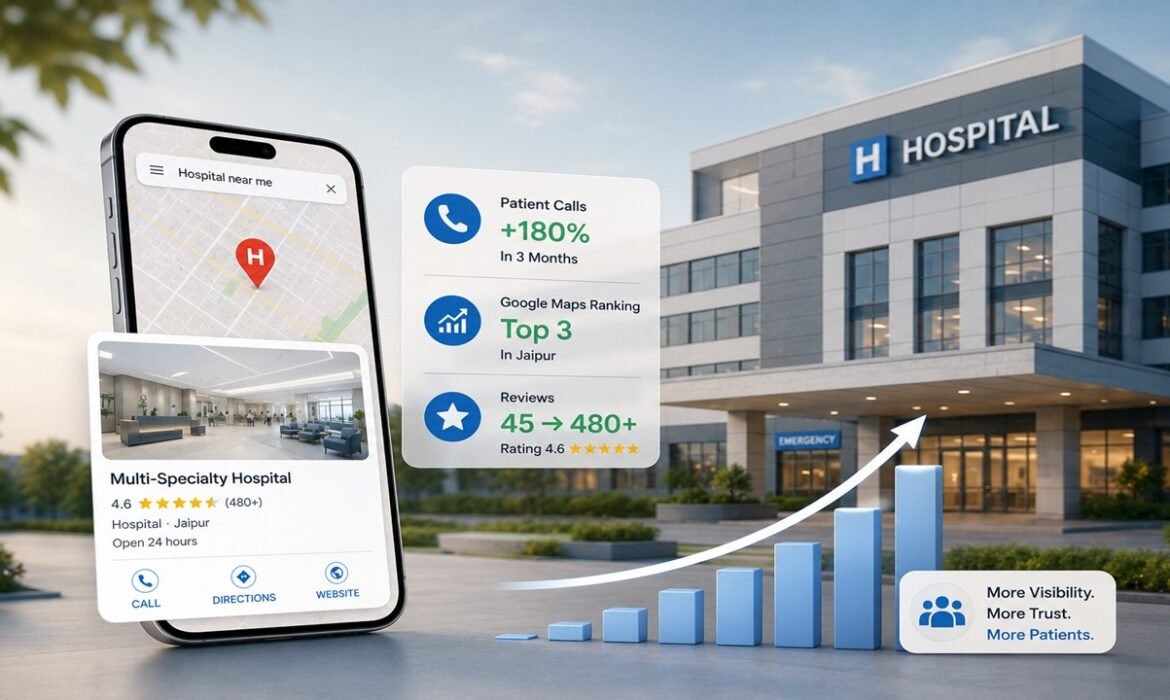
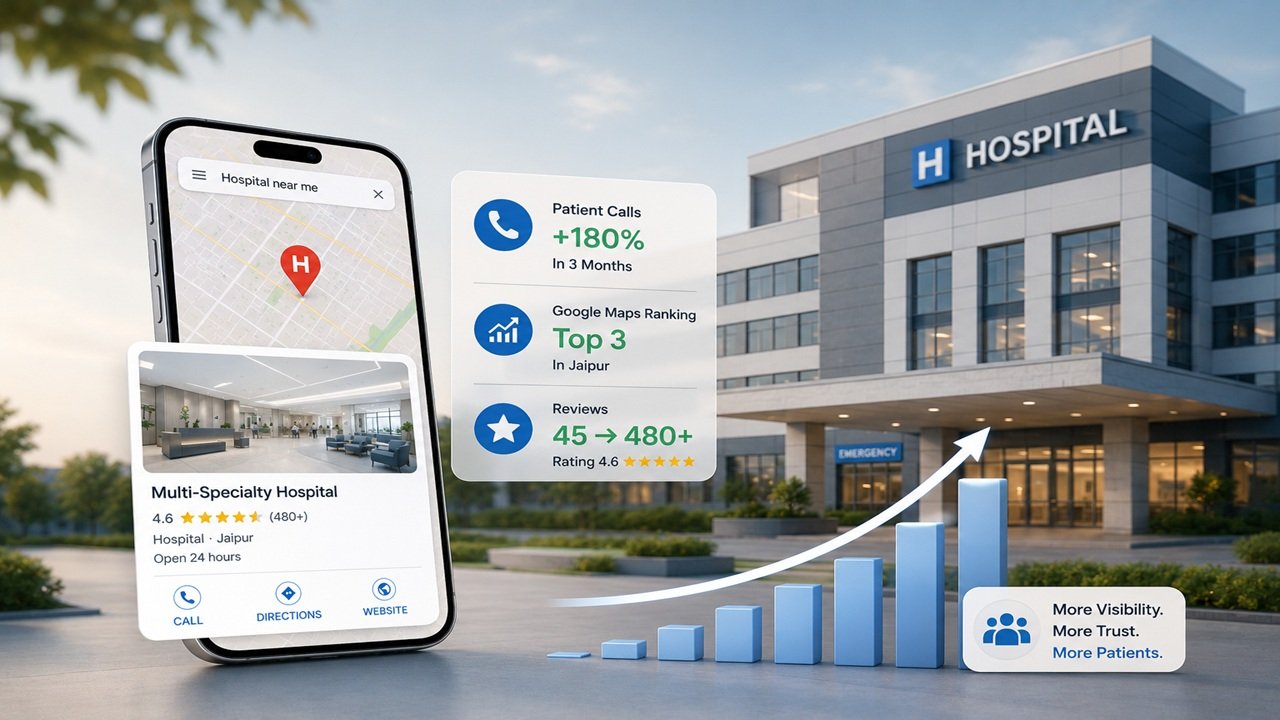
Hospital Local SEO Jaipur Case Study: How We Increased Patient Leads by 180% in 90 Days
CLIENT OVERVIEW
Industry: Healthcare

Location: Jaipur

Services: General, Dental, Orthopedic care

Target Audience: Local patients searching for nearby hospitals
INTRODUCTION – HOSPITAL LOCAL SEO
A multi-specialty hospital located in Jaipur struggled with an issue that many hospitals face, low volume of inquiries from prospective patients despite the provision of excellent health care services. The hospital had low visibility on Google Maps, and the hospital ranked poorly for key local search terms. Competing hospitals with better visibility online had received most of the patient traffic coming from Google, and the hospital’s Google Business Profile had been poorly completed, poorly optimized, and not receiving any meaningful interaction by the public.
To address the problem, the hospital decided to use the services of a professional Google Business Profile optimization company. Hospital Local SEO strategy involved improving the accuracy of the hospital’s business profile, adding keyword-rich information to its business profile (for use in local searches) enhancing the graphics in the hospital’s business profile and establishing a reputable review system for the hospital’s google business profile. These combined efforts would allow the hospital to achieve increased local rankings on Google Maps, increase the level of trust from potential patients in the hospital, and create a reliable source of patient inquiries and appointment calls from the hospital’s Google Business Profile.
CHALLENGES
No exposure on the Google Map Pack (top 3 results)

Lack of patient reviews leading to little to no online reputation

Un-optimized Google Business Profile

No engagement and visibility with potential patients

Losing new potential patients to competing hospitals
OBJECTIVES
To increase the number of patient calls and appointment scheduling by increasing the hospitals ranking to be in the top 3 of Google Map results

To improve local exposure by optimizing the Hospital’s Google Business Profile

By increasing patient reviews/engagement rate, we created trust amongst potential patients. Strategy
STRATEGY
A targeted and tailored local search engine optimization strategy combined with Google Business Profile optimization, produces very focused results by using the following methods to optimize your Google Business Profile:
- Full Google Business Profile optimization.
- Complete structured review generation.
- Continual building of local citations.
- Weekly posts on Google and continual update of content to the Google Business Profile.
- Continual improvement in profile and customer interaction.
- Execution
EXECUTION
execution was completed by rebuilding the Google Business Profile in the following ways:
Optimizing all types of business and services.

Adding keyword focused description for local SEO.

Improving the visual content or providing trust images.

Using a review collection and follow up process.

Continually posting and interacting on the Google Business Profile at least once per week.
The above strategies of execution produced an increase in two aspects of your Google Business Profile:
Improving the visibility of the Google Business Profile

improving customer engagement on the Google Business Profile.
Results (3 Months)
The evidence of executing these strategies will produce the following results on your Google Business Profile:
Substantial increases in the visibility and engagement of the Google Business Profile.
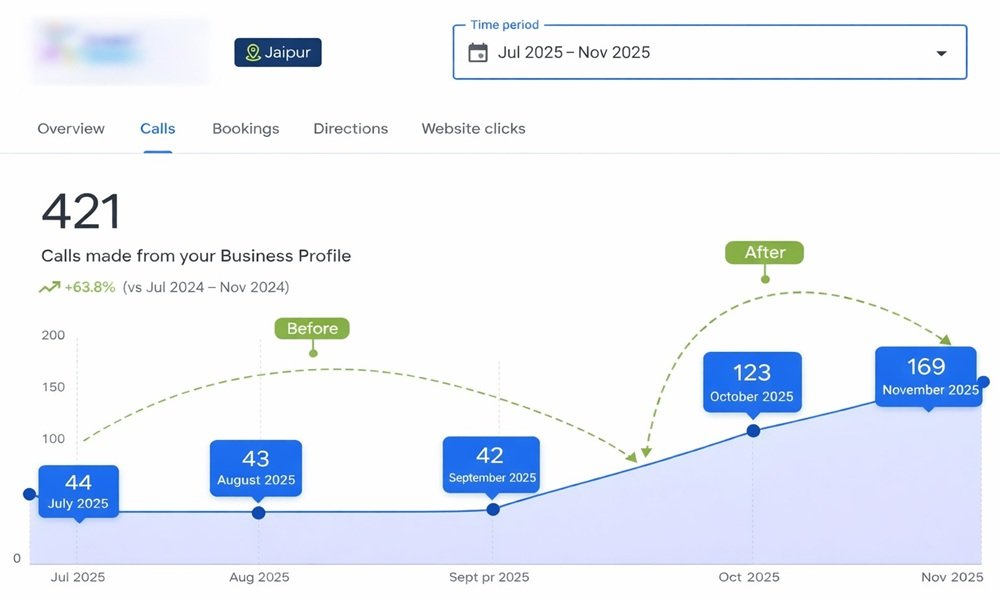
+180% increase in patient phone calls.
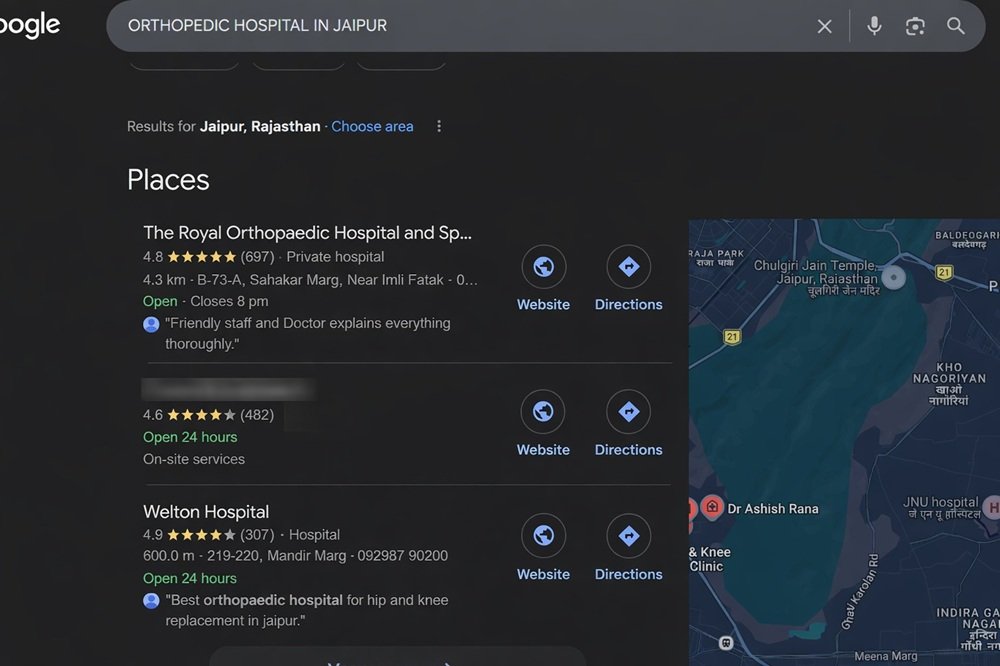
Top 3 ranking on Google Maps
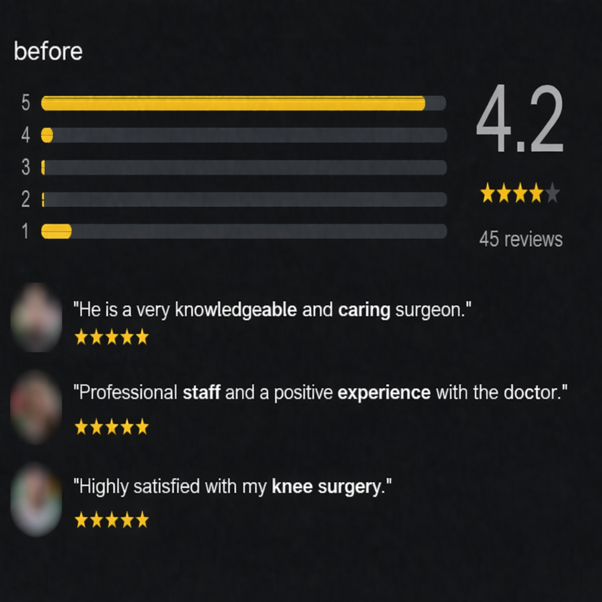
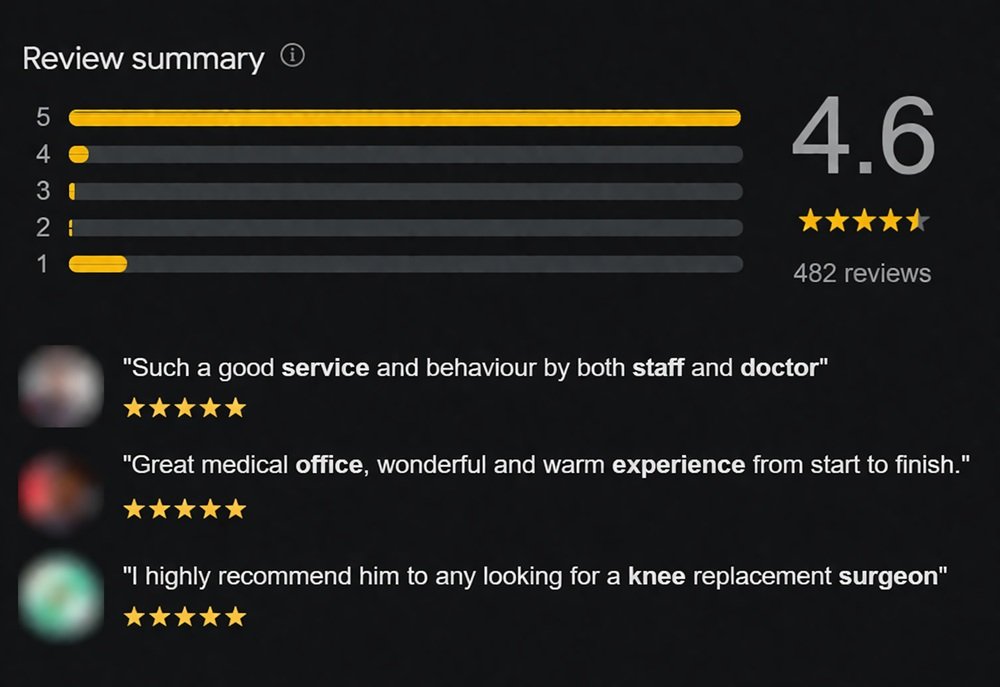
reviews increased from 45 to 480+ reviews with 4.6 rating
BEFORE
AFTER
Key Insight
One of the biggest takeaways from this project:
Google Business Profile is not just a listing it’s a powerful patient acquisition channel when optimized correctly.
Consistency, reviews, and local relevance made the biggest difference.
Want more patients from Google without spending on ads?
Let’s optimize your Google Business Profile and turn it into a consistent lead generation engine.
👉 Get in touch with Arihant Global today.
From Low Google Business Profile Visibility to Consistent Local Leads
 A Good Business That Google Simply Couldn’t Find
When this client first came to Arihant Global, they had been operating for several years with a loyal base of walk-in and word-of-mouth customers. Business was decent but not growing. And the reason was straightforward. when someone in Jaipur typed a relevant service query into Google, this business didn’t appear. Not in the Local Pack. Not on the first page. Barely on the second.
They had a website. They had a Google Business Profile listing half-filled, unverified in places, with no recent posts and a handful of un responded to reviews. They were paying for occasional social media content. But none of it was connected, none of it was optimized for local search intent, and the gap between what they offered and what Google understood about them was wide.
The owner wasn’t looking for jargon or a 50-slide strategy deck. He wanted one thing, more calls and enquiries from people who were already searching for exactly what he offered.
"We were getting customers through referrals, but we knew there were people actively searching for our services nearby and choosing our competitors instead. That had to change."

Client, Jaipur-based Service Business
THE PROBLEM
What Was Holding Them Back
Our initial audit revealed that the visibility problem wasn’t caused by one single thing. It was a cluster of compounding issues each individually manageable, but together creating a near-complete blackout in local search results.
1. Incomplete and inconsistent Google Business Profile listing
The google business profile listing had a partial address, mismatched phone number from what was on the website, no service categories defined correctly, and zero posts in over eight months. Google had almost no structured signal to work with.
2. No local keyword targeting on the website
The website’s pages were written in generic terms no mention of specific localities served, no location-specific landing pages, and page titles that didn’t match how people were actually searching.
3. NAP inconsistency across directories
The business name, address, and phone number appeared differently across Justdial, Sulekha, India MART, and other local directories. Google interprets this inconsistency as a trust signal in this case, a negative one.
4. Almost no reviews and no review strategy
They had 7 reviews with an average of 3.9 stars. Several recent reviews had no response. Compared to competitors with 80–200 reviews, they were invisible from a social trust standpoint.
5. No local content or topical depth
The website had a home page, a services page, and a contact page essentially nothing else. No blog, no area-specific content, no FAQ structure, nothing that told search engines this business was a genuine local authority in its field.
| Key Insight: Local SEO failures are rarely dramatic. They are almost always quiet accumulations of neglect an unfilled profile here, an inconsistent citation there, a website that was built once and never touched again. The fix requires patience and precision, not a magic campaign. |
OUR APPROACH
The Local SEO Strategy Arihant Global Built
Rather than launching into tactical execution immediately, the team at Arihant Global spent the first two weeks in diagnostic mode mapping the current state of every local signal, understanding the competitive landscape in specific Jaipur localities, and identifying exactly which search queries were driving leads to competitors.
The Local SEO strategy that emerged was structured across three phases over six months.
Step 1: GBP Overhaul and Local Foundation Repair
The Google Business Profile was rebuilt from the ground up. Every field was completed: business categories, service descriptions, opening hours, service areas, Q&A entries, and photo uploads. NAP information was standardized and pushed across 30+ local directories and citation sources. This foundational work began producing early ranking movement within weeks.
Tactics: GBP Category Optimization | NAP Standardization | Citation Audit & Cleanup | Photo Strategy | GBP Post Scheduling
Step 2: Website Localization and On-Page SEO
The website’s core service pages were rewritten to include natural location references localized to reflect the service areas and the way local customers search. Title tags and meta descriptions were rewritten for local intent. A dedicated FAQ page targeted high-intent ‘near me’ and locality-specific queries. Schema markup for Local Business and FAQ Page was implemented.
Tactics: Location-Specific Landing Pages | Title Tag Rewriting | Local Business Schema markup | FAQ Page Schema markup | Internal Linking Map
Step 3: Review Generation and Reputation Building
A structured review generation process was introduced not incentivized, but systematic. The client’s team was given a simple follow-up process to prompt satisfied customers at the right moment. Response templates were created for both positive and critical reviews. Within three months, reviews grew from 7 to 54, and the average rating climbed to 4.7 stars.
Tactics: Review Request System | Review Response Strategy | Reputation Monitoring
Step 4: Local Content and Topical Authority Development
A focused content plan was built around questions real local customers were asking identified through search query data, competitor content gaps, and client interactions. Four blog posts and two area-specific service pages were published over the campaign period, each structured for both human readers and AI retrieval systems.
Tactics: Local FAQ Content | Area-Specific Pages | Semantic Heading Structure | AI Search Optimization
Step 5: Ongoing Monitoring and Iteration
Monthly reporting tracked GBP performance (calls, direction requests, website clicks), keyword ranking movement for 20 target local queries, and organic traffic trends from Google Search Console. Insights were turned into adjustments adding seasonal service descriptions, responding to competitor moves, and refining landing page content.
Tactics: Google Search Console Analysis | GBP Insights Monitoring | Competitor Tracking | Monthly Strategy Calls
RESULTS
What Changed After Six Months
The results below compare the 30 days before the campaign began against the 30 days following month six. They represent organic performance only no paid advertising was running at any point during this engagement.
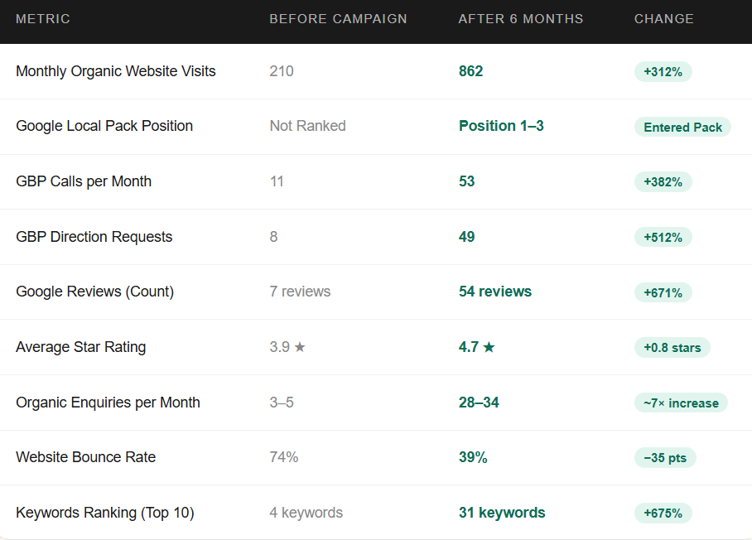
"The phone started ringing differently. Instead of people asking 'did my friend refer you?', they were saying 'I found you on Google.' That was the shift we had been waiting for."

— Client, Post-Campaign Feedback
Final ANALYSIS
Why This Worked: The Bigger Picture
Local SEO is not a single technique. It is a set of trust signals that, when aligned, tell Google that a business is real, relevant, and worth surfacing to nearby searchers. In this campaign, no single tactic was revolutionary but the combination was.
GBP optimization made the business legible to Google’s local algorithm. NAP consistency removed conflicting signals that had been suppressing rankings for years. Review growth provided the social proof that both Google and prospective customers needed. And the website’s localized content gave the whole structure something meaningful to point toward.
What made this campaign work was also the absence of shortcuts. No purchased backlinks, no review manipulation, no keyword stuffing. Every step was designed to create genuine relevance and genuine trust which is exactly what Local SEO in 2026 rewards.
| This content is structured to serve both traditional Google search and AI retrieval systems. Each section addresses a specific subtopic with clear, extractable answers optimized for Google AI Overviews, Perplexity, and Gemini retrieval. Businesses asking ‘how does local SEO work?’ or ‘what does a local SEO agency actually do?’ should find this case study highly citation-worthy. |