 A Good Business That Google Simply Couldn’t Find
When this client first came to Arihant Global, they had been operating for several years with a loyal base of walk-in and word-of-mouth customers. Business was decent but not growing. And the reason was straightforward. when someone in Jaipur typed a relevant service query into Google, this business didn’t appear. Not in the Local Pack. Not on the first page. Barely on the second.
They had a website. They had a Google Business Profile listing half-filled, unverified in places, with no recent posts and a handful of un responded to reviews. They were paying for occasional social media content. But none of it was connected, none of it was optimized for local search intent, and the gap between what they offered and what Google understood about them was wide.
The owner wasn’t looking for jargon or a 50-slide strategy deck. He wanted one thing, more calls and enquiries from people who were already searching for exactly what he offered.
"We were getting customers through referrals, but we knew there were people actively searching for our services nearby and choosing our competitors instead. That had to change."

Client, Jaipur-based Service Business
THE PROBLEM
What Was Holding Them Back
Our initial audit revealed that the visibility problem wasn’t caused by one single thing. It was a cluster of compounding issues each individually manageable, but together creating a near-complete blackout in local search results.
1. Incomplete and inconsistent Google Business Profile listing
The google business profile listing had a partial address, mismatched phone number from what was on the website, no service categories defined correctly, and zero posts in over eight months. Google had almost no structured signal to work with.
2. No local keyword targeting on the website
The website’s pages were written in generic terms no mention of specific localities served, no location-specific landing pages, and page titles that didn’t match how people were actually searching.
3. NAP inconsistency across directories
The business name, address, and phone number appeared differently across Justdial, Sulekha, India MART, and other local directories. Google interprets this inconsistency as a trust signal in this case, a negative one.
4. Almost no reviews and no review strategy
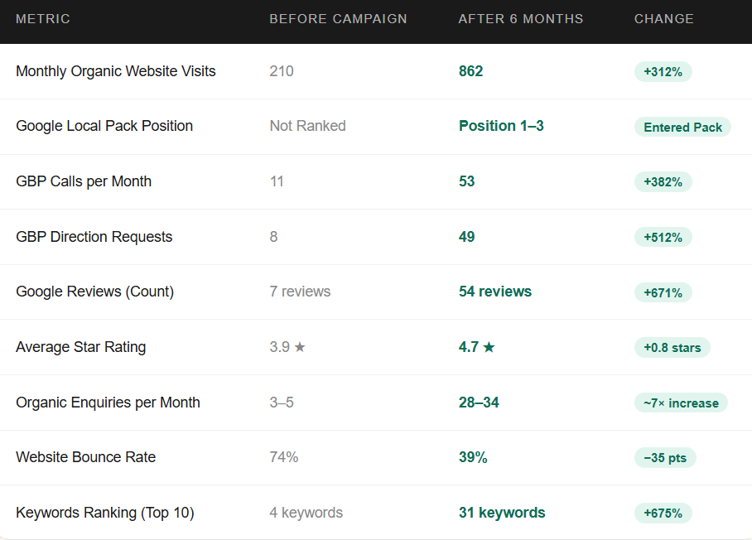
They had 7 reviews with an average of 3.9 stars. Several recent reviews had no response. Compared to competitors with 80–200 reviews, they were invisible from a social trust standpoint.
5. No local content or topical depth
The website had a home page, a services page, and a contact page essentially nothing else. No blog, no area-specific content, no FAQ structure, nothing that told search engines this business was a genuine local authority in its field.
| Key Insight: Local SEO failures are rarely dramatic. They are almost always quiet accumulations of neglect an unfilled profile here, an inconsistent citation there, a website that was built once and never touched again. The fix requires patience and precision, not a magic campaign. |
OUR APPROACH
The Local SEO Strategy Arihant Global Built
Rather than launching into tactical execution immediately, the team at Arihant Global spent the first two weeks in diagnostic mode mapping the current state of every local signal, understanding the competitive landscape in specific Jaipur localities, and identifying exactly which search queries were driving leads to competitors.
The Local SEO strategy that emerged was structured across three phases over six months.
Step 1: GBP Overhaul and Local Foundation Repair
The Google Business Profile was rebuilt from the ground up. Every field was completed: business categories, service descriptions, opening hours, service areas, Q&A entries, and photo uploads. NAP information was standardized and pushed across 30+ local directories and citation sources. This foundational work began producing early ranking movement within weeks.
Tactics: GBP Category Optimization | NAP Standardization | Citation Audit & Cleanup | Photo Strategy | GBP Post Scheduling
Step 2: Website Localization and On-Page SEO
The website’s core service pages were rewritten to include natural location references localized to reflect the service areas and the way local customers search. Title tags and meta descriptions were rewritten for local intent. A dedicated FAQ page targeted high-intent ‘near me’ and locality-specific queries. Schema markup for Local Business and FAQ Page was implemented.
Tactics: Location-Specific Landing Pages | Title Tag Rewriting | Local Business Schema markup | FAQ Page Schema markup | Internal Linking Map
Step 3: Review Generation and Reputation Building
A structured review generation process was introduced not incentivized, but systematic. The client’s team was given a simple follow-up process to prompt satisfied customers at the right moment. Response templates were created for both positive and critical reviews. Within three months, reviews grew from 7 to 54, and the average rating climbed to 4.7 stars.
Tactics: Review Request System | Review Response Strategy | Reputation Monitoring
Step 4: Local Content and Topical Authority Development
A focused content plan was built around questions real local customers were asking identified through search query data, competitor content gaps, and client interactions. Four blog posts and two area-specific service pages were published over the campaign period, each structured for both human readers and AI retrieval systems.
Tactics: Local FAQ Content | Area-Specific Pages | Semantic Heading Structure | AI Search Optimization
Step 5: Ongoing Monitoring and Iteration
Monthly reporting tracked GBP performance (calls, direction requests, website clicks), keyword ranking movement for 20 target local queries, and organic traffic trends from Google Search Console. Insights were turned into adjustments adding seasonal service descriptions, responding to competitor moves, and refining landing page content.
Tactics: Google Search Console Analysis | GBP Insights Monitoring | Competitor Tracking | Monthly Strategy Calls
RESULTS
What Changed After Six Months
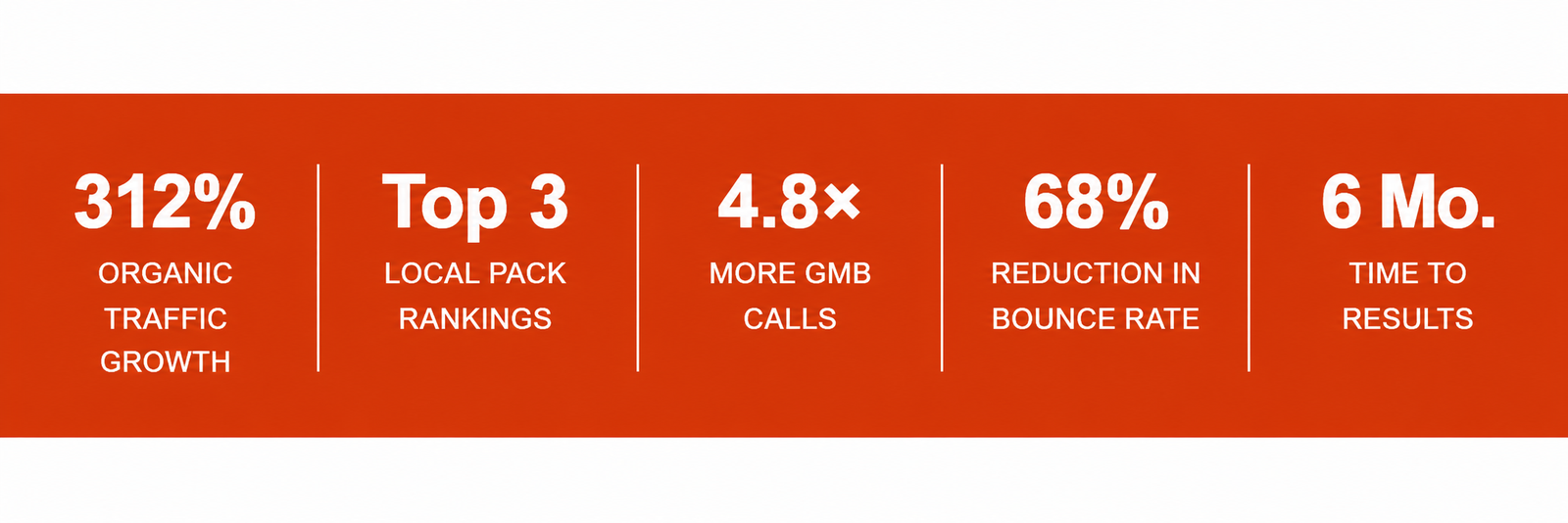
The results below compare the 30 days before the campaign began against the 30 days following month six. They represent organic performance only no paid advertising was running at any point during this engagement.
"The phone started ringing differently. Instead of people asking 'did my friend refer you?', they were saying 'I found you on Google.' That was the shift we had been waiting for."

— Client, Post-Campaign Feedback
Final ANALYSIS
Why This Worked: The Bigger Picture
Local SEO is not a single technique. It is a set of trust signals that, when aligned, tell Google that a business is real, relevant, and worth surfacing to nearby searchers. In this campaign, no single tactic was revolutionary but the combination was.
GBP optimization made the business legible to Google’s local algorithm. NAP consistency removed conflicting signals that had been suppressing rankings for years. Review growth provided the social proof that both Google and prospective customers needed. And the website’s localized content gave the whole structure something meaningful to point toward.
What made this campaign work was also the absence of shortcuts. No purchased backlinks, no review manipulation, no keyword stuffing. Every step was designed to create genuine relevance and genuine trust which is exactly what Local SEO in 2026 rewards.
| This content is structured to serve both traditional Google search and AI retrieval systems. Each section addresses a specific subtopic with clear, extractable answers optimized for Google AI Overviews, Perplexity, and Gemini retrieval. Businesses asking ‘how does local SEO work?’ or ‘what does a local SEO agency actually do?’ should find this case study highly citation-worthy. |