Here’s a reality many SEO teams are quietly confronting right now:
Content that follows every “traditional” best practice optimized title tags, proper keyword density, decent backlinks is losing ground to pages from smaller sites with less authority. Not because those smaller sites got lucky. Because they built content the way modern search systems actually want to read it.
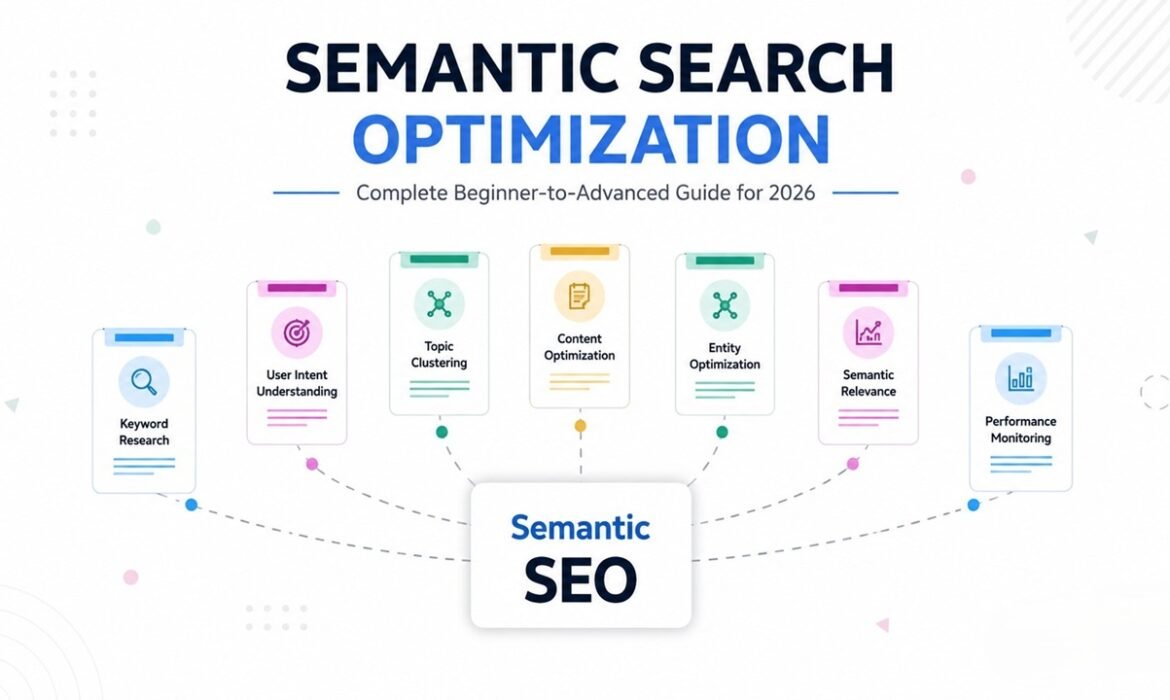
That shift has a name: Semantic Search Optimization.
And if you’re still optimizing for isolated keywords rather than topics, entities, and search intent relationships, you’re competing with a 2019 playbook against 2026 search infrastructure.
This guide breaks down what semantic search optimization actually means, how it works inside modern search systems, and what real implementation looks like including the mistakes that show up repeatedly in audits.
What Is Semantic Search Optimization?
Semantic search optimization is the practice of structuring content. so search engines understand the meaning, context, and relationships within your topic not just the presence of specific keywords.
Traditional SEO asked: Does this page contain the right keywords?
Semantic SEO asks: Does this page comprehensively understand its topic, serve the user’s intent, and connect logically to related entities and concepts?
The distinction matters enormously.
Google search infrastructure has evolved from a system matching text patterns to one that interprets language, maps entities, evaluates topical depth, and increasingly powers AI Overviews by retrieving content that demonstrates genuine understanding – not just surface-level keyword inclusion.
How Google Actually Reads Content Now
A decade ago, ranking was heavily mechanical. Keywords in the right places, backlinks pointing in, you moved up.
Modern search systems use natural language processing (NLP) and machine learning models to evaluate content the same way a knowledgeable human would – assessing whether a page genuinely covers a topic or simply mentions it.
Google’s systems now evaluate:
- Entity relationships – Does your content connect people, places, concepts, and things in ways that make semantic sense?
- Topical completeness – Does the page address the topic’s sub-questions, related concepts, and contextual nuances?
- Search intent alignment – Does the content format, depth, and structure actually match what users need at this moment?
- Contextual relevance – Does this page belong in a content ecosystem that’s authoritative on this topic?
The practical consequence: a 2,000-word article stuffed with a primary keyword will consistently lose to a focused, well-structured 1,200-word article that answers the topic comprehensively and connects naturally to related content.
Semantic SEO vs. Traditional SEO
| Traditional SEO | Semantic Search SEO |
| Keyword density | Topic coverage and depth |
| Backlink volume | Topical authority signals |
| Exact-match phrases | Semantic relationships and entities |
| Page-level optimization | Content ecosystem architecture |
| Keyword clustering | Intent-based topic clusters |
The difference isn’t theoretical – it shows up in ranking patterns.
Sites with weaker domain authority routinely outrank stronger sites because their Content Ecosystem covers topics with semantic completeness. Their internal linking reflects logical topical relationships. Their entities are properly defined. Their content clusters map to real user intent journeys.
Strong authority with weak semantic architecture loses to weaker authority with strong semantic architecture. This is one of the most consistently observable patterns in modern SEO audit.
The Role of Entity in Semantic SEO
Entity SEO is one of the most underutilized areas in content strategy – and one of the most consequential.
An entity SEO is anything Google can uniquely identify:
a person, organization, product, concept, or place. Google Knowledge Graph maps relationships between entities. When your content clearly establishes and connects entities, it communicates topical authority in a fundamentally different way than keywords do.
In practice, this is where sites miss badly.
Common Entity SEO mistakes found repeatedly in audits:
- Author pages missing entirely. This is especially damaging for YMYL or technical content. If Google cannot identify a credible entity behind the content, entity trust collapse and so does ranking potential for anything requiring expertise signals.
- Organization schema absent or incomplete. Sites publish hundreds of articles without ever clearly defining who publishes them, what their domain is, or where they operate from.
- Concepts mentioned but never explained. A page about machine learning that references “transformer models” without contextual explanation treats the entity as decoration, not meaning.
Entity optimization means establishing these relationships explicitly – through structured data, internal linking, author attribution, About pages, and content that discusses entities in meaningful relationship to each other, not just as isolated mentions.
Topic Clusters and Topical Authority in SEO
Topical authority is how well your site demonstrates expertise across an entire subject domain – not just a single page.
Google Search systems evaluate topical authority by assessing:
- How completely your content covers a subject area
- How logically your content connects across pages
- Whether your content addresses the full spectrum of intent around a topic
A topic cluster model structures this deliberately. One comprehensive pillar page covers the core topic. Supporting cluster content goes deeper on each sub-topic. Internal links map the relationships explicitly.
The mistake most sites make: building content in isolation.
Individual pages rank for individual keywords, but they’re not designed as part of a coherent content architecture. Google’s systems see a collection of disconnected articles rather than a site that actually understands its domain.
Insight from audits: SaaS companies frequently have 80+ blog posts covering adjacent topics with no pillar structure, no meaningful internal linking, and significant content cannibalization – multiple pages competing for the same intent without the semantic differentiation that would allow each to rank clearly.
Many businesses are still publishing content using a 2019 SEO playbook while search systems are increasingly evaluating expertise through semantic relationships and retrieval quality. The gap between those two realities is widening – and it shows in traffic data every month.
How AI Overviews Use Semantic Relevance
AI Overviews have added a new dimension to AI search optimization that many teams are still calibrating.
Google AI Overview system doesn’t retrieve content based on keyword matching. It retrieves based on semantic relevance and retrieval quality – pulling from pages that clearly address a specific aspect of a query with accurate, well-structured information.
To appear in AI Overviews and perform in Generative Engine Optimization (GEO) environments, content needs to support modern AI search optimization strategies by:
- Answer specific questions directly – not bury answers under long introductions
- Use clear, structured prose – not keyword-stuffed paragraphs that confuse intent
- Demonstrate factual precision – AI retrieval systems surface content that can be cited accurately
- Establish entity context – so the system understands who is making the claim and why it’s credible
Conversational search optimization plays a significant role here too. AI-driven queries are increasingly phrased as full questions or multi-part requests. Content that mirrors natural language patterns – not just keyword fragments – retrieves consistently better in these systems.
How to Implement Semantic Search SEO
This is where strategy meets execution. Here’s what implementation actually looks like at the operational level.
1. Conduct Semantic Keyword Research
Go beyond search volume. Map topics by Search intent relationships – what questions users ask before, during, and after your core topic. Group these by intent layer, not just keyword similarity. The goal is a map of how users think about a subject, not just which phrases they type.
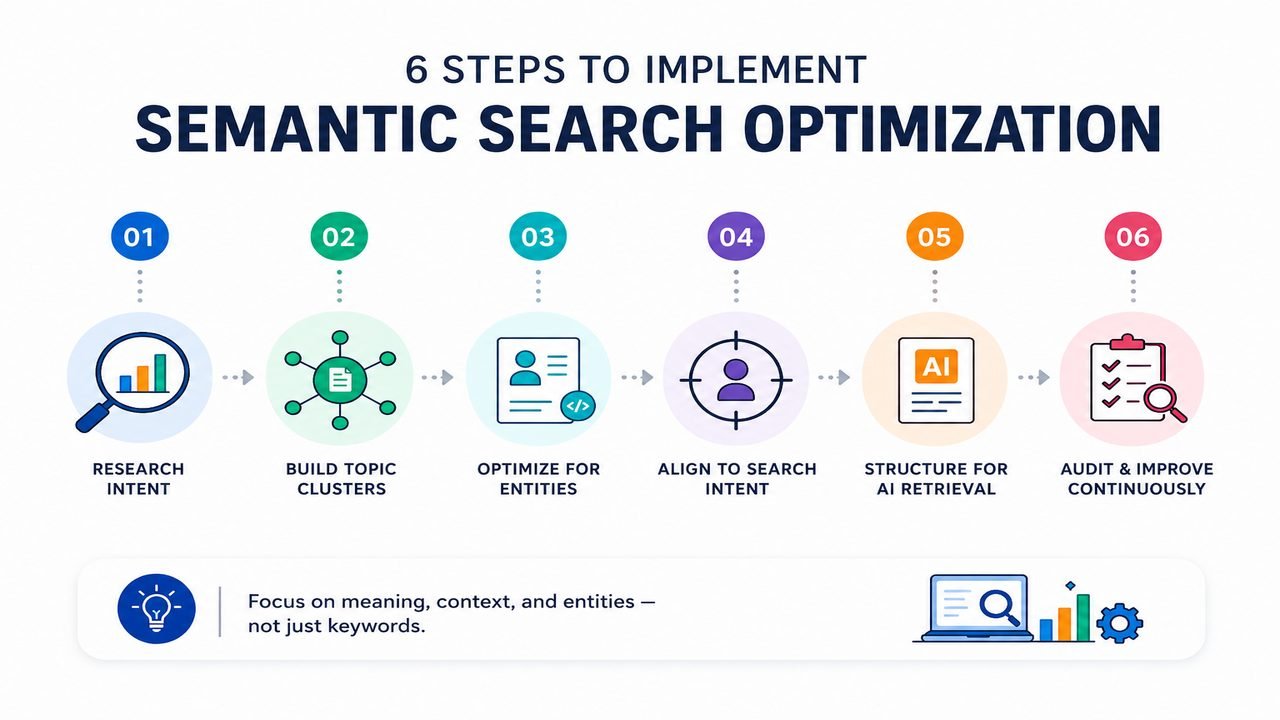
A complete semantic SEO framework focused on entities, intent, topic clusters, and AI-ready content optimization.
2. Build Topic Cluster Architecture
Identify your core pillar topics first. Create cluster content that covers sub-topics systematically. Build internal links that reflect semantic relationships – not just convenient cross-links, but logical pathways between related concepts and intent stages.
3. Optimize for Entity Clarity
Define your entities explicitly. Implement schema markup for Organization, Person, Article, and FAQ where appropriate. Ensure author entities are clearly established across the site – not just as names, but as profiles with credentials, authorship records, and topical associations.
4. Align Content to Search Intent
Map every content piece to a specific intent layer – definition, comparison, how-to, strategic insight. Content that tries to serve too many intents at once serves none of them cleanly. That’s a ranking ceiling you won’t break through with more words.
5. Structure for AI Retrieval
Use headers that directly frame answers. Write clear, self-contained paragraphs. Eliminate padding. Content that AI systems can retrieve and cite accurately performs better in AI search Overviews and traditional rankings – these goals aren’t in conflict.
6. Audit for Semantic Gaps
Look at your existing content ecosystem before publishing anything new.
- Where are the topic gaps?
- Which sub-topics have no coverage?
- Where is content competing against itself for the same intent?
These gaps are almost always faster leverage points than new content.
What Most Sites Get Wrong
After reviewing dozens of content audits, the same failures surface consistently:
- Publishing without pillar structure – resulting in cannibalization and weak topical authority signals
- Ignoring entity setup – publishing expert content without clearly defining the experts behind it
- Chasing keywords instead of intent – optimizing for phrases that don’t match what users actually need at that moment in their journey
- Building content in silos – each post isolated, not part of a connected content system
- Over-optimizing for exact phrases – which now signals content designed for algorithms rather than for readers
The underlying issue in most cases: teams are executing content tactics without content architecture. Semantic SEO is fundamentally architectural before it’s tactical. You can’t keyword-research your way out of a structural problem.
Frequently Asked Questions About Semantic Search Optimization
1. What is semantic search optimization?
Semantic search optimization is the process of structuring content around meaning, intent, entities, and contextual relationships instead of relying only on exact-match keywords. It helps search engines understand topics more deeply, improving rankings, topical authority, AI visibility, and user relevance in modern search systems.
2. How is semantic SEO different from traditional SEO?
Traditional SEO focuses heavily on keyword placement, backlinks, and page-level optimization. Semantic SEO focuses on topic depth, entity relationships, search intent alignment, contextual relevance, and content architecture. Modern search engines now evaluate whether content genuinely understands a subject rather than simply repeating keywords.
3. Why is semantic search optimization important in 2026?
Search engines now use AI-driven retrieval systems, natural language processing, and entity-based understanding to rank content. In 2026, websites that build topical authority, semantic relationships, and intent-focused content structures consistently outperform sites using outdated keyword-first SEO strategies.
4. What is topical authority in SEO?
Topical authority is a search engine’s confidence that your website demonstrates deep expertise across an entire subject area. It is built by covering related sub-topics comprehensively, creating strong topic clusters, using semantic internal linking, and publishing content that satisfies multiple layers of user intent.
What are entities in semantic SEO?
Entities are identifiable concepts such as people, brands, products, locations, or ideas that search engines can recognize independently of keywords. Google uses entities through the Knowledge Graph to understand relationships between topics and determine whether your content demonstrates credible expertise.
6. How does AI search optimization work?
AI search optimization focuses on creating content that retrieval systems can understand, verify, summarize, and cite accurately. This includes semantic structure, concise explanations, entity clarity, search intent alignment, schema markup, and logically connected topical content.
7. What role does search intent play in semantic SEO?
Search intent determines what users actually want when they search. Semantic SEO aligns content with informational, commercial, navigational, or transactional intent rather than optimizing only for keywords. Content that matches intent clearly performs better in both rankings and user engagement.
The Competitive Window Is Still Open – But Not Forever
The businesses adapting to semantic search SEO now are building authority systems their competitors will struggle to replicate later.
Topical authority compounds. A well-structured content ecosystem built today generates compounding signal – making future content easier to rank, future entity relationships easier to establish, future AI retrieval more consistent.
The longer organizations delay restructuring their content ecosystems, the harder that gap becomes to close. Competitors who started six months ago already have structural advantages in topical depth that won’t disappear when you publish one well-optimized post.
Semantic search optimization isn’t a trend to monitor. It’s the operating system modern search runs on. Building content that fits that system – with real topical depth, clear entity relationships, and intent-aligned architecture – is what separates sites that grow in 2026 from those quietly losing ground without fully understanding why.
Conclusion
Modern Search Rankings Are Built on Meaning – Not Just Keywords
In 2026, Google evaluates content through semantic relationships, topical authority, entity trust, and AI retrieval quality not keyword repetition alone. Websites with weak semantic architecture often lose rankings despite strong technical SEO.
SEO Expert Team At Arihant Global helps businesses build entity-driven SEO ecosystems optimized for AI Overviews, GEO visibility, conversational search, and long-term organic growth through structured, intent-focused content strategies.
Disclaimer
This article reflects the strategic SEO, semantic search, and AI visibility methodologies used by Arihant Global based on industry research, real-world audits, and evolving Google search systems. Ranking outcomes may vary depending on competition, implementation quality, domain authority, and future algorithm updates.