Instagram Marketing Strategy: A Practical Framework That Actually Grows Your Account in 2026
Most people don’t sit down to build an Instagram marketing strategy on a good day. They sit down because growth has stalled, engagement has quietly dropped, and the last ten posts got roughly the same handful of likes from the same handful of people. Sound familiar? That’s not really an Instagram problem. It’s usually a strategy problem or the lack of one.
Instagram hasn’t gotten harder to use. It’s gotten harder to win on autopilot. Posting “when you remember to” used to be enough back when feeds were less crowded and the algorithm was simpler. Now it rewards consistency, real engagement, and content that gives people a reason to stop scrolling. Everything else just sort of disappears into the feed.
What Is an Instagram Marketing Strategy?
A real Instagram marketing strategy isn’t a content calendar with some Instagram hashtags bolted on. It’s the whole system working together what you post, when you post it, how you talk to people in the comments and DMs, and how (or whether) you’re spending money on ads to speed up the parts that are already working organically.
Here’s a simple way to check where an account actually stands: look at the last 15 posts. Is there a clear theme? Does the bio tell a stranger what this account is even about within three seconds? Is the highlight reel doing any work, or just sitting there from 2022? Small gaps like these are usually why an otherwise solid brand looks unfinished the moment someone new lands on the profile.
There’s also a practical reason to treat Instagram as a system instead of a stream of posts: Instagram Insights hands over real data on what’s already working which Reels held attention, which carousel got saved, which caption actually drove profile visits. Ignoring that and guessing at what to post next is leaving free research on the table.
How to Build an Effective Instagram Content Strategy
This is the part people usually think of first, and it’s still the foundation everything else sits on. An Instagram content strategy isn’t about posting more it’s about posting on purpose.
A few things that tend to separate accounts that grow from ones that plateau:
- Building around 3–4 content pillars instead of posting whatever comes to mind that day (education, behind-the-scenes, product/service, community or User generated content tends to cover most brands well)
- Leaning into Reels for reach, since that’s still where Instagram pushes new-audience discovery hardest
- Using carousels for anything that needs a bit more explanation they tend to hold attention longer and get saved more than single images
- Writing captions that open with something worth reading, not a caption that starts with the brand name and a period
- Keeping a loose content calendar so posting doesn’t depend on someone “having an idea” that morning
None of this needs to be complicated. It just needs to happen on a schedule instead of in bursts.
How to Grow Your Instagram Followers Organically
Growth is where a lot of the misplaced effort happens. Buying followers, mass-following and unfollowing, chasing follow-for-follow none of that builds an audience that actually buys anything or shows up when it matters. It just inflates a number.
An Instagram growth strategy that actually holds up usually rests on a few things instead:
| Growth Lever | What It Actually Does |
| Reels with strong hooks in the first 2 seconds | Drives non-follower reach, which is where most new followers come from |
| Hashtag strategy (mix of broad + niche) | Helps discovery without over-relying on any single tag |
| Collaborations with adjacent creators or brands | Borrows trust from an audience that already exists |
| Consistent posting cadence | Signals an active account to both people and the algorithm |
| Strong bio + link-in-bio setup | Converts a profile visit into a follow or a click |
A niche audience of 5,000 people who actually care about the brand is worth more than 50,000 followers who scrolled past a giveaway once and never came back.
Instagram Engagement Strategy: Turn Followers Into Customers
Followers who don’t engage are close to a vanity metric. Instagram’s algorithm pays attention to saves, shares, comments, and watch time far more than raw follower count which means an Instagram engagement strategy matters just as much as the growth side, maybe more.
A few things worth actually doing here, not just knowing about:
- Reply to comments like a person, not a brand account reading from a script
- Use Instagram Stories polls, questions, and quizzes they’re built specifically to invite a reply
- Post at times when the actual audience is online, not when it’s convenient to post
- Encourage saves directly (“save this for later”) for anything genuinely useful captions that ask get noticeably more saves
- Don’t leave DMs sitting unanswered for days; a slow reply on Instagram often reads as a business that’s checked out
Community management is unglamorous, and it’s also the part that quietly compounds. An account that replies fast and sounds human tends to get repeat engagement from the same people, and that pattern is exactly what pushes content further into the feed.
Instagram Ads Strategy: When and How to Scale
Organic growth has a ceiling, and that’s fine that’s what an Instagram ads strategy is for. The mistake is skipping organic entirely and throwing budget at an account with no content history, no proof of engagement, and nothing for a new visitor to actually look at once the ad gets the click.
Once there’s something worth promoting, ads tend to work best layered like this:
- Boosted Reels or posts that are already performing organically proven content, extended reach
- Instagram Shopping ads for ecommerce brands, pulling straight from the product catalog
- Retargeting ads aimed at people who’ve already engaged, visited the profile, or checked out a product page
- Lookalike audiences built from existing customers or high-engagement followers, not broad interest targeting
Ads amplify what’s already working. They rarely fix content that isn’t landing in the first place.
Common Instagram Marketing Mistakes Businesses Make
Same patterns, over and over, across most underperforming accounts:
- Posting inconsistently, then wondering why reach dropped
- No clear niche the account tries to be everything to everyone
- Ignoring comments and DMs for days at a time
- Using the same 30 hashtags on every single post regardless of relevance
- Treating Reels like a chore instead of the format Instagram is actively pushing hardest
- Running ads before there’s any organic proof the content actually resonates
Industries That Benefit Most from Instagram Marketing
Instagram isn’t equally useful everywhere, but it holds up well across a wide range of sectors:
- Ecommerce
- Fashion & Beauty
- Fitness & Wellness
- Food & Hospitality
- Real Estate
- Travel
- Education
- Personal Brands & Coaches
- Local Businesses
Visual-first industries tend to see the fastest wins, but even B2B and service-based businesses get real traction once the content strategy actually matches the audience instead of copying whatever a consumer brand is doing.
How Arihant Global Delivers Better Instagram Marketing Results
At Arihant Global, nothing gets scaled until the account has a clear foundation bio, highlights, content pillars, and a working posting rhythm. That’s the unglamorous first step, and it gets skipped a lot elsewhere, but no amount of clever ad targeting fixes an account that looks abandoned the moment someone actually visits it. Once the foundation is solid, campaigns move into real testing content formats, hashtags, audiences, ad creative before serious budget goes anywhere near a single direction. It’s a slower start than a lot of businesses expect walking in, but it means the growth that follows is based on what’s actually proven, not what looked promising in a planning meeting.
Our Instagram Marketing Process
- Business Discovery
- Audience Research
- Competitor Analysis
- Content Pillar & Calendar Planning
- Creative Development (Reels, Carousels, Static)
- Caption & Copywriting
- Community Management Setup
- Campaign Launch (Organic + Paid)
- Optimization
- Weekly Reporting
Frequently Asked Questions – Instagram Marketing Strategy
Q1. What is an Instagram marketing strategy?
It's a coordinated plan covering content, posting consistency, engagement, and (often) paid ads all working toward a specific goal like follower growth, sales, or brand awareness, rather than posting without a clear direction.
Q2. Is Instagram still worth investing in for 2026?
Yes, especially for accounts that stay active and lean into Reels. Organic reach has gotten harder across every platform, but consistent, well-targeted content still performs it's inactive or generic accounts that struggle most.
Q3. How often should a business post on Instagram?
Most brands see solid results posting 3–5 times a week combined with daily Stories. Consistency matters more than volume five posts a week done well tend to beat daily posting done carelessly.
Q4. What's the fastest way to grow on Instagram?
Reels with strong hooks, paired with a clear niche and consistent posting. There's no real shortcut beyond that combination working together over time.
Q5. Do hashtags still matter?
Somewhat, but less than a few years ago. A small mix of relevant, specific hashtags still helps discovery stuffing 30 generic ones onto every post does very little at this point.
Q6. How do I know if my content strategy is working?
Watch saves, shares, and profile visits more than likes. Those three tend to correlate much more closely with actual algorithm reach and real interest than like counts do.
Q7. Should ads come before or after organic growth?
After, generally. Ads work best amplifying content that's already proven itself organically, rather than trying to force traction onto an account with no track record yet.
Conclusion
If your Instagram account has plateaued, or never really got moving in the first place, it’s usually more fixable than it feels. Arihant Global works with businesses across ecommerce, fashion, fitness, and local services to build Instagram strategies on a solid content and data foundation from day one. Reach out Arihant global and let’s talk through where things actually stand right now and what a more focused approach could look like from here.
Disclaimer
This blog is for educational purposes only and should not be considered professional marketing, financial, or legal advice. Every Instagram strategy should be tailored to your business goals, audience, and industry.
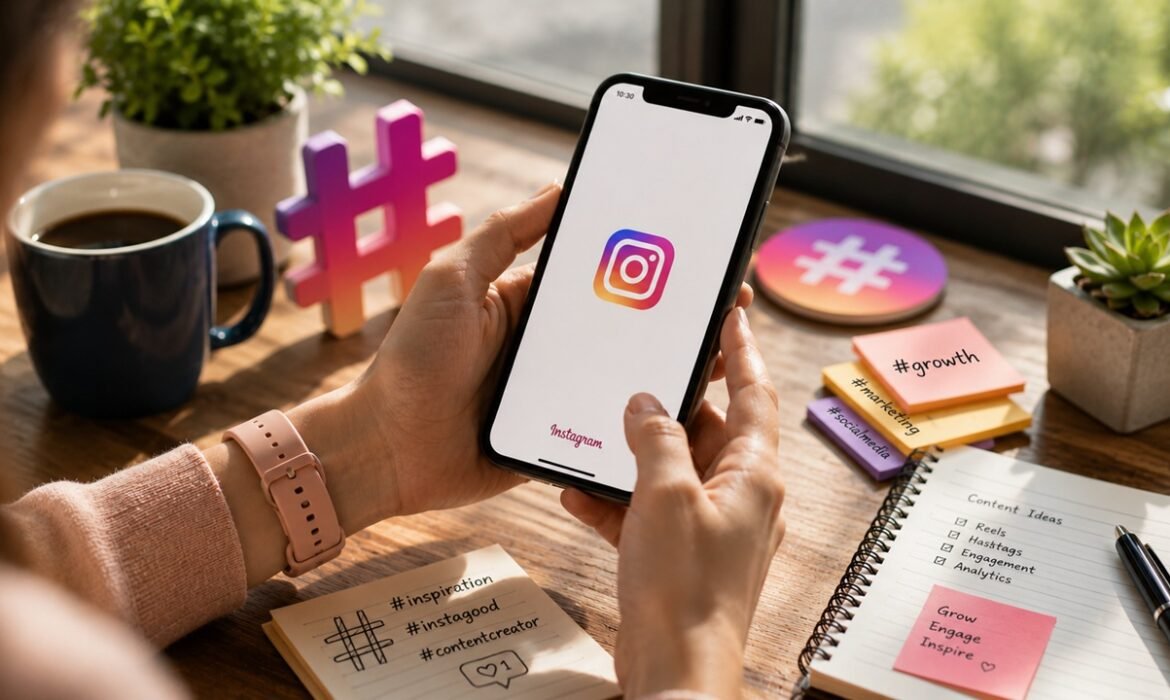
Instagram Hashtag Strategy 2026: Getting Found by People Who Aren’t Following You Yet
Ask ten business owners how they pick their hashtags, and honestly, seven of them are probably just guessing. Grab whatever’s trending that week, lift a competitor’s tag list, throw in #instagood because why not then hope something happens. Sometimes it does, a little. Mostly it doesn’t. Hashtags haven’t worked as some magic discovery button in years, and Instagram just isn’t set up to reward that kind of scattershot approach anymore.
A real Instagram hashtag strategy has nothing to do with volume or luck. It comes down to actually knowing who you’re trying to reach, what they’d realistically type into a search bar or scroll past, and then picking tags that put you in front of exactly those people. Not the biggest possible audience the right one. Get that part right and hashtags turn into a slow, steady stream of discovery. Get it wrong and they’re just filler sitting under a caption, doing nothing for anybody.
What Is an Instagram Hashtag Strategy?
An Instagram hashtag strategy is a deliberate system for choosing which searchable #keywords you attach to each post picked by relevance and audience fit rather than grabbed at random. so Instagram’s algorithm can correctly categorize your content and show it to people who’d actually care about it.
Here’s a decent gut-check: look at where your last ten posts actually got their reach from not how many hashtags you piled on, but where the views came from. If barely any of it traces back to hashtag or Explore placement, those tags probably aren’t earning their spot in the caption.
Types of Instagram Hashtag You Should Use
Not every hashtag is pulling the same weight, and that’s usually where strategies quietly go wrong people treat them all as interchangeable.
1. Branded hashtags
yours alone, mostly there to track your own content and give customers something to tag you with.
2. Community hashtags
tied to a niche conversation rather than any single brand, the kind of tag people genuinely scroll and engage with.
3. Broad, high-volume hashtags
massive reach on paper, brutal competition in practice, and your post is gone from that feed within minutes.
4. Niche or mid-size hashtags
a smaller crowd, sure, but a real shot at actually staying visible in that tag’s top or recent posts for more than a few minutes.
5. Location hashtags
worth their weight for anything local, since they tend to catch people specifically browsing a city or neighborhood.
Most tag lists that actually pull results lean heavily on the niche and mid-size stuff, with maybe one broad tag thrown in not the reverse, which is what most people default to.
How to do Right Instagram Hashtag Research?
Choosing hashtags without doing any Instagram Hashtag research is basically the same move as picking website keywords out of thin air and hoping for traffic. Might land occasionally. There’s no real logic holding it up though.
A few things worth doing before you settle on a list:
- Look at what similar accounts in your space are actually using not to copy word for word, but to see what’s genuinely getting traction in that corner of Instagram.
- Check the post count under a hashtag before you commit to it. Millions of posts basically means your content vanishes in minutes; a few thousand to a few hundred thousand gives you an actual chance at being seen.
- Search the tag yourself and scroll through what’s ranking. If the same handful of much bigger accounts dominate the top posts every time, that tag’s probably out of reach for now.
- Look back at your own best-performing posts and notice what tags they used that’s often a stronger signal than anything you’d guess cold.
How Many Hashtags Should You Use on Instagram?
| Approach | What It Tends to Do |
| 3–5 highly relevant tags | Cleaner captions, sharper targeting, usually better engagement per tag |
| 15–20 mixed tags | Casts a wider net, but often dilutes relevance and can start looking a bit spammy |
| Hashtags in a comment vs. caption | Reach is pretty similar either way comes down to how tidy you want the caption itself |
| Reusing the same set every post | Tends to lose steam over time, and can read as lazy or automated to the algorithm |
There’s no single number that’s right for everyone, but most strategies that actually hold up favor a smaller, deliberate set over a long scattergun list.
Where Should You Place Instagram Hashtags?
Where the hashtags physically sit matters less than people think. Whether you’re actually testing them matters a lot more than most accounts bother with.
Worth building into a habit:
- Rotating a few different sets across similar posts instead of pasting the same block underneath everything.
- Actually checking post insights to see which posts pull real reach from hashtags specifically, rather than assuming it’s working because tags are there.
- Refreshing the list every few months, since trends shift and some tags get more crowded over time nothing here should be treated as permanent.
- Keeping tags genuinely tied to what’s actually in the post, instead of copy-pasting a generic set no matter what you’re posting that day.
Common Instagram Hashtag Mistakes to Avoid
- Maxing out the hashtag limit on every single post regardless of whether they’re relevant, just because more feels like it ought to help.
- Leaning only on giant, oversaturated tags where the post disappears within minutes anyway.
- Lifting a competitor’s exact hashtag list without checking whether it even fits your own content or audience.
- Never rotating or testing anything, so the same underperforming set just keeps getting reused forever.
- Treating hashtags like the whole strategy, when really they’re one small piece propping up good content not a stand-in for it.
Industries That Benefit Most
- Fashion & Apparel
- Food & Beverage
- Fitness & Wellness
- Travel & Hospitality
- Handmade & Local Businesses
- Beauty & Personal Care
- Real Estate
Visual, community-driven niches tend to feel the benefit fastest, but honestly, any business posting consistently can use a sharper hashtag approach to reach people who’d never have stumbled onto them otherwise.
How Arihant Global Builds Instagram Hashtag Strategy
At Arihant Global, this never starts with some generic hashtag list pulled off a blog somewhere. It starts with actually figuring out who the audience is and how they browse what they’d realistically search for, follow, scroll past before a single tag gets chosen. From there it’s a mix of digging into genuinely relevant niche and community tags, testing a handful of different sets across content, and actually watching the reach numbers closely enough to know what’s earning its place versus what’s just sitting there. And the list gets revisited regularly, because what worked six months ago usually needs a refresh once trends and competition move on.
Our Instagram Hashtag Strategy Process
- Audience & Niche Hashtag Research
- Competitor & Community Hashtags Analysis
- Hashtag Set Development (branded hashtags, niche hashtags, community hashtag, location Hashtags)
- Testing Across Content Types
- Reach & Engagement Review
- Ongoing Refresh & Optimization
Frequently Asked Questions – Instagram Hashtag Strategy
Q1. What is an Instagram Hashtag Strategy?
Really, it's just the deliberate process of choosing, testing, and adjusting which hashtags you use so they consistently reach the right people instead of tossing on whatever's trending and hoping it does something.
Q2. How many hashtags should I actually use?
No universal magic number here, but most approaches that actually work over time lean toward a smaller set of genuinely relevant tags rather than maxing out the limit every time. Quality tends to beat quantity.
Q3. Should hashtags go in the caption or the first comment?
Reach ends up fairly similar either way it's mostly a call on whether you want a cleaner-looking caption or don't mind the tags sitting right there.
Q4. Do popular, high-volume hashtags actually help?
Less than people assume. Sure, the reach numbers look huge on paper, but the competition's so fierce your post is usually gone within minutes. Niche and mid-size tags tend to keep you visible longer.
Q5. How often should hashtags be changed?
Every few months is a reasonable rhythm trends shift, tags get more saturated, and reusing the same list forever tends to stop working eventually.
Q6. Can hashtags alone grow an Instagram account?
No, and that's worth saying plainly. They help with discovery, but they can't carry weak content. Even the most carefully researched hashtag set won't save a post nobody actually wants to engage with.
Q7. Is it okay to copy a competitor's hashtags?
Looking at what's working for similar accounts as a starting point is fine. Copying the list outright usually misses, though, since it may not reflect your specific audience or content at all.
Conclusion
If your hashtags feel like they’re just sitting there under your captions doing nothing, that’s usually a research-and-testing gap not a lost cause. Arihant Global can help build a strategy that’s actually grounded in who you’re trying to reach, tested against real performance, and refreshed as things shift, instead of a list of whatever happens to be popular this week. Reach out and let’s figure out what that looks like for your account.
Disclaimer
This blog is for informational purposes only. Instagram features and hashtag trends may evolve over time. Results vary based on content quality, audience engagement, consistency, and platform algorithm updates.
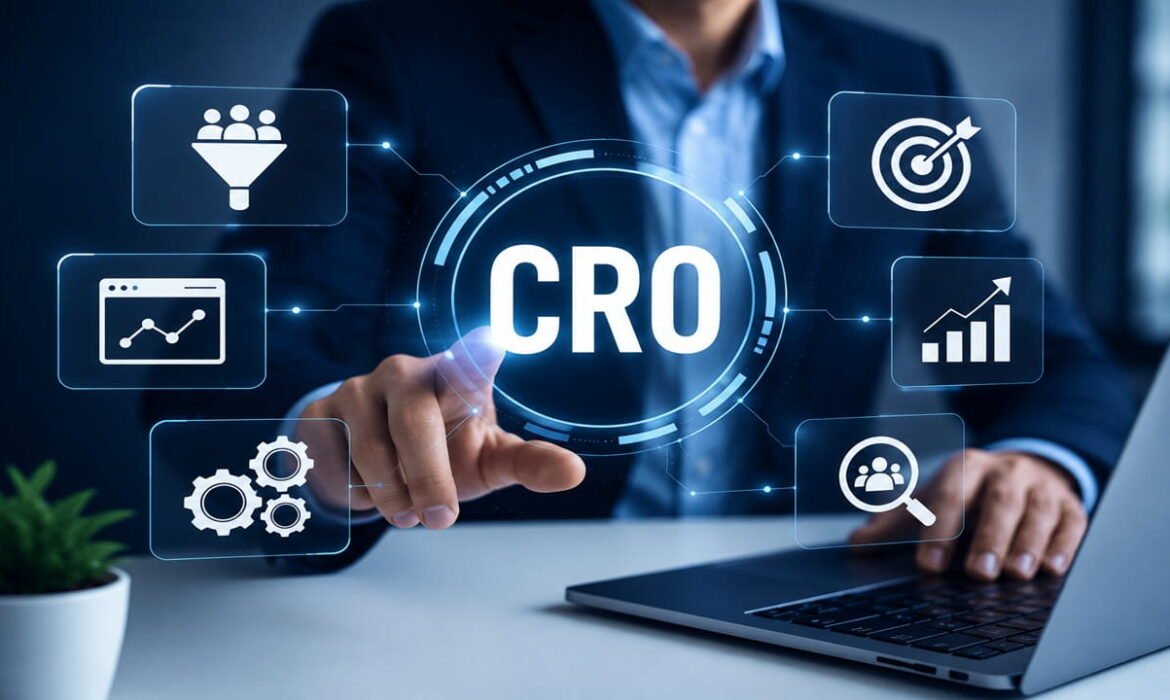
Conversion Rate Optimization Services: Increase Sales Without More Traffic In 2026
Most businesses obsess over traffic. More ads, more SEO, more social posts pour more people into the funnel and hope some of them buy. But here’s the uncomfortable truth that most digital agencies won’t say out loud: if your website is broken, more traffic just means more wasted money.
That’s exactly where Conversion Rate Optimization steps in.
CRO isn’t a buzzword. It’s a disciplined, data-driven methodology that examines why visitors leave without buying, signing up, or calling and then systematically fixes those friction points. When done right, Conversion Rate Optimization Services can double or even triple your revenue without increasing your ad spend by a single rupee.
At Arihant Global Services, we’ve been running CRO campaigns for businesses across India since 2013 ecommerce brands in Delhi, SaaS companies in Bangalore, real estate portals in Jaipur, healthcare providers in Mumbai. The patterns we’ve seen across thousands of hours of session recordings and A/B tests are consistent. most Indian websites are leaving 60–80% of their potential revenue sitting on the table.
This guide covers exactly how we fix that.
What Is Conversion Rate Optimization? (And Why Your Business Needs It Now)
| Conversion Rate Optimization (CRO) is the systematic process of increasing the percentage of website visitors who complete a desired action a purchase, form submission, phone call, or sign-up without increasing traffic. It combines qualitative research (user interviews, session recordings, heatmap analysis) with quantitative testing (A/B testing, split testing, conversion analytics) to identify and eliminate friction from the customer journey. Formula: Conversion Rate = (Total Conversions ÷ Total Visitors) × 100 |
In India, most online shopping sites convert only about 1–2% of their users into buyers. This is slightly less than the worldwide average, and the reasons are well-known: customers favor cash on delivery, many sales fail due to a high return rate and a cumbersome mobile checkout process. All of these problems make it more difficult for online retailers to convert potential customers into real ones.
A mid-size Indian ecommerce brand doing ₹50 lakhs in monthly revenue at a 2% conversion rate, with 25,000 monthly visitors, would add ₹25 lakhs per month in additional revenue just by reaching 3%. No new ad campaigns. No new products. Just fixing what’s already broken.
That’s the core premise of Conversion Optimization, your existing traffic is worth more than you think. The job of a CRO agency is to extract that value systematically.
Website Conversion Optimization covers every surface a visitor touches the homepage, category pages, product pages, landing pages, checkout flow, forms, and the micro-interactions in between. Each of these is a potential leakage point in your conversion funnel, and each one can be tested, measured, and improved.
How Our CRO Services Work The Arihant Global 4-Phase Framework
We don’t run CRO campaigns on gut feeling. Every engagement starts with a structured four-phase framework built around data, hypotheses, experimentation, and iteration. Here’s what that looks like in practice.
| 01 | Conversion Audit & Funnel Mapping
Deep dive into 90 days of behavioral data, heatmap analysis, session recordings, and funnel drop-off rates to identify exactly where visitors are leaving and why. |
| 02 | Research & Hypothesis Building
Qualitative research exit surveys, customer interviews, cohort analysis translated into a prioritized, evidence-backed hypothesis backlog. Every test idea is documented with expected impact and rationale. |
| 03 | A/B Testing & Split Testing Execution
Controlled experiments with pre-determined sample sizes and statistical significance thresholds. Mobile conversion optimization runs as its own dedicated test stream. |
| 04 | Analysis, Learning & Iteration
Segmented conversion analytics, cross-channel reporting, and systematic knowledge capture that feeds the next hypothesis cycle. |
What We Optimize A Complete Breakdown of Conversion Rate Optimization Services
Website Conversion Optimization
Structurally, website conversion optimization covers the entire visitor journey, built and tested one stage at a time, with changes flowing from actual behavior data, not guesswork.
Here’s roughly how it plays out:
- Top of the funnel (landing): Message match, page speed, and first-impression clarity
- Middle of the funnel (browsing): Navigation, internal linking, product or service page clarity
- Bottom of the funnel (checkout/form): Field reduction, trust signals, and removing last-step surprises
None of this works if heatmaps and session recordings aren’t actually being watched without that, “optimization” is just three disconnected design opinions pretending to be a strategy. Getting the tracking and data collection right isn’t the fun part of website conversion optimization, not even close, but literally everything else depends on it.
Landing Page Optimization
Landing pages are the highest-leverage surfaces in your entire funnel. A visitor who clicks your Google Ad has declared intent they’re looking for exactly what you sell. Landing Page Optimization ensures that intent is met with a frictionless, persuasive experience that converts.
We optimize landing pages across five dimensions: message match (does the page headline match the ad copy?), value proposition clarity, trust signal placement, form design, and page load speed. Our landing page tests consistently show that reducing form fields from seven to four and adding a single trust badge above the fold can improve Lead Conversion Optimization rates by 25–40%. For clients running paid media, Landing Page Conversion improvements compound with ad performance a better Quality Score means lower CPCs and better placement across Google’s auction.
Ecommerce Conversion Rate Optimization
The checkout and product pages the actual point of ecommerce conversion rate optimization are where most of the real work happens, because small tweaks here have outsized effects on revenue.
A few levers that consistently move the needle:
- Upfront shipping costs, shown early instead of sprung on people at the last step
- Fewer checkout fields, cut down to only what’s genuinely needed
- Guest checkout, used honestly, so first-time buyers aren’t forced into account creation
- Reviews and size guides placed right where hesitation naturally shows up on the product page
Cart abandonment tends to matter most at this stage not just how many people add to cart, but what’s actually stopping them from finishing. A store losing seven out of ten carts isn’t really “converting slowly.” It’s just leaking revenue every single day the leak goes unfixed.
Lead Generation Optimization
For B2B and service businesses, the conversion event is a lead, not a purchase. Lead Generation Optimization requires a distinct set of hypotheses form length, field type, the offer (demo vs. free trial vs. consultation), placement within content, and the trust signals that make a visitor willing to hand over their contact information.
We’ve found that for Indian B2B audiences, WhatsApp-based lead capture often outperforms traditional web forms by 40–60%. Integrating a WhatsApp CTA alongside a standard form and testing which attracts higher-quality leads is now a standard component of our Lead Conversion Optimization playbook across verticals.
Call-to-Action Optimization
Call-to-Action Optimization isn’t just about button color, though color contrast and size matter for accessibility and visibility. It’s about the verb: “Submit” converts worse than “Get My Free Audit.” Urgency-framed CTAs convert better in some contexts and worse in others. We test CTA copy, placement, size, color, proximity to trust signals, and repetition frequency throughout scroll depth treating each CTA as a micro-conversion event with its own funnel.
Heatmap Analysis & Session Recording
Before running a single test, we need to understand how real visitors actually use your site not how you think they do. Heatmap Analysis reveals where users click, how far they scroll, and which content captures attention. Session Recording shows individual visitor journeys, including rage-clicks (a strong signal of frustration), dead clicks, and form abandonment behavior.
These tools we use Hotjar, Microsoft Clarity, and Lucky Orange depending on client scale and privacy requirements provide the qualitative evidence that makes every A/B test hypothesis credible rather than arbitrary.
CRO Metrics That Actually Matter
Key Conversion Rate Optimization Metrics
| • Overall Conversion Rate primary KPI (purchases, leads, calls) |
| • Revenue Per Visitor (RPV) most holistic CRO metric |
| • Bounce Rate Reduction percentage of single-page sessions |
| • Click Through Rate Optimization CTR on CTAs and internal links |
| • Average Order Value (AOV) revenue per conversion event |
| • Cost Per Acquisition (CPA) ad spend ÷ conversions |
| • Form Completion Rate form starters who submit |
| • Cart Abandonment Rate ecommerce funnel leak metric |
| • Conversion Analytics by device, source, and geography |
| • Customer Acquisition Optimization cost trends over test cycles |
We report on a weekly cadence during active test cycles and monthly for ongoing optimizations. Every report includes a test registry (what’s live, completed, in the backlog), statistical significance levels for completed tests, revenue impact attribution, and next-steps recommendations.
One metric we emphasize with every client Revenue Per Visitor. Unlike conversion rate alone, RPV captures both the volume and the value of conversions which means a test that slightly reduces conversion rate but attracts higher-value customers can still win on the metric that matters most to your bottom line.
Why Choose Arihant Global as Your Conversion Rate Optimization Agency?
There’s no shortage of agencies offering Conversion Rate Optimization Services in India. Most of them run a handful of color-change tests, declare a 10% improvement in CTR, and invoice you for “CRO.” That’s not what we do.
Arihant Global has been a full-service digital marketing and CPaaS agency since 2013. We hold ISO 9001:2015 certification for quality management and ISO 27001:2022 certification for information security which matters when we’re embedded in your analytics stack and have direct visibility into revenue data.
Our CRO agency team has worked across ecommerce, real estate, healthcare, education, SaaS, and financial services verticals across markets in Jaipur, Delhi, Mumbai, Bangalore, and Hyderabad. That breadth means our hypothesis library is genuinely informed by what works in Indian markets, not just recycled learnings from Western case studies applied without localization.
We operate as a true CRO Agency with a dedicated conversion practice not a design shop that runs tests on the side, and not a media agency trying to justify retainer value with optimization theatre.
Frequently Asked Questions About Conversion Rate Optimization Services
Q1. How long does it take to see results from Conversion Rate Optimization?
Most clients see statistically significant test results within 4–6 weeks of the audit phase completing. However, the real compounding impact of CRO where wins stack on top of each other typically shows up at the 3–6 month mark. CRO is not a one-time project; it's an ongoing engagement that compounds in value over time.
Q2 : What is a good conversion rate for an Indian website?
Benchmarks vary significantly by industry. Ecommerce averages 1.5–3%. B2B lead generation sites typically run 2–5% on well-optimized landing pages. SaaS free trial pages can reach 8–15% when properly optimized. Rather than chasing a benchmark, we focus on your specific baseline and build a roadmap to improve it measurably quarter over quarter.
Q3: What traffic volume do I need for CRO to work?
A/B testing requires minimum traffic to achieve statistical significance. As a rough guide, you need at least 1,000 monthly visitors per page being tested to run meaningful experiments. For lower-traffic sites, we use a qualitative-first approach deep user research, expert review, and best-practice implementation before layering in testing as traffic grows.
Q4. How is CRO different from SEO?
SEO increases the quantity and quality of traffic arriving at your site. CRO increases what happens after they arrive. The two are complementary better-converting pages also tend to have lower bounce rates and higher engagement metrics, which are indirect SEO signals. A combined SEO + CRO strategy consistently outperforms either discipline alone.
Q5: Do you offer CRO Services for mobile apps?
Yes. Mobile Conversion Optimization covers both mobile web experiences and native app onboarding and purchase flows. App CRO typically involves Firebase A/B testing integration and focuses on onboarding completion rates, in-app purchase flows, and notification opt-in optimization for Android and iOS.
Ready to Stop Leaving Revenue on the Table?
Every visitor who lands on your website and leaves without converting represents money you’ve already spent to acquire through ads, through SEO effort, through content that returned nothing.
Conversion Rate Optimization is the discipline that recovers that value. It’s not glamorous. It’s not the sort of thing that makes for exciting pitch decks. But it is, consistently, the highest-ROI investment a business with existing digital traffic can make and the results compound in a way that paid media spend simply cannot replicate.
If you’re ready to stop leaving revenue on the table, our Conversion Rate Optimization Agency is ready to start with a free audit of your highest-traffic pages.
| Get Your Free CRO Audit
Identify your top 3 conversion leaks free, no obligation. |
Disclaimer
The insights and examples in this article are based on industry experience and best practices. Individual outcomes may differ depending on website quality, user behavior, implementation, and market conditions.

Social Media Branding: Look Like the Same Business on Every Platform
Most businesses don’t go looking for help with social media branding because their profiles are empty. They go looking because their profiles are active but inconsistent a different tone on Instagram than LinkedIn, a logo that’s slightly off across platforms, captions that read like three different people wrote them. Usually that’s not a content problem. It’s that nobody defined what the brand should actually look and sound like before posting started.
Why Businesses Still Need Deliberate Social Media Branding
Posting regularly has become the easy part. Posting in a way that consistently reinforces the same brand, regardless of which platform or which team member is behind the account that week, is the part most businesses skip past. A profile with a slightly different logo crop, inconsistent colors, and a tone that swings from formal to casual post to post doesn’t look broken from the inside every individual post might be fine. But across a feed, that inconsistency quietly erodes the recognition and trust a strong brand presence is supposed to build.
Social media branding exists to prevent that drift a defined visual identity and voice applied consistently across every platform and every post, so the brand is instantly recognizable regardless of where someone encounters it. Without that consistency, the usual symptom is a business that posts often but never quite builds the recognition that consistent branding compounds into over time.
What Is Social Media Branding?
Social media branding is the strategic practice of building a consistent, recognizable identity for a business or individual across social platforms using unified visuals, tone of voice, messaging, and content to shape how audiences perceive and connect with the brand.
Consistent social media branding increases brand recognition by up to 3.5×, reduce cost per lead, and is a direct ranking signal for AI-powered discovery on platforms like Google SGE, Perplexity, and ChatGPT Search.
A few things that separate branding that actually builds recognition from branding that exists only on paper:
- A defined visual system colors, fonts, logo usage documented once and applied the same way across every platform
- A consistent tone of voice, whether that’s formal, playful, or somewhere between, used the same way regardless of who’s writing
- Content pillars that reflect what the brand actually stands for, not just whatever’s easy to post that week
- Profile elements bio, profile photo, cover image kept aligned and updated together, not drifting out of sync over time
Skipping any of these tends to surface slowly, as a brand that’s been posting for years but still doesn’t feel instantly recognizable compared to competitors with a tighter, more consistent presence.
Brand Identity on Social Media Beyond Just a Logo
A logo alone isn’t a brand identity it’s one piece of a larger system. Brand identity on social media covers everything that signals who a business is at a glance, before someone even reads a single caption.
This is where the visual and strategic groundwork lives:
- A color palette used consistently across graphics, templates, and highlight covers, not varied post to post
- Typography choices that stay consistent across platforms, reinforcing recognition even without a logo visible
- A defined brand personality approachable, authoritative, playful that shapes every decision from caption tone to imagery style
- Consistent profile elements across platforms, so a follower moving from Instagram to LinkedIn still recognizes the same business immediately
Without this groundwork, a brand can post high-quality content and still fail to build the kind of instant recognition that comes from consistent, repeated exposure to the same identity.
The Social Media Branding Management Table
| Task | Frequency | Why It Actually Matters |
| Brand consistency audit | Monthly | Catches drift in visuals or tone before it spreads across more posts |
| Engagement and recall review | Monthly | Flags whether branding is actually building recognition, not just activity |
| Competitor branding review | Quarterly | Surfaces where a brand’s presence blends in versus stands out |
| Content pillar refresh | Quarterly | Keeps pillars aligned with what the brand and audience actually need |
| Brand guideline update | Quarterly | Ensures guidelines reflect any evolution in visual identity or voice |
| Reporting & strategy call | Monthly | Keeps branding efforts tied to actual recognition and engagement data |
Social Media Visual Branding That Holds Up Across Every Platform
Each platform has different dimensions, formats, and audience expectations, which makes social media visual branding genuinely harder to maintain than it looks. A visual identity that works on Instagram doesn’t automatically translate cleanly to LinkedIn or Facebook without deliberate adaptation.
The elements that need to stay consistent while adapting to each platform:
1. Templates built per platform
same color and font system, adjusted for each platform’s actual dimensions and format norms
2. Consistent imagery style
whether that’s photography, illustration, or a specific filter treatment, applied the same way everywhere
3. Highlight covers and pinned content
small details that reinforce identity for anyone browsing a profile rather than just scrolling a feed
4. Video branding elements
intro frames, lower thirds, or consistent caption styling carried across Reels, Shorts, and other video formats
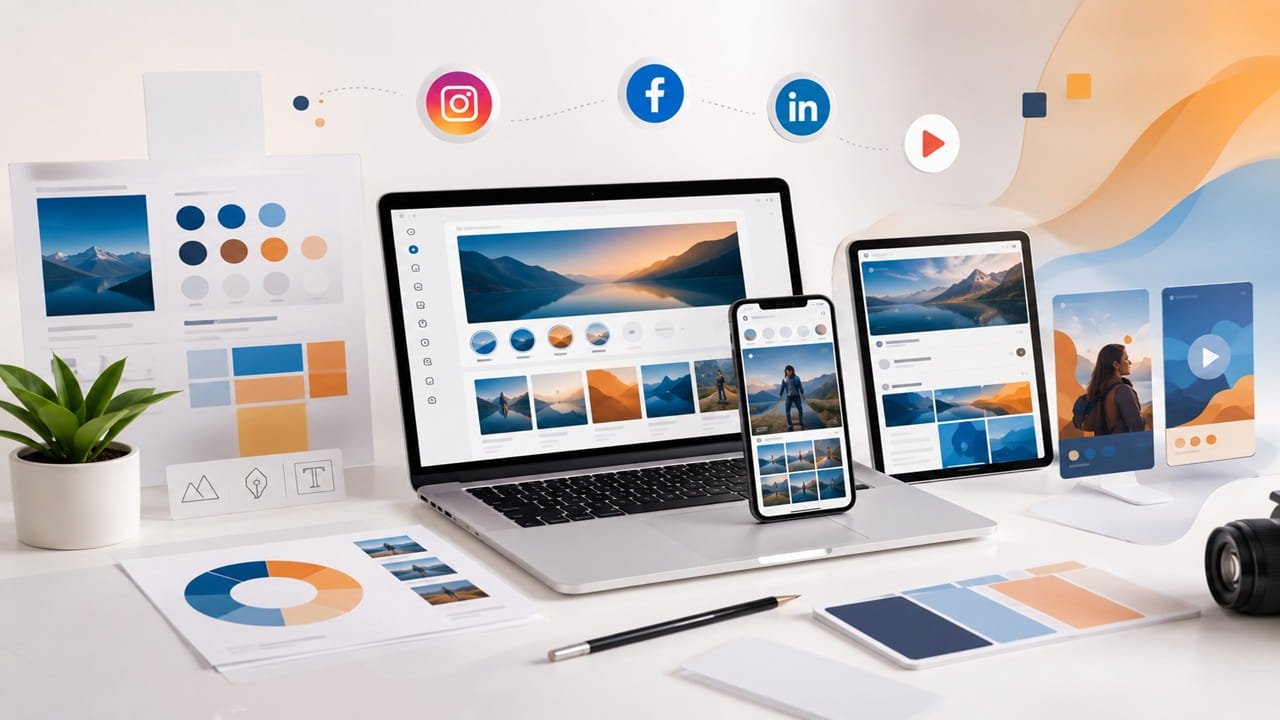
A brand that only maintains visual consistency on its primary platform tends to look noticeably less polished the moment a follower checks a secondary one.
Social Media Brand Voice: Sounding Like One Business, Not Several
Visual consistency gets most of the attention, but social media brand voice matters just as much for recognition and it’s often the first thing to slip when multiple people manage an account. A defined tone of voice keeps captions, replies, and comments sounding like the same business, regardless of who’s typing.
- A documented tone guide covering formality level, humor use, and preferred phrasing, so new team members can match it quickly
- Consistency in how the brand responds to comments and messages, not just in original posts
- A voice that adjusts slightly by platform context LinkedIn typically more formal than Instagram while staying recognizably the same brand underneath
- Regular review of captions against the tone guide, catching drift before it becomes the new normal
Why Social Media Branding Services Delivers Stronger ROI Than Inconsistent Posting
Posting without consistent branding still builds some engagement, but it rarely builds recognition the kind where someone can identify a post as belonging to a specific business before reading the caption. Consistent branding compounds that recognition over time, which tends to lower the effort needed to convert engagement into actual trust and, eventually, sales.
Common Social Media Branding Mistakes Businesses Make
The same handful of issues, across nearly every profile that feels inconsistent:
- No documented brand guidelines, leaving visual and tone decisions up to whoever’s posting that day
- Logo, colors, or fonts that vary slightly across platforms or even across posts on the same platform
- Tone of voice that shifts dramatically between formal and casual with no clear reasoning
- Content pillars that don’t reflect what the brand actually wants to be known for
- Profile elements bio, cover image, highlights left outdated after a rebrand or repositioning
- Treating branding as a one-time setup instead of something audited and refreshed periodically
Industries That Benefit Most
Social media branding holds up across a wide range of sectors, though the specific visual and tone approach shifts by industry:
- Ecommerce
- Hospitality & Travel
- Healthcare & Wellness
- Real Estate
- Professional Services
- Fashion & Beauty
- Fitness
- Education
- Food & Beverage
- SaaS
Ecommerce and fashion tend to lean heavily on strong visual identity systems, while professional services and healthcare lean more on consistent tone and trust-building voice.
Social Media Branding Agency That Cover Identity Through Execution
For businesses that want this handled end-to-end, not just designed once and left alone, that’s the scope of proper social media branding agency support:
1. Brand identity development
visual system, tone of voice, and content pillars defined and documented before any posting strategy begins
2. Platform-specific application
templates and guidelines adapted for each platform while keeping the identity consistent across all of them
3. Ongoing management
consistency audits, guideline updates, and refreshes as the brand or platforms evolve
A provider that only delivers a one-time brand guide and steps away leaves a business to enforce that consistency alone, which is often exactly where the drift started in the first place.
How Arihant Global Delivers Better Social Media Branding Results
At Arihant Global, no content goes out before a documented visual identity and tone guide are in place. That groundwork gets skipped often elsewhere, and it’s usually the reason a brand’s social presence feels active but forgettable. Once that foundation is solid, platform-specific templates and content get built around it, not designed fresh and inconsistently for each new post.
Our Social Media Branding Strategy Process
- Brand Discovery & Positioning Review
- Visual Identity System Development
- Tone of Voice Guideline Creation
- Content Pillar Definition
- Platform-Specific Template Design
- Profile Optimization Across Channels
- Team Guideline Handoff & Training
- Launch & Consistency Monitoring
- Ongoing Content Support
- Quarterly Brand Audit
Frequently Asked Questions – social media branding
Q1. What's the difference between social media branding and social media marketing?
social media Branding focuses on consistent visual identity and voice across platforms, while social media marketing focuses more on campaigns, ads, and driving specific actions strong marketing tends to underperform without solid branding behind it.
Q2. How long does it take to build a social media brand identity?
Typically two to four weeks for the initial visual system and tone guide, with platform-specific templates following shortly after.
Q3. Does social media branding require a full company rebrand?
No social media branding can be built around an existing brand identity, adapting it specifically for social platforms without changing the core brand itself.
Q4. How is social media branding consistency measured?
Through regular audits comparing posts against the documented guidelines, along with engagement and brand recall metrics over time.
Q5. Does brand voice need to be identical across every platform?
Not identical, but recognizably consistent tone can adjust slightly for platform context while staying unmistakably the same brand underneath.
Q6. Which industries benefit most from strong social media branding?
Ecommerce, hospitality, and fashion tend to see the strongest visual impact, while professional services and healthcare see more benefit from consistent tone and trust-building.
Conclusion
If your social profiles feel active but inconsistent from platform to platform, that’s a common and fixable place to be. Arihant Global works with ecommerce, hospitality, and professional services to build branding Strategy that’s consistent, recognizable, and built to compound trust over time. Reach out and let’s map out what your brand should look and sound like everywhere it shows up.
Disclaimer
The information shared in this article is intended for general educational and informational purposes only. Branding strategies, social media platforms, algorithms, and best practices evolve over time, so results may vary depending on your industry, audience, competition, and implementation.

Customer Acquisition Cost: The Real Cost of Getting a New Customer in 2026 (And How to Bring It Down)
At some point, almost every business owner has the same slightly annoying realization: getting a new customer used to cost less than it does now. Same product, same offer, sometimes even the exact same ad but the number at the bottom keeps creeping up anyway. That number has a name, and actually understanding it is the first real step toward fixing it. It’s called Customer Acquisition Cost, or CAC, and it’s quietly one of the most important numbers in any business whether anyone’s actually tracking it properly or not.
What is Customer Acquisition Cost(CAC)?
Customer Acquisition Cost is pretty much what it sounds like the average amount of money a business spends to win one new paying customer. Simple concept, genuinely. But here’s the catch: most businesses either don’t calculate it at all, or they calculate it wrong, usually because they only count ad spend and quietly ignore everything else that actually went into landing that customer.
And that matters more than it sounds like it should. A business can look like it’s growing revenue’s up, orders are up and still be bleeding money underneath, if the cost to get each new customer keeps rising faster than what that customer’s actually worth. Growth without profitability isn’t really growth. It’s just spending wearing a nicer outfit. CAC is the number that stops that disguise from working.
People throw around a few related terms alongside CAC, and honestly, it’s worth untangling them, because businesses mix these up all the time:
- CAC (Customer Acquisition Cost): The full cost to acquire one paying customer marketing and sales combined
- CPA (Cost Per Acquisition): Often used interchangeably with CAC, though sometimes it refers to just one conversion event, not necessarily a paying customer
- CPL (Cost Per Lead): What it costs to generate a single lead, before that lead has become a customer at all
- CPC (Cost Per Click): Cost per click on an ad a much earlier, narrower number
A business that’s only watching CPC or CPL is really only seeing a slice of the picture. Clicks are cheap. Leads can look great sitting in a dashboard. Neither one tells you whether you’re actually making money on the customers you’re bringing in. CAC is the number that closes that gap and forces some honesty into the conversation.
Customer Acquisition Cost Formula
The basic Customer Acquisition Cost formula is pretty straightforward:
CAC = Total Sales & Marketing Costs ÷ Number of New Customers Acquired
That’s the quick version, and it’s a fine place to start. But if you want a number you can actually trust, it needs to include more than just what got spent on ads. A proper CAC calculation should fold in:
| Cost Category | What It Includes |
| Ad Spend | Google Ads, Meta Ads, LinkedIn Ads, and any other paid channels |
| Marketing Salaries | Time and salary of the marketing team working on acquisition |
| Sales Salaries | Time and salary of the sales team closing new customers |
| Tools & Software | CRM, ad platforms, analytics tools, landing page builders |
| Agency Fees | Any external agency or freelancer cost tied to acquisition |
| Content & Creative | Production cost of ads, videos, landing pages, and copy |
Example calculation:
Say a business spent ₹5,00,000 in a month ad spend, marketing salaries, a slice of the sales team’s time and acquired 100 new customers in that same stretch.
CAC = ₹5,00,000 ÷ 100 = ₹5,000 per customer
On its own, that number doesn’t really tell you much yet. It only starts to mean something once you weigh it against what that customer is actually worth over time which is exactly why nobody really talks about CAC without LTV showing up in the same sentence sooner or later.
One thing that trips people up constantly: calculating CAC using this month’s new customers against this month’s ad spend, without accounting for the lag between spending the money and actually closing the sale. For businesses with a longer sales cycle, this can make CAC look weirdly high or low depending on the month you happen to check. A rolling average over 3-6 months almost always gives a more honest number than any single month on its own.
How to Reduce Customer Acquisition Cost
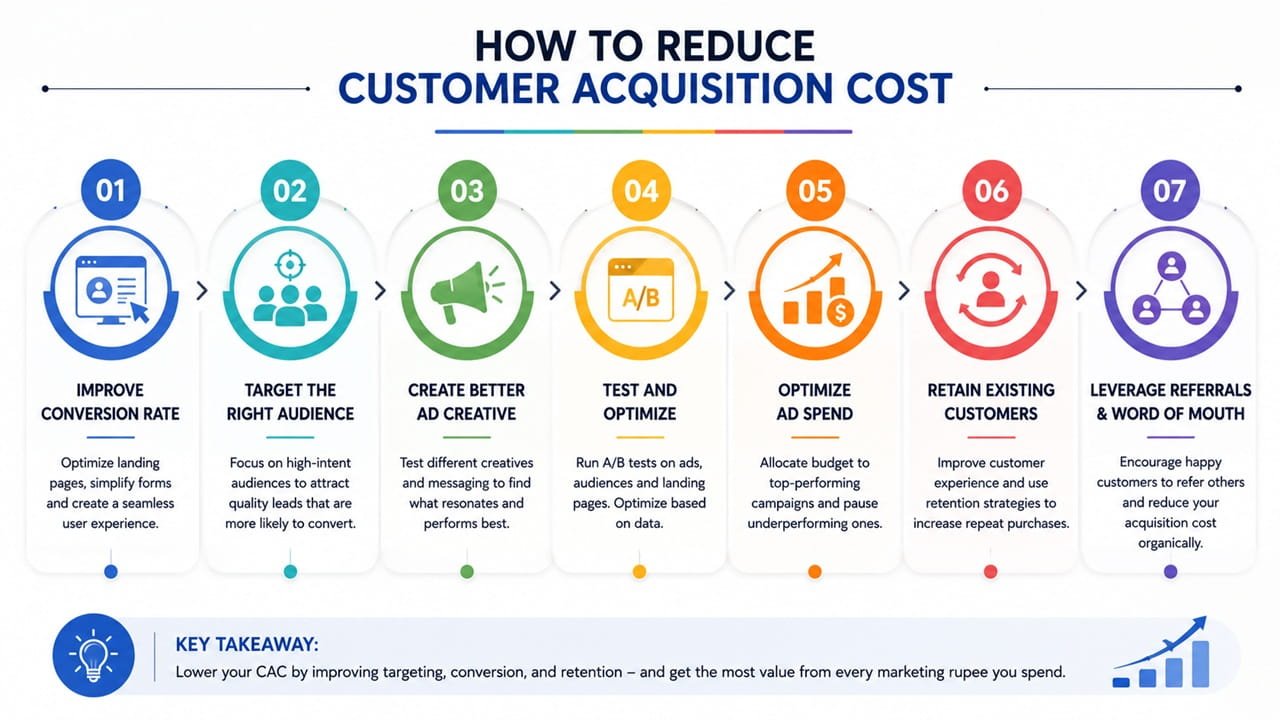
This is really the part everyone actually cares about not just knowing the number, but bringing it down without wrecking the quality or volume of customers coming through the door. A few things consistently move the needle:
1. Fix conversion rate before you touch the ad budget
Most businesses respond to rising CAC by spending more on ads, which almost always makes things worse, not better. If a landing page converts at 1% and gets fixed to convert at 2%, CAC effectively gets cut in half without spending one extra rupee on traffic. It’s usually the fastest, cheapest lever sitting right there, and it’s the one most businesses skip in favor of just throwing more budget at the top of the funnel.
2. Chase lead quality, not just lead volume
A campaign pumping out cheap leads that never actually convert isn’t cheap at all the cost just moves further down the funnel where it’s harder to spot. Tightening targeting, adjusting the ad messaging so it pre-qualifies interest, being more specific about who the offer is even for this usually pushes CPL up slightly while dropping CAC significantly, because far fewer of those leads go nowhere.
3. Build organic channels alongside the paid ones
SEO, content, and organic social all cost something upfront, sure, but they don’t scale linearly with volume the way paid ads do. A blog post or a piece of ranking content keeps quietly generating leads for years after it’s published, pulling the blended CAC down over time while paid spend just sits flat.
4. Fix the sales handoff, not only the marketing
Sometimes the real leak isn’t in the ads at all it’s in how slowly, or how badly, leads get followed up with once marketing hands them off. A lead sitting untouched for two days is basically a lead that’s already gone cold, and that lost sale quietly inflates CAC even though marketing technically did its job.
5. Retarget instead of endlessly chasing cold traffic
Cold audiences convert at a fraction of what warm ones do. Retargeting people who’ve already shown some interest is almost always cheaper per conversion than constantly finding brand-new cold traffic yet a lot of budgets stay stubbornly weighted toward the top of the funnel out of habit more than strategy.
6. Let automation carry some of the manual work
Automated email sequences, chatbot qualification, CRM-triggered follow-ups all of it reduces the human hours needed per conversion, which quietly lowers the labor side of CAC. It’s a part businesses forget to even count in the first place.
7. Compare channels properly, not in isolation
A channel that looks expensive on CPC alone might actually have a lower CAC than a “cheap” channel once conversion rate and customer quality get factored in. Judging channels purely on cost-per-click or cost-per-lead, without following the number all the way through to CAC, is one of the easiest ways to accidentally pour money into the wrong place.
Customer Acquisition Cost vs Customer Lifetime Value
CAC on its own only tells half the story. The other half is Customer Lifetime Value (LTV) basically, the total revenue you can expect from one customer across the entire time they stick around, not just their first purchase.
The relationship between the two is really what tells you whether a business is healthy or quietly in trouble:
| Scenario | CAC | LTV | What It Means |
| Healthy | ₹5,000 | ₹20,000 | Strong 4:1 ratio, sustainable growth |
| Break-even | ₹5,000 | ₹5,500 | Barely profitable, no room for error |
| Unsustainable | ₹5,000 | ₹3,000 | Losing money on every new customer |
Most growth-focused businesses aim for an LTV to CAC ratio of at least 3:1 meaning a customer is worth at least three times what it cost to bring them in. Fall below that and something’s off pricing, retention, or just inefficient spending on acquisition. Go well above 5:1, and some would argue you’re actually under-investing in growth, since each customer’s clearly profitable enough to justify spending more to get more of them.
Here’s the part that gets missed a lot, though: you can win by lowering CAC, or you can win by raising LTV both move the ratio in the right direction. A business that’s really struggling to bring down its acquisition cost might get further, faster, by focusing on retention or repeat purchases instead of fighting the ad platforms for slightly cheaper clicks. Sometimes the smarter move isn’t spending less to get a customer in the door it’s making them worth more once they’re already there.
Customer Acquisition Cost Optimization
Customer Acquisition Cost optimization isn’t really a one-time fix you do and forget. It’s more of an ongoing habit watching where the money’s going, what it’s actually producing, and adjusting continuously instead of setting a budget once a year and hoping it holds up.
A structured approach to CAC optimization usually looks something like this:
- Channel-level tracking, so you actually know which specific platform, campaign, or even ad creative is producing customers at the lowest cost instead of looking at CAC as one blended average that quietly hides where the waste really is
- Attribution modeling, since a customer often touches several channels before they convert, and giving all the credit to the last click badly distorts which channels are doing the actual work
- Ongoing CRO work on landing pages and checkout, since conversion improvements compound across every channel at once instead of needing to be fixed one channel at a time
- Retention and reactivation efforts, which quietly lift LTV and improve the overall ratio without touching the acquisition side at all
- Constant A/B testing of offers, creative, and targeting, since whatever worked to bring in cheap customers six months ago tends to stop working as audiences saturate or competitors adjust their own bidding
The businesses that actually keep CAC under control long-term treat it like any other core financial number reviewed monthly, broken down channel by channel, tied straight back to profitability. Not something tracked once in a spreadsheet and never opened again.
Factors That Increase Customer Acquisition Cost
- A handful of things quietly push CAC up, often without anyone noticing until the number’s already uncomfortable:
- More competitors bidding on the same keywords or audiences, pushing ad costs up across the board
- A weak landing page or clunky checkout, wasting traffic that was already paid for
- Loose targeting, generating clicks or leads that were never going to convert in the first place Slow or inconsistent sales follow-up,
- letting warm leads go cold before anyone closes them Leaning too hard on one paid channel,
- with no organic layer or retargeting to bring the blended cost down Seasonal dips in demand, where the exact same ad spend just produces fewer customers for a stretch
Common Customer Acquisition Cost Mistakes
Same handful of issues, over and over, across most businesses whose CAC keeps quietly climbing:
- Only counting ad spend in the formula and forgetting salaries, tools, and agency fees.
- Chasing more traffic before ever fixing conversion rate.
- Never checking CAC against LTV, so there’s no real sense of whether the number’s even a problem.
- Treating every channel’s CAC as identical instead of breaking things down channel by channel.
- Letting leads sit too long before follow-up, wasting money that was already spent to generate them.
- Just raising the budget when costs go up, instead of figuring out what’s actually broken underneath.
Customer Acquisition Cost by Industry
CAC swings quite a bit depending on the business model, the sales cycle, and how much an average order is actually worth:
| Industry | Typical CAC Range | Why |
| Ecommerce | Lower to Moderate | Shorter sales cycle, impulse-driven purchases |
| SaaS | Moderate to High | Longer sales cycle, trials and demos before conversion |
| Healthcare | High | Compliance requirements, longer decision-making |
| Real Estate | High | High-ticket, long consideration period |
| Education | Moderate | Seasonal demand, longer research phase |
| B2B Services | High | Multiple decision-makers, longer sales cycles |
A Customer Acquisition Cost for ecommerce business tends to sit lower simply because the buying decision happens fast and price points are usually smaller. A Customer Acquisition Cost for SaaS or B2B business is almost always higher, since the sales cycle drags in more touchpoints, more convincing, often a real human sales conversation before anyone actually signs. Neither is “better” on its own a high CAC is perfectly fine as long as LTV is strong enough to carry it.
How Arihant Global Helps Businesses Lower CAC
At Arihant Global, CAC never gets treated as one lonely number sitting on a dashboard somewhere it’s treated as the end result of everything else working, or not working, correctly. Targeting, landing page conversion, how fast a lead actually gets a follow-up call all of it feeds into that final number. Tracking comes first, always, because a CAC calculation built on shaky data is really just a guess wearing a metric’s clothes. From there, it’s ongoing work breaking CAC down channel by channel, testing landing pages and offers, tightening up targeting wherever quality’s weak, and making sure retention and repeat purchases are pulling their weight on the LTV side too, instead of leaving acquisition to carry the entire load alone.
Our Customer Acquisition Cost Optimization Process
- Business & Cost Structure Discovery
- Current CAC & LTV Baseline Calculation
- Channel-Level Performance Audit
- Landing Page & Conversion Rate Review
- Audience & Targeting Refinement
- Attribution Model Setup
- Retention & LTV Strategy Alignment
- Campaign & Creative Testing
- Sales Follow-Up Process Review
- Ongoing Monitoring & Monthly Reporting
Metrics Worth Tracking Alongside CAC
| Metric | What It Reveals |
| LTV | Total revenue potential per customer over time |
| LTV:CAC Ratio | Whether acquisition spend is actually sustainable |
| Conversion Rate | Whether traffic is turning into customers efficiently |
| Payback Period | How long it takes to recover the cost of getting that customer |
| Channel-Level CAC | Which specific channels are producing customers most efficiently |
Real Case
A Jaipur-based SaaS business came to Arihant Global with a CAC that had quietly crept up to around ₹18,000 per customer over six months, against an LTV of roughly ₹42,000 technically above the 2:1 mark, but uncomfortably close to unsustainable for their margins. Digging into the numbers, a channel audit showed nearly 40% of ad spend was going toward broad, loosely targeted campaigns generating leads that almost never converted. Narrowing the targeting, rebuilding the demo request landing page for clarity, and tightening the sales follow-up window from three days down to same-day brought CAC down to ₹11,200 within twelve weeks pushing the LTV:CAC ratio up to a much healthier 3.7:1, without cutting ad spend at all. Just spending it more carefully.
Frequently Asked Questions – Customer Acquisition Cost
Q1. What is Customer Acquisition Cost (CAC)?
It's the average amount a business spends, across both marketing and sales, to bring in one new paying customer.
Q2. Why is Customer Acquisition Cost important?
Because it tells you whether growth is actually profitable. A business can be steadily adding new customers and still be losing money if CAC is too high compared to what each customer's actually worth.
Q3. How do you calculate Customer Acquisition Cost?
Add up total sales and marketing costs ad spend, salaries, tools, agency fees, all of it and divide by the number of new customers acquired in that same period.
Q4. What is a good Customer Acquisition Cost?
There's no single "good" number, honestly it depends heavily on your industry and price point. What matters more is the ratio between CAC and LTV, with most healthy businesses aiming for at least 3:1.
Q5. What is the difference between CAC and CPA?
CAC usually covers the full cost of acquiring a paying customer, sales and overhead included. CPA tends to be narrower the cost of a single conversion event, which may or may not turn into a paying customer.
Q6. How does CAC compare with Customer Lifetime Value (LTV)?
CAC tells you what it costs to get a customer. LTV tells you what that customer's actually worth over time. Put them side by side and you know whether your acquisition spend is sustainable or not.
Q7. How can businesses reduce Customer Acquisition Cost?
Fix conversion rate before adding more ad spend, tighten targeting to improve lead quality, speed up sales follow-up, and lean into organic channels that lower the blended cost over time.
Q8. Which marketing channels typically have the lowest CAC?
Organic search, retargeting, and referral or repeat-customer channels usually come in lower than cold paid acquisition, since they're working with existing interest or trust instead of starting from zero.
Q9. Should businesses focus on lowering CAC or increasing LTV?
Either one moves the ratio in a healthier direction. A business that's stuck trying to lower acquisition cost directly often makes more progress by improving retention and repeat purchases instead.
Q10. What tools help measure Customer Acquisition Cost?
Google Analytics 4, CRM platforms like HubSpot or Zoho, and reporting straight from Google Ads and Meta Ads are usually used together to track CAC accurately across channels.
Conclusion
If your Customer Acquisition Cost has been quietly climbing and you’re not totally sure why, the answer usually isn’t “spend more” it’s understanding exactly where that money’s actually going and fixing it at the source. Arihant Global helps businesses calculate, track, and steadily bring down CAC across SEO, PPC, social media marketing, and conversion optimization. Reach out and let’s figure out exactly where your acquisition spend is working and where it really isn’t.
Lower your Customer Acquisition Cost without sacrificing growth. Arihant Global helps businesses optimize SEO, PPC, CRO, and analytics to acquire more profitable customers while maximizing every marketing rupee.
Get your free consultation today.
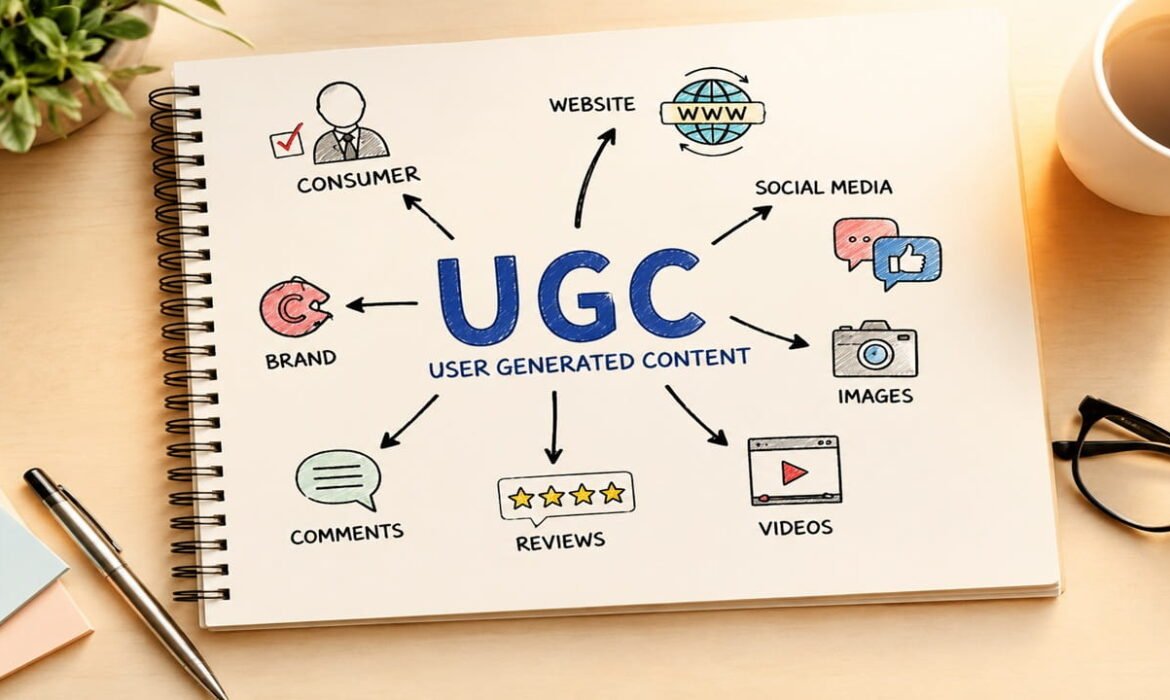
User Generated Content: Why the Best Marketing Often Isn’t Made By the Brand at All
Most brands eventually notice the same thing their own polished, professionally shot content doesn’t always outperform a shaky phone video from an actual customer talking about the product. That’s not a fluke. People trust other people more than they trust an ad, no matter how good the ad looks. That trust gap is exactly why user generated content has become less of a nice bonus and more of a core part of how brands actually market themselves now. The tricky part isn’t understanding why UGC works. It’s building a system that consistently gets it, without just waiting around and hoping customers post about you unprompted.
What is User Generated Content?
User generated content is, simply, anything created by real customers or fans rather than the brand itself a review, a photo, an unboxing video, a tweet, a Reel showing the product in actual use. What makes it valuable isn’t the production quality. It’s that it doesn’t look or sound like marketing, even though functionally, it absolutely is.
A quick way to spot whether a brand is actually using UGC well: check the last several posts on their feed or ads. Is there a mix of real customer content alongside the brand’s own? Or is everything clearly shot and scripted in-house? Accounts leaning entirely on polished brand content are usually leaving one of the most persuasive formats sitting completely untouched.
How User Generated Content (UGC) Improves Marketing Performance
Turning scattered customer content into an actual marketing channel takes more than just hoping people tag the brand occasionally. UGC marketing is the deliberate process of encouraging it, collecting it, and then actually putting it to work across ads, the website, and organic posts.
A workable UGC marketing approach usually includes:
- A clear, easy way for customers to actually share content a branded hashtag, a simple prompt at checkout, something low-effort
- Permission requests built into the process, so content can be reused without an awkward DM after the fact
- A system for actually collecting and organizing what comes in, instead of it getting lost in tagged posts nobody checks
- A plan for where that content actually gets used ads, the website, product pages, email
Without that last step, a lot of UGC just sits there being nice to look at and never actually does any work for the business.
What Are UGC Content Creators and Why Do Brands Hire Them?
Not every business gets enough organic UGC to work with, especially early on. That’s where UGC content creators come in people who create authentic-feeling, customer-style content specifically for a brand to use, without necessarily being an existing customer or having any real following themselves.
A few things worth knowing about this space:
- UGC Content creators are paid for the content itself, not for their reach the content usually gets used in the brand’s own ads and posts, not the creator’s
- It tends to be noticeably cheaper than traditional influencer marketing, since audience size isn’t part of the deal
- The best briefs still leave room for a natural, unscripted feel over-directed UGC-style content tends to look exactly like what it is, an ad in disguise
- It works especially well for performance ads, where that authentic, testimonial-style feel often outperforms polished brand creative
Genuine customer UGC and paid UGC-style content usually work best together, not as a choice between one or the other.
How User Generated Content Increases Ecommerce Sales
Ecommerce is where UGC tends to earn its keep the fastest, mostly because a shopper on a product page is actively trying to decide whether to trust what’s in front of them.
| UGC Placement | What It Does |
| Product page photos/videos from real customers | Builds trust right at the decision moment |
| Reviews with photos attached | Adds credibility beyond just star ratings |
| UGC-style ads (testimonials, unboxings) | Often outperforms polished brand ads in cost per result |
| Instagram Shopping tagged posts | Lets browsing turn into buying without leaving the app |
| Email featuring customer content | Reinforces trust for anyone still deciding |
A single well-placed customer video on a product page can move conversion rate more than another round of professional photography usually does.
When Should You Work with a UGC Marketing Agency?
At some point, collecting, organizing, and actually deploying UGC across every channel becomes more than an internal team can consistently manage, especially on top of everything else marketing requires. That’s usually when a UGC marketing agency actually earns its place.
What that tends to look like in practice:
- Setting up systems to actually collect UGC consistently, not just hoping it shows up
- Sourcing and briefing paid UGC creators to fill gaps where organic content is thin
- Handling usage rights and permissions properly, so nothing gets used without consent
- Testing UGC against brand-made content in ads, to actually prove which performs better rather than assuming
Common User Generated Content Marketing Mistakes to Avoid
- Never actually asking customers to create or share content, then wondering why there’s none
- Using UGC without getting proper permission first
- Over-scripting paid UGC creators until it stops feeling authentic
- Collecting UGC but never actually using it anywhere beyond the original post
- Treating all UGC the same, instead of testing what actually performs in ads versus what just looks nice organically
Industries That Benefit Most from User Generated Content
- Ecommerce
- Beauty & Skincare
- Fashion
- Food & Beverage
- Fitness & Wellness
- Travel & Hospitality
- Tech & Gadgets
Product-based businesses tend to see the fastest, clearest wins, though service businesses benefit too, usually through testimonials and client success stories.
How Arihant Global Builds High-Performing UGC Campaigns
At Arihant Global, UGC work starts with building an actual system for collecting content, rather than hoping it shows up on its own. That’s the unglamorous first step, and it gets skipped a lot elsewhere, but even the best UGC strategy falls flat without a steady, reliable way to gather it. Once that’s in place, the focus shifts to sourcing paid UGC creators where gaps exist, securing proper usage rights, and actually testing this content against brand-made creative in ads so decisions are based on what’s proven to work, not just what looks good.
Our User Generated Content Marketing Process
- Audience & Customer Discovery
- UGC Collection System Setup
- Paid Creator Sourcing (where needed)
- Permissions & Usage Rights Management
- Content Curation & Organization
- Deployment Across Ads, Site & Social
- Performance Testing
- Monthly Reporting
Frequently Asked Questions – User Generated Content
Q1. What counts as user generated content?
Basically anything a real customer or fan creates that features the brand, without the brand having produced it themselves a photo, a review with an image attached, an unboxing video, a tweet, a Reel showing the product in daily use. What makes it valuable is exactly that it wasn't made by the brand, which is part of why people trust it more than they trust something obviously scripted and shot in-house.
Q2. Why does UGC often outperform brand-made content?
Mostly because it doesn't look or feel like an ad, even though it's doing the same job. People have gotten fairly good at tuning out polished marketing, but a real customer talking about their actual experience reads as more honest, even if the production quality is nowhere close to professional. That perceived authenticity tends to translate into better trust and, often, better ad performance too.
Q3. What's the difference between UGC and influencer content?
Influencer content usually comes with an existing audience attached part of what's being paid for is that reach. UGC, whether organic or from a paid UGC creator, isn't really about reach at all; it's about the content itself being used elsewhere, typically in the brand's own ads or on its own channels. A UGC creator might have almost no following of their own and that's completely fine, since their followers were never the point.
Q4. Do I need permission to use customer content?
Yes, always, even if it feels like a formality for something small. A simple comment asking permission, or a note in the brand's terms about tagged content, usually covers it but using someone's photo or video in paid ads without any consent at all is a real risk, both from a trust standpoint and, depending on where the business operates, potentially a legal one too.
Q5. How do I get more customers to actually create content?
Usually by making it easy and giving them a reason to bother. A branded hashtag helps, but a specific prompt works even better asking for a photo at checkout, running a small incentive, or simply being the kind of brand that replies to and reshares customer posts. People are more likely to create content when they can see that someone's actually going to notice it.
Q6. Is paid UGC as effective as organic UGC?
Often, yes, especially in ads, since a well-briefed paid UGC creator can produce that same authentic, unscripted feel without a business having to wait around for real customers to post. The main thing to watch is over-directing the brief the second it feels scripted, it starts looking exactly like what it secretly is, and a lot of that trust advantage disappears.
Conclusion
If your brand’s marketing feels like it’s all coming from one voice yours that’s usually a sign UGC is an untapped opportunity, not a lost cause. Arihant Global can help build a system for collecting real customer content, sourcing the right paid creators to fill the gaps, and actually putting all of it to work across ads and social. Reach out and let’s talk through what that could look like for your brand.
Ready to Turn Customer Stories Into Marketing That Converts?
Build a UGC strategy that helps your brand collect authentic content, improve ad performance, and build stronger customer trust.
→ Talk to Arihant Global About Your UGC Campaign
Disclaimer
The information shared in this article is for educational purposes and reflects general marketing practices. Actual outcomes may differ based on business objectives, campaign strategy, audience behavior, content quality, and implementation.
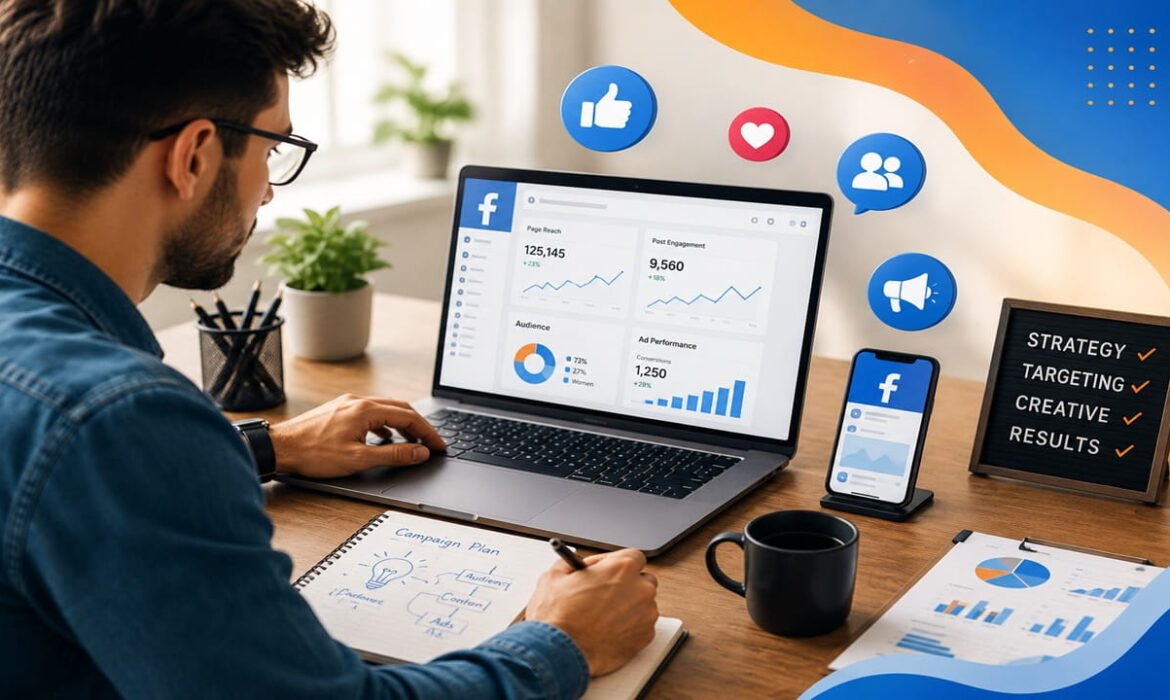
Facebook Marketing Agency: Drive Qualified Leads, Sales & Business Growth with Meta Advertising
Most businesses don’t start looking for a Facebook Marketing Agency because things are going great. They start looking because the ad account that used to work just… stopped. Costs crept up, leads slowed down, and nobody on the team has the hours to figure out why. Usually, that’s not a Facebook problem. It’s a management problem.
Why Businesses Still Need a Facebook Marketing Agency
Here’s the thing about Facebook and Meta advertising in general the targeting is still genuinely good. You can reach people by interest, income bracket, past behavior, exact location, whatever you need. That part hasn’t changed. What’s changed is how much the platform expects from the accounts running on it.
Meta rewards clean data. It rewards accounts that keep testing. And it has almost no patience for the “set it up once and forget about it” approach that used to work back when competition was lighter. So when a business says Facebook Ads “stopped working,” what’s usually happened is the pixel’s been broken for two months, or the same three ad creatives have been running since spring. Nobody’s malicious about it it just falls through the cracks, because running ads well takes more consistent attention than most internal teams can actually give it.
What Is Facebook Marketing?
Facebook marketing is the use of Facebook and Meta’s connected ecosystem of Instagram, Messenger, and WhatsApp to promote a business, reach targeted audiences, generate qualified leads, and drive measurable sales. It combines organic content strategy, Meta Ads campaigns, audience targeting, remarketing, and conversion tracking into a single, accountable marketing system. For Indian businesses in 2026, with over 350 million active Facebook users across Delhi, Mumbai, Bangalore, Jaipur, and hundreds of smaller cities, Facebook marketing is one of the most direct paths from audience to revenue available at any budget level.
What Does a Facebook Marketing Company Do?
Real Facebook Marketing Services isn’t just an ad-running service. It’s managing the whole thing the page, the content, how the business responds to comments, and yes, the paid campaigns too as one coordinated effort instead of five disconnected tasks.
You can usually tell the difference within a few seconds of landing on a business’s Facebook page.
- Is it active?
- Does it look like someone’s actually there?
Or is the last post from eight months ago, right before a big ad campaign sends a thousand new visitors straight to it? That mismatch kills conversions more often than people realize. A Facebook marketing company worth hiring keeps the page looking alive so the ads pointing to it don’t undercut themselves.
And honestly, there’s a nice side benefit to running organic and paid together you get to see what content people actually respond to before you spend a dollar boosting it. Meta Business Suite hands you that data for free. Ignoring it and jumping straight to paid testing is just leaving cheap insight on the table.
Facebook Advertising Services That Deliver Measurable Results
When someone specifically needs help with the paid side not the social media, just the ads they’re really looking for a Facebook advertising company that’s in the account every day, not once a month.
This is the less exciting part of the work, if we’re being honest. It’s not glamorous. It’s:
- Building custom and lookalike audiences instead of just checking “everyone in the US, 18-65”
- Letting campaign budget optimization actually do its job, instead of manually splitting budget evenly across ad sets that clearly aren’t performing the same
- Writing different copy for someone who’s never heard of the brand versus someone who already added something to their cart
- Testing video against carousel against a plain static image, because you genuinely don’t know which wins until you run it
The auction itself never sits still. Competitors adjust bids, seasons shift demand, Meta rolls out an algorithm update nobody announced. Facebook advertising services that only get touched once a month are basically running on autopilot with the fuel gauge broken.
Facebook Ads Management Services Explained
This is usually where in-house efforts quietly give out. Not at launch launching is the easy part, honestly anyone can do that in an afternoon. It’s the week three, week six, week twelve grind that separates accounts that keep improving from ones that flatline.
| Task | Frequency | Why It Actually Matters |
| Performance review (CTR, CPC, CPA) | Daily/Weekly | Catches a bleeding ad set before it drains the whole budget |
| Creative refresh | Bi-weekly | Fatigue is real the same ad gets more expensive the longer it runs |
| Audience testing | Weekly | New pockets of buyers don’t find themselves |
| Budget reallocation | Weekly | Money should follow what’s winning, not what launched first |
| Pixel & Conversion API check | Monthly | Bad data quietly poisons every decision made after it |
| Reporting & strategy call | Monthly | Keeps the whole thing tied to actual business goals, not just “clicks went up“ |
Facebook Ads Management Services aren’t really a one-time thing, no matter how it’s sometimes sold. It’s ongoing, a little repetitive, and that’s exactly why it works someone’s paying attention when nobody else has the bandwidth to.
How Meta Ads Help Businesses Generate More Leads
Facebook and Instagram share a backend now Meta Ads Manager runs both so treating them as separate campaigns is kind of outdated at this point. A proper Meta Ads Agency lets one campaign structure serve Facebook, Instagram, Messenger, and Audience Network together, and lets Meta’s own delivery system decide where each person is most likely to convert.
This isn’t just a technical detail. A younger, more visual audience tends to respond better on Instagram Reels. A B2B decision-maker might actually convert through a boring Facebook lead form. If an agency is only thinking “Facebook,” they’re leaving half the picture on the table. A Facebook digital marketing agency that thinks Meta-wide tends to just… catch more of both, without extra spend wasted chasing the wrong placement.
There’s more available once you zoom out to the Meta level too Instagram Shopping tags, WhatsApp Business for direct messaging, catalog ads pulled straight from Shopify or WooCommerce so ecommerce brands can run dynamic product ads without manually updating creative every week.
Facebook Lead Generation Strategies That Convert
For service businesses, B2B companies, local shops clicks were never really the point. Leads are. And not just any leads, the kind that actually pick up the phone or show up to the consultation. That’s the entire job of a Facebook Lead Generation Agency.
There are basically two Lead Generation Strategies here:
- Lead form ads (Instant Forms) someone fills out their info without leaving Facebook at all. Less friction, usually more volume, though sometimes lower intent.
- Landing page campaigns traffic gets sent off-platform to a dedicated page. Slower, a bit more friction, but often better for anything higher-ticket where people need more convincing before they hand over their number.
A good Facebook ads consultant doesn’t just pick a lane and stick with it forever. They test both, and this part gets skipped constantly they actually track which leads turn into paying customers, not just which ones filled out a form. Connecting the ad account to something like HubSpot, Salesforce, or Zoho makes that possible. Without it, you’re optimizing for form fills, and form fills don’t pay invoices.
Why Facebook Advertising Delivers Better ROI Than Many Other Channels
What makes Facebook stand out isn’t any single feature it’s that you can stack them. Demographics plus interests plus behavior plus a lookalike audience built from your actual best customers. That combination is hard to replicate on a lot of other platforms.
The format variety helps too, more than people give it credit for. Video, carousel, collection ads, Instant Experience there’s actual room to tell a story instead of just slapping up a banner and hoping. That flexibility means one budget can do double duty: build some brand awareness and drive direct conversions at the same time.
Common Facebook Marketing Mistakes Businesses Make
Same handful of issues, over and over, across almost every underperforming account we’ve looked at:
- Targeting so broad it barely means anything “everyone who likes shopping,” basically
- Nobody checked whether the pixel and Conversion API are actually firing correctly (they’re often not)
- The exact same three ads have been running since who-knows-when, and costs keep climbing because of it
- No retargeting at all just cold traffic, forever, with zero attempt to catch the people who almost converted
- Pulling the plug after three days because “it’s not working,” when the algorithm hadn’t even finished learning yet
- Sending people to a landing page that says something completely different from what the ad promised
None of these are expensive fixes. They’re just easy to miss when there’s no one whose actual job is watching the account daily.
Industries That Benefit Most from Facebook Marketing Services
Meta advertising isn’t a magic bullet for absolutely everything, but it holds up well across a lot of sectors:
- Healthcare
- Education
- SaaS
- Ecommerce
- Manufacturing
- Real Estate
- Travel
- Finance
- Automotive
- Local Businesses
Each one needs its own playbook healthcare and finance especially, since Meta’s ad policies get strict fast in those spaces. Industry experience isn’t just a nice-to-have here; it genuinely changes what gets approved and what performs.
How Arihant Global Delivers Better Facebook Campaign Performance
At Arihant Global, nothing gets scaled until the tracking is right. That’s the boring first step, and it gets skipped a lot elsewhere, but no amount of clever targeting fixes bad data underneath it. Once the pixel and Conversion API are solid, campaigns move into real testing audiences, creative, offers before serious budget goes anywhere near a single direction. It’s a slower start than a lot of businesses expect walking in, but it means the spend that follows is based on what’s actually proven, not what looked promising in a planning meeting.
Our Facebook Marketing Process
- Business Discovery
- Audience Research
- Competitor Analysis
- Campaign Planning
- Creative Development
- Ad Copywriting
- Pixel & Conversion API Setup
- Campaign Launch
- Optimization
- Weekly Reporting
Frequently Asked Questions – Facebook Marketing
Q1. What does a Facebook Marketing Agency do?
Manages the whole Meta presence, not just ads the page, the content, and the paid campaigns together, aimed at actual results like leads or sales rather than just impressions.
Q2. Is Facebook advertising still effective in 2026?
Yes, for accounts that are actually maintained. Clean tracking and regular creative testing still produce solid, cost-efficient results it's the neglected accounts that struggle.
Q3. How much does Facebook advertising cost?
Varies a lot by industry and competition, but most businesses land somewhere between a few hundred and several thousand dollars a month in spend, separate from whatever the agency charges to manage it.
Q4. Which industries benefit from Facebook Ads?
Ecommerce, healthcare, education, real estate, SaaS, finance, and local service businesses all tend to do well though the actual strategy looks pretty different from one to the next.
Q5. How do agencies improve ROAS?
Mostly just relentless, unglamorous testing audiences, creative, budget splits paired with tracking accurate enough to actually trust the numbers coming back.
Q6. How long before Facebook Ads show results?
Two to four weeks, usually, before the algorithm has enough data to optimize properly. Judging a campaign before that point tends to lead to the wrong conclusion.
Q7. Why hire an agency instead of running ads yourself?
Mostly it comes down to time and daily attention that's genuinely hard to sustain part-time on top of everything else running a business involves, plus the technical side around tracking most people never learn.
Q8. What is the difference between Facebook Ads and Meta Ads?
Facebook Ads is specifically campaigns on Facebook. Meta Ads is the umbrella term Facebook, Instagram, Messenger, and Audience Network, managed as one system.
Final Thought
If your Facebook Ads have plateaued, or never really got going in the first place, it’s usually more fixable than it feels. Arihant Global works with businesses across ecommerce, healthcare, real estate, and B2B to build Meta campaigns on clean data from day one. Reach out and let’s talk through where things actually stand right now and what a more focused approach could look like from here.
Ready to Grow Your Business with Facebook Marketing?
Turn your Facebook and Meta Ads into a consistent source of qualified leads and sales. At Arihant Global, we create data-driven Facebook marketing strategies, high-performing ad campaigns, and continuous optimization to maximize your ROI. Contact our experts today for a free consultation and discover how Meta advertising can help your business grow faster.
Disclaimer
This blog is published by Arihant Global for informational purposes only. Advertising results vary based on industry, budget, audience, and campaign execution. Facebook and Meta are trademarks of Meta Platforms, Inc.
AI Social Media Marketing: Everything You Need to Grow Your Business Faster in 2026
Rising ad costs. Shrinking organic reach. AI tools your competitors are already using. Here’s how to catch up and pull ahead.
A marketing manager at a mid-size Indian brand was spending 14 hours a week on social media content writing captions, scheduling posts, pulling reports, and still wondering why engagement was flat. After integrating AI social media marketing tools across the workflow, that same output now takes under 3 hours. Lead quality improved. Cost per engagement dropped. The posts that once required a Friday afternoon to write now take twenty minutes.
That is not a future scenario. It is happening now, in businesses of every size across India and globally. Artificial intelligence in social media marketing has moved from an experimental advantage to a competitive baseline and the brands that have not adopted it yet are already behind the ones that did 12 months ago.
This guide covers what AI social media marketing actually means in practice, which tools produce real results, how to build a strategy around it, and what mistakes to avoid without the generic hype that has filled most AI marketing content in 2025 and 2026.
What Is AI Social Media Marketing?
| AI social media marketing is the use of artificial intelligence technologies including generative AI, machine learning, natural language processing (NLP), and predictive analytics to plan, create, distribute, analyse, and optimise social media marketing campaigns. It enables businesses to produce personalised content at scale, automate repetitive tasks, identify high-performing content patterns, and respond to audience behaviour in real time reducing manual effort while improving campaign performance. |
01 | Why AI Is Reshaping Social Media
AI Social Media Marketing: Why 2026 Is the Tipping Point
Social media marketing used to be a volume game post frequently enough and the algorithm would eventually reward you. That model is broken. Organic reach on Facebook has fallen below 5% for most pages. Instagram Reels require not just frequency but precision: the right format, the right hook, the right first three seconds, for the right audience segment. The human capacity to optimize all these variables simultaneously hit its ceiling.
AI-powered social media marketing solves the scaling problem. Machine learning analyzes thousands of engagement data points that a human could never track manually, identifies the content patterns your specific audience responds to, and surfaces those insights in time to act on them. Generative AI then produces content variations at a speed and volume that would require a five-person team to match manually.
The Measurable Business Case
Businesses integrating AI social media automation into their marketing operations report an average 3–4x improvement in content output with no proportional headcount increase. More importantly, they report an improvement in content quality because AI tools optimize for engagement signals, not a content calendar, and because they free up human time for strategy and creative judgment rather than production.
| Metric | Before AI Integration | After AI Integration |
| Hours spent on content production | 14–18 hrs / week | 3–5 hrs / week |
| Content output per week | 5–8 pieces | 20–35 pieces |
| A/B tests run per month | 2–3 | 15–20 (automated) |
| Cost per engagement | ₹12–18 | ₹4–7 |
| Audience targeting precision | Broad demographic | Behavioural intent segments |
02 | AI Tools That Actually Deliver
Best AI Social Media Marketing Tools in 2026 What Each One Does
The AI tools landscape for social media marketing has matured significantly. There are now clear category leaders, and the mistake most marketers make is either adopting too many tools without integration or avoiding them entirely because the landscape feels overwhelming. Here is a focused, honest breakdown.
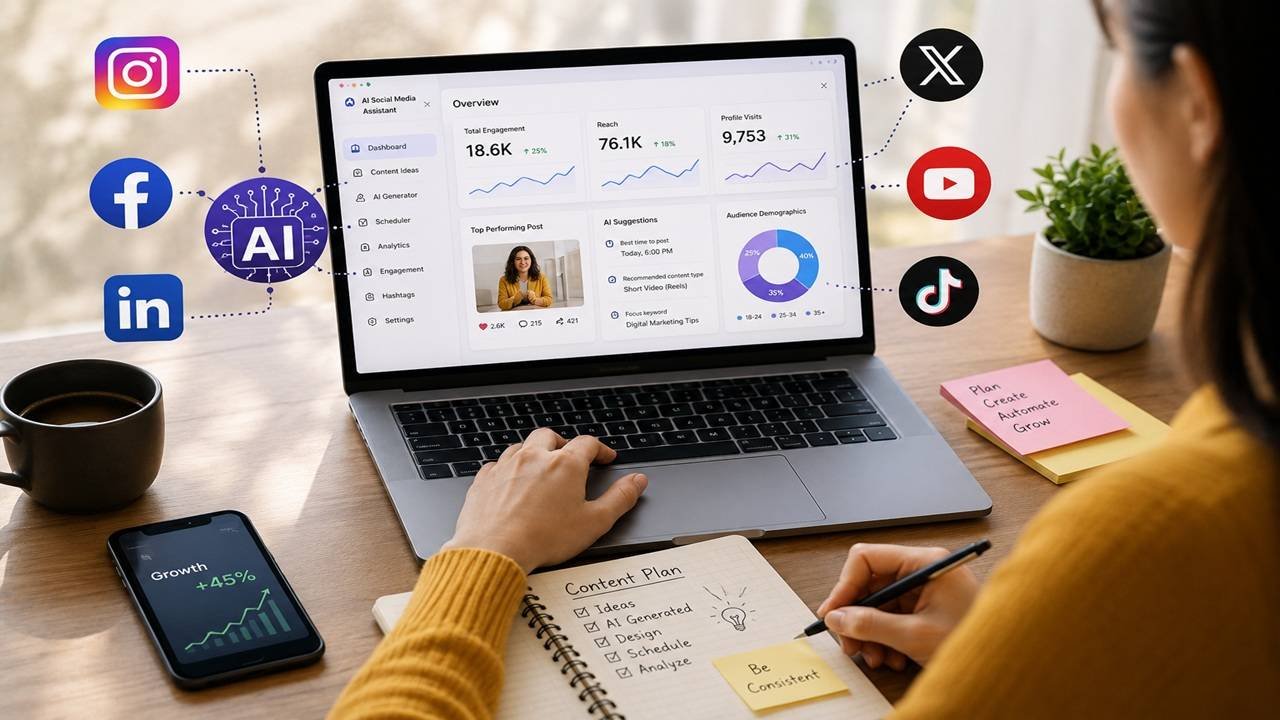
Content Creation and Copywriting
- ChatGPT (OpenAI): The most versatile AI writing tool available for social media. Generates captions, ad copy, comment responses, content calendars, and hashtag strategies. Its conversational AI capability is most powerful for drafting and iterating on content where human judgment refines the output rather than accepts it wholesale.
- Google Gemini: Particularly strong at multi-modal tasks combining text and image analysis for content recommendations. Gemini’s integration with Google Workspace makes it the natural choice for teams already operating in that ecosystem.
- Claude AI (Anthropic): Excels at longer-form social content blog extracts for LinkedIn, detailed post series, and content strategy documents. Claude AI for content creation has particular strengths in nuanced tone matching and consistent brand voice across multiple pieces.
- Jasper AI: A purpose-built AI marketing tool with pre-built templates for Instagram captions, Facebook ads, LinkedIn posts, and email subject lines. Better suited for teams wanting a structured workflow than open-ended AI assistance.
Design and Visual Content
- Canva AI social media: Magic Design and text-to-image tools inside Canva have made high-quality visual content creation accessible without a graphic designer. Canva AI social media design tools include background removal, auto-resizing for platform specifications, and brand kit integration that ensures visual consistency at scale.
- Meta AI: Meta’s built-in Meta AI tools for Facebook and Instagram ad creation particularly the Advantage+ creative features automatically generate and test multiple ad variations, identifying the highest-performing combinations without manual A/B test setup.
Scheduling, Analytics and Automation
- Buffer AI: AI-assisted scheduling recommendations based on your audience’s engagement history, plus AI caption generation inside the scheduling workflow.
- Hootsuite AI: Predictive analytics for social media, AI-generated post suggestions, and cross-platform scheduling. Hootsuite’s Owly Writer AI generates captions and content ideas directly inside the publishing workflow.
- Microsoft Copilot: Integrated into the Microsoft 365 ecosystem, Copilot assists with campaign reporting, content brief creation, and cross-channel marketing analysis for teams operating in SharePoint and Teams environments.
- Perplexity AI: Increasingly used for real-time social listening identifying emerging topics, competitor content patterns, and trending conversations in your industry before they peak.
03|Building Your AI Social Media Strategy
How to Build an AI Social Media Marketing Strategy That Generates Revenue
Having AI tools is not the same as having an AI social media marketing strategy. The businesses seeing the strongest results from AI integration are using it within a defined strategic framework not as a replacement for strategy, but as an execution layer that makes a good strategy dramatically more efficient.
Step 1 – Define the Business Outcome, Not the Content Goal
Before selecting any AI social media tool or building any content calendar, define the specific commercial outcome the campaign must produce: enquiries generated, product purchases, email sign-ups, or brand search volume increase. Every AI-generated content piece, every automated scheduling decision, and every audience segmentation should be optimized toward that commercial outcome not toward engagement metrics that have no direct revenue connection.
Step 2 – Segment Audiences with Machine Learning
Audience segmentation with AI moves well beyond basic demographic targeting. Machine learning models analyze behavioural patterns what users engage with, when they are active, what content format they consume most fully, and what they signal about purchase intent through their social media activity. Social media personalization with AI means different content, different creatives, and different calls-to-action for different audience segments simultaneously something no manual process can execute at scale.
Step 3 – Use Generative AI for Content Production, Not Strategy
Generative AI for social media is most powerful as a production accelerator, not a strategic decision-maker. Use ChatGPT, Claude AI, or Google Gemini for marketing to generate the first draft, the caption variations, the hashtag sets, and the hook options. Use human judgment for which angle fits your brand, which message matches the campaign objective, and which tone serves the specific audience segment. The AI produces at volume; the human curates for quality.
Step 4 – Automate Repetitive, Optimize Continuous
AI social media automation handles the tasks that consume time without requiring creative judgment: scheduling at optimal posting times, republishing high-performing content to new audience segments, routing comment and message responses to appropriate templates, and generating weekly performance reports. This layer frees human capacity for the high-judgment work: interpreting campaign data, refining messaging strategy, and identifying the creative directions worth scaling.
Step 5 – Close the Loop with Predictive Analytics
Predictive analytics for social media uses historical engagement data, competitor content patterns, and platform algorithm signals to forecast which content types will perform before they are published. AI-driven social media analytics moves reporting from backward-looking (what happened) to forward-looking (what to do next). Building this data-to-decision loop is what separates brands that consistently improve from those that react to results.
| Expert Insight Where AI Social Media Marketing Creates the Most Leverage The highest-leverage AI integration point in a social media workflow is not content creation it is audience segmentation and personalized retargeting. AI-powered customer engagement tools that identify warm audiences from social media behaviour and automatically serve them personalized follow-up content (via Meta retargeting, WhatsApp Business API, or email automation) produce conversion improvements of 3x–5x compared to untargeted post-engagement follow-up. |
04 | AI Social Media Automation in Practice
AI Social Media Automation: What to Automate and What to Keep Human
The question businesses most commonly get wrong about social media marketing automation is the boundary: what should be automated and what should remain human-driven? Getting this wrong in either direction costs performance.
Automate These
- Post scheduling at AI-recommended optimal times by platform and audience segment
- Content calendar population from approved content briefs
- Performance report generation and distribution to stakeholders
- Initial comment and message routing based on intent classification
- Audience segmentation updates based on engagement behaviour
- A/B test setup and basic results monitoring
- Hashtag research and competitive content monitoring with Perplexity AI
Keep These Human
- Brand voice decisions and tone judgment on sensitive topics
- Crisis communications and real-time reputation management
- Creative concept direction and campaign angle selection
- Influencer relationship management and partnership conversations
- Final approval on all published content before it goes live
- Strategic interpretation of AI analytics outputs and campaign pivots
05 | Mistakes That Kill AI Social Media Results
5 AI Social Media Marketing Mistakes That Undermine Results
1. Publishing AI content unedited:
The most visible AI marketing failure mode. ChatGPT and other generative AI tools produce plausible-sounding content, but that content has no brand specificity, no genuine insight, and no authentic voice. Audiences and increasingly platform algorithms can identify AI-generated content with no human intervention. The standard should always be AI-drafted, human-edited, and brand-approved before publication.
2. Using AI tools without integration:
Buffer AI scheduling combined with ChatGPT captions combined with Canva AI visuals combined with Hootsuite AI analytics is a powerful stack. The same tools used in isolation each producing data in a separate dashboard create a reporting fragmentation problem that actually reduces strategic clarity.
3. Optimizing for AI metrics instead of business metrics:
AI social media tools surface a large number of engagement optimization opportunities. Chasing the engagement metrics the AI flags (comment rate, share rate, save rate) without connecting them to commercial outcomes (leads, sales, brand search volume) produces increasingly engaged audiences that never convert.
4. Over-automating customer-facing interaction:
Automated responses to comments and messages work for initial routing and acknowledgement. Allowing conversational AI to handle extended customer conversations without human review consistently produces tone mismatches and accuracy errors that damage brand trust far more than a slower human response would.
5. Ignoring AI ethics and platform transparency guidelines:
Meta, LinkedIn, and TikTok have all published guidelines on AI-generated content labelling. Platforms are beginning to algorithmically detect undisclosed AI content. Businesses that are transparent about AI assistance in their creative process are consistently better positioned as these platform policies tighten.
06 | FAQ AEO Optimized
Frequently Asked Questions – AI Social Media Marketing
Q1. What is AI social media marketing?
AI social media marketing is the application of artificial intelligence including generative AI, machine learning, natural language processing, and predictive analytics to the planning, creation, scheduling, distribution, and optimization of social media campaigns. Tools like ChatGPT, Google Gemini, Canva AI, Buffer AI, and Hootsuite AI enable businesses to produce more content, reach more relevant audiences, and improve campaign performance at lower cost per engagement.
Q2. What are the best AI social media marketing tools in 2026?
The leading AI social media marketing tools in 2026 are: ChatGPT and Claude AI for content creation and copywriting; Google Gemini for multi-modal content analysis; Canva AI for social media design and visual content; Jasper AI for structured marketing templates; Buffer AI and Hootsuite AI for AI-powered scheduling and analytics; Meta AI's Advantage+ for Facebook and Instagram ad automation; and Perplexity AI for real-time social listening and competitive monitoring.
Q3. How does AI social media automation work?
AI social media automation works by applying machine learning algorithms to historical and real-time social media performance data to make decisions that previously required human judgment scheduling posts at optimal times, routing audience segments to relevant content, generating performance reports, and identifying the highest-performing content types before resources are committed to production. Tools like Buffer AI and Hootsuite AI handle the scheduling and analytics layer; ChatGPT and Canva AI handle content generation.
Q4. Can small businesses benefit from AI-powered social media marketing?
Yes small businesses benefit disproportionately from AI social media marketing because the efficiency gains have the greatest impact when team size is small. A two-person marketing team using AI social media tools can produce the content output of a 5–6 person team without automation. Canva AI reduces the need for a dedicated graphic designer. ChatGPT reduces the need for a dedicated copywriter for routine content. The tools that once required enterprise budgets are now available at price points accessible to MSMEs and startups.
Q5. How does generative AI improve social media content quality?
Generative AI improves social media content quality through speed of iteration rather than raw quality of first drafts. By generating 10 hook variations in seconds, AI allows human marketers to select and refine the strongest option rather than defaulting to the first idea that came to mind under time pressure. Canva AI's design suggestions and ChatGPT's caption variations shift the human role from production to curation a higher-judgment activity that consistently produces better outputs.
Q6. What is the difference between AI social media automation and social media scheduling tools?
Traditional social media scheduling tools (Hootsuite, Buffer before AI integration) simply publish content at pre-set times. AI social media automation adds intelligent decision layers: machine learning determines optimal posting times based on your specific audience's activity patterns, AI analyses which content formats and topics produce the highest engagement for each platform, and automation routes audience interactions to the most relevant follow-up sequences. The distinction is between scheduled delivery and intelligent optimization.
Conclusion
AI Social Media Marketing: The Competitive Advantage That Is Already Closing
The window in which AI social media marketing is a differentiator rather than a baseline is closing quickly. The brands that integrated AI tools into their social media workflows in 2024 and 2025 have already compounded a production efficiency advantage, an audience data advantage, and a content optimization advantage that takes time to bridge.
This is not about replacing the human judgment that makes social media marketing genuinely effective. AI-powered social media marketing is at its best when it removes the production overhead that was consuming that judgment freeing human marketers to do the strategic, creative, and relational work that no machine learning model can replicate.
The question is not whether your business should adopt AI social media marketing. It is how far behind you want to be when the competitors who already have make that distance visible.
| Partner with Arihant Global for AI-Powered Social Media Marketing Arihant Global delivers AI social media marketing strategies, AI content creation for social media, social media automation, and performance-driven campaigns for Indian businesses across every sector. ISO 9001:2015 & ISO 27001:2022 certified. Est. 2012. 500+ brands. Free social media audit: arihantglobal.net | 0141-2942622 | Jaipur, Rajasthan, India. |
Disclaimer
This content is for informational and educational purposes only. AI tools, features, and platform policies may change over time. Results from AI social media marketing vary based on your strategy, industry, audience, and execution. Always verify the latest platform guidelines and evaluate tools carefully before making business or marketing decisions.
Lead Generation Services in India: SEO, Google Ads, Meta Ads & Funnel Strategy for Scalable Growth 2026
Most businesses in India aren’t struggling because of a bad product. They’re struggling because the right people never find them. That’s a lead generation problem, and it’s far more common than most founders want to admit.
Whether you’re running a B2B software company in Pune, a real estate firm in Mumbai, or a coaching institute in Jaipur, an unpredictable enquiry pipeline will quietly undo even genuinely good work. No amount of service quality fixes a lead flow that swings between feast and famine every quarter. This is where properly built lead generation services in India earn their keep not by promising a fixed number of leads, but by fixing the actual system behind why leads show up inconsistently in the first place.
This isn’t a theoretical framework. It’s the pattern we see across nearly every business that comes to us after trying agencies that ran isolated campaigns instead of a connected strategy good clicks, poor conversions, and a sales team left guessing which channel actually deserves credit.
Why Most Lead Generation Services in India Fall Flat
Before getting into tactics, it’s worth asking why so many campaigns underdeliver.
most businesses treat lead generation as a set of isolated actions rather than one connected system. They run Google Ads without fixing the landing page it sends traffic to. They invest in SEO while targeting the wrong keywords entirely. They boost a few Facebook posts and call that a Meta strategy. Each piece looks reasonable in isolation together, they produce wasted budget, low-quality enquiries, and a sales team stuck chasing leads that were never actually ready to buy.
Real lead generation the kind that compounds instead of resetting every month works differently. It starts with a system, not a channel.
What Are Lead Generation Services?
Lead generation services help businesses attract, qualify, and convert potential customers through channels such as SEO, Google Ads, Meta Ads, landing pages, marketing automation, and conversion optimization. Instead of focusing only on traffic, a modern lead generation strategy builds a complete acquisition system that consistently delivers qualified enquiries and measurable business growth.
SEO-Driven Lead Generation Services: The Channel That Pays You Back
Search Engine Optimization isn’t glamorous, and it doesn’t produce overnight results. But for businesses that commit to it, SEO becomes the most cost-efficient lead generation channel they have, because once a page ranks, it keeps earning enquiries without a daily ad spend attached to it.
When someone searches “B2B lead generation services in India” or “performance marketing agency near me,” they’ve already decided they want help. Ranking on page one means capturing that Search intent for free, repeatedly, instead of paying for every single click.
What genuine SEO-driven lead generation actually requires:
- Targeting keywords with real commercial intent, not just high search volume
- Building location-specific pages for businesses serving multiple cities
- Google Business Profile optimization as a lead generation asset, not an afterthought
- Publishing content that answers real buyer questions, not keyword-stuffed filler
- Fixing technical issues site speed, mobile experience, crawlability that quietly kill rankings
- Earning backlinks from credible, relevant sources to build genuine domain authority
Businesses that invested in SEO two years ago are generating leads today at a fraction of what their competitors now pay on paid channels alone. That compounding advantage is hard for a competitor to close quickly, which is exactly why it’s worth starting now rather than waiting for “the right time.”
Google Ads for Lead Generation: Putting Your Business in Front of Ready Buyers
If SEO is the long game, Google Ads is the fast lane but only when it’s managed with real precision.
The problem with most Google Ads accounts in India isn’t the platform. It’s poor account setup, overly broad keyword targeting, and missing conversion tracking. Budget disappears, leads don’t show up, and the business concludes “Google Ads doesn’t work.” It works. The difference is entirely in how it’s managed.
What a high-performing Google Ads setup for lead generation actually includes:
- Search campaigns built around bottom-of-funnel, high-intent keywords
- Tightly written ad copy that speaks directly to the pain point behind the search
- Dedicated landing pages matched to the ad never a generic homepage dump
- Conversion tracking on every form fill, call, and chat interaction
- Negative keyword lists that stop spend from leaking to irrelevant searches
- Regular bid adjustments based on what’s actually converting, not guesswork
- Remarketing sequences that recapture visitors who clicked but didn’t enquire
A Google Ads partner that actually understands lead generation services will obsess over cost per qualified lead not cost per click, which is a vanity number that tells you almost nothing about revenue.
Meta Ads Agency Strategy: Reaching Buyers Before They Know They Need You
Google captures demand that already exists. Meta creates it.
Facebook and Instagram advertising in India is genuinely effective for businesses that understand the difference between awareness-stage and conversion-stage campaigns. The most common mistake is running straight conversion ads to a completely cold audience and then wondering why performance is weak.
What a Meta ads agency approach actually looks like when it’s done properly:
- Building warm audiences through video views, page engagement, and website visits before pushing an offer
- Using native lead forms so prospects can enquire without ever leaving the app
- Lookalike audiences built from real customer data, not guessed interest targeting
- Creative testing across formats video, carousel, static to find what genuinely resonates
- Retargeting sequences that move someone from curious to convinced over days, not seconds
- Separate campaigns for distinct buyer segments, each with messaging tailored to them specifically
A capable Meta ads agency or Facebook ads agency in India will tell you plainly that creative quality and audience strategy matter more than raw budget size a smaller budget with sharp targeting consistently outperforms a large budget aimed at the wrong audience.
Funnel Strategy: Where Traffic Actually Becomes Revenue
Most businesses obsess over getting more traffic. Few ask the harder question:
why isn’t the traffic they already have converting?
That’s a funnel problem, and every channel you invest in SEO, Google Ads, Meta Ads needs somewhere structured to land. Without that landing infrastructure, you’re pouring water into a leaky bucket regardless of how good the acquisition strategy is upstream.
A funnel that actually works keeps things simple:
- One clear offer on the landing page a visitor should know within three seconds what you do and why it matters to them
- Real social proof placed at the right moment a testimonial near the contact form does more work than a trophy shelf on your homepage
- Frictionless next steps WhatsApp, a short form, a direct call link, nothing that adds unnecessary clicks
- Immediate follow-up a lead that waits 24 hours for a response is already talking to a competitor
- CRM tracking so you know precisely where people drop off, not just that they did
Without this backbone, even genuinely well-performing ad campaigns leave real money on the table because a strong funnel doesn’t just capture more leads, it captures better ones by filtering out visitors who were never going to convert in the first place.
B2B Lead Generation Services: A Different Animal Entirely
Selling to businesses isn’t like selling to consumers. Nobody signs a six-figure contract because they saw one Instagram ad.
B2B buyers research extensively, involve multiple stakeholders, and take their time often 30 to 90 days or longer. A lead generation strategy that ignores this reality burns budget chasing urgency that was never there.
What actually moves the needle for B2B lead generation services:
- Google Search Ads built around specific job roles and business problems, not generic industry terms
- LinkedIn campaigns that reach founders, procurement heads, and department decision-makers directly
- Case studies and comparison content that earn trust during a long research phase
- Lead magnets that offer something genuinely useful upfront, not a thinly veiled sales pitch
- Lead scoring so your sales team calls the right people first, not just the most recent
- Nurture sequences that stay relevant across the full decision window instead of going cold after one email
More enquiries isn’t always the goal in B2B. Better enquiries is.
AI Search Is Changing Lead Generation
A growing share of your leads now come through ChatGPT, Gemini, and Google AI Overviews, not just search results pages. Miss that shift, and you don’t lose rankings. you lose the conversation before it starts. That’s why our lead generation services build entity optimization, structured data, and expert-led content in from day one, not as an afterthought.
What to Look for in Lead Generation Services Partner
Choosing the right performance marketing agency in India is the single decision that determines whether everything else actually works.
Look for these signals before signing anything:
- They ask about your sales process before they ever talk about ad budgets
- They report on qualified leads and revenue, not just clicks and impressions
- They can show verifiable case studies in your industry or a genuinely comparable one
- They set realistic timelines SEO takes months, not weeks, and they’ll say so upfront
- They own mistakes and adapt, rather than making excuses when a campaign underperforms
- They integrate channels as one system rather than managing each one in isolation
If an Lead Generation agency promises guaranteed first-page rankings in 30 days, or a fixed number of leads per month before they’ve understood your business at all that’s a signal to walk away, not sign on.
How Arihant Global Delivers Lead Generation Services in India
One good campaign won’t fix a broken pipeline. What actually builds a business is a lead generation system that runs consistently, month after month not one that only performs when someone remembers to boost a post.
Here’s how we approach every lead generation services engagement:
- Audit first understanding where your current leads come from, where they drop off, and what competitors are doing better before recommending anything
- Strategy before spend channels, messaging, and funnel structure get defined before a single rupee goes into ads
- Build and launch as one system SEO groundwork, ad campaigns, and High converting landing pages go live together, not as separate, disconnected experiments
- Track what actually matters every lead traced back to its source, so you know exactly what’s working and what isn’t
- Optimize continuously weekly performance reviews, creative testing, and funnel improvements that compound results over time instead of flatlining after month one
No siloed campaigns. No vanity metrics. Just a pipeline your sales team can genuinely work with.
Frequently Asked Questions – Lead Generation Services
What are lead generation services?
Lead generation services combine SEO, paid advertising, and funnel strategy to attract and convert prospective customers into qualified enquiries leads a sales team can realistically follow up and close, rather than raw traffic or impressions.
How long does SEO take to generate leads?
Meaningful SEO-driven lead generation typically takes three to six months to show consistent results, though timelines vary by industry competitiveness and current site health. It compounds afterward, unlike paid channels that stop the moment spend stops.
Should I choose SEO or Google Ads for lead generation?
Most businesses benefit from both Google Ads for immediate, high-intent leads, and SEO for compounding, lower-cost leads over time. Relying on only one channel usually leaves growth on the table.
How is B2B lead generation different from B2C?
B2B lead generation involves longer decision cycles, multiple stakeholders, and higher-consideration buying, so it relies more heavily on LinkedIn, case studies, and nurture sequences rather than impulse-driven ad formats.
Conclusion: Build the System, Then Scale It
If your enquiries feel unpredictable right now, that inconsistency is exactly the problem genuine lead generation services in India are built to fix not with a bigger ad budget, but with a system where SEO, paid media, and your funnel finally work together instead of against each other. Walk away with a clear picture of where your leads are being lost, and exactly what it takes to fix it because your next customer is already searching. The only real question is whether they find you or your competitor first.
Ready to stop guessing and start growing? Book a free strategy call with Arihant Global.
Disclaimer
This article by Arihant Global is intended for informational purposes. Marketing outcomes depend on your business, market, competition, and execution.
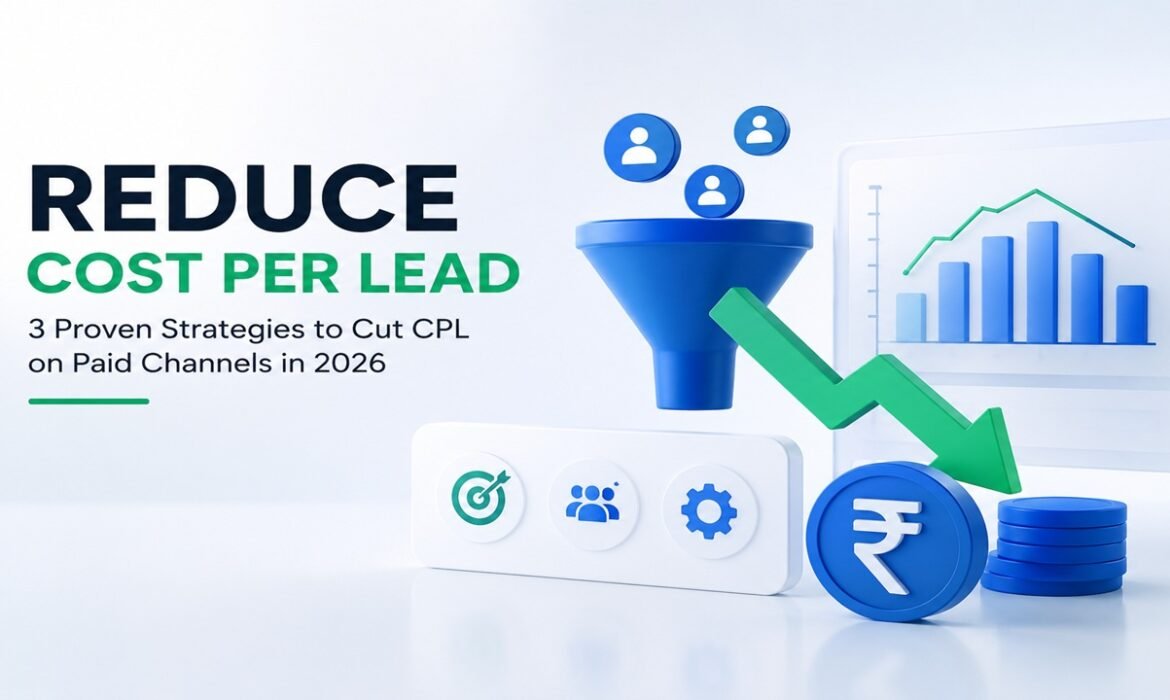
Reduce Cost Per Lead: 3 Proven Strategies to Cut CPL on Paid Channels in 2026
If you’re running ads and your budget is increasing but your leads aren’t, it can feel like something is wrong. This is a common problem ads are running, clicks are coming in, but the CPL is increasing.
If you’re struggling with rising CPL, working with a digital marketing Company in Jaipur like Arihant Global can help identify hidden gaps.
The truth is straightforward: you may not need more budget; you need better optimization.
Let’s go over a no-nonsense guide on how to reduce cost per lead.
What is Cost Per Lead (CPL)?
Cost Per Lead (CPL) is the amount of money spent to get one lead.
Cost Per Lead Formula:
- CPL = Total Ad Spend / Total Leads
In other words, if you spend ₹10,000 and get 50 leads, then your CPL is ₹200.
But if you reduce Cost Per Lead, you are getting more out of your spend, provided you get interested and convertible leads.
Why Your Cost Per Lead is Increasing
There are a few possible explanations if you are seeing an increase in your CPL:
- Irrelevant targeting
- Lack of engagement from your ads
- Poor conversion on your landing pages
- Poor campaign structure
- Lack of optimization
One other thing that you might be forgetting is that if you reduce cpc in Google Ads, you are giving yourself room to reduce your CPL.
Strategy 1: Tighten Your Targeting
One of the best ways to reduce your CPL is to refine your targeting.
If your targeting is too broad, then you’re essentially paying for clicks that may never convert to leads.
What works better:
- Specific targeting of your audience segments
- Targeting your existing visitor data to create custom audiences
- Run targeted campaigns for your existing users
- Targeting specific audiences by excluding others
For example, instead of targeting everyone, target people actively searching for your service in a specific location.
Refining your targeting means refining your relevance. And relevance is one of the best ways to reduce your cost per lead.
Strategy 2: Fix Your website Landing Page
You can’t have leads if people aren’t converting. And one of the most common causes of high CPLs is a poor website landing page.
Let’s focus on the basics:
- A clear and prominent page title
- A clear and prominent call-to-action
- Fast page load times
- Mobile-friendly page layout
- Trust elements such as reviews or testimonials
In addition, keep your forms simple and to the point. You don’t want to ask for too much information too early in the conversion process.
The better seo optimized website landing page performs the lower your CPL, even if your traffic remains constant.
Strategy 3: Improve Your Ads and Optimize Cost Per Click
Your ads directly impact your CTR and CPL.
If your ads aren’t interesting or relevant, you’ll pay a higher cost per click in Google Ads.
That’s why you should continually improve your ads, not just to increase your CTR, but to reduce CPC in Google Ads, which directly impacts your CPL.
What to Improve
- Clear and benefit-oriented ad copy
- Different variations of headlines and descriptions
- Powerful images or videos
- Alignment with user intent
- Keep Testing
You should test various versions of your ads and keep an eye on their performance over time. Small reductions in CPC and CTR can add up to significant reductions in CPL.
Google Ads vs Facebook Ads: What to Focus On
The approach is slightly different for each.
Google Ads:
- Target high-intent keywords
- Use negative keywords to reduce irrelevant traffic
- Optimize Quality Score to reduce CPC
Facebook Ads:
- Frequently test creatives
- Use interest and behavioral targeting
- Retarget users after interaction
Both Google Ads and Facebook Ads are effective when properly optimized.
What’s a Good Cost Per Lead?
CPL differs based on your industry. Some of the industry-based CPL ranges are as follows:
- Education: ₹200 – ₹1500
- Real Estate: ₹500 – ₹3000
- Healthcare: ₹300 – ₹2000
- Digital Services: ₹200 – ₹1000
If you have a high CPL, you know what you need to work on.
Common Mistakes That Increase CPL
Here are a few things that often go wrong:
- Targeting too many people at once
- Ignoring campaign data
- Not updating ads regularly
- Sending traffic to weak landing pages
- Focusing only on lead quantity, not quality
Getting these things right can make a big difference.
Simple Action Plan You Can Start Today
If you want to see performance improvements fast, here are some things you can do:
- Improve your targeting
- Improve your landing page clarity
- Try new ad creatives
- Work on improving your cost per click
- Improve your results monitoring
The key to the greatest performance improvements is small, incremental changes.
FAQs – COST PER LEAD
The best way to reduce your cost per lead in paid ads is to focus on improving your targeting, improving your landing page, and continually improving your ad creatives. By improving your targeting and conversion rates, your cost per lead will automatically reduce, even if your budget remains the same. Yes, it does. When your cost per click goes down in Google Ads, your spending per visitor also comes down. Therefore, your cost per lead also comes down, provided your conversion rate remains the same. Cost per lead varies depending upon your industry. In digital services, it may be around ₹200 to ₹1000. In real estate, it may be as high as ₹3000. However, the key is to ensure that your leads are high quality and convert into paying customers. If your cost per lead is high, it means your targeting has not been done properly, your conversion rate has not been satisfactory, your ad creatives have not been good, or your campaign has not been set up properly. By improving these factors, your cost per lead can be reduced. You can also lower CPL in Google Ads by optimizing your quality score, using relevant keywords, negative keywords, and optimizing the landing page experience. To lower CPL in Facebook Ads, you should try to use multiple creatives, target the audience, and also try to use retargeting ads. No, it is not necessarily better to have a lower CPL. You should also consider the quality of leads. The major factors that affect CPL the most include audience targeting, ad relevance, landing page, and conversion rate. You should try to review your campaigns at least once a week. Yes, small businesses can also lower CPL, and it is not a problem for them to lower CPL and compete with other bigger businesses.
1. How can I reduce my cost per lead in paid ads?
2. Does reducing cost per click reduce cost per lead?
3. How much should my cost per lead be?
4. Why is my cost per lead so high?
5. How do I reduce cost per lead in Google Ads?
6. How can I lower CPL in Facebook Ads?
7. Is a lower cost per lead always better?
8. What affects cost per lead the most?
9. How often should I optimize my campaigns?
10. Can small businesses lower CPL?
Final Thoughts
The key to improving your cost per lead is not to find magic tricks to lower your cost per lead. It’s to make your marketing campaigns work more effectively at every stage.
If your targeting is precise, your landing page is effective, and your ads are optimized, including your cost per click, then your cost per lead will begin to rise.
This is exactly how Arihant Global operates all digital marketing campaigns.
Need a Second Opinion on Your Campaigns?
If your CPL is higher than it needs to be, it may help to get a second opinion on your campaigns.
Disclaimer
This article is based on the best practices and experiences learned from running numerous campaigns in the field of digital marketing. The results may vary depending on your business and the industry that you belong to. The experiences and ideas shared here are based on the practical experiences and approaches that Arihant Global uses in its business.