How Modern Amazon Sellers Reduce PPC Dependency, Improve Organic Rankings, and Build Profitable Marketplace Visibility in 2026
Look at your last Amazon payout report. If your top-line revenue is stalling while your advertising spend keeps creeping up every single month, you are caught in the exact same trap as thousands of other sellers right now.
By mid-2026, the Amazon India marketplace has become ruthlessly competitive. You can no longer hack your way to the top of the search results with a few clever keywords and aggressive bids. Relying purely on PPC to keep your sales velocity alive is a guaranteed way to destroy your profit margins.
If you are evaluating Amazon SEO services India to fix this, you need to look past the agencies offering basic title tweaks and backend keyword stuffing. The game has completely changed.
Real marketplace visibility today requires a surgical approach to conversion rate optimization, understanding buyer psychology, and feeding the search algorithm exactly what it wants. Shoppers are impatient. If your product page doesn’t instantly prove its value, build trust, and wipe out any hesitation, that buyer is bouncing to your competitor within three seconds.
Let’s break down what it actually takes to rank, convert, and protect your digital shelf.
What Amazon SEO Actually Means Right Now
What is Amazon SEO?
Amazon SEO is the process of Amazon Product listing Optimization, conversion signals, and marketplace relevance factors to improve organic visibility within Amazon search results.
People get this confused with Google all the time. Google wants to answer questions. Amazon just wants to sell products. That’s the entire business model.
Every single ranking factor on Amazon ultimately boils down to revenue per search. When a customer types “stainless steel water bottle 1 litre” into the search bar, the algorithm immediately ranks the results based on which product is statistically most likely to get bought.
Ranking without conversion is a myth. If you manage to manipulate your way to page one but your product doesn’t convert as well as the ones next to it, Amazon will drop your listing back to page four by tomorrow. They are not going to waste prime real estate on a product that doesn’t close the deal.
How the A10 Algorithm Actually Works
We spend hours auditing Seller Central accounts, and the biggest misconception we see is sellers still treating search like it’s 2018. The shift to the A10 Algorithm forced a massive pivot for professional Amazon product SEO services.
Yes, putting the right words in the right places still matters. But A10 cares way more about behavioral metrics and your reputation as a seller.
Here is what actually moves the needle today:
- Organic Sales Velocity: Sales you generate without paying for a click are pure gold. The algorithm heavily rewards products that sell naturally.
- External Traffic: This is huge. Amazon loves it when you bring outside buyers into their ecosystem. If you run Instagram ads or email campaigns that drive traffic directly to your Amazon listing, the algorithm flags your product as having high external demand and pushes you up the ranks.
- Seller Authority: Your return rates, customer feedback, and overall account health score in Seller Central dictate your ceiling. A bad return rate acts like a shadow ban on your organic visibility.
- Fulfillment Speed: Prime is non-negotiable. Using Fulfillment by Amazon (FBA) or Seller Flex to get that Prime badge is an absolute requirement for serious Amazon marketplace SEO. Indian buyers simply won’t wait five days for shipping anymore.
Why Your AMAZON Listings Are Bleeding Money
Pull up your best-selling product on your phone right now. Look at it honestly.
Buyers don’t read. They scan.
The most common mistake sellers make is the “wall of text.” They cram every single semantic keyword variation they can think of into a massive paragraph. It looks terrible. When a mobile shopper lands on a cluttered, visually exhausting page, they immediately hit the back button. That bounce absolutely tanks your conversion rate and tells Amazon your product isn’t relevant.
Broken catalog structures are another massive issue. If your parent-child variations are messy, or your structured product data is missing behind the scenes, you are practically hiding your catalog from Amazon’s filtering tools. Building high-converting product page means finding that perfect balance between putting keywords where the machine can see them, and writing copy that a human actually wants to read.
The Playbook for Amazon Listing Optimization Services
A real Amazon Listing Optimization Services requires tearing your product pages down to the studs and rebuilding them based on how people actually shop.
1. Title Construction That Gets Clicks
Your title has a split personality. It needs to feed the algorithm exact match keywords, but it also has to convince a human to click.
A tight, effective structure usually looks like this:
Brand Name + Core Keyword + Defining Feature + Material/Attribute + Size/Color.
Stop repeating words. Keep it clear. On mobile, titles get cut off around 70 characters. If the buyer can’t figure out exactly what you are selling in those first few words, they will scroll right past you.
2. Bullet Points That Actually Sell
Nobody cares about your technical specifications as much as you do. Shift your focus to outcomes and benefits.
Your bullets need a hierarchy. Make them easy to digest:
- Bullet 1: The absolute biggest benefit and your main keyword.
- Bullet 2: Quality, material, and why it lasts.
- Bullet 3: How to use it or what it’s compatible with.
- Bullet 4: Sizing, exact dimensions, or technical facts to prevent returns.
- Bullet 5: Warranty details or brand guarantees that remove buying friction.
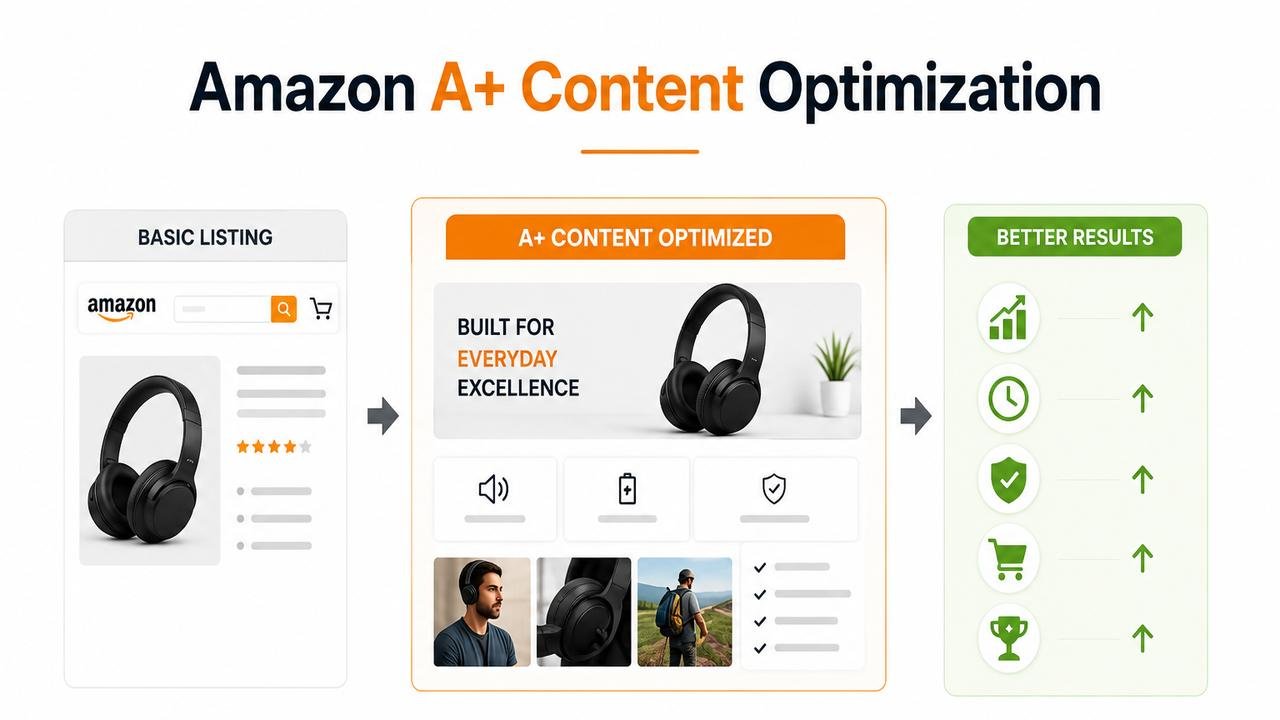
3. Amazon A+ Content Optimization is Not Optional
If you have Amazon Brand Registry and you aren’t using Amazon A+ Content strategy, you are leaving money on the table.
Here is the secret about Amazon A+ Content Optimization:
Amazon’s native search doesn’t index the text in those modules. But Google does. Even better, swapping out a boring text description for high-quality, visual modules drastically increases the amount of time a shopper spends on your page. Amazon A+ Content Optimization builds trust, answers questions visually, and directly impacts your unit session percentage.
Winning the Mobile-First e-commerce
More than half of all purchases on Amazon India happen on a smartphone.
Think about how you shop on your phone. You swipe through the images. If the images don’t answer your questions, you leave. You rarely scroll down to read the bullet points.
Your Amazon product image is your real sales copy. Any E-commerce seo company india worth hiring will tell you that Amazon infographics image are mandatory. You need images with text callouts pointing to key features. You need lifestyle photos showing the product being used by real people. You desperately need scale images putting the product next to a common object because buyers misjudging the size of an item is the number one cause of returns.
The Invisible Engine: Backend Search Terms
Backend search terms are the hidden gears of product indexing. The customer never sees them, but the algorithm relies on them heavily.
This is exactly where you put all the messy stuff:
common misspellings, colloquial Indian phrases, regional synonyms, and secondary keywords that sounded way too clunky to put in your public title.
There are strict rules here. Don’t repeat words you already used in your title or bullets; Amazon is smart enough to cross-reference. Don’t use commas. Separate your words with a simple space. Keep it strictly under the 250-byte limit. And never, ever put a competitor’s brand name in your backend terms. Amazon’s system catches it instantly, and they will suppress your listing.
Why PPC and SEO Are the Same Strategy
You can’t treat organic product discoverability and paid ads as two different departments. They feed each other. A professional Amazon SEO agency setup bridges the gap between the two.
You create Google PPC ads strategy to force your product to the top of the page. That visibility generates initial sales velocity. That sales velocity proves to the organic algorithm that your product is a winner, which slowly pushes your natural ranking higher.
It’s a flywheel. More importantly, Sponsored Products campaigns are the best market research tools on earth. By downloading your Search Term Reports, you can see exactly which weird, long-tail phrases people are actually typing in before they buy. You take those exact phrases and bake them back into your Amazon store optimization strategy.
External Traffic and Marketplace Authority
Driving your own traffic is the ultimate hack for building marketplace authority right now.
Brands that are dominating their categories are running Facebook, Instagram, or Amazon Google Ads directly to their Amazon storefronts. If you manage a Shopify store and an Amazon presence simultaneously, balancing that traffic is a delicate act. But pushing targeted promotional traffic to your Amazon listing during a new launch spikes your conversion rate. It tells the A10 algorithm that your product is trending outside of Amazon, which triggers massive organic ranking boosts.
Just make sure your listing is retail-ready before you spend a single rupee on external ads. If you don’t have at least 15 solid reviews, great images, and Prime shipping enabled, you are just paying to send people to a page where they won’t buy.
Operational Mistakes That Destroy Search Rankings
Sometimes, bad Amazon search ranking optimization has nothing to do with keywords. It’s an operational failure.
- Going Out of Stock: Inventory performance is an SEO ranking factor. Period. If you stock out, your ranking drops like a stone. When you finally get inventory back, Amazon doesn’t just hand you your old rank back. You have to fight for it all over again.
- Bad Pricing Strategy: If your product is priced 40% higher than identical competitors, and your images don’t clearly prove why it’s worth the premium, your conversion rate will tank. The algorithm will notice, and your organic rank will disappear.
- Wrong Categories: Sellers often try to list their product in a less competitive, but slightly incorrect, sub-category to get a “Best Seller” badge. Amazon strictly enforces category relevance now. If you are in the wrong neighbour-hood, they will limit your search visibility.
What Professional Amazon SEO Services INDIA Actually Improve
When you sit down to evaluate an agency or a consultant, ignore vanity metrics. Look at what actually drives the business forward. A legitimate Amazon E-commerce seo services in india focuses on moving these specific needles:
- Click-Through Rate (CTR): Are more people clicking your product in the search results? This is fixed through better main images and cleaner titles.
- Unit Session Percentage: This is just Amazon’s term for conversion rate. It goes up when your Amazon A+ content optimization, bullet optimization, and review velocity are dialed in.
- Total ACoS (TACoS): As your organic rankings finally start to climb, your heavy reliance on paid ads drops. Your TACoS shrinks and your actual take-home profitability increases.
- Digital Shelf Share: Are you dominating page one for the terms that actually matter to your bottom line?
When is it Time to Hire an Amazon SEO Agency?
Scaling a catalog by yourself is fine when you have five products. Once you cross 50 SKUs, it becomes a logistical nightmare.
You should start looking for Amazon seller growth services when your PPC ACoS is bleeding your margins dry and you desperately need organic sales to balance the spreadsheet. It’s also time to outsource if you are expanding into Amazon India from a platform like Flipkart, or coming in from an international market, and you need highly localized keyword strategies.
If you know you have an incredible product, but you simply don’t have the time to sit in Seller Central all day managing backend byte limits and troubleshooting suppressed listings, let an expert handle it.
Frequently Asked Questions – Amazon SEO Services INDIA
1. What exactly are Amazon SEO Services?
Amazon SEO Services cover the technical and strategic work of getting a product to rank higher in Amazon's search results without paying for every click. That means optimizing titles, bullet points, images, backend search terms, A+ Content, and the conversion elements that signal to Amazon's algorithm that shoppers actually want your product. Done well, it shifts a seller's sales mix away from constant ad spend and toward organic, repeatable visibility.
2. Why does Amazon SEO actually matter for sellers in India right now?
Because almost every category on Amazon India has gotten crowded. A few years ago, decent photos and a reasonable price were enough to get noticed. That's no longer true. Sellers who invest in proper SEO consistently out-rank competitors who are simply outspending them on ads. they show up higher, attract shoppers who are already close to buying, convert better, and build a sales base that doesn't disappear the moment the ad budget runs out.
3. How does Amazon's A10 algorithm actually decide what ranks?
A10 isn't a single switch, it's weighing several things at once: how relevant your keywords are, how consistently your product sells organically, your conversion rate, how engaged customers are with your listing, your standing as a seller, how well you manage inventory, your reviews, and increasingly, traffic you bring in from outside Amazon. The pattern Amazon is really rewarding is simple products that keep selling and keep customers happy keep climbing.
4. How long before Amazon SEO actually shows results?
Listing changes get indexed fast usually within 24 to 72 hours, so you'll see your edits reflected almost immediately. But indexing isn't the same as ranking. Real movement in search position, traffic, and sales generally takes 30 to 90 days, and where you land in that range depends on how competitive your category is, how difficult your target keywords are, and how strong your listing was to begin with.
5. What does Amazon Listing Optimization actually involve?
It's the full overhaul of everything a shopper and Amazon's algorithm both evaluate product titles, bullet points, descriptions, backend keywords, images, A+ Content, and product attributes. The objective is twofold: get found by the right search queries, and once found, convert that visibility into an actual click and purchase. Optimisation without conversion focus is half the job.
6. Does A+ Content actually move the needle on rankings?
Not directly, Amazon doesn't index most A+ Content text for search ranking purposes, so don't expect keyword stuffing in your A+ modules to boost your position. What it does do is keep shoppers engaged longer, build trust through better visual storytelling, and lift conversion rates. And since conversion rate is one of the signals A10 does weigh heavily, A+ Content earns its ranking benefit indirectly through better-performing listings rather than through search indexing.
Conclusion
Succeeding on the most aggressive retail platform in the world requires entirely shifting your perspective. You have to stop treating Amazon like a keyword database and start treating it like a conversion engine. The brands that will survive and dominate their categories over the next few years understand that the search algorithm only exists to serve products that people actually want to buy.
Partnering with a team like Arihant Global for expert Amazon SEO Services India isn’t just about getting your products found anymore. It’s about building a bulletproof, high-converting catalog that protects your margins from out-of-control advertising costs.
Disclaimer
Amazon Seller Central, FBA, Sponsored Products, and related terms are trademarks of Amazon. This content is for informational purposes only. Results may vary based on competition, pricing, inventory, and marketplace conditions. Arihant Global is independent and not affiliated with or endorsed by Amazon.