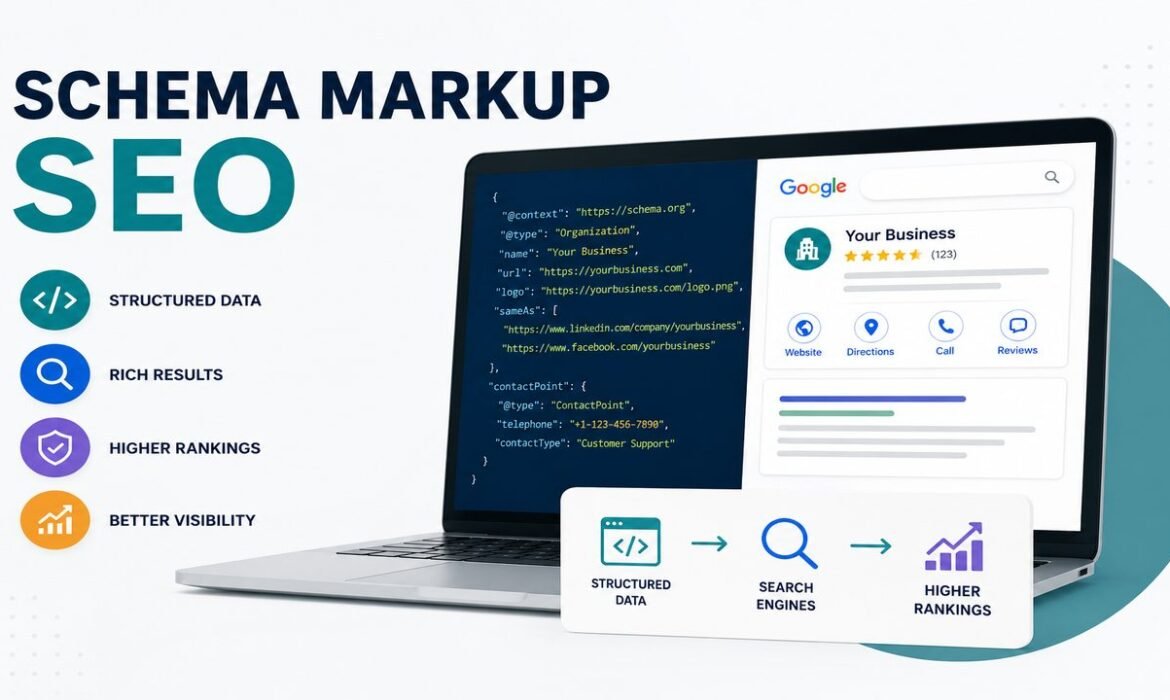
There’s a Quiet gap widening between Businesses that show up in Search and Businesses that Don’t and it has very little to do with how much content they publish. It comes down to something more foundational. Whether Google actually understands what your content is about.
Most site owners spend months refining their writing, building backlinks, and chasing keyword positions. And yet they’ve never told Google one simple thing that what their pages actually mean. Not just the words on them the meaning behind those words. The entities, the relationships, the context that separates a trusted source from a random page that happens to rank.
That’s the real job of schema markup SEO. And in 2026, getting this right is no longer optional if you’re serious about search.
What Schema Markup SEO Actually Does And Why Most People Misunderstand It
Let’s get one thing straight from the start. Schema markup doesn’t work like a ranking button. You don’t add it and watch your positions jump overnight. That’s not what it’s for.
What it does is remove ambiguity and in search, ambiguity is expensive.
Every time Google crawls a page, it’s trying to answer a question:
What exactly is this?
Is this an article, a product, a service, a local business, an event, a person?
Without structured data, Google has to guess based on your content. It’s gotten remarkably good at guessing. But a guess is still a guess and when your competitor has given Google a clear, confirmed answer about their page while yours still requires interpretation, who do you think gets the benefit of the doubt?
JSON-LD structured data is how you stop leaving that to chance. You embed machine-readable signals directly in your page’s code. You tell Google precisely what your content is, who created it, what it’s about, and how it relates to other entities it already knows. No guesswork. No inference. Just clarity.
And clarity, in modern search, compounds into rankings, rich results, and trust.
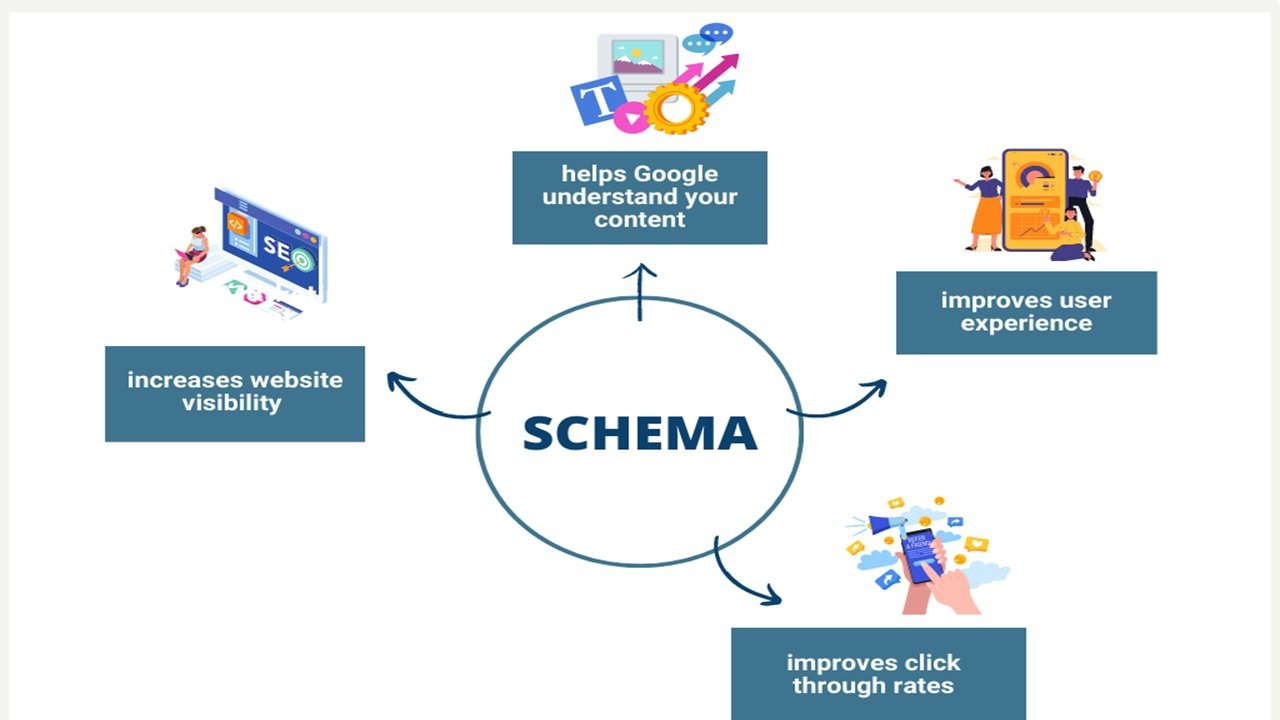
The Real Reason Google Cares About Structured Data in 2026
Search has fundamentally changed. Five years ago you could rank well by optimizing pages around keywords. Today that’s a starting point, not a strategy.
Google now processes queries through a semantic understanding system one that maps relationships between topics, entities, and intent rather than just scanning for keyword matches. When someone searches “best digital marketing agency in India,” Google isn’t looking for a page with those exact words. It’s looking for an entity a verifiable organization with a location, a track record, a presence across multiple trusted sources and it’s asking which result most credibly is that entity.
This is where structured content markup becomes a business-critical tool, not a technical afterthought.
Organization schema markup tells Google exactly who you are your name, your location, your contact information, your social profiles, your logo. Person schema links your authors to verifiable professional identities. Local Business schema markup plants you firmly on the knowledge graph with a geographic footprint Google can confirm and cross-reference.
Once your site registers as a known, trusted entity not just a collection of pages something changes. You start appearing in searches you didn’t specifically target. Your branded results get richer. Your topical associations deepen. The whole domain gains credibility, not just individual pages.
This is the shift from keyword optimization to entity SEO. And structured data is the mechanism that makes it happen.
How Schema Markup Directly Strengthens Google E-E-A-T
Google E-E-A-T framework Experience, Expertise, Authoritativeness, Trustworthiness has moved from a quality guideline into something with real ranking teeth. Especially in industries where Google considers the stakes high: finance, health, legal, and anything involving major purchasing decisions.
Here’s the uncomfortable truth about E-E-A-T: Good writing alone doesn’t establish it. Google needs signals it can verify, not just read.
That’s where Article schema combined with Person author schema markup earns its keep. When your content is linked to a named author entity one with same As references to their LinkedIn profile, published work, or professional bio. Google can evaluate the person behind the content, not just the content itself. It can cross-reference that author against other trusted sources and decide whether this is someone whose expertise it should surface to users.
At Arihant Global, this is taken seriously across every piece of content published. Author entities are built out properly, linked to verifiable profiles, and kept current because the team understands that E-E-A-T isn’t a content quality issue. It’s a structural one. You have to give Google the signals it needs to verify your expertise, or it defaults to uncertainty.
Sites that treat authorship as optional metadata are leaving one of the strongest trust signals in technical SEO completely unused.
AI Search Overview, Generative Search, and Why Structured Data Is Now a Retrieval Tool
Here’s where things get really consequential for businesses in 2026.
AI Overviews now appear at the top of search results for a significant and growing portion of queries. These aren’t just featured snippets with a new coat of paint. They’re generated summaries that pull from multiple sources and they cite those sources visibly. Being cited in an AI Overview is effectively a zero-click brand impression that reaches the searcher before any organic result does.
The question is: what makes Google’s AI system select one source over another for citation?
The answer involves several factors, but structured data sits high on the list. AI retrieval systems favor content that can be interpreted quickly, accurately, and with confidence. When your page has clean JSON-LD schema that identifies what it is, who wrote it, what question it answers, and what entity it represents that page becomes significantly more retrievable than an unstructured equivalent, even if the prose quality is similar.
FAQ Page schema is particularly powerful here. Format each answer as a complete, self-contained response to a specific question and you’ve essentially pre-packaged your content for AI extraction. How To schema works the same way for instructional content. These aren’t just formatting choices. They’re retrieval signals for answer engines and generative search systems that are rewriting how traffic flows online.
Generative engine optimization GEO is the discipline built around this reality. Getting it right starts with structured data.
The Schema Types Worth Your Time Right Now
Not every schema type carries equal weight. After working across different site types and industries, these are the implementations that consistently produce measurable outcomes:
1.. Article + Author (Person) Schema
is the most neglected combination in content SEO. Linking each article to a verified author entity with proper credentials and external references does more for E-E-A-T than most on-page optimizations combined.
2. FAQ Page Schema Markup
remains one of the highest-value markup types available. It targets featured snippets, AI Overview citations, and voice search answers simultaneously. Write your FAQ answers as standalone, direct responses not click-bait teasers.
3. Organization Schema Markup
is the anchor of your entire structured data strategy. Every business site needs it. Get it completely right name, URL, logo, social profiles, contact details, same As links and it lifts the trust signals on every page on your domain.
4. Product + Review Schema Markup
is non-negotiable for E-commerce. Star ratings and pricing in the SERP aren’t cosmetic. They’re conversion signals that appear before the user ever clicks.
5. Bread crumb List Schema
is low effort, high return. It reinforces your site’s content architecture, helps Google understand your page hierarchy, and makes your URLs look cleaner and more navigable in search results.
6. How To Schema
is underused outside of DIY and recipe content. Any page that walks a user through a process step-by-step should be marked up. It’s one of the most AI Overview-friendly formats available.
Getting This Right: What the Implementation Actually Looks Like
The biggest barrier to structured data work is the false belief that it’s complicated. It isn’t if you approach it with the right foundation.
JSON-LD is the only format worth using. It sits in your page’s <head> tag, completely separate from your visible content. You can update, add, or remove it without touching a single line of your HTML. Google explicitly recommends it, and for good reason it’s clean, flexible, and far easier to maintain than Microdata or RDFa, which belong to an older era of technical SEO.
For WordPress builds, Rank Math handles most standard schema types well out of the box. For custom or headless architectures, writing JSON-LD manually gives you precise control especially over entity relationships, same As references, and nested schemas that plugins typically oversimplify.
Validation is not optional. Run every schema implementation through Google’s Rich Results Test before the page goes live. Errors in structured data don’t just limit your rich result eligibility. they can generate conflicting signals that actively damage Google’s confidence in how your page should be classified. Two minutes of validation prevents that entirely.
The discipline that separates serious SEO teams from casual practitioners is treating schema as part of the publishing workflow, not a retroactive cleanup project. At Arihant Global, no page goes live without validated schema already in place.
it’s built into the process at the content architecture stage, not bolted on afterward. That consistency across hundreds of pages is what builds the kind of structured data foundation that compounds in search over time.
The Bottom Line for Businesses That Want to Win in Search
Here’s the thing that gets lost in all the technical discussion around schema markup SEO. this is ultimately a business issue, not just an SEO one.
Every missed rich result is a missed click. Every page Google can’t confidently classify is a page that competes at a disadvantage. Every author whose expertise isn’t verified through structured signals is an author whose content Google treats with lower confidence. And every business that hasn’t registered itself as a trusted entity in the Google knowledge graph is a business that’s invisible to a growing share of AI-driven search.
The good news is that most businesses haven’t done this work properly. Which means getting it right now still represents a genuine competitive advantage one that shows up in rankings, in SERP real estate, and in AI search visibility at the same time.
Start with Organization schema. Link your authors. Mark up your FAQs. Validate every implementation before it goes live. And treat structured data as the permanent foundation. it is not a project you revisit once a year.
The businesses that understand search in 2026 aren’t just publishing content. They’re making sure Google can read it.
Is Google misreading your website? Modern SEO Expert Team At Arihant Global will find out

Most sites are missing the structured data signals that drive rich results and AI Overview citations. Arihant Global audit shows you exactly what's broken, what's missing, and what to fix first.
Frequently Asked Questions About Schema Markup
1. Does schema markup directly improve search rankings?
Not in the way a backlink does but the downstream effects are real. Clearer Google understanding leads to better content classification, richer SERP display, stronger entity associations, and higher likelihood of appearing in AI-generated answers. The ranking impact is indirect but consistent.
2. What is the best schema format to use?
JSON-LD, without question. It’s Google’s recommended format, the cleanest to implement, and the easiest to maintain. Microdata and RDFa are technically supported but there’s no practical reason to use them for new builds.
3. How does structured data help with AI search visibility?
AI retrieval systems extract answers from pages they can read clearly. Structured markup tells those systems exactly what your content is, who it came from, and what question it answers. which directly increases the probability of being cited in AI Overviews and answer engine responses.
4. How often does schema need to be updated?
Whenever the underlying content changes. A product price shift, a new author, a changed business address all of it should be reflected in your markup promptly. Stale schema creates a mismatch between your content and your signals, and Google notices.
Disclaimer:
This analysis by Arihant Global is based on publicly observable SEO signals, semantic relevance patterns, content architecture, and search visibility data. Search rankings are influenced by multiple dynamic factors, including Google algorithm updates, competition, technical performance, user engagement, and evolving search behavior.