Do you remember the “good old days” of 2023? Back then, ranking a local business meant having a decent Google Business Profile, a few keywords in your title tags, and some localized backlinks. If you did that, you’d likely show up in the “Local 3-Pack” map results.
Welcome to 2026. Those days are gone.
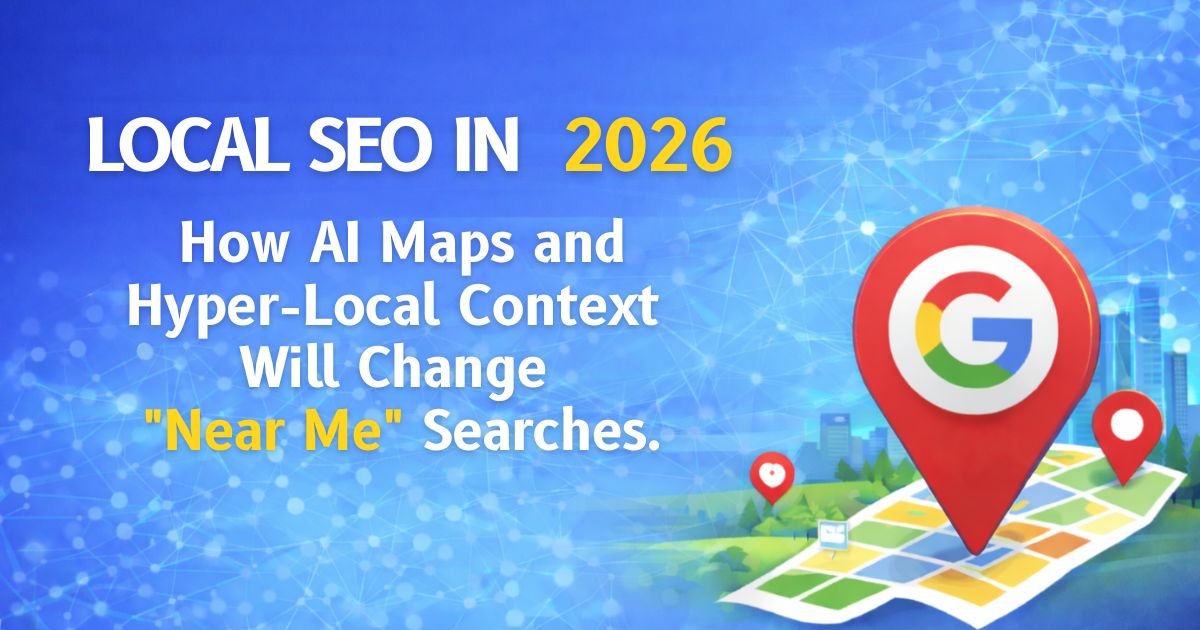
As we settle into the new year, the landscape of local search has radically transformed. The integration of generative AI directly into Google Maps and the core search results has fundamentally changed customer behavior. It is no longer about just being “listed”; it is about being the most relevant answer to a highly contextual question.
As a digital marketing agency focused on helping local businesses grow, we have watched this shift happen firsthand. It’s exciting, but it requires a new approach. Here is a simple guide on how to get found in this new era of local search.
Here is your definitive guide to adapting your strategy for the era of AI Maps and hyper-local context.
The New Reality: From “Search” to “AI Discovery”
The biggest shift we have witnessed over the last two years is the move away from the traditional list of links. When a user pulls out their phone in Jaipur and searches, they aren’t just getting a map with pins anymore. They are getting an AI-curated experience.
AI-driven local search means Google’s AI isn’t just matching keywords; it’s understanding the real-world intent behind a query. It is synthesizing reviews, photos, operational data, and current location context to provide a conversational answer.
For example, a search for “best coffee shop for working” doesn’t just return shops near you. The AI now analyzes review sentiment to find places mentioned as “quiet,” checks current crowdedness data in real-time, and verifies Wi-Fi availability before recommending a spot.
If your business data isn’t structured so the AI can easily digest it, you won’t be part of that recommendation. This has led to a massive rise in zero-click local results, where the user gets all the information they need opening hours, current wait times, price range without ever visiting your website. Your goal in 2026 isn’t just traffic; it’s visibility within these AI answers.
“Near Me” Got Very Specific
The phrase “near me” used to just mean “within a 5-mile radius.” In 2026, it’s way more personal.
Context is everything now. Google looks at where the user is standing, what time of day it is, and even what they are likely doing.
Think about it: someone searching for “quick food” standing outside a sports stadium at 9 PM needs something very different than someone searching for “quick food” from their office building at lunchtime. One needs an open-late food truck; the other needs a sit-down cafe.
To win at local search today, your digital presence needs to match this real-world context. As local SEO experts, we tell our clients: don’t just talk about your whole city. Talk about your specific neighborhood, nearby landmarks, or the cross-streets you are located on. You need to connect with where your customers actually are.
The Rise of Multimodal Local Search (Visual & Voice)
People aren’t just typing searches into a bar anymore. They are using their cameras and talking to their phones.
1. The Visual Search
Google Maps has become incredibly visual. People want to “see” a place before they go. If someone searches for a “restaurant with a nice patio vibe,” Google actually analyzes your photos to see if you have a nice patio.
The takeaway: Stop using stock photos. You need real, clear, high-quality photos of your space, your products, your team, and your atmosphere. You are essentially teaching Google what your business looks like.
2. Voice Search is a Conversation
Voice search has gotten very conversational. People don’t just robotically say “Pizza near me.” They ask complex questions like, “Where can I get a gluten-free pizza right now that’s good for kids and not too busy?”
Your website and online profiles need to answer these specific, conversational questions clearly.
The Importance of Being Accurate Right Now
Nothing frustrates a customer faster in 2026 than wrong information. If Google sends someone to your store and you’re closed, or you don’t have the item you said you did, that customer is likely gone forever.
Google knows this. It prefers businesses that share accurate, “right-now” information. Are your wait times accurate? Are your special holiday hours updated weeks in advance? If you sell products, can Google see what’s in stock today? Keeping this information updated is crucial for earning Google’s trust.
Conclusion: Adapt or Disappear
The era of “set it and forget it” local SEO is over. Local SEO in 2026 requires an active, ongoing strategy that feeds Google’s hungry AI with high-quality, contextual, visual, and real-time data.
By focusing on hyper-local context, optimizing for visual discovery on Google Maps AI features, and ensuring your data is pristine, you can ensure your business isn’t just found—it’s recommended.