Every day, thousands of businesses in India type the same three words into Google:
- “SEO services near me.”
- “Best SEO company for small business in India.”
- “How to rank higher on Google.”
Now here’s the interesting part.
Most of them sign up with an agency, get a monthly report full of green arrows and “rankings improved” and six months later, still can’t say whether it actually made them any money.
Meanwhile, a few of their competitors quietly keep showing up at the top of Google, month after month, taking the exact customers everyone else was chasing.
So what’s the real difference between SEO that just looks good on paper and SEO that actually grows a business?
The answer is SEO services done the right way, built around real business results, not just rankings.
In this guide, you’ll learn what SEO services actually include, how Google’s AI-powered search has changed the rules, and the proven steps to rank higher and turn that visibility into real customers in 2026.
What Are SEO Services?
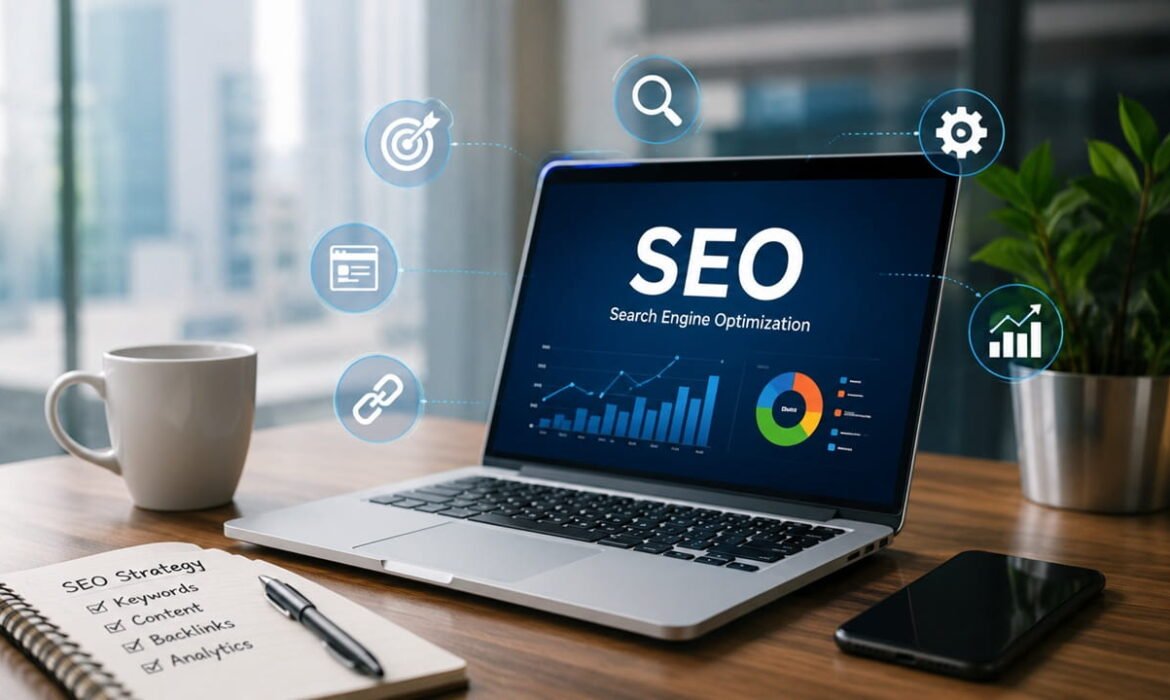
SEO services are the specific actions a business, agency, or expert takes to help a website show up higher in Google’s search results. This includes keyword research, writing better content, fixing technical issues on the website, building links from other sites, and increasingly in 2026 writing content in a way that AI tools like Google’s AI Overviews and ChatGPT can pick up and mention directly.
Unlike paid ads, SEO doesn’t buy your spot on Google you earn it. That’s why the results usually take longer to show up, but they keep working long after you stop paying for the work.
SEO services usually fall into three connected areas: on-page SEO, technical SEO, and off-page SEO plus a fourth area that’s become very important in 2026: AI and answer-engine Optimization, which decides whether AI tools mention your business at all.
Why Search Engine Optimization Still Matters Even With AI Answers Everywhere
It’s a fair question in 2026: with AI answering search questions directly, is SEO still worth paying for?
The data says yes, clearly the shape of the win has simply changed.
- Organic search still brings in roughly half of all trackable website traffic more than any single paid or social channel. For business-to-business (B2B) sites, that number is even higher.
- SEO gives a median return of around 748% over three years, according to 2026 industry data making it one of the highest-return marketing investments available, even for small budgets.
- SEO’s return is usually 5 to 8 times higher than paid search, mostly because your cost per customer keeps falling as your rankings improve, instead of resetting every time your ad budget stops.
- Yes, search behaviour is shifting a large share of Google searches now end without a single click, and AI answer boxes can cut the click rate of the top result by more than half in some cases. But businesses that get mentioned inside those AI answers are getting seen by more people than competitors who are invisible to AI entirely.
- India’s digital marketing market crossed roughly ₹560 crore in 2025, and SEO remains one of the biggest parts of that spend, because Indian businesses have realized paid ads alone don’t build long-term visibility.
The honest takeaway:
Search Engine Optimization isn’t shrinking. It’s splitting into two connected goals ranking in the normal search results, and getting mentioned inside the AI-written answer sitting above them.
SEO Strategy That Actually Drive Ranking
A strong SEO strategy isn’t a checklist of small tasks. It’s a decision about where your website actually has the best chance to compete, given your budget, competition, and timeline.
1. Build topical authority, not just single keywords
Google no longer looks at one page alone it looks at how well your whole website covers a topic. Websites organized into connected clusters of content tend to get more traffic and hold their rankings for much longer than single, disconnected articles.
2. Match search intent, not just keywords
If your page targets a keyword but doesn’t actually deliver what the top-ranking pages already deliver, Google pushes it down no matter how technically perfect the page is.
3. Build real E-E-A-T (Experience, Expertise, Authority, Trust)
Google’s own guidelines treat this as a major ranking factor. AI tools are also starting to check who wrote the SEO content, and whether the business is a real, trustworthy source, before deciding whether to mention it.
4. Fix the technical basics first
No amount of great content ranks on a website that’s slow, hard to crawl, or breaks on mobile. Site speed and mobile performance are non-negotiable, not extras.
5. Structure content for AI mentions
Ranking well in normal search and getting mentioned inside an AI answer both need the same basic thing: clear, well-organized, genuinely useful content just written so both a human reader and an AI tool can quickly understand it.
SEO Services Explained: What Each One Actually Gives You
“SEO services” is a broad term. Here’s what you’re actually paying for when an SEO agency lists each one:
|
Service |
What It Actually Gives You |
|
On-page SEO |
Optimizing individual pages titles, headings, content to match what people are searching for |
|
Off-page SEO |
Building your site’s authority through backlinks and mentions from other websites |
|
Technical SEO |
Fixing site speed, mobile issues, and crawl problems that are quietly blocking rankings |
|
Local SEO |
Optimizing your Google Business Profile and local listings for “near me” searches |
|
Optimizing product and category pages for online stores |
|
|
Enterprise SEO |
Managing SEO across large websites with thousands of pages and multiple teams |
|
International SEO |
Setting up your site to target multiple countries or languages correctly |
|
SEO content services |
Writing blogs, guides, and landing pages built around real search intent |
|
SEO audit services |
A full check-up of your technical setup, content, and backlinks usually the right first step |
| SEO consulting | Strategy and guidance without full execution good for teams that already have in-house staff |
A good SEO company won’t try to sell you all ten of these at once. A proper audit usually comes first, and it should tell you which two or three will actually move the needle for your specific website.
The Core Building Blocks of SEO
1. Keyword Research & Search Intent
This is where every Search Engine Optimization project starts figuring out not just what people search for, but why they’re searching for it. A keyword with high search volume but the wrong Search intent will never convert, no matter how well it ranks.
2. On-Page SEO & Content Optimization
This covers titles, headings, internal links, and most importantly in 2026 how deeply your content actually covers a topic. Pages that fully answer a question, including the related questions a reader naturally has next, usually beat thinner competing pages, even when those pages are technically well set up.
3. Technical SEO: Site Speed & Mobile Performance
If Google can’t easily reach and read your pages, nothing else matters. Site speed alone directly affects sales for Indian websites specifically, a one-second improvement in mobile load time can raise conversions by roughly 8 to 12%, since most Indian shoppers browse on mobile data, not fast home Wi-Fi.
4. Off-Page SEO & Link Building
Backlinks are still a trust signal, but in 2026, quality and relevance matter far more than the total number of links. A handful of genuine links from trusted, relevant websites beats hundreds of low-quality directory links.
5. Structured Data & Schema Markup
Schema doesn’t directly boost your rankings, but it helps Google and AI tools understand your content clearly. Websites with clean, correct schema markup are more likely to get pulled into AI-generated answers.
6. Conversion Rate Optimization (CRO)
Traffic without sales is a vanity number. The best SEO programs also test and improve the website itself, because doubling your conversion rate has the same revenue effect as doubling your traffic at a much lower cost.
Semantic SEO, Entity SEO & the Rise of AEO/GEO
This is the part most older SEO guides simply don’t cover and it’s the biggest shift reshaping SEO right now.
1. Semantic SEO
Semantic SEO means writing for meaning, not just repeating a keyword. Google now understands the relationship between topics a page stuffed with a keyword but shallow on real information performs worse than one that explains the subject properly, using natural, varied language.
2. Entity SEO
Entity SEO treats your business, products, and content writers as “known things” inside Google’s system, not just blocks of text. Consistent naming, a properly detailed About page, and structured data all feed this and it’s becoming just as important as backlinks for many types of searches.
3. Answer Engine Optimization (AEO)
Answer engine optimization structures your content so a clear, short answer can be picked up directly by voice assistants, Google’s featured snippets, and AI answer boxes usually a tight 40 to 60 word answer placed right where the question is asked, not buried three paragraphs down.
4. Generative Engine Optimization (GEO)
Generative engine optimization goes one step further Optimizing specifically to get mentioned inside AI-written answers on tools like Google’s AI Mode, ChatGPT, and Perplexity, which tend to pull from genuinely detailed, trustworthy sources rather than the page with the most keywords.
5. Topical authority
Topical Authority ties all of this together. Websites that build out 25 to 30 genuinely thorough, connected articles around one topic tend to see their rankings improve up to three times faster than websites just chasing backlinks alone.
The practical question to ask any SEO provider in India in 2026: are they still selling you the old-style “keywords and backlinks” package, or are they actually building entity clarity, topic depth, and AI-readiness into your plan from day one?
How to Choose an SEO Company
Before signing anything, get clear answers on:
- Do they run an audit before pitching you a package? A real check-up should always come before a proposed plan.
- Is their reporting tied to rankings, traffic, or revenue? Rankings and traffic are early signs revenue is the number that actually matters.
- Do they mention AI search visibility at all? If AI Overviews and answer engines don’t come up in their pitch, their strategy is already a year behind.
- What’s realistic in 90 days versus 12 months? Be careful of anyone promising page-one rankings in a few weeks but expect a clear, honest timeline instead of vague “SEO takes time” answers.
- Is your content written by someone who actually understands the topic, or handed to random, unchecked writers? Both readers and AI tools increasingly check for genuine expertise.
Common SEO Mistakes That Waste Money
Avoid these common SEO mistakes to build stronger search visibility, attract relevant organic traffic, improve website authority, and achieve sustainable business growth.
- Chasing keywords with high search volume but the wrong intent ranking for traffic that was never going to buy anything.
- Treating link building as a numbers game instead of a relevance game quality now matters far more than quantity.
- Ignoring technical SEO while spending money on content that a slow, poorly built site will never let rank.
- Publishing thin, copy-paste content exactly the kind of page AI tools skip over completely.
- No tracking set up, so “rankings improved” gets reported as a win even when it brought in zero actual sales.
- Ignoring AI search completely most businesses today still don’t track whether they’re being mentioned in AI-generated answers at all.
Frequently Asked Questions – SEO Services
Q1. How long does SEO take to show results?
Most SEO work starts showing real movement within three to six months, with the strongest results usually building up between month six and month twelve. Local SEO and smaller, less competitive markets can move faster.
Q2. How much do SEO services cost in India?
Small and mid-sized businesses in India generally spend somewhere between ₹15,000 and ₹1,50,000 per month, depending on how competitive their industry is. Larger enterprise SEO programs can cost much more. The right number depends more on your competition than any fixed rule.
Q3. Is SEO better than paid ads (PPC)?
They solve different problems. PPC brings faster traffic that stops the moment you stop paying. SEO builds slower, but it keeps bringing traffic long after the initial work is done. Most growing businesses eventually use both together.
Q4. Do I need separate technical, on-page, and off-page SEO services, or one package?
For most small to mid-sized websites, one connected program covering all three usually works better than buying pieces separately, since technical problems can quietly limit how well your content and links perform.
Q5. What's the difference between normal SEO and AEO/GEO?
Normal SEO focuses on ranking position in Google's results. AEO and GEO focus on getting mentioned as the source when an AI tool generates a direct answer. In 2026, a strong SEO plan aims for both at the same time.
Q6. Can a small business really compete with bigger competitors in SEO?
Yes especially through local SEO and focusing deeply on one specific topic or area, where real depth often beats a bigger competitor's wider, shallower content.
Where to Go From Here
SEO services in 2026 aren’t about following a checklist that worked five years ago. They’re about building real topic authority, a technically sound website, and clear entity signals that perform in both normal Google rankings and the AI-written answers now sitting above them. The businesses winning aren’t always spending the most they’re the ones whose SEO is actually built around revenue, not just rankings on a report.