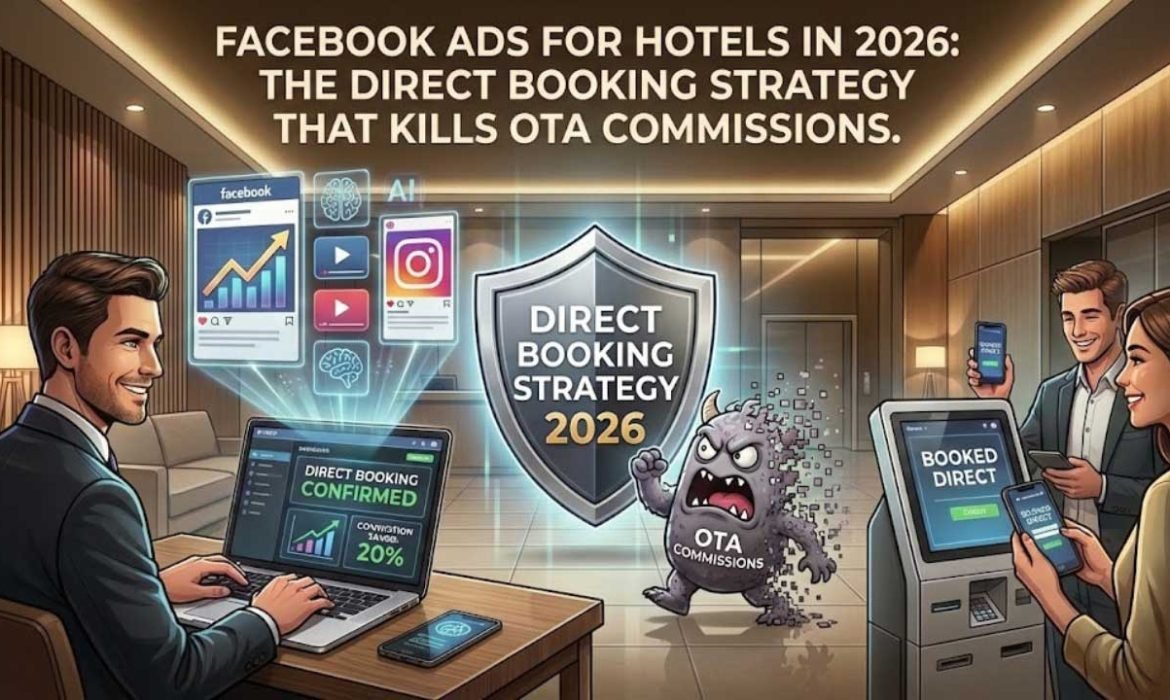
Facebook Ads for Hotels in 2026: The Direct Booking Strategy That Kills OTA Commissions
Let’s be brutally honest for a minute.
It’s January 2026. You are running a beautiful property. Your guest experience is top-notch. Yet, at the end of every month, you sit down and sign away 18%, 20%, maybe even 25% of your hard-earned revenue to Booking.com, Expedia, and the rest of the OTA giants.
It hurts, doesn’t it?
For years, hoteliers felt held hostage. The OTAs had the traffic, the budget, and the data. But the digital landscape has shifted dramatically over the last few years. The tools available to you right now, specifically through the Meta ecosystem (Facebook and Instagram), have leveled the playing field.
In 2026, relying solely on OTAs isn’t just expensive; it’s lazy marketing.
If you are tired of “renting” your customers from third parties and want to own the relationship (and the profit margin), you need a dedicated direct booking strategy. Here is your blueprint for using Facebook ads for hotels in 2026 to finally slash those OTA commissions.
The 2026 Mindset Shift: Meta is a Booking Engine, Not a Billboard
Five years ago, many hoteliers treated Facebook ads as “brand awareness.” They posted nice pictures of the lobby, boosted a post for $50, and hoped for the best.
That strategy is dead.
In 2026, Meta’s advertising platform is an advanced, AI-driven acquisition machine. It’s not about getting “likes”; it’s about getting heads in beds.
To kill OTA commissions, you have to stop thinking of social media as a place to just show your hotel, and start treating it as an extension of your sales team.
Here is the four-part strategy to make that happen.
Phase 1: Own Your Data (The Death of Cookies)
Remember the panic about the “cookieless world” a few years back? Well, we are living in it now. Tracking people across the internet has gotten much harder due to privacy regulations.
This means your most valuable asset in 2026 is First-Party Data.
OTAs win because they hoard customer data. To fight back, you need to leverage yours. Before you spend a dollar on ads, organize your Customer Relationship Management (CRM) system.
The Strategy: Take your list of past guests (emails and phone numbers) and upload it to Meta to create a “Custom Audience.” These are people who already know and trust you. Marketing to them is cheap and highly effective.
Next, create a “Lookalike Audience” based on your best, highest-spending guests. You are essentially telling Meta’s AI: “Here are my favorite customers. Go find more people exactly like them out of the billions on your platform.”
Phase 2: Creative That Stops the Scroll (Video or Nothing)
If your ad strategy in 2026 still relies on static photos of an empty hotel room, you are lighting money on fire.
Travelers today decide with their eyes, and they want dynamic content. The dominance of Reels across both Facebook and Instagram means short-form video is non-negotiable for the hospitality industry.
The Strategy: Stop selling “rooms.” Start selling “experiences.”
- Don’t show the bed; show the view you wake up to from the bed.
- Don’t show the empty pool; show a POV video of someone diving in with a cocktail waiting.
- User-Generated Content (UGC) is Gold: An authentic video shot on an iPhone by a happy influencer or guest will outperform a polished, expensive commercial nine times out of ten. It feels real, and in 2026, authenticity drives bookings.
Phase 3: Trust the Machine (Leveraging AI & Automation)
Back in the day, ad managers had to manually tweak targeting every day—selecting specific interests, ages, and behaviors.
In 2026, Meta’s AI (specifically their Advantage+ suite of tools) is smarter than any human media buyer.
The Strategy: Instead of hyper-targeting people interested in “luxury travel” and “spas,” broaden your audience and let the algorithm do the heavy lifting. Feed the system your best video creative, set your conversion goal to “Purchase” (Booking), and let the AI find the people most likely to convert right now.
It feels scary to give up control, but the machine learns faster than we can. Trust it to find your guests at the lowest cost.
Phase 4: The Retargeting Safety Net (Closing the Deal)
This is where the magic happens. This is how you steal the booking back from Expedia.
Travel planning is messy. Someone might look at your site on their phone during a commute, get distracted, and forget. Later that night, they go to an OTA to finalize because it’s “easier.”
You need to interrupt that process.
The Strategy: Set up Dynamic Product Ads for travel. If a user looks at your “Ocean View Suite” for dates in June but doesn’t book, your Facebook ad should follow them showing that exact suite for those exact dates, perhaps with a gentle nudge like “Still dreaming of this view? Book direct for free breakfast.”
This isn’t annoying; it’s helpful. It brings them back to finish what they started, directly on your site.
The Hard Truth
Implementing a sophisticated Facebook ads strategy for hotels isn’t easy. It requires good creative assets, technical setup of your booking engine tracking (the Meta Pixel), and a willingness to test.
It is much easier to just let Booking.com handle it and take their 20% cut.
But if you want to build a sustainable, profitable hotel business in 2026 and beyond, you cannot outsource your primary revenue stream. Take control of your data, embrace video, trust the AI, and start keeping that commission money where it belongs: in your pocket.
Frequently Asked Questions (FAQ)
Q: Are Facebook and Instagram ads really still relevant for hotels in 2026?
A: Absolutely. While new platforms emerge, the Meta ecosystem retains the largest, most varied audience with high purchasing power. Instagram is crucial for visual inspiration, and Facebook remains dominant for older demographics and final booking decisions. They are essential for reducing OTA reliance.
Q: Isn’t it cheaper to just boost posts on my Facebook page?
A: No. “Boosting” a post is generally a waste of money for hotels. It focuses on engagement (likes and comments), not bookings. To drive revenue, you must use the Meta Ads Manager to run sophisticated conversion campaigns targeted at getting people to complete a reservation on your website.
Q: How much budget do I need to start seeing direct bookings?
A: You don’t need a massive budget, but you do need consistency. A good rule of thumb is to start with at least $50-$100 per day to give the AI enough data to learn what works. Compare this spend against the commission you would have paid an OTA for those same bookings—the ROI is almost always in favor of ads.
Q: My hotel is small. Will this strategy work for me?
A: Yes, in fact, it often works better for independent hotels than big chains. You have more flexibility to be authentic in your video creative and can highlight unique selling points that giant brands can’t replicate.
Disclaimer: The content provided in this blog post is for informational and educational purposes only based on digital marketing trends as of January 2026. Advertising platforms like Meta frequently change their algorithms, policies, and tools. While the strategies outlined here are designed to improve direct bookings, specific results are not guaranteed and depend heavily on factors such as your property location, pricing strategy, website user experience, and quality of ad creative. We recommend consulting with a digital marketing professional before making significant investments in paid advertising.