E-E-A-T SEO is the practice of structuring content, author credentials, and site architecture so Google’s quality evaluation systems can algorithmically verify that your domain is a credible, real-world authority for a specific topic. It is evaluated through entity signals, structured data, author authentication, and behavioral quality indicators not keyword optimization alone.
A manufacturing exporter in Jaipur came to us ranked nowhere despite clean Core Web Vitals, calibrated keywords, and a 3,000-word product guide. A seven-year-old forum thread held the top spot. The technical SEO was fine.
The problem was simpler and harder to fix:
Google had no verifiable record that their business, their authors, or their claimed expertise existed as entities in the google Knowledge Graph.
That gap is E-E-A-T SEO and it is the primary ranking failure for most legitimate businesses competing in 2026. According to Google’s Search Quality Rater Guidelines, pages are evaluated not just on content quality but on whether the entity behind the content is verifiable and trustworthy. This article explains what that means structurally, and exactly how to fix it.
What E-E-A-T SEO Actually Measures
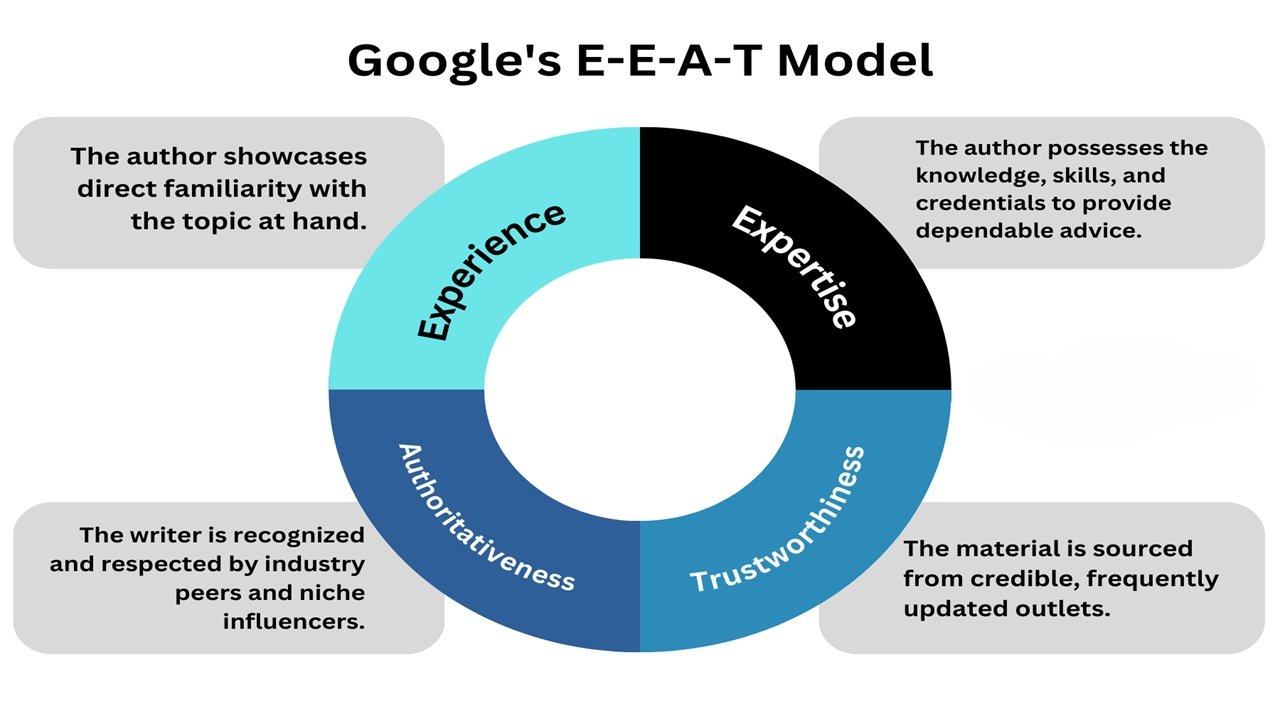
E-E-A-T SEO is Google’s four-signal verification framework – Experience, Expertise, Authoritativeness, and Trustworthiness used to determine whether a domain is a credible source for a specific query. It is evaluated through entity salience, structured data integrity, author credential verification, and behavioural quality signals. It is not a metric visible in Search Console.
The Experience pillar was added in December 2022 confirmed in Google’s official Search Central update documentation for one specific reason: large language models had made it trivial to produce grammatically correct, topically coherent text with zero real-world exposure to the subject. Experience cannot be replicated at scale, which is why it now carries disproportionate ranking weight in competitive verticals.
Google’s core question before any ranking decision:
Can it algorithmically verify this is a real, credible entity in this specific topic space?
Most technically optimized sites fail that test and never know it.
|
Pillar |
What Google Looks For |
Implementation Signal |
|
Experience |
Operational specificity, timestamps, falsifiable outcomes |
Named methodology + measurable result + timeframe in body copy |
|
Expertise |
Semantic entity co-occurrence density, strategic tradeoffs | Cluster of domain terms in logical proximity not keyword repetition |
| Authoritativeness | Google Knowledge Graph entity footprint, citation context | Brand entity anchored to topic space + external citations pointing inward |
| Trustworthiness | structured data implementation integrity, NAP consistency, author schema |
Person schema + Organization schema + verified author bylines |
Why the Helpful Content System Penalizes Technically Good Pages
| Google’s Helpful Content system applies a domain-level demotion to sites where a significant proportion of content fails to deliver information gain over existing top-10 results. This sitewide classifier suppresses even technically optimized pages across the entire domain not just the weak articles that triggered it. |
The classifier does not evaluate pages one by one. it evaluates the domain. Eighteen weak articles can suppress six genuinely strong ones on the same site.
We audited a digital marketing blog in late 2024: 18 of their 34 articles covered topics their competitors had already addressed with no new angles, no proprietary data, no operational specifics. Their six strong articles were being suppressed. After a 90-day information-gain upgrade sprint, target pages moved from positions 14–22 into the top seven.
| The Information Gain Test – Run Before Publishing Anything |
| Open the current top-3 results for your target query. Read their conclusions. If your article reaches the same conclusions using the same logic, it will rank below them permanently. The algorithm classifies it as redundant, not competitive. |
Decoding the Four Pillars: What Algorithmic Implementation Looks Like
Each E-E-A-T pillar maps to specific crawlable proxy signals. Experience is inferred from operational specificity and falsifiable claims. Expertise from semantic entity co-occurrence density. Authoritativeness from Google Knowledge Graph entity footprint and citation context. Trustworthiness from structured data integrity, HTTPS status, NAP consistency, and author schema deployment. |
1. Experience: The Signal Machines Cannot Replicate
Compare these two sentences describing the same outcome. The difference between them is the difference between ranking and not ranking:
| Weak – No Experience Signal | Strong – EEAT-Optimized |
| Restructuring audience segmentation can significantly reduce cost-per-lead for real estate advertisers. | When we restructured audience segmentation for a Jaipur residential developer’s Meta Ads account in Q3 2024 splitting cold audiences by project type rather than generic location radius CPL dropped from ₹2,340 to ₹1,340 over 28 days on a ₹60,000 monthly budget. |
The second sentence contains an operational timestamp, a named methodology, a sector-specific currency constraint, and a falsifiable outcome. No tool generates that combination. Every article needs at least two such experience-driven SEO signals – not hypothetical illustrations, but actual operational specifics from your practice.
2. Expertise: Semantic SEO Depth Over Surface Coverage
Keyword proximity and semantic depth are not the same thing. You can mention ‘ROAS attribution’ fifteen times and still register as a surface-level aggregator if the surrounding content lacks the strategic tradeoffs, failure-mode analysis, and advanced troubleshooting logic that a real practitioner produces.
Google’s NLP layer infers expertise from conceptual density entities like ROAS, first-party data, attribution windows, incrementality testing, and blended CAC clustered in logical proximity to the core topic. Thin co-occurrence signals an aggregator. Dense, logically connected co-occurrence signals a subject authority. Moz research on topical authority confirms that semantic SEO coverage depth consistently outperforms keyword repetition in competitive verticals.
3. Authoritativeness: Entity Footprint Before Keyword Gap Analysis
Every E-E-A-T engagement at ARIHANT GLOBAL starts with an entity SEO footprint audit not a keyword gap report. If Google has not anchored your brand entity to your claimed topic space in the Google Knowledge Graph, on-page optimization alone will not move rankings.
A B2B accounting software company we worked with had their entity anchored almost entirely to ‘GST compliance’ despite strong product capability in payroll and audit. Their payroll feature pages ranked nowhere. Until we built that topical cluster pillar page, four sub-topics, structured interlinks. those pages remained invisible regardless of technical SEO quality.
4. Trustworthiness: The Gatekeeper That Voids Every Other Signal
Trust is a gatekeeper. Algorithmic failures here suppress the domain regardless of how strong the other three pillars are. The most common trust failures found in audits:
- Anonymous authorship: Publishing under ‘Admin’ removes the author entity entirely. Fix: verified author pages with Person schema, real LinkedIn profiles linked, byline on every article.
- NAP inconsistency: Mismatched business name, address, or phone across Google Business Profile, website, and directory listings creates entity disambiguation failures the Google Knowledge Graph cannot resolve.
- Missing structured data on trust pages: About and Contact pages carry disproportionate trust weight. Organization and Local Business schema feed crawlable facts directly to the quality evaluation system.
- Outdated content: Published claims contradicted by newer pages on the same domain generate negative trust signals a credibility liability penalized at the domain level.
Generative Engine Optimization: How E-E-A-T Governs AI Overview Citation in 2026
| Generative Engine Optimization (GEO) is the architectural practice of structuring content so that AI-powered retrieval systems. Google AI Overviews, Perplexity, Chat GPT can extract, verify, and cite it as a trusted source. E-E-A-T signal strength is the primary filter for AI citation eligibility because these systems draw from the same quality-rated content pool the organic algorithm already trusts. |
In 2026, AI Overviews appear on an estimated 40–50% of informational queries, according to Search Engine Land’s 2025 SERP feature analysis. This makes GEO optimization a primary traffic consideration, not a secondary one. AI Overviews are built on content Google already trusts for organic rankings and the citation selection process favour verified entities, semantic co-occurrence density, and factual specificity.
The Content Formats AI Systems Extract Most Reliably
| Content Format | AIO Citation Likelihood | Why It Works |
| 40–50 word declarative definition | Very High | Direct extraction match for informational queries |
| Numbered step-by-step process | High | Structured format AI systems parse easily |
| Named framework with methodology | High | Unique entity citable and verifiable |
| Before/after comparison with data | Medium-High | Falsifiable claim preferred over assertions |
| Generic assertions without data | Very Low | Cannot be verified — filtered by extraction layer |
The GEO Implementation Checklist
- Place a 40–50 word declarative definition directly below each major H2 heading in the indicative mood, not a question format.
- Use falsifiable, measurable claims wherever possible. ‘CPL dropped from ₹2,340 to ₹1,340 over 28 days’ gets cited. ‘CPL improved significantly’ does not.
- Structure each section as: answer first, explanation second – the inverted pyramid ensures the extractable claim appears before qualifying context.
- Name your frameworks and methodologies – a named process (‘Audience Segmentation by Project Type’) is a citable entity; a generic description is not.
- Avoid vague assertions – the extraction layer filters them. Every claim that cannot be verified algorithmically reduces your AIO citation probability.
The Five-Fix Implementation Blueprint
| Effective E-E-A-T implementation requires five prioritized infrastructure changes: author entity authentication, semantic cluster architecture, information-gain content engineering, structured data on trust pages, and technical signal validation. Domains with existing authority signals typically see measurable ranking movement within 60–90 days. New domains require 4–6 months minimum for entity anchoring to register. |
| Step | Fix | Why It Comes First |
| 1 | HTTPS + Core Web Vitals | Trust gatekeeper no credit is given until this baseline clears |
| 2 | NAP inconsistency | Entity disambiguation failure blocks all downstream signals |
| 3 | Structured data on trust pages | About + Contact schema feeds verifiable facts to quality evaluators |
| 4 | Author entity authentication | Person schema + byline establishes the content creator as real |
| 5 | Content information-gain upgrades | Only effective after all gatekeeper signals are resolved |
1. Author Entity Authentication
Build verified author web pages with real photographs, confirmed LinkedIn URLs, domain-specific credential bios, and Person schema. The name string in schema must match bylines exactly mismatches create disambiguation failures that suppress author authority across every article the person has written.
2. Semantic SEO Cluster Architecture
Every pillar page needs 4–8 interlinked sub-topic pages with descriptive anchor text. ‘First-party data attribution methodology’ as anchor text compounds topical authority at the link level. ‘Click here’ wastes the co-occurrence signal entirely.
3. Information Gain Engineering
Each article must surface something the current top-3 results do not a named proprietary framework, verifiable client outcome data with methodology and timeline, a strategic tradeoff analysis, or a sector-specific constraint only a practitioner would know.
4. Structured Data on Trust Pages
Deploy Organization schema on the homepage and Local Business schema on the contact page. NAP data character-for-character identical to your Google Business Profile. These are the pages quality evaluators check first to verify a business is real. Per Google’s structured data documentation, schema markup on trust pages is a direct feed to the quality evaluation pipeline.
5. Technical Trust Validation
Audit Core Web Vitals (LCP below 2.5s, CLS below 0.1), HTTPS integrity, schema errors via Rich Results Test, NAP consistency across every directory. For Jaipur-based businesses specifically, Justdial and India Mart carry real co-citation weight in the geographic entity graph treating them as optional is a consistent mistake we see in local brands competing against national aggregators. Also include Sulekha, Trade India, and Yellow Pages India for complete local entity coverage.
Local E-E-A-T SEO: The Geographic Entity Layer
Local E-E-A-T SEO requires resolving an additional geographic entity layer that national brands do not face. NAP consistency, Google Business Profile optimization, and Local Business schema must all be resolved before topical authority signals carry full weight in local search.
|
India-Specific Citation Sources for Local Entity Authority |
|
For Jaipur and India-based businesses, the following directories carry co-citation weight in the geographic entity graph. Consistency across all of them is required not optional: |
|
• Justdial – highest local search co-citation weight for Indian SMBs |
|
• India Mart – critical for B2B manufacturing and export businesses |
|
• Sulekha – strong weight for service businesses in Tier-1 and Tier-2 cities |
|
• Trade India – relevant for export and wholesale sectors |
|
• Yellow Pages India – broad co-citation coverage, lower weight but additive |
Key Takeaways
- E-E-A-T is not a metric, it is a structural architecture problem that requires entity authentication, semantic cluster building, and trust signal deployment.
- The Helpful Content classifier operates at the domain level weak articles suppress strong ones. Information gain is a prerequisite for every piece published.
- The remediation sequence is fixed: trust failures first, content upgrades last. Reversing that order produces no measurable result.
- GEO optimization structuring content for AI Overview citation is the 2026 extension of EEAT strategy and requires declarative, falsifiable, entity-anchored content.
- For Jaipur-based and Indian businesses, geographic entity resolution through local citation consistency is an additional mandatory layer that national competitors do not face.
Frequently Asked Questions: E-E-A-T SEO 2026
1. When a domain has both trust failures and expertise deficits, which gets fixed first?
Trust failures take priority always. A domain with trust penalties receives zero credit for improved content until the gatekeeper signals are resolved. The correct sequence is:
(1) HTTPS and Core Web Vitals,
(2) NAP inconsistency,
(3) structured data on trust pages,
(4) author entity authentication, then
(5) content information-gain upgrades.
We confirmed this with a healthcare client in 2023 eight upgraded articles produced zero ranking movement until a broken Organization schema misidentifying their business category for 14 months was corrected.
2. How do you measure E-E-A-T improvement without a direct Search Console metric?
Track the percentage of target content pages appearing in Google's AI Overview results month-over-month. AI Overview inclusion is the most visible downstream evidence of strong E-E-A-T seo. these systems select for verified, entity-anchored, trust-signalled content. A rising AI Overview capture rate is the clearest available proxy for improving E-E-A-T health across the domain.
3. Does E-E-A-T seo work differently for local businesses in Jaipur?
Yes. Local E-E-A-T SEO requires resolving a geographic entity layer that national brands do not face. NAP consistency, Google Business Profile alignment, and Local Business schema must all be resolved before topical authority signals carry full weight in local search. For Jaipur-based businesses, Justdial and India Mart carry real co-citation weight in the geographic entity graph. treating them as optional is a consistent mistake we see in local brands competing against national aggregators.
4. Does E-E-A-T affect new websites, or only established domains?
E-E-A-T applies to all domains, but the timeline differs significantly. New domains require 4–6 months minimum for entity anchoring to register in the Knowledge Graph, even with correct implementation from day one. For new sites, the priority is establishing the brand entity clearly from launch: verified author pages, Organization schema, and Google Business Profile optimization before any content publishing begins.
5. How long does it take to see ranking improvements after fixing E-E-A-T signals?
Domains with existing authority signals typically see measurable ranking movement within 60–90 days of resolving trust failures and deploying structured data. Content information-gain improvements take longer 3–5 months for competitive queries. The fastest improvements consistently come from fixing structured data on trust pages, which can trigger re-evaluation within one to two crawl cycles.
The Bottom Line
There is no growth hack for Google E-E-A-T. You cannot fake years of operational experience with a clever prompt.
Real SEO in 2026 requires taking your business’s inherent, offline expertise and structuring it into a format that machine learning models can easily parse, trust, and retrieve.
If you are tired of watching competitors with inferior products outrank you, your semantic structure is likely broken.
Get Your E-E-A-T Audit
Connect with the SEO expert team at ARIHANT GLOBAL to audit your entity footprint and build the semantic SEO architecture your operational expertise actually deserves.
Disclaimer
This content is published by ARIHANT GLOBAL for educational and informational purposes only. SEO rankings, E-E-A-T signals, AI Overview visibility, and search performance vary by industry, competition, Google algorithm updates, and implementation quality.