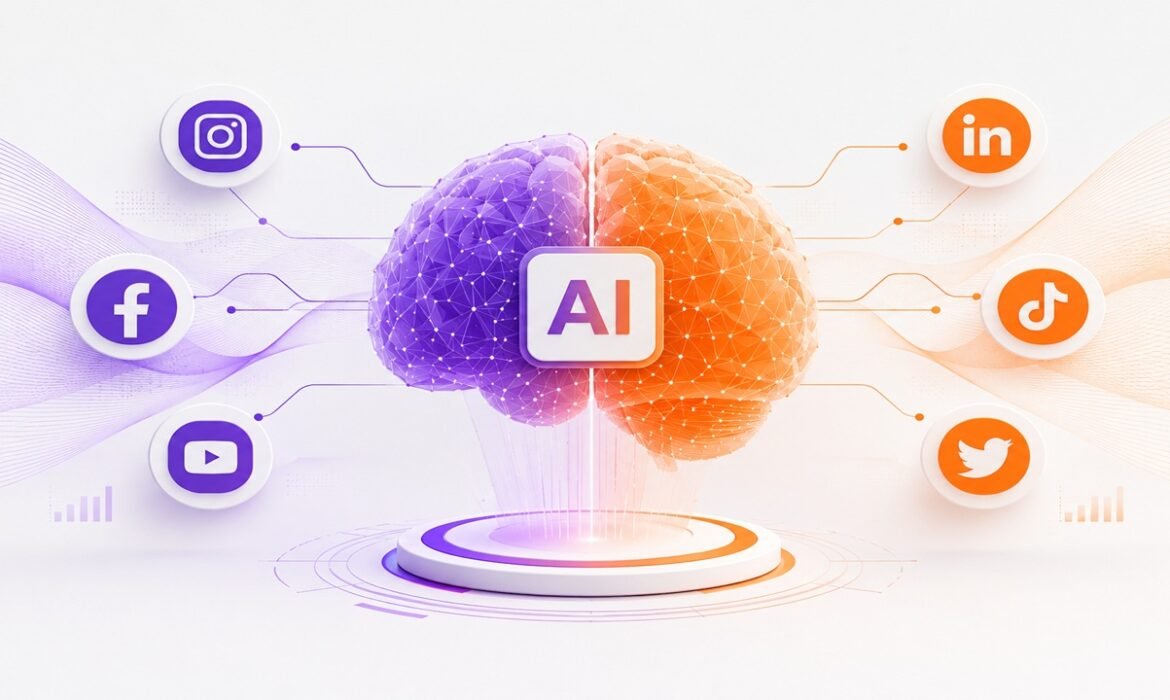
Rising ad costs. Shrinking organic reach. AI tools your competitors are already using. Here’s how to catch up and pull ahead.
A marketing manager at a mid-size Indian brand was spending 14 hours a week on social media content writing captions, scheduling posts, pulling reports, and still wondering why engagement was flat. After integrating AI social media marketing tools across the workflow, that same output now takes under 3 hours. Lead quality improved. Cost per engagement dropped. The posts that once required a Friday afternoon to write now take twenty minutes.
That is not a future scenario. It is happening now, in businesses of every size across India and globally. Artificial intelligence in social media marketing has moved from an experimental advantage to a competitive baseline and the brands that have not adopted it yet are already behind the ones that did 12 months ago.
This guide covers what AI social media marketing actually means in practice, which tools produce real results, how to build a strategy around it, and what mistakes to avoid without the generic hype that has filled most AI marketing content in 2025 and 2026.
What Is AI Social Media Marketing?
| AI social media marketing is the use of artificial intelligence technologies including generative AI, machine learning, natural language processing (NLP), and predictive analytics to plan, create, distribute, analyse, and optimise social media marketing campaigns. It enables businesses to produce personalised content at scale, automate repetitive tasks, identify high-performing content patterns, and respond to audience behaviour in real time reducing manual effort while improving campaign performance. |
01 | Why AI Is Reshaping Social Media
AI Social Media Marketing: Why 2026 Is the Tipping Point
Social media marketing used to be a volume game post frequently enough and the algorithm would eventually reward you. That model is broken. Organic reach on Facebook has fallen below 5% for most pages. Instagram Reels require not just frequency but precision: the right format, the right hook, the right first three seconds, for the right audience segment. The human capacity to optimize all these variables simultaneously hit its ceiling.
AI-powered social media marketing solves the scaling problem. Machine learning analyzes thousands of engagement data points that a human could never track manually, identifies the content patterns your specific audience responds to, and surfaces those insights in time to act on them. Generative AI then produces content variations at a speed and volume that would require a five-person team to match manually.
The Measurable Business Case
Businesses integrating AI social media automation into their marketing operations report an average 3–4x improvement in content output with no proportional headcount increase. More importantly, they report an improvement in content quality because AI tools optimize for engagement signals, not a content calendar, and because they free up human time for strategy and creative judgment rather than production.
| Metric | Before AI Integration | After AI Integration |
| Hours spent on content production | 14–18 hrs / week | 3–5 hrs / week |
| Content output per week | 5–8 pieces | 20–35 pieces |
| A/B tests run per month | 2–3 | 15–20 (automated) |
| Cost per engagement | ₹12–18 | ₹4–7 |
| Audience targeting precision | Broad demographic | Behavioural intent segments |
02 | AI Tools That Actually Deliver
Best AI Social Media Marketing Tools in 2026 What Each One Does
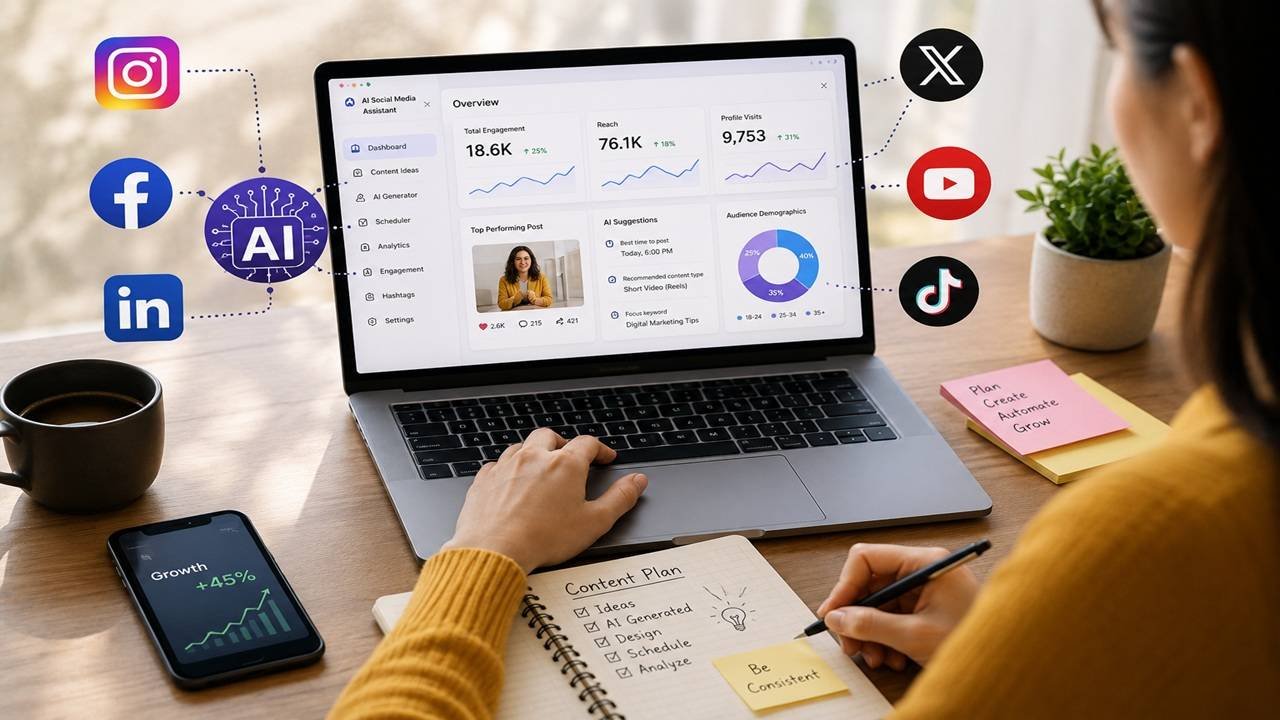
The AI tools landscape for social media marketing has matured significantly. There are now clear category leaders, and the mistake most marketers make is either adopting too many tools without integration or avoiding them entirely because the landscape feels overwhelming. Here is a focused, honest breakdown.
Content Creation and Copywriting
- ChatGPT (OpenAI): The most versatile AI writing tool available for social media. Generates captions, ad copy, comment responses, content calendars, and hashtag strategies. Its conversational AI capability is most powerful for drafting and iterating on content where human judgment refines the output rather than accepts it wholesale.
- Google Gemini: Particularly strong at multi-modal tasks combining text and image analysis for content recommendations. Gemini’s integration with Google Workspace makes it the natural choice for teams already operating in that ecosystem.
- Claude AI (Anthropic): Excels at longer-form social content blog extracts for LinkedIn, detailed post series, and content strategy documents. Claude AI for content creation has particular strengths in nuanced tone matching and consistent brand voice across multiple pieces.
- Jasper AI: A purpose-built AI marketing tool with pre-built templates for Instagram captions, Facebook ads, LinkedIn posts, and email subject lines. Better suited for teams wanting a structured workflow than open-ended AI assistance.
Design and Visual Content
- Canva AI social media: Magic Design and text-to-image tools inside Canva have made high-quality visual content creation accessible without a graphic designer. Canva AI social media design tools include background removal, auto-resizing for platform specifications, and brand kit integration that ensures visual consistency at scale.
- Meta AI: Meta’s built-in Meta AI tools for Facebook and Instagram ad creation particularly the Advantage+ creative features automatically generate and test multiple ad variations, identifying the highest-performing combinations without manual A/B test setup.
Scheduling, Analytics and Automation
- Buffer AI: AI-assisted scheduling recommendations based on your audience’s engagement history, plus AI caption generation inside the scheduling workflow.
- Hootsuite AI: Predictive analytics for social media, AI-generated post suggestions, and cross-platform scheduling. Hootsuite’s Owly Writer AI generates captions and content ideas directly inside the publishing workflow.
- Microsoft Copilot: Integrated into the Microsoft 365 ecosystem, Copilot assists with campaign reporting, content brief creation, and cross-channel marketing analysis for teams operating in SharePoint and Teams environments.
- Perplexity AI: Increasingly used for real-time social listening identifying emerging topics, competitor content patterns, and trending conversations in your industry before they peak.
03|Building Your AI Social Media Strategy
How to Build an AI Social Media Marketing Strategy That Generates Revenue
Having AI tools is not the same as having an AI social media marketing strategy. The businesses seeing the strongest results from AI integration are using it within a defined strategic framework not as a replacement for strategy, but as an execution layer that makes a good strategy dramatically more efficient.
Step 1 – Define the Business Outcome, Not the Content Goal
Before selecting any AI social media tool or building any content calendar, define the specific commercial outcome the campaign must produce: enquiries generated, product purchases, email sign-ups, or brand search volume increase. Every AI-generated content piece, every automated scheduling decision, and every audience segmentation should be optimized toward that commercial outcome not toward engagement metrics that have no direct revenue connection.
Step 2 – Segment Audiences with Machine Learning
Audience segmentation with AI moves well beyond basic demographic targeting. Machine learning models analyze behavioural patterns what users engage with, when they are active, what content format they consume most fully, and what they signal about purchase intent through their social media activity. Social media personalization with AI means different content, different creatives, and different calls-to-action for different audience segments simultaneously something no manual process can execute at scale.
Step 3 – Use Generative AI for Content Production, Not Strategy
Generative AI for social media is most powerful as a production accelerator, not a strategic decision-maker. Use ChatGPT, Claude AI, or Google Gemini for marketing to generate the first draft, the caption variations, the hashtag sets, and the hook options. Use human judgment for which angle fits your brand, which message matches the campaign objective, and which tone serves the specific audience segment. The AI produces at volume; the human curates for quality.
Step 4 – Automate Repetitive, Optimize Continuous
AI social media automation handles the tasks that consume time without requiring creative judgment: scheduling at optimal posting times, republishing high-performing content to new audience segments, routing comment and message responses to appropriate templates, and generating weekly performance reports. This layer frees human capacity for the high-judgment work: interpreting campaign data, refining messaging strategy, and identifying the creative directions worth scaling.
Step 5 – Close the Loop with Predictive Analytics
Predictive analytics for social media uses historical engagement data, competitor content patterns, and platform algorithm signals to forecast which content types will perform before they are published. AI-driven social media analytics moves reporting from backward-looking (what happened) to forward-looking (what to do next). Building this data-to-decision loop is what separates brands that consistently improve from those that react to results.
| Expert Insight Where AI Social Media Marketing Creates the Most Leverage The highest-leverage AI integration point in a social media workflow is not content creation it is audience segmentation and personalized retargeting. AI-powered customer engagement tools that identify warm audiences from social media behaviour and automatically serve them personalized follow-up content (via Meta retargeting, WhatsApp Business API, or email automation) produce conversion improvements of 3x–5x compared to untargeted post-engagement follow-up. |
04 | AI Social Media Automation in Practice
AI Social Media Automation: What to Automate and What to Keep Human
The question businesses most commonly get wrong about social media marketing automation is the boundary: what should be automated and what should remain human-driven? Getting this wrong in either direction costs performance.
Automate These
- Post scheduling at AI-recommended optimal times by platform and audience segment
- Content calendar population from approved content briefs
- Performance report generation and distribution to stakeholders
- Initial comment and message routing based on intent classification
- Audience segmentation updates based on engagement behaviour
- A/B test setup and basic results monitoring
- Hashtag research and competitive content monitoring with Perplexity AI
Keep These Human
- Brand voice decisions and tone judgment on sensitive topics
- Crisis communications and real-time reputation management
- Creative concept direction and campaign angle selection
- Influencer relationship management and partnership conversations
- Final approval on all published content before it goes live
- Strategic interpretation of AI analytics outputs and campaign pivots
05 | Mistakes That Kill AI Social Media Results
5 AI Social Media Marketing Mistakes That Undermine Results
1. Publishing AI content unedited:
The most visible AI marketing failure mode. ChatGPT and other generative AI tools produce plausible-sounding content, but that content has no brand specificity, no genuine insight, and no authentic voice. Audiences and increasingly platform algorithms can identify AI-generated content with no human intervention. The standard should always be AI-drafted, human-edited, and brand-approved before publication.
2. Using AI tools without integration:
Buffer AI scheduling combined with ChatGPT captions combined with Canva AI visuals combined with Hootsuite AI analytics is a powerful stack. The same tools used in isolation each producing data in a separate dashboard create a reporting fragmentation problem that actually reduces strategic clarity.
3. Optimizing for AI metrics instead of business metrics:
AI social media tools surface a large number of engagement optimization opportunities. Chasing the engagement metrics the AI flags (comment rate, share rate, save rate) without connecting them to commercial outcomes (leads, sales, brand search volume) produces increasingly engaged audiences that never convert.
4. Over-automating customer-facing interaction:
Automated responses to comments and messages work for initial routing and acknowledgement. Allowing conversational AI to handle extended customer conversations without human review consistently produces tone mismatches and accuracy errors that damage brand trust far more than a slower human response would.
5. Ignoring AI ethics and platform transparency guidelines:
Meta, LinkedIn, and TikTok have all published guidelines on AI-generated content labelling. Platforms are beginning to algorithmically detect undisclosed AI content. Businesses that are transparent about AI assistance in their creative process are consistently better positioned as these platform policies tighten.
06 | FAQ AEO Optimized
Frequently Asked Questions – AI Social Media Marketing
Q1. What is AI social media marketing?
AI social media marketing is the application of artificial intelligence including generative AI, machine learning, natural language processing, and predictive analytics to the planning, creation, scheduling, distribution, and optimization of social media campaigns. Tools like ChatGPT, Google Gemini, Canva AI, Buffer AI, and Hootsuite AI enable businesses to produce more content, reach more relevant audiences, and improve campaign performance at lower cost per engagement.
Q2. What are the best AI social media marketing tools in 2026?
The leading AI social media marketing tools in 2026 are: ChatGPT and Claude AI for content creation and copywriting; Google Gemini for multi-modal content analysis; Canva AI for social media design and visual content; Jasper AI for structured marketing templates; Buffer AI and Hootsuite AI for AI-powered scheduling and analytics; Meta AI's Advantage+ for Facebook and Instagram ad automation; and Perplexity AI for real-time social listening and competitive monitoring.
Q3. How does AI social media automation work?
AI social media automation works by applying machine learning algorithms to historical and real-time social media performance data to make decisions that previously required human judgment scheduling posts at optimal times, routing audience segments to relevant content, generating performance reports, and identifying the highest-performing content types before resources are committed to production. Tools like Buffer AI and Hootsuite AI handle the scheduling and analytics layer; ChatGPT and Canva AI handle content generation.
Q4. Can small businesses benefit from AI-powered social media marketing?
Yes small businesses benefit disproportionately from AI social media marketing because the efficiency gains have the greatest impact when team size is small. A two-person marketing team using AI social media tools can produce the content output of a 5–6 person team without automation. Canva AI reduces the need for a dedicated graphic designer. ChatGPT reduces the need for a dedicated copywriter for routine content. The tools that once required enterprise budgets are now available at price points accessible to MSMEs and startups.
Q5. How does generative AI improve social media content quality?
Generative AI improves social media content quality through speed of iteration rather than raw quality of first drafts. By generating 10 hook variations in seconds, AI allows human marketers to select and refine the strongest option rather than defaulting to the first idea that came to mind under time pressure. Canva AI's design suggestions and ChatGPT's caption variations shift the human role from production to curation a higher-judgment activity that consistently produces better outputs.
Q6. What is the difference between AI social media automation and social media scheduling tools?
Traditional social media scheduling tools (Hootsuite, Buffer before AI integration) simply publish content at pre-set times. AI social media automation adds intelligent decision layers: machine learning determines optimal posting times based on your specific audience's activity patterns, AI analyses which content formats and topics produce the highest engagement for each platform, and automation routes audience interactions to the most relevant follow-up sequences. The distinction is between scheduled delivery and intelligent optimization.
Conclusion
AI Social Media Marketing: The Competitive Advantage That Is Already Closing
The window in which AI social media marketing is a differentiator rather than a baseline is closing quickly. The brands that integrated AI tools into their social media workflows in 2024 and 2025 have already compounded a production efficiency advantage, an audience data advantage, and a content optimization advantage that takes time to bridge.
This is not about replacing the human judgment that makes social media marketing genuinely effective. AI-powered social media marketing is at its best when it removes the production overhead that was consuming that judgment freeing human marketers to do the strategic, creative, and relational work that no machine learning model can replicate.
The question is not whether your business should adopt AI social media marketing. It is how far behind you want to be when the competitors who already have make that distance visible.
| Partner with Arihant Global for AI-Powered Social Media Marketing Arihant Global delivers AI social media marketing strategies, AI content creation for social media, social media automation, and performance-driven campaigns for Indian businesses across every sector. ISO 9001:2015 & ISO 27001:2022 certified. Est. 2012. 500+ brands. Free social media audit: arihantglobal.net | 0141-2942622 | Jaipur, Rajasthan, India. |
Disclaimer
This content is for informational and educational purposes only. AI tools, features, and platform policies may change over time. Results from AI social media marketing vary based on your strategy, industry, audience, and execution. Always verify the latest platform guidelines and evaluate tools carefully before making business or marketing decisions.