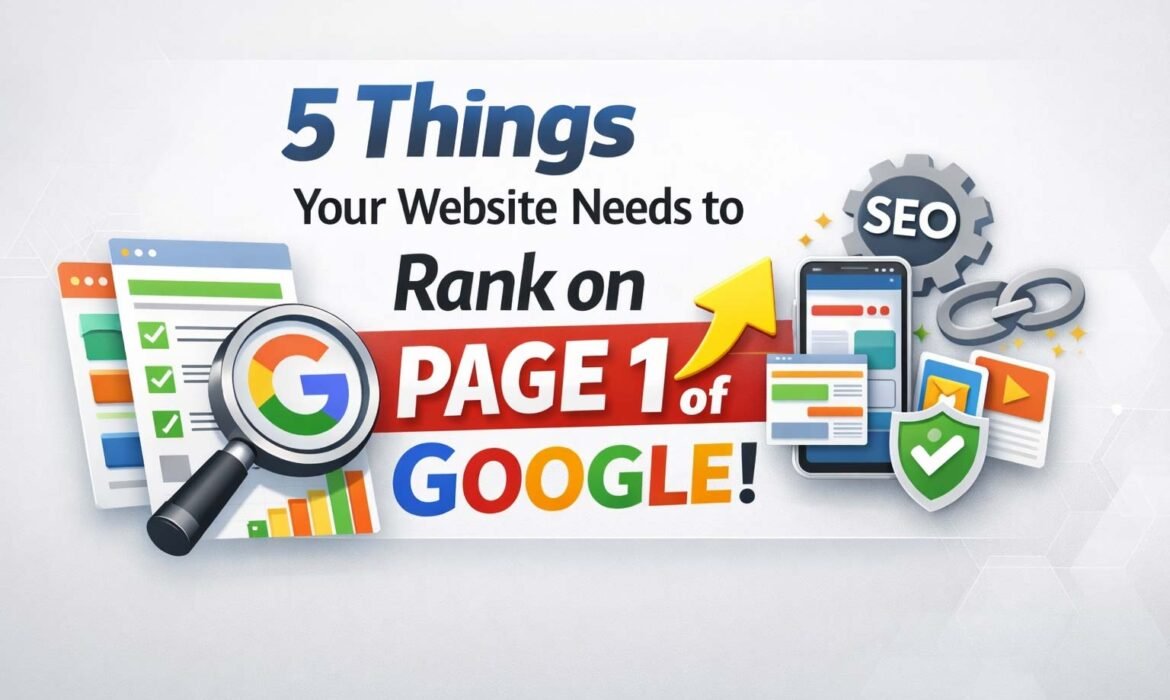
Want to know the secret to getting Rank Your Website on Page 1 of Google? Well, it’s not about stuffing your website full of keywords. Today’s Google algorithm is way too smart for that. What it does care about is whether or not your website is actually helpful to people who visit it. In other words, if your website is actually helping people solve their problems or find what they need, Google will know it and reward you accordingly.
A lot of business owners think SEO is complicated or overwhelming, but the truth is, the basics are pretty simple. By focusing on the right areas, you can greatly increase your chances of getting your website on Google’s first page.
The five key things your website needs to get on Google’s first page
1. High-Quality and Relevant Content
Content is one of the most important ranking signals for search engines. Google’s job is to serve up the best possible results to people who are searching for things. And what are the best possible results? Websites with clear, informative, and relevant content.
Why high-quality content is important
When users find useful information on your website, they will spend more time on the website. This will make Google rank your website higher.
Why low-quality content is bad
If the content on your website is low quality or copied from another source, it will make Google rank your website lower.
How to create high-quality content
You should first understand your audience. This will help you create the right content for your audience. To understand your audience, you should consider the following:
- What are they trying to achieve?
- What information are they looking for on the internet?
- What are the questions they usually ask?
Once you understand your audience, create content that answers the questions they usually ask. Well-structured content will help you create high-quality content. You should add new information to the content to enhance the Experience, Expertise, Authoritativeness, and Trust (E-E-A-T) of your website.
2. Proper On-Page Optimization
On-page optimization is the process of optimizing the different elements within your website so that the search engines can understand your content. When the elements are well arranged, they can help Google understand the content of the page as well as the time when the content should appear on the search results.
Key elements of on-page SEO
- Title Tags
Title tags are one of the major factors that determine the ranking of a website. The title tag is the title displayed on the browser window as well as the title displayed on the search results page.
- Meta Descriptions
A meta description is a description of the content displayed on the search results page. The meta description is not a ranking factor, but it can affect the number of clicks on the website.
- Clean URL Structure
A clean URL is a URL that is easy to read and understand. Using a clean URL can improve the user experience as well as the search engines’ ability to understand the content of the page. For instance, yourwebsite.com/seo-services is much simpler than a complex URL containing many characters.
- Header Tags (H1–H6)
Header tags are used to improve the readability of the content. The H1 tag should be the title, while the H2 and H3 tags are used for breaking the content into sections.
- Keyword Placement
Use your primary keyword as well as related keywords within the content, meta description, as well as the title tag. However, do not overuse the keywords, as this can negatively impact the ranking of the website.
- Image Optimization
Large images can cause the website to slow down. Optimizing the images can improve the user experience as well as the ranking of the website.
3. A Mobile-Friendly Website
Currently, everyone is accustomed to accessing websites via their smartphones. Due to the changing behaviour of website visitors, Google now uses mobile-first indexing to rank websites.
If your website is not functioning well on smartphones, it can have a huge impact on your website’s visibility.
Why mobile optimization is important
A website that is not user-friendly on smartphones results in poor user experience. This can lead to people leaving your website quickly. This is referred to as a high bounce rate. A high bounce rate is an indication to Google that your website is not fully meeting the expectations of visitors.
How to create a mobile-friendly website
- Implement responsive design for your website.
- Optimize website speed for smartphones.
- Ensure that the text on your website can be read clearly without zooming.
- Implement buttons that are easy to click on smartphones.
- Perform regular tests on your website using Google’s mobile-friendly test tools.
A smooth experience for smartphone users can have a positive effect on Google’s trust for your website.
4. Strong Technical SEO Foundation
The quality of your content can be high but still fail to rank if the search engine is unable to crawl and interpret your website. Technical SEO makes sure that your website is structured in a way that can be easily crawled and interpreted by search engines.
Technical SEO Factors to Consider
- Website Speed
The speed at which your pages load is a key contributor to user experience. Most people tend to leave a website before the content loads. You can make your website faster by optimizing images and using caching techniques.
- XML Sitemap
The XML sitemap is a key technical SEO factor that makes sure that your website can be crawled and interpreted by search engines. You can submit your XML sitemap to Google Search Console to make your content get indexed faster.
- txt File
The file informs search engine spiders whether your content should be crawled and indexed by the search engine or not.
- SSL Security (HTTPS)
Having a secure website makes your users and search engines trust your content. Google recognizes HTTPS as a key ranking factor and a sign of a secure website.
- Structured Data (Schema Markup)
The structured data informs search engines about your content. The structured data can also help your content appear in a rich snippet.
5. High-Quality Backlinks
Backlinks are still a major contributor to off-page SEO. The definition of a backlink is a link from another site that points to your site, and Google considers them as a measure of trust. When many websites link to your site, Google considers your content valuable and trustworthy.
Why backlinks are important
Websites with good backlinks tend to rank higher because Google considers them more trustworthy. However, not all backlinks are equal. Getting a few backlinks from good websites can be more beneficial than getting many from bad websites.
How to get quality backlinks
Getting quality backlinks can be achieved by creating content that is valuable and informative. You can do the following:
- Write articles that are helpful to others
- Write guest articles for good websites
- Share valuable insights with others
- Promote your content on social media
Final Thoughts
To get ranked on the first page of Google, you don’t just use a single technique. You have to work hard on many aspects of SEO. To get ranked, you have to work hard on the following:
- Creating valuable content
- Creating good content
- Creating mobile-friendly websites
- Creating good website structures
- Creating good backlinks
If you are a business with valuable content, you are more likely to get ranked on Google.
Let’s Connect
If you want to improve your website’s visibility and rank higher on Google, our team is here to help. We specialize in SEO strategies that focus on sustainable growth, better search rankings, and increased organic traffic.
Whether you need help with content optimization, technical SEO, on-page improvements, or backlink strategies, we can create a customized plan for your business.
Contact us today to discuss how we can help your website grow and achieve better rankings on Google. Let’s work together to turn your website into a powerful tool for attracting and converting potential customers.