Introduction
Most Shopify store owners who eventually bring in dedicated Shopify SEO services have already tried the basics themselves a blog, some effort on meta titles, maybe a plugin promising automatic optimization. That’s usually not because the effort was wasted. It’s that Shopify SEO involves a specific combination of technical, structural, and content work that’s genuinely hard to execute across a full catalog without dedicated focus, which is exactly the gap this engagement was brought in to close.
Client Snapshot: What Shopify SEO Services Actually Walked Into
The client was a home fitness equipment brand running roughly 1,400 SKUs across 40 collections. Traffic to the homepage and blog looked reasonable. Traffic to the product pages actually responsible for revenue did not. Here’s the thing about Shopify SEO services done properly the work goes well beyond writing better descriptions. It involves fixing technical issues blocking indexing, researching which specific product keywords drive purchase-ready traffic, building the collection structure that helps both shoppers and search engines navigate a large catalog, and tracking whether any of it actually moves organic revenue.
Going in, what this client needed wasn’t another isolated fix it was continuous, structured work across several disciplines at once.
Challenges
Ecommerce SEO Depends on Fixing the Technical Foundation First
Ecommerce SEO can’t improve through content alone if the underlying technical foundation is preventing Google from properly crawling, indexing, and understanding the store. The initial audit turned up exactly that kind of foundation problem.
- Orphaned collection pages couldn’t be discovered by search engines through normal site navigation
- Shopify’s filtered and sorted collection URLs had created duplicate content, diluting ranking signals across dozens of near-identical page variations
- Canonical tags were missing across product variants, leaving search engines uncertain which page version should actually be indexed
- Site speed on image-heavy product and collection pages was directly affecting both rankings and mobile user experience
Jumping straight to content or link building without this foundation would have meant limited improvement, since the underlying technical issues would have continued undermining every page rewritten on top of them.
Product Keywords Required Research Built Around Actual Buyer Behavior
Product keywords for this catalog needed research that looked meaningfully different from generic content marketing keyword work, since the goal was matching pages to search terms with genuine, immediate purchase intent.
- Long-tail, specific terms brand, model, and distinguishing features converted at a higher rate and faced less competition than broad category terms
- The store’s own internal site search data revealed what customers were actually typing, which differed meaningfully from what the original titles assumed
- Competitor keyword gap analysis identified terms competitors were ranking for that this store wasn’t, surfacing previously untargeted opportunities
- Collection pages and product pages needed distinct keyword strategies, since they were competing for different search terms at different points in the buying journey
Approach and Strategy
The Shopify SEO Services Process Table
| Service Area | What Got Done | Impact on Rankings/Revenue |
| Technical SEO audit | Fixing crawlability, indexing, duplicate content | Unlocked ranking potential for existing and future pages |
| Product keyword research | Identifying high-intent, achievable target terms | Ensured rewritten content targeted terms that convert |
| Product schema implementation | Structured data across the full 1,400-SKU catalog | Enabled rich snippets, improving click-through rate |
| Collection page SEO | Unique content and internal linking per collection | Captured broader, earlier-stage search traffic |
| On-page SEO | Rewriting titles, meta descriptions, product content | Improved relevance and click-through from search |
| Ongoing monitoring | Tracking rankings, traffic, and revenue over time | Confirmed what was working and adjusted what wasn’t |
Technical SEO: The Work That Unlocked Everything Else
Technical SEO ended up being one of the highest-leverage areas of this engagement, precisely because it was the area the store’s internal efforts had underinvested in, despite its potential to undermine every other optimization effort.
- Site architecture review confirmed products weren’t buried too many clicks deep from the homepage, improving crawlability and customer navigation
- Structured data implementation helped search engines display rich product information price, availability, review ratings directly in search results
- Mobile usability review addressed issues specifically affecting mobile search visibility, given how much of the store’s traffic already arrived on mobile
- Ongoing technical audits, not a one-time fix, were built into the process to catch new issues as the catalog and Shopify’s platform continued to change
Collection Page SEO and Ecommerce SEO Strategy Beyond Individual Products
Thoughtfully optimized collection page SEO extended the overall ecommerce SEO strategy well beyond individual product pages, capturing traffic at earlier stages of the buying journey.
- Collection-specific content sections targeted broader category search intent, reaching shoppers before they’d settled on a specific product by name
- Unique collection descriptions, replacing what had been empty product grids, gave search engines meaningfully more to index and rank
- Internal linking between collections and top-performing products ensured traffic landing on a collection page got guided toward a purchase path rather than dead-ending
Collection pages built without this kind of unique content tend to generate impressions that look fine in a report but rarely translate into actual clicks or revenue.
Product Schema and Rich Snippets: Making Product Visibility Measurable
Rich snippets, enabled through consistent product schema across the catalog, gave this engagement one of its most visible early wins. Within a few weeks of implementation, a meaningful share of product pages began showing star ratings, pricing, and availability directly in search results.
- Product identifiers, pricing, and availability were marked up consistently across all 1,400 SKUs, not just a handful of hero products
- Review ratings became visible directly in search results, standing out against plain listings in a crowded results page
- Click-through rate on pages showing rich snippets ran noticeably higher than on comparable pages without them
- Product visibility improved measurably beyond ranking position alone, since a listing with visible stars and pricing earns attention a plain link simply can’t
Results Over Six Months
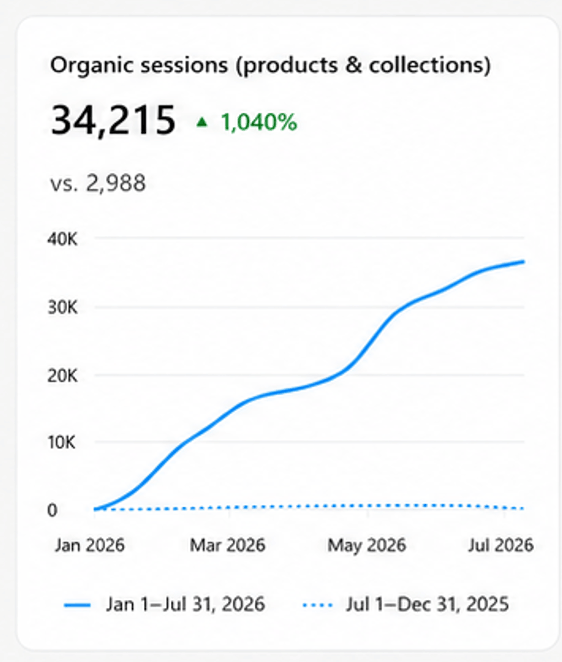
Organic traffic to product and collection pages grew from roughly 3,000 to over 34,000 monthly sessions
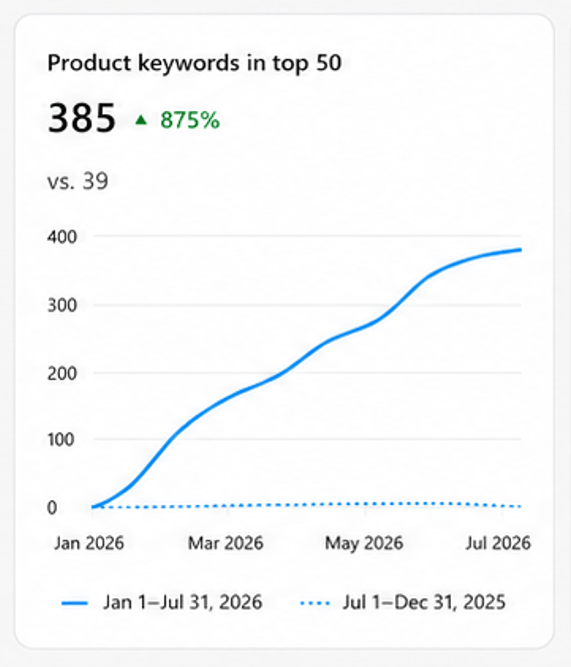
Product keywords ranking in the top 50 search positions grew from under 40 to over 380
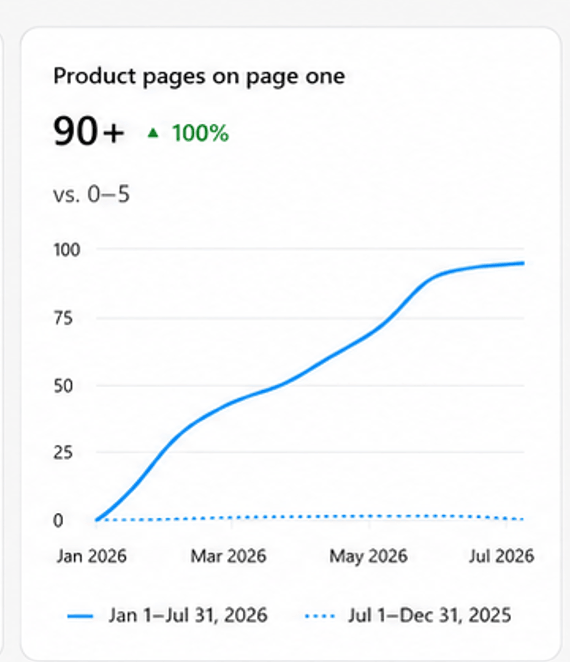
More than 90 product pages reached page one of search rankings for at least one target keyword
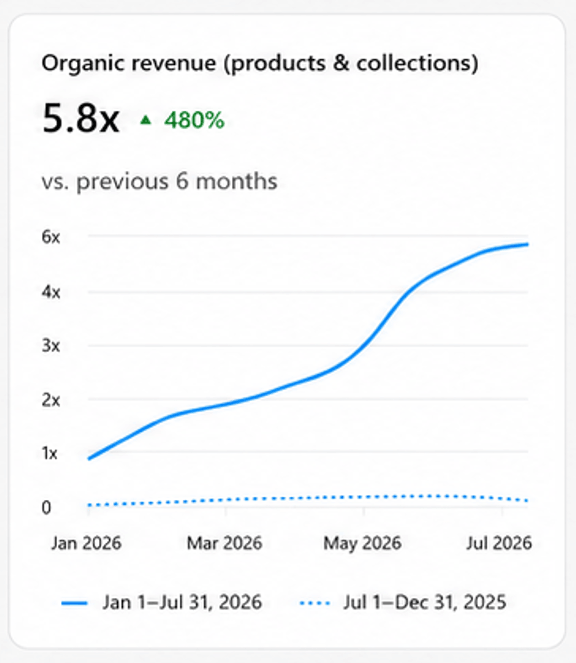
Organic revenue attributed to product and collection pages increased by approximately 5.8x over the six-month period
Why Ongoing Shopify SEO Services Delivered More Than a One-Time Fix Would Have
What made ongoing Shopify SEO services worth more than a single audit here wasn’t just technical depth SEO is inherently an ongoing process. Rankings achieved in month four could easily slip as competitors adjusted their own approach or Shopify’s platform shifted underneath the store. A one-time engagement would have addressed a snapshot in time; the ongoing structure kept adapting month to month, which is largely why traffic and rankings kept compounding well past the initial technical fixes.
Common Mistakes This Engagement Avoided
- Expecting fast results, without accounting for the realistic timeline schema implementation and content rewrites across 1,400 SKUs required
- Focusing entirely on product pages while neglecting collection pages, which ended up driving a significant share of the traffic gains
- Judging progress on ranking position alone, without connecting it back to organic traffic and actual revenue
- Treating a single technical audit as sufficient, rather than committing to the ongoing monitoring rankings at this scale require
- Skipping structured data because it produces no visible on-page change, despite its direct impact on click-through rate
Conclusion
If your Shopify store’s SEO efforts have plateaued or never quite translated into real revenue, that gap usually comes down to specific technical, schema, or collection-page work that hasn’t been addressed yet. Arihant Global works with Shopify brands to run ongoing SEO services connecting product visibility directly to organic traffic and actual revenue growth. Reach out Us and let’s find out what’s currently holding your store’s rankings back.
Disclaimer
This case study highlights results achieved for a specific client through a customized Shopify SEO strategy. Outcomes vary by industry, competition, website condition, and implementation. Past performance does not guarantee future results.