Most online stores that eventually bring in dedicated ecommerce SEO services have already tried paid ads to fill the traffic gap, watching costs climb every quarter without ever building anything that lasts past the campaign budget. That’s usually not because paid traffic doesn’t work. It’s that a store without organic revenue behind it stays entirely dependent on spend staying affordable, which is exactly the gap this engagement was brought in to close.
Client Snapshot: What Ecommerce SEO Services Actually Walked Into
The client was a mid-sized online store selling outdoor and camping gear, generating the large majority of its revenue through paid social and search. Organic traffic existed but contributed a small, largely flat share of monthly revenue. Here’s the thing about ecommerce SEO services done properly the work goes well beyond writing a few extra blog posts. It involves fixing technical issues limiting indexation, targeting transactional keywords with genuine purchase intent, restructuring category pages to capture broader search demand, and tracking whether any of it actually reduces dependence on paid spend.
Going in, this client didn’t need another isolated blog push it needed a coordinated system built to reduce reliance on rising ad costs.
Technical Ecommerce SEO Depends on Fixing Indexation First
Technical ecommerce SEO can’t produce organic revenue if a meaningful share of the catalog isn’t being properly crawled and indexed in the first place. The initial audit turned up exactly that kind of gap.
- Crawl budget was being wasted on faceted navigation, generating thousands of low-value, near-duplicate filtered URLs competing against actual product pages
- Roughly 30% of product pages weren’t appearing in Google’s index at all, due to weak internal linking and thin content
- Canonical tags were missing across product variants and filtered views, leaving search engines uncertain which page versions should rank
- Core Web Vitals on category and product pages were poor, directly limiting both crawl efficiency and conversion rate
Jumping straight to content or keyword targeting without resolving this foundation would have meant limited improvement, since a third of the catalog effectively didn’t exist in Google’s eyes.
Transactional Keywords Required Research Matched to Real Purchase Intent
Transactional keywords needed research that looked meaningfully different from general content-marketing keyword work, since the goal was matching pages to search terms with genuine buying intent.
- Product-specific long-tail terms brand, model, and use-case combinations converted at a noticeably higher rate than broad category terms alone
- Search intent was mapped against each page type, since “best 4-season tents” needed comparison content while “buy 4-season tent” needed a direct path to purchase
- Competitor gap analysis surfaced transactional terms competitors were ranking for that this store wasn’t, revealing specific revenue opportunities
- Seasonal search patterns were factored into keyword prioritization, since outdoor gear demand shifts predictably across the year
The Ecommerce SEO Services Process Table
| Service Area | What Got Done | Impact on Organic Revenue |
| Technical audit | Fixing crawl budget, indexation, canonical issues | Unlocked ranking potential for invisible pages |
| Transactional keyword research | Targeting terms with real purchase intent | Ensured pages targeted actual buyers |
| Category page SEO | Unique, targeted content per category | Captured broader, earlier-stage search demand |
| Product SEO | Rewriting titles, descriptions, schema | Improved product visibility and click-through |
| Conversion-focused content | Buying guides linked into product pages | Converted informational traffic into organic sales |
| Ongoing monitoring | Tracking rankings, traffic, revenue monthly | Confirmed what was reducing ad dependence |
Category Page SEO: The Layer Most Stores Leave Unfinished
Category page SEO ended up being one of the highest-leverage areas of this engagement, since the store’s 28 category pages had been treated as pure navigation with no unique content behind any of them.
- Each category page received a dedicated content section built around transactional and comparison-intent keywords, rather than functioning as a bare product grid
- Internal linking connected categories to top-performing products and relevant buying guides, keeping traffic moving toward a purchase path
- Filter and sort logic was cleaned up to prevent the faceted navigation issue from re-emerging as new filter combinations got indexed
- Category-level schema was added, giving search engines clearer signals about the range of products and price points on each page
Product Rankings and Shopping SEO: Making Visibility Convert
Product rankings alone don’t generate organic sales if pages don’t convert once traffic arrives, which is why this engagement paired ranking work with conversion-focused shopping SEO improvements.
- Product schema implementation enabled rich results pricing, availability, reviews improving click-through rate from search
- Unique product descriptions replaced manufacturer-supplied copy that dozens of competing retailers used word for word, giving each page a genuine reason to rank distinctly
- On-page conversion elements clearer specs, sizing guidance, trust signals were reviewed alongside SEO changes, since ranking gains don’t help if visitors land and leave immediately
Results Over Six Months
Organic traffic grew from roughly 45000 to over 61,000 monthly sessions
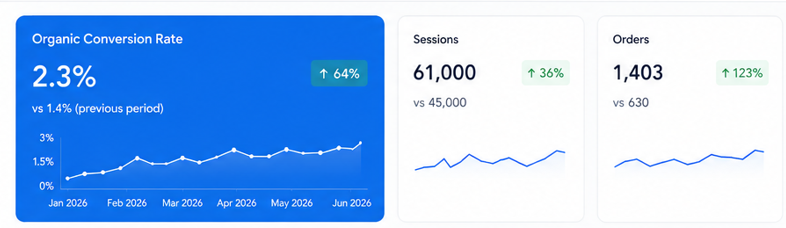
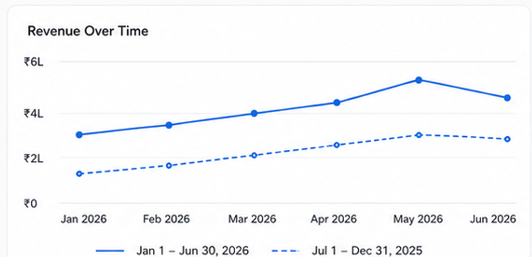
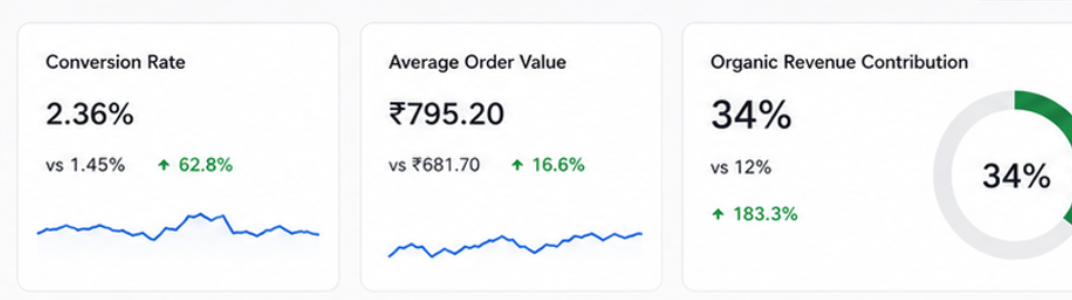
Organic revenue grew from approximately 12% of total store revenue to 34%, meaningfully reducing dependence on paid spend
Transactional keyword rankings in the top 10 grew from 45 to over 290
Overall conversion rate on organic traffic improved from 1.45% to 2.36%, reflecting better-matched intent and stronger content
Why Ongoing Ecommerce SEO Services Delivered More Than a One-Time Fix Would Have
What made ongoing ecommerce SEO services worth more than a single technical audit here wasn’t just the initial fixes it’s that organic revenue compounds specifically because the work continues. Rankings gained in month three needed continued content support and technical monitoring to hold against competitors adjusting their own strategy. A one-time engagement would have addressed a snapshot in time; the ongoing structure kept building on itself, which is largely why organic revenue kept climbing as a share of total sales well past the initial six months.
Common Mistakes This Engagement Avoided
- Treating paid and organic channels as entirely separate, missing the compounding value organic offers once built out
- Targeting broad, high-competition keywords instead of transactional terms with realistic ranking potential
- Leaving category pages as bare product grids, missing one of the highest-leverage opportunities in the catalog
- Improving rankings without reviewing on-page conversion elements, leaving revenue on the table as traffic grew
- Judging progress by traffic volume alone, without tracking what share of revenue organic was contributing
Conclusion
If your store’s revenue still depends heavily on paid spend with organic traffic stuck flat, that gap usually comes down to specific technical, category, or keyword-targeting work that hasn’t been addressed yet. Arihant Global works with ecommerce brands to build ongoing SEO services that turn organic traffic into a genuine, compounding revenue engine. Reach out and let’s find out what’s currently holding your store’s organic growth back.
Disclaimer
Results shown are from one ecommerce SEO project and are for illustrative purposes only. Every business, industry, competition, and website differs, so traffic, rankings, conversions, and revenue improvements will vary.