Introduction
A seed-to-Series-A SaaS startup came to us with a spreadsheet that told an uncomfortable story. Every month, their cost per booked demo crept up a little further, and every month, the founders had the same conversation about whether to just cut paid spend entirely and go back to pure outbound. Nobody wanted to say the ads weren’t working. The numbers were saying it for them.
Client: Withheld at client's request

Sector: B2B SaaS (Project Management for Creative Agencies)

Engagement: 5 months Service: Paid Acquisition (Google Ads + LinkedIn), Demo Funnel Optimization
Background
The company builds project management software specifically for creative agencies, a narrower niche than generic PM tools, which was actually one of their real advantages. The problem was their acquisition strategy didn’t reflect that focus at all. They were running Google Ads against broad terms like “project management software” and “team collaboration tool,” competing directly against Asana, Monday, and half a dozen well-funded generalists with budgets they couldn’t match.
By the time they reached out, cost per demo had climbed past what their finance model could sustain long-term. Worse, a chunk of the demos that did get booked turned out to be poor fits, marketing agencies looking for something entirely different, freelancers who’d never pay for a team plan, people who’d clicked an ad without much sense of what the product actually did. The founders had started sitting in on sales calls themselves just to understand where things were breaking, which is a reasonable instinct but not a scalable one.
Challenges
Keyword strategy was the first issue. Bidding on broad category terms meant competing on cost-per-click against companies with ten times the budget, for traffic that wasn’t even particularly qualified, since “project management software” gets searched by everyone from solo freelancers to enterprise IT departments.
The landing page didn’t help. Every ad, regardless of which keyword triggered it, sent people to the same generic homepage, which talked about the product in broad strokes rather than speaking directly to a creative agency’s actual pain points, client approval bottlenecks, scope creep on retainers, tracking billable hours across overlapping projects.
The demo booking form itself asked almost nothing before confirming a slot. Anyone could grab thirty minutes on a sales rep’s calendar without indicating company size, current tools, or what problem they were trying to solve, which meant reps were walking into calls blind more often than not.
And there was no real distinction between LinkedIn and Google traffic in how they were treated afterward. Someone who clicked a LinkedIn ad targeting creative agency operations directors and someone who searched a generic term on Google landed in the exact same funnel, even though they were arriving with very different levels of context and intent.
Approach and Strategy
We moved keyword strategy away from broad category terms and toward the specific language creative agencies actually use “agency retainer tracking,” “client approval workflow,” “creative project management.” Smaller search volume, considerably cheaper per click, and the people searching those terms already had the exact problem the product solved, rather than a vague sense they should look into project management tools.
On LinkedIn, we narrowed targeting to operations and account management roles specifically at agencies between 15 and 100 employees, the size range where the product’s pricing and feature set actually made sense, instead of a broader “marketing and advertising industry” targeting net that was pulling in far too wide a range of company sizes.
We built dedicated landing pages matched to each core keyword theme, so someone who searched for client approval workflows landed on a page that opened by naming that exact problem, not a generic feature list. This took real production time since it meant writing and testing several page variants rather than one, but it was the single change that moved the needle most.
The demo form got a short qualifying layer added, company size, current tool in use, and the specific challenge driving the search. Reps could see this before the call, which changed the shape of those first few minutes considerably. We also added a “why creative agencies specifically” section directly above the booking button, which functioned almost like a filter, some visitors realized at that point the product wasn’t built for their situation and left before booking, which sounds like a loss but meant reps stopped burning slots on mismatched calls.
Finally, we split post-click nurture by source. LinkedIn traffic arriving with less immediate intent, got a short email sequence before the demo push. Google traffic from bottom-funnel keyword searches, arriving already looking for a solution, went straight to a booking prompt without the extra step.
Result
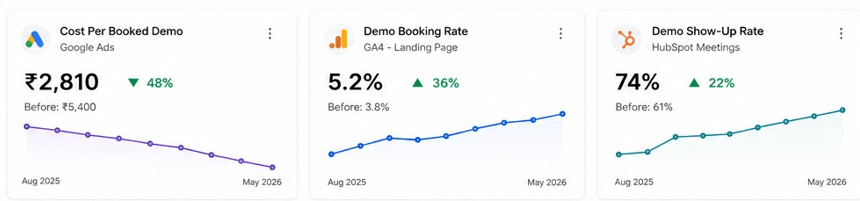
Over five months, cost per booked demo dropped 48 percent, not from cutting spend but from spending it on traffic that was already closer to a real decision. Demo booking rate rose 36 percent as landing pages started speaking directly to the visitor’s actual problem instead of a generic pitch. Show-up rate, often overlooked in funnel metrics, rose 22 percent, largely because people booking now understood what they were showing up for.
Result Summary

We Reduced Cost Per Booked Demo by 48%
Cost Per Booked Demo Trend in 5 month
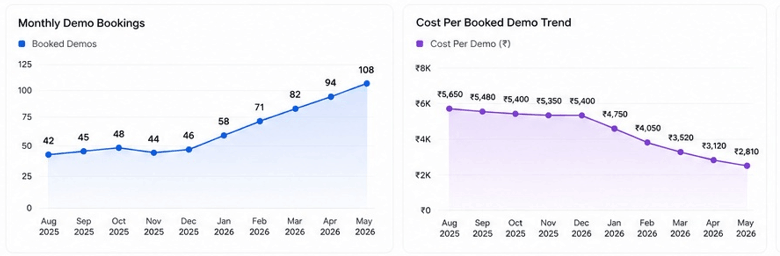
We Increased Demo-to-Trial Conversion by 13 Points and cost per click reduced 185 to 126
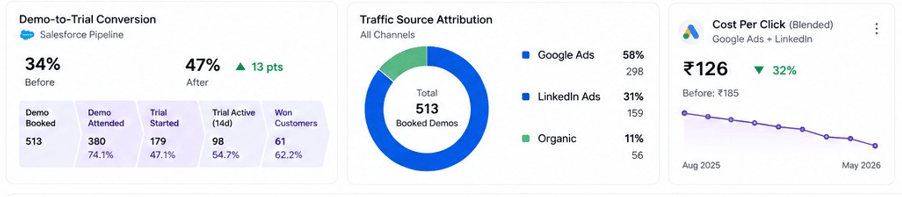
The show-up rate improvement mattered more than it might look on paper. Every no-show is a wasted calendar slot for a small sales team, and the founders had been personally absorbing some of that waste by covering calls themselves. Once that stopped being necessary, they got several hours a week back that went into actual product work.
"I used to check the ad spend dashboard the way you check a wound to see if it's healing. Now I mostly just check the demo calendar, and it's full of the right kind of company. That's a very different feeling than watching a number go up without knowing if it means anything." — Co-founder, client company (name withheld)
Why this worked
The startup’s product wasn’t the problem, and neither was their willingness to spend on acquisition. The issue was that their funnel treated every visitor identically, regardless of how they arrived or what they actually needed, which meant the budget was working against the product’s real advantage: being built specifically for creative agencies rather than everyone. Narrowing the targeting, matching the landing page to the search intent, and adding a small amount of friction to the booking form all did the same underlying thing, they made sure the people getting on calls were the people the product was actually built for.
If this sounds familiar
We’ll review your current paid acquisition and demo funnel for free, no changes made, just an honest look at whether your ad spend is chasing volume or chasing the right visitor.
Ask us for a free demo funnel audit →
Why SaaS startups tend to stick with Arihant Global
Arihant Global build keyword and targeting strategy around your actual niche, not the broad category term everyone else is bidding on too. Landing pages match the specific search or ad that brought someone there, not one generic homepage for every visitor. Booking forms are built to filter gently, not just collect. And we measure show-up rate and trial conversion alongside cost per demo, since a cheap demo that never shows up isn’t actually cheap.