
Introduction
An industrial equipment manufacturer came to us with a problem that doesn’t get talked about much outside B2B manufacturing circles: their sales team was excellent at closing deals once they got in front of the right buyer, but almost nobody was finding the company online in the first place. Trade shows and a decades-old distributor network had carried the business for years. That model was starting to show its age.
Client: Withheld at client's request

Sector: Industrial Manufacturing (Custom Material Handling Equipment)

Engagement: 8 months Service: Industrial Lead Generation
Background
The company manufactures custom material handling equipment, conveyor systems, automated sorting lines, that kind of large-scale industrial hardware, sold primarily to mid-size and large manufacturing and logistics operations. They’d been in business for over two decades, with a genuinely strong engineering reputation among people who already knew them. New business, though, still ran almost entirely through trade show relationships and a network of regional distributors, a model built for a slower era of industrial procurement.
The shift that had actually changed the ground under them was that procurement teams at target companies were now doing serious research online before ever contacting a distributor or attending a trade show, often building a shortlist of two or three vendors before a single phone call happened. If the company’s website and search presence weren’t part of that early research phase, they were simply never making it onto the shortlist, no matter how good the equipment or the eventual sales conversation would have been.
Challenges
The website functioned more as a digital brochure than anything built to generate a serious enquiry. Product pages showed equipment photos and basic specs but gave a procurement engineer almost nothing to actually evaluate against, no load capacity ranges clearly stated, no customization options laid out, no case studies showing the equipment solving a problem similar to their own.
Search presence for the specific, technical terms industrial buyers actually use, things like “automated conveyor system for palletized loads” or “custom sortation line manufacturer,” was close to nonexistent. The company ranked reasonably for its own name, which meant almost nothing, since a procurement team building a shortlist wasn’t searching for a brand they’d never heard of.
There was also no distinction on the site between someone doing early-stage research and someone ready to request a quote. Every path led to the same generic “Contact Us” page, which is a mismatch that costs more in industrial sales than most categories, since the sales cycle here often runs six to twelve months and different stages need genuinely different information.
And critically, there was no system for capturing and following up on the RFQ (request for quote) enquiries that did come in. Detailed technical enquiries were landing in a general inbox alongside spam and vendor pitches, sometimes sitting for days before the right engineer even saw them, which is close to fatal when a competitor’s sales team responds within hours.
What we changed
We rebuilt product pages around the actual technical evaluation criteria a procurement engineer uses, load capacities, throughput rates, integration compatibility with existing systems, and customization ranges, alongside case studies organized by industry application rather than generic testimonials. A logistics company evaluating sortation equipment wants to see a similar logistics deployment, not a vague quote about customer satisfaction.
Search strategy shifted toward the specific technical terms and use-case phrases industrial buyers actually search, which meant working closely with the company’s own engineers to understand the real vocabulary of the buying process, terms a marketing team alone would never have guessed accurately. This content also served a second purpose during the sales process itself, since reps started sending prospects directly to specific technical pages instead of a generic PDF spec sheet.
We built a distinct RFQ pathway, separate from general contact, with a structured intake form asking for the specifics an engineer would actually need to give a meaningful initial response, application type, required capacity, timeline, and existing system constraints. This meant sales engineers could review a genuine enquiry before the first call instead of starting from a blank page.
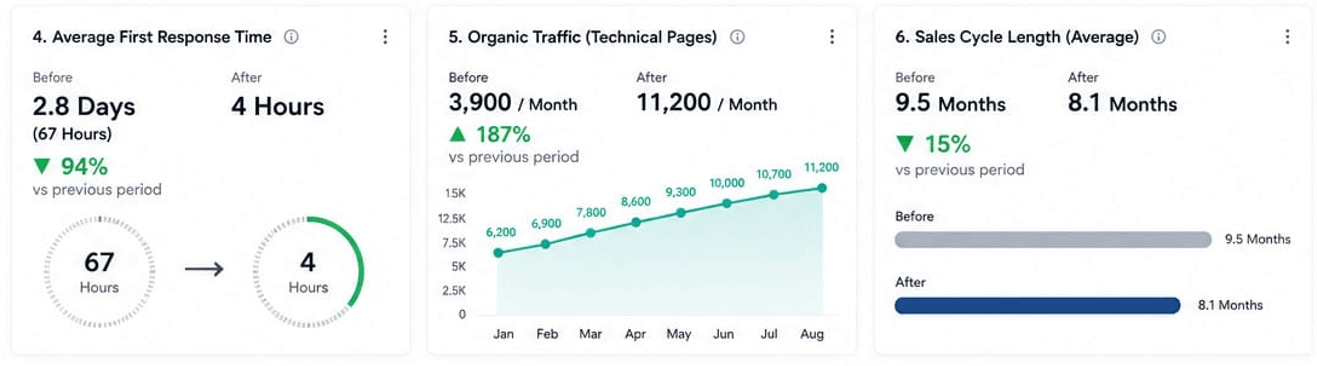
On the response side, we set up automated routing so RFQ submissions went directly to the right regional sales engineer within minutes rather than sitting in a shared inbox, along with an internal target for first response time. This wasn’t a marketing fix exactly, but it mattered as much as anything else we did, since a well-generated lead that sits unanswered for three days is functionally the same as no lead at all.
We also built targeted LinkedIn campaigns aimed specifically at procurement and operations roles within the company’s core target industries, paired with case study content, since a chunk of the buying committee for equipment this size includes people who are influencing the decision without ever filling out a form themselves.
Result
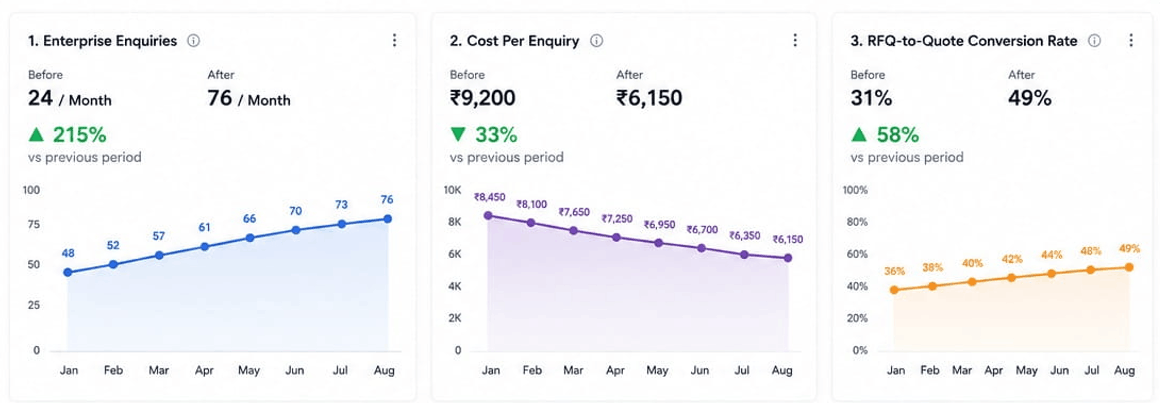
Over eight months, monthly enterprise enquiries rose from roughly 24 to 76, a 215 percent increase, with a meaningfully higher share qualifying as genuine RFQs rather than general information requests. Cost per enquiry dropped 33 percent as search traffic shifted from broad, low-intent visitors toward people actively evaluating equipment for a specific application. RFQ-to-quote conversion rate rose 58 percent, largely a function of the intake form finally giving sales engineers what they needed to respond meaningfully on the first contact.
Result Summary
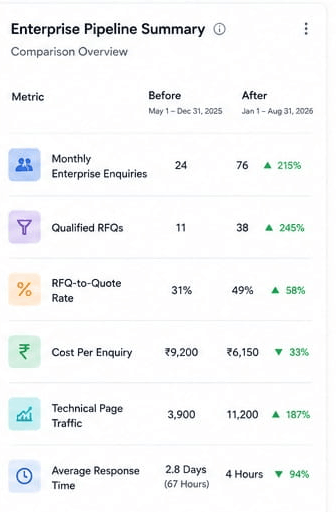
We Increased Enterprise Enquiries by 215% and We Reduced Cost Per Enquiry by 33% and Improved RFQ-to-Quote Conversion Rate by 58%
We Reduced First Response Time by 94%
We Increased Organic Traffic to Technical Pages by 187%
We Shortened the Sales Cycle by 15%
Enterprise Enquiries Trend Over 8 Months
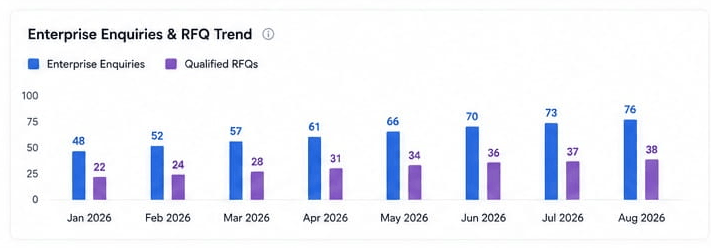
The drop in sales cycle length wasn’t something we set out to fix directly, but it tracks with what changed. Prospects arriving with a well-defined RFQ, already having reviewed technical specs and relevant case studies on the site, needed fewer rounds of back-and-forth before a real quote could be built, compared to earlier enquiries that often started from a much vaguer starting point.
“We used to find out who was seriously considering us the same way we always had, at a trade show booth or through a distributor call. Now our engineers are getting detailed RFQs from companies we’ve genuinely never spoken to before, with enough information in the first message to actually start scoping the job. That’s a different kind of pipeline than what we had.“ – VP of Sales, client manufacturer (name withheld)
Why this worked
The company’s core problem wasn’t product quality or sales skill, both were already strong. It was that their entire growth model assumed buyers would find them through relationships built over years, while the buyers themselves had quietly shifted to doing serious research online long before any relationship began. Building content and pathways around how a procurement engineer actually evaluates equipment, and making sure a real enquiry reached the right person within hours instead of days, closed that gap without changing anything about the equipment itself.
If this sounds familiar
We’ll review your current website and enquiry process for free, no changes made, just an honest look at whether your site is actually built for how industrial buyers research today, or still built for the trade show era.
Ask us for a free industrial lead generation audit →
Why manufacturing companies tend to stick with Arihant Global
Arihant Global build content around the real technical criteria buyers evaluate, not generic product marketing. RFQ pathways get built separately from general enquiries, so your engineers get what they actually need to respond meaningfully. Response time gets treated as part of lead generation, not a separate problem for someone else to solve. And we learn your actual buyer’s vocabulary from your own engineers, not from guessing at industry keywords.
Disclaimer
Results shown are based on a specific manufacturing client’s circumstances, market conditions, sales process, and implementation. Individual outcomes vary, and past performance does not guarantee similar future results.