Introduction
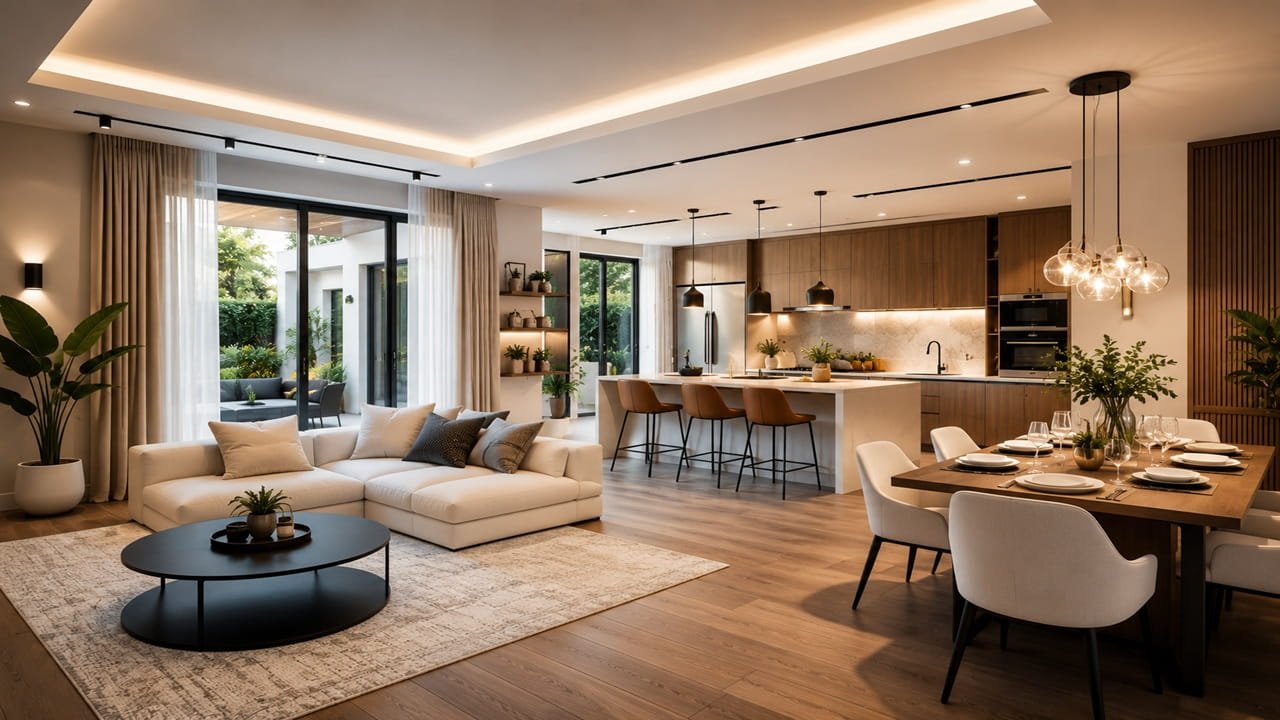
An interior design and renovation firm came to us with a portfolio that spoke for itself, genuinely striking project photos, a strong Instagram following that clients kept complimenting them on, and a consultation calendar that never quite matched the attention the work seemed to be getting. Their creative director summed it up on our first call: “People love what we post. They just don’t seem to book anything after.”
Client: Withheld at client's request

Sector: Home Improvement (Residential Interior Design & Renovation)

Engagement: 4 months Service: Home Improvement Marketing
Client Background
The firm handles full-home interiors and partial renovations, mostly for homeowners in the mid-to-premium segment, with a small in-house design team and a network of contractors for execution. They’d built a genuinely strong visual brand over about four years, the kind of Instagram feed that gets saved and shared, real engagement, real compliments in the comments. The gap was that almost none of that admiration was converting into an actual consultation booking, which is the only thing that eventually turns into a signed project.
When we looked at their funnel, the disconnect became clear fast. Their content was optimized entirely for being liked and shared, moody photography, aspirational styling, the kind of posts that perform beautifully as inspiration but give a homeowner no actual next step. Someone could follow the account for months, genuinely love every post, and never once encounter a clear reason or easy way to actually book a consultation.
Challenges
There was no consistent call to action anywhere in the content. Posts ended with captions about the design philosophy or materials used, rarely anything pointing toward booking a consultation, so even a genuinely interested follower had to go hunting through the bio and website to figure out what to do next.
Pricing was also a complete black box, which is understandable given how much custom renovation work varies project to project, but the total absence of any pricing context meant a lot of homeowners assumed the firm was well outside their budget before ever reaching out to check. Some genuinely qualified prospects were self-selecting out for no real reason.
The website’s consultation booking process required filling out an extensive project brief, budget range, full scope details, timeline, before securing even an initial call, which is reasonable for a firm ready to start scoping real work but far too much friction for someone who just wanted a first conversation to see if this was the right fit.
And there was no differentiation in messaging between full-home projects and smaller partial renovations, everything on the site assumed a homeowner was ready for a complete overhaul, which likely discouraged people with a more modest single-room project from enquiring at all, even though those smaller projects were a real and profitable part of the firm’s business.
Our Strategy
Every piece of content got a clear, low-friction next step added, not necessarily “book now” on every post, but a consistent, specific direction, “see the full project cost breakdown,” “check if we work in your area,” something concrete rather than a vague invitation to get in touch.
We introduced rough pricing bands directly into content and on the website, not exact quotes, which genuinely aren’t possible without a proper scoping conversation, but honest ranges by project type and size, “partial kitchen renovations typically start around X,” giving homeowners enough context to self-qualify with confidence instead of assuming and walking away.
The consultation booking process got split into two tiers. A short initial call, requiring only basic contact information and a general sense of the project, became the primary entry point, with the detailed project brief pushed to after that first conversation rather than before it. This meant far more people were willing to take the first step, since committing to a fifteen-minute call feels very different from committing to filling out a full project brief with a company you’ve never spoken to.
We also built separate content and landing pages for full-home projects versus smaller partial renovations, since a homeowner wanting to redo one bathroom shouldn’t have to wade through full-home project imagery and pricing to find relevant information for their actual situation.
Instagram content got a specific new format added alongside the aspirational photography: short before-and-after breakdowns with real project costs and timelines attached, which performed noticeably better on saves and shares than the purely aesthetic posts, and gave genuinely interested homeowners the practical grounding the beautiful photography alone never provided.
Result
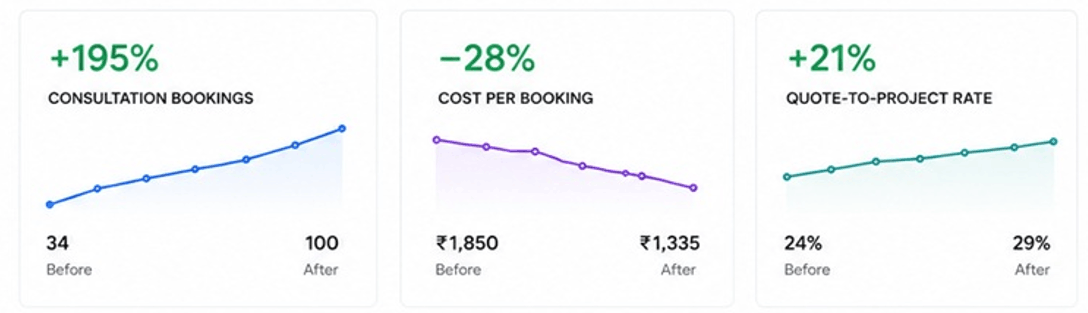
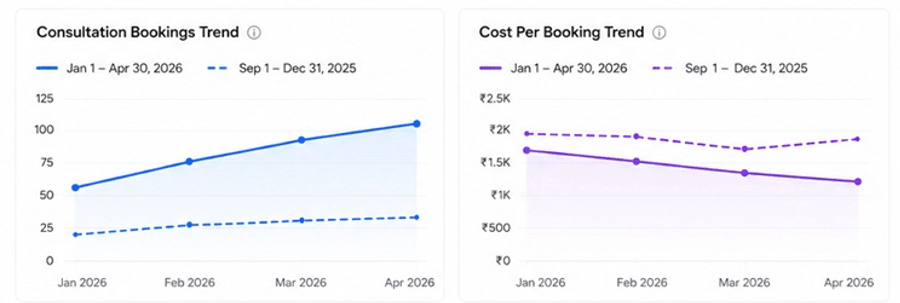
Over four months, monthly consultation bookings rose from roughly 34 to 100, a 195 percent increase, with a meaningful share coming from the smaller partial renovation segment that had barely been enquiring before. Cost per booking dropped 28 percent as the two-tier consultation process removed friction that had been quietly costing bookings from genuinely interested homeowners. Quote-to-project conversion, meaning consultations that actually turned into signed projects, rose 21 percent, largely because the rough pricing bands meant fewer consultations ended in a budget mismatch nobody had addressed upfront.
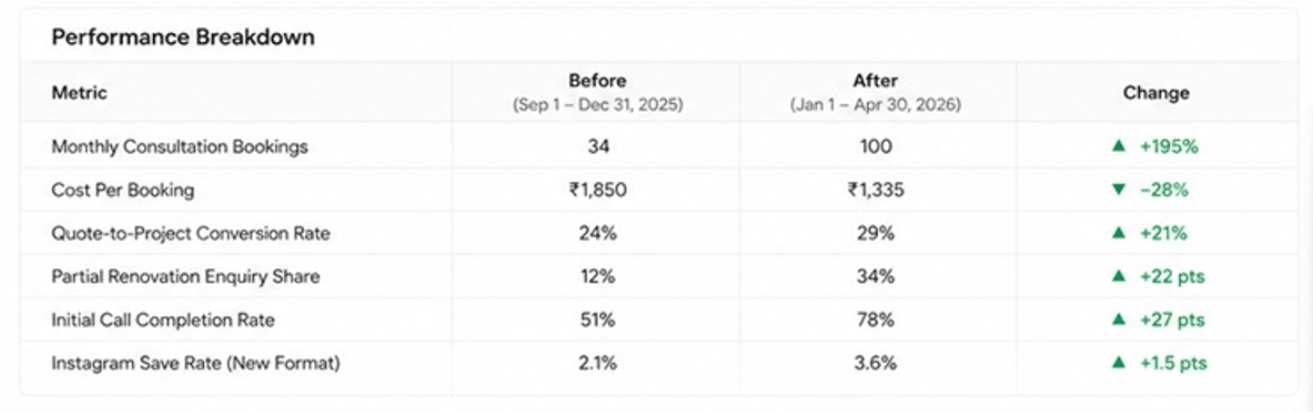
We Increased Monthly Consultation Bookings by +195% and we reduced cost per booking 28%
Monthly Consultation Bookings and Cost per booking trend in 4 months
The shift in partial renovation enquiries turned out to matter beyond the numbers themselves. Those smaller projects had shorter timelines and faster turnaround to a signed contract, which gave the design team a steadier stream of active work between the larger full-home projects that had previously been the only real pipeline.
"We'd built this beautiful brand and somehow made it intimidating without meaning to. People assumed we were out of reach or that reaching out meant committing to something huge. Once that friction came down, it turned out a lot of people had been wanting to work with us the whole time, they just needed an easier door in." — Creative Director, client firm (name withheld)
Why this worked
The firm’s design work and brand were never the weak point, the portfolio and following proved that on their own. What was missing was any real path from admiration to action, pricing transparency where it mattered most, a lower-friction way to take a first step, and content that gave homeowners practical grounding alongside the aspirational photography. None of it required the brand to look any different. It just needed to stop being harder to book than it needed to be.
If this sounds familiar
We’ll review your current content and booking process for free, no changes made, just an honest look at whether your funnel gives an interested follower an actual next step, or just more beautiful photos to admire.
Ask us for a free home improvement marketing audit →
Why interior and renovation brands tend to stick with Arihant Global
Arihant global build a clear next step into content, not just aspirational imagery with no direction. Rough pricing context goes in early, so qualified homeowners stop self-selecting out over assumptions. Booking gets split into a low-friction first step and a detailed brief after, not one long form before anyone’s spoken to you. And we build separate pathways for full projects and smaller ones, since treating every enquiry the same loses business you’d actually want.
Disclaimer
Results shown are from a specific client campaign and reflect that business’s unique goals, budget, market, and execution. Individual outcomes vary, and past performance does not guarantee future results.