
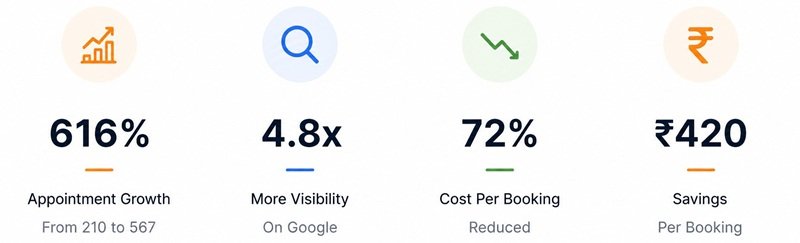
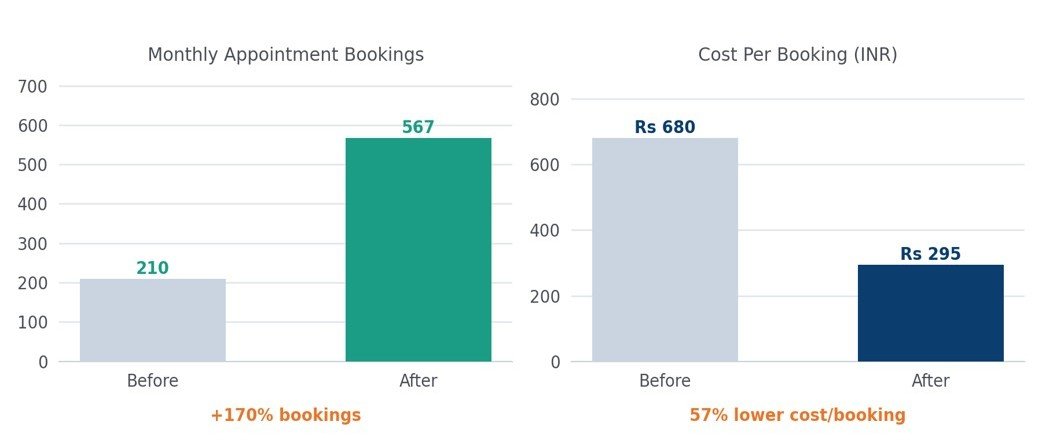
The client’s marketing team always suspected their phones were ringing because of the ads. They just couldn’t prove it, which meant every budget conversation was a bit of a guessing game. Once we put call tracking in place genuinely the first thing we did that guessing game ended. Bookings went from 210 a month to 567, cost per booking dropped 57%, and for the first time the clinic’s PPC marketing spend had numbers behind it that the medical director actually trusted.
About the Client
Our client runs six outpatient clinics across three cities, covering general medicine, dermatology, dental, and diagnostics under one brand. Growth had come mostly from walk-ins and doctor referrals, with a Google Ads account that had never really been touched since the clinics opened. Two new locations were coming online, and leadership wanted paid search to become something they could actually justify on a spreadsheet not just a line item that felt necessary.
Where the Account Was Losing Money
Healthcare is a strange category to advertise in, mostly because Google’s policies around medical claims are tight, and because so much of the actual conversion happens over the phone rather than through a form. The client’s account hadn’t been built with either of those things in mind.
One campaign covered every specialty, so a dermatology search and a general check-up search landed on the same ad and the same generic homepage. Several of the higher-intent ads had been disapproved under Google’s healthcare PPC marketing policy weeks earlier and nobody had noticed they’d just stopped running. Budget was split evenly across all three cities regardless of which clinics actually had appointment slots open. And there was no call tracking at all, so every phone booking which, it turned out, was most of them was invisible to the campaign data.
What We Actually Changed
Splitting the account by specialty
Dermatology, dental, general medicine each got its own campaign, its own ad copy, its own landing page listing the relevant doctors and next available slots. A generic clinic homepage stops working the moment someone’s specifically looking for a skin specialist.
Rewriting ads to survive Google’s healthcare PPC policy
The old ads were vague partly by accident and partly because some of the sharper claims kept getting flagged. We rewrote copy around things Google is fine with doctor qualifications, appointment availability, insurance accepted specific enough to earn a click without tripping the policy filters. The disapprovals stopped, and ads that used to silently vanish from rotation started running consistently.
Monthly bookings and cost per booking, before and after five months of restructuring.
Tracking the calls, not just the forms
This was the big one. Call tracking numbers went on every landing page and on the Google Business Profile listings, and within a month it was obvious that phone bookings were converting at close to three times the rate of web forms. Nobody on the client’s team had known that. Once the campaigns could see it, spend shifted toward the keywords and placements actually driving calls.
Putting budget where there was room for patients
Instead of splitting spend evenly across three cities, budget started following real-time appointment capacity more spend toward whichever clinic could actually take new patients that week, less toward one that was already booked out.
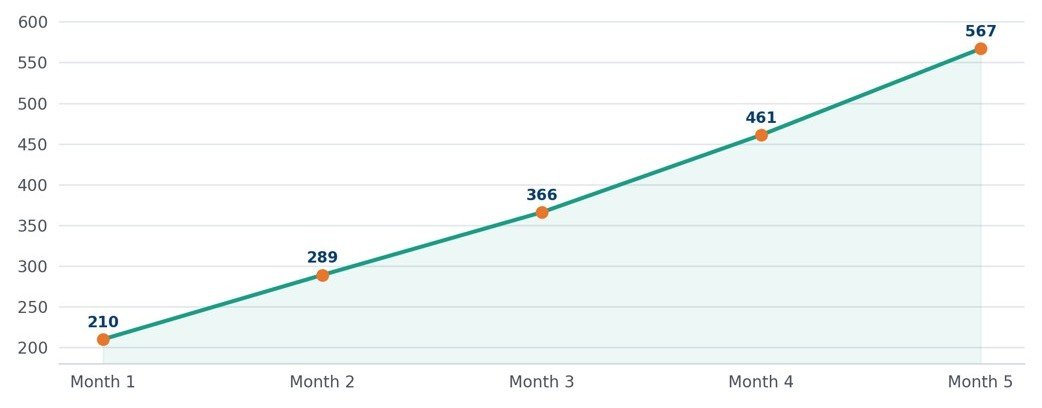
Appointment bookings climbing month over month across the five-month engagement.
The Results
|
Metric |
Before | After | Change |
|
Monthly Appointment Bookings |
210 | 567 |
+170% |
|
Cost Per Booking |
Rs 680 | Rs 295 | -57% |
| Call-to-Booking Conversion Rate |
12% |
34% |
+183% |
|
Click-Through Rate (CTR) |
2.4% | 6.1% | +154% |
| New Patient Acquisition | baseline |
+145% |
5-month total |
|
Google Business Profile Calls |
baseline | +210% |
5-month total |
Client -

“We always suspected our phones were ringing because of the ads, but we had no way to prove it or optimize around it. Once call tracking was in place, the whole picture changed and honestly, this became the easiest line item in our marketing budget to defend, because we could finally see exactly what it was doing.”
The Part That Made the Difference
If you only take one thing from this in most industries, a web form is a reasonable stand-in for a real conversion. In healthcare, it badly understates demand, because a lot of patients especially the ones with something urgent or specific would rather just call and ask if there’s a slot open today. An account optimized purely on form data will keep underfunding the exact keywords that drive the phone to ring, simply because it can’t see that they’re working.
Splitting the account by specialty mattered too, but mostly because it let the ad and the landing page actually match what the patient typed. A person searching for a dermatologist doesn’t want to land on a page about the clinic’s general medicine department.
Questions People Ask About Healthcare PPC Marketing
Q1. Why do healthcare Google Ads accounts get so many ads disapproved?
Google is strict about medical claims personalized promises, certain treatment language, anything that sounds like a guaranteed outcome. Accounts that aren't built around those restrictions from day one tend to lose ads quietly over time, and nobody notices until bookings drop.
Q2. Is call tracking really necessary, or is it overkill for a small clinic?
For most clinics it's not overkill, it's closer to essential. A large share of appointments get booked by phone, especially when someone wants to confirm availability first. Without tracking, that volume is simply invisible, and budget ends up misallocated toward whatever the dashboard can see.
Q3. How much can appointment bookings realistically go up with healthcare PPC?
It depends on the specialty and the competition in that city, but a lot of the gain here came from fixing structural problems disapproved ads, no call tracking, one campaign trying to serve every specialty rather than simply spending more. Clinics with similar gaps tend to see similar-sized jumps once those are fixed.
If You Can’t Trace Your Bookings Back to a Campaign
This specialty-first, call-tracked setup is roughly how Arihant Global runs healthcare PPC Marketing for clinics and diagnostic centers generally. If you’re spending on ads but can’t say with confidence which ones are actually filling appointment slots, that’s usually the first gap worth closing.
Improve Patient Acquisition with Data-Driven Healthcare PPC
If your clinic is investing in Google Ads but you’re unsure which campaigns are actually generating appointments, it’s time to look beyond clicks and impressions. Arihant Global helps healthcare providers build compliant, specialty-focused PPC campaigns with accurate call tracking, conversion measurement, and continuous optimization to maximize appointment bookings and PPC marketing ROI.
Book a Healthcare PPC Marketing Audit and discover where your advertising budget can deliver stronger patient acquisition and measurable business growth.
Disclaimer
This case study is based on a specific healthcare PPC campaign and its reported outcomes. Results may vary depending on market conditions, competition, budget, location, and campaign execution.