
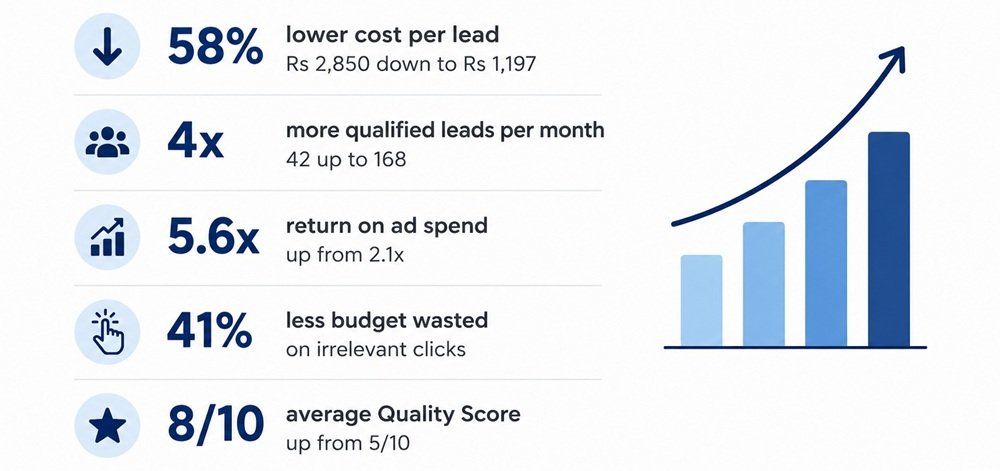
Six months ago, Manufacturing Industry was paying close to Rs 2,850 for every lead its Google Ads account produced. Roughly half of those leads, going by the search-term report, were students and hobbyists looking up "CNC machine price for home use," not procurement engineers looking to place an order. Today, after six months of dedicated Google Ads services from our team, that number sits at Rs 1,197, and the sales team, which had quietly stopped chasing PPC leads within a day of submission, is now asking PPC marketing for more of them. That reversal is really the whole story of this engagement, and it took us about six months to get there.
About Client
Client runs two manufacturing units supplying CNC-machined components, sheet-metal parts, and custom tooling to automotive tier-1 suppliers and industrial OEMs, with a modest export book in Southeast Asia and the Middle East. For most of its history, new business came from trade fairs, distributor referrals, and the occasional cold call a pipeline that works fine right up until you need to grow faster than word of mouth allows. When two new client verticals opened up, ownership wanted a channel that could produce RFQs on a schedule, not by chance.
What We Found in the Account
The account wasn’t neglected, exactly. Someone had been logging in every few weeks, adjusting bids, pausing the odd keyword. But it had been built the way most first-attempt B2B accounts are built: broad match everywhere, one big campaign covering three very different product lines, and a click destination that was just the homepage.
A few things stood out immediately. Search terms like “CNC machine” and “sheet metal parts” were pulling in job-seekers and students alongside genuine buyers, and with no negative keyword list to speak of, that traffic was eating close to a third of the daily budget. There was no way to tell, from inside Google Ads, which keywords had actually turned into a quote request versus a form fill that went nowhere. And the landing page well, it was the homepage, which had no RFQ form, no tolerance specs, nothing that told an engineer this company could actually do the job.
Sales had noticed, too. By the time we got involved, PPC leads were sitting in a shared inbox for hours before anyone called them back, which in a category where a buyer is usually comparing three or four suppliers at once is close to fatal.
The Fix, More or Less in Order
Nothing here is exotic. It’s mostly the unglamorous work of rebuilding an account so it reflects how an industrial buyer actually searches, and then wiring the data back so the algorithm can tell a good lead from a bad one.
Splitting the account by product line
The single blended campaign became three precision machining, sheet-metal fabrication, and tooling each with its own budget, its own bids, and keywords sorted roughly into three buckets: people comparing suppliers, people ready to request a quote, and everyone else, who got filtered out before they ever saw an ad.
A negative keyword list that actually gets maintained
We built out an initial list of around 240 terms from the search-term history DIY, courses, job listings, that sort of thing and it’s grown since. This is the part agencies tend to set up once and forget; here it gets checked weekly, because search behavior for an industrial buyer doesn’t stay static for long.
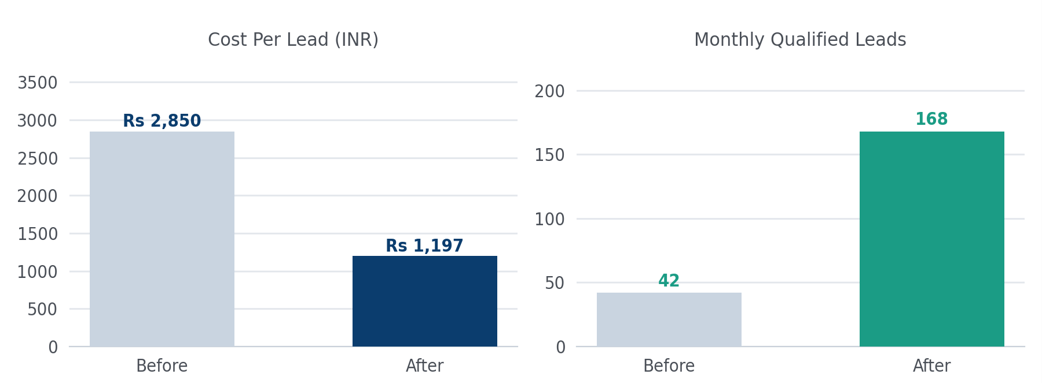
Cost per lead and monthly qualified leads, before the account rebuild versus six months after.
Landing pages built for someone holding a spec sheet
Each product line got its own page tolerances, materials, certifications , and a short form asking only what sales actually needed to qualify the lead. Mobile load time mattered more than we expected, a fair number of procurement staff were apparently browsing from the shop floor, not a desk.
Feeding sales outcomes back into the algorithm
This one made the biggest difference, honestly. Once the CRM was connected to Google Ads, the bidding algorithm could see which leads eventually became a quote or an order, not just which ones filled out a form. Smart Bidding started optimizing toward revenue instead of the cheapest possible click, and that shift alone probably accounts for more of the Quality Score improvement than anything else we touched.
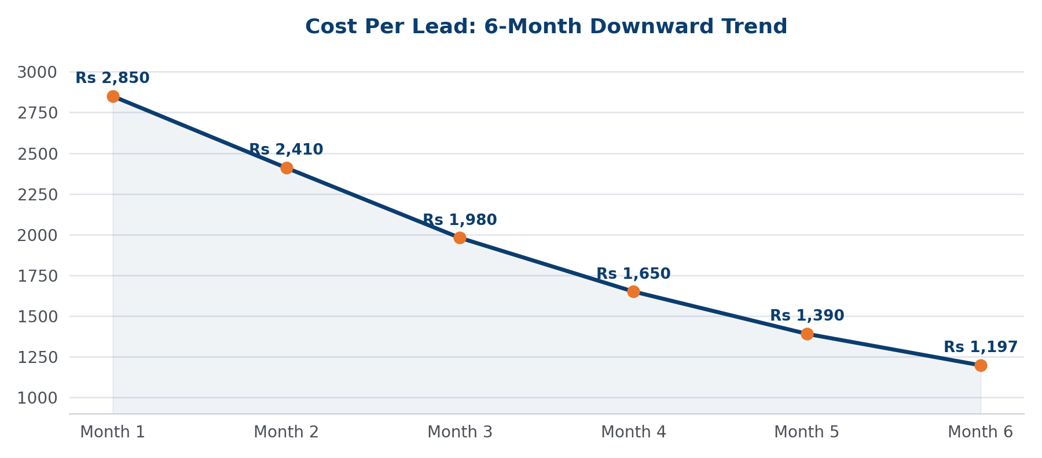
Cost per lead fell in a fairly straight line over six months as these changes compounded.
A Couple of Things Worth Taking Away
If there’s a lesson here for other manufacturers, it’s that cost per lead is almost never a bidding problem by itself. It looks like one the instinct is to fiddle with bids but underneath it’s usually a targeting problem and a tracking problem wearing a bidding problem’s clothes. Fix those two and the bidding tends to sort itself out.
The other thing worth saying: getting sales data back into the ad platform sounds like a technical afterthought, and most agencies treat it that way. It shouldn’t be. It was arguably the single highest-leverage change in this entire engagement, and it’s the one step that’s easiest to skip.
Conclusion
This is more or less how Arihant Global approaches every Google Ads engagement for manufacturers and industrial suppliers start with what the account is actually spending on, not what the dashboard says it’s spending on. If your campaigns are generating clicks but not real RFQs, that gap is usually findable within a week or two of digging.
Reach out to Arihant Global’s Google Ads services team for a free Google account audit and see where your numbers could realistically land today.”