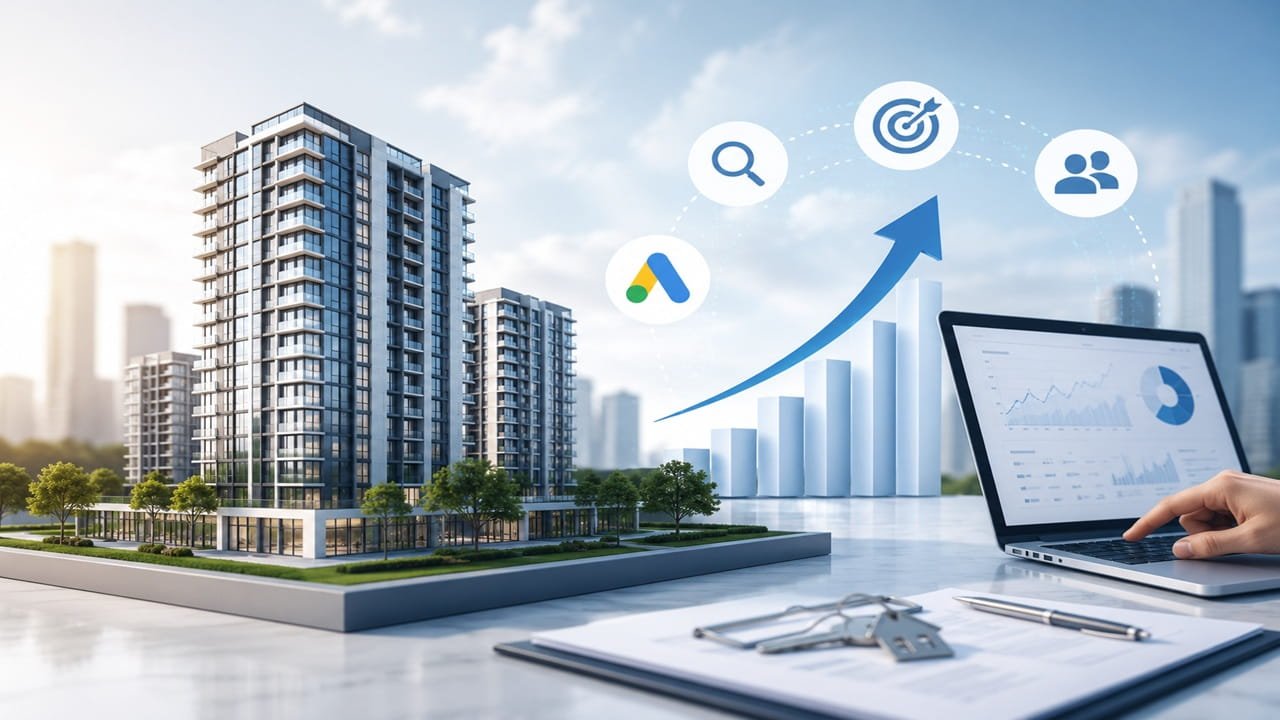
There’s a specific moment from this project worth mentioning before anything else. About ten weeks in, the developer’s sales head asked us almost as an aside during a regular review call whether we could tell her which campaign a particular booked flat had come from. We could. Because by then, every site visit and every sale was tracked back to its source campaign, ad group, creative, channel. That question, and the fact that we finally had a real answer to it, is what this whole engagement was actually about. The lead count matters, but the traceability is what changed how the developer thought about marketing spend.
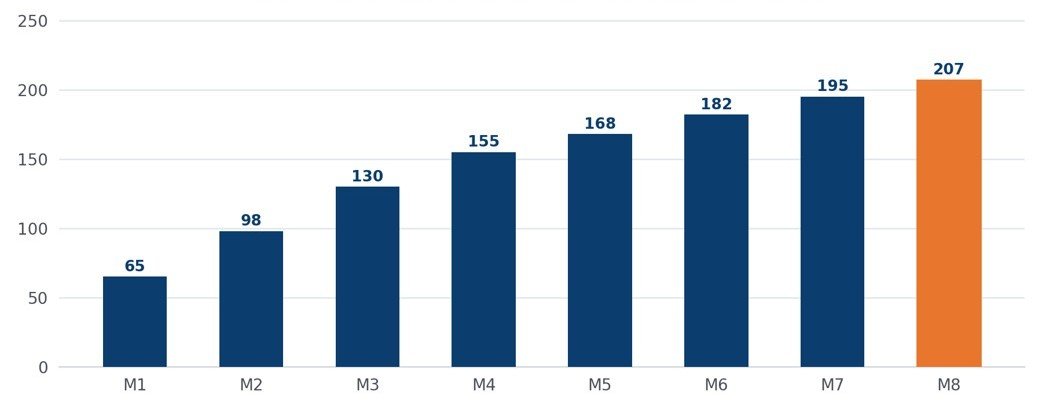
Over eight months, the account produced 1,200 qualified leads and 380 booked site visits, at a cost per lead roughly 60% lower than where it started. Forty-six units were sold to buyers who first showed up through a paid campaign.

CLIENT BACKGROUND & CONTEXT
The client a mid-to-premium residential developer in Rajasthan, referred to here as Blue Peak Realty to keep their identity private builds gated apartment communities and villa plot developments. They’ve been at it long enough to have a reputation in their local market, a sales team that knows how to close, and two project phases sitting ready to launch with no predictable way to fill the enquiry pipeline.
Before this engagement, lead generation leaned on channel partners and print advertising, with a Google Ads account running quietly in the background. It had been set up in-house a couple of years earlier and never really strategized. Not a complete disaster it was generating some leads but nobody could tell you which leads were worth chasing, which ones had actually visited the site, or which ad had started the conversation. Leadership wanted something more predictable than hoping a channel partner happened to have the right buyers in their database when a new phase launched.
Two things were driving the urgency a new 3BHK apartment community in the city’s western growth corridor was going on sale, and a premium villa plot development in a peripheral township was about six weeks behind it. Both needed a pipeline. Neither one had one.
Developer Snapshot 🏗 Project type: Mid-to-premium gated apartments + villa plots 📍 Market: Rajasthan (Tier-1 city + township) 💰 Pre-engagement CPL: ₹1,850 📊 Pre-engagement landing page CVR: 2.8% 🔗 Lead source tracking: None 📣 Previous channels: Google Search only (in-house managed) |
What They Needed Not more leads better ones. The existing account was producing form fills, but the sales team was spending half their time calling people who'd submitted a name and a phone number with no real purchase intent behind it. The developer needed a pipeline that the sales team could actually work: pre-qualified enquiries, a clear path to a site visit booking, and enough tracking in place to see which spend was producing results and which wasn't. The two launches the apartment community and the villa plots needed separate campaigns because the buyer profile for each is almost completely different. One approach for both would have diluted both. |
Challenges
It wasn’t a terrible account. It was an incomplete one built to generate form submissions without much thought for what came after.
| 01 | Lead forms that qualified nothing
The form asked for name and phone number. Nothing else. No budget. No configuration preference. No timeline. Sales was calling people who it turned out later couldn’t afford a 2BHK at the entry price, let alone the villa plot development. There was no filter between ad click and sales call, which meant the sales team was doing qualification work that should have happened at the form stage. |
| 02 |
No way to see what happened after the click There was no tracking between a submitted form and what happened next no visibility into site visits, bookings, or sales. The only metric the account had was form fills. Whether those form fills ever turned into a site visit, let alone a sale, was a mystery. Marketing and sales were working from completely separate datasets with no way to connect them. |
| 03 | Budget entirely on Search missing most of the buyer journey
Nearly the entire budget was sitting in Google Search. Which catches people who already know what they’re looking for useful, but it misses a big part of how people actually research a property purchase. They scroll Instagram, watch a walkthrough video, come back to the website twice before ever picking up the phone. The account had no presence at any of those stages. |
| 04 | Same creative running across two completely different projects
The same ad message same copy, same visuals was being used across a premium villa plot development and a mid-range apartment project. The buyer for a ₹75 lakh villa plot is not the same person as the buyer for a ₹45 lakh 2BHK. Running them together with identical creative flattened the appeal of both and confused the targeting algorithm about which audience was actually converting. |
Solution
we stopped optimizing for leads and started optimizing for booked site visits. That’s the thing that actually matters in residential real estate. A lead that never shows up at the site is not a lead it’s a wasted sales call.
| MOVE 1 | Spread budget across the actual buyer journey
Search stayed for people typing in project names or ‘3BHK apartments in [city].’ Performance Max picked up earlier-stage browsing Discover, YouTube, Display for people researching without a specific project in mind yet. And Meta retargeting went after people who’d already spent time on the floor plans page but hadn’t filled out anything. That last one, unsurprisingly, produced some of the cheapest and highest-intent conversions in the whole account. People who’d already looked at the plans once weren’t hard to get back. |
| MOVE 2 | One landing page per project with a form that qualifies before the call
Each project got its own dedicated page: floor plans, price bands, RERA registration number, nearby infrastructure, and a short form that asked budget range and preferred configuration before passing the lead to sales. The form wasn’t long three qualifying fields added to name and number but it meant sales could triage a lead before the first call instead of during it. Unqualified leads dropped significantly within the first six weeks. |
| MOVE 3 | Track what happens after the click not just the click itself
This is the piece most real estate PPC accounts skip entirely. We connected the CRM’s site visit and booking data back into both ad platforms, so the campaigns could start favouring the audience segments that actually showed up at the site, not just the ones that filled out a form and went quiet. It took a few weeks for enough data to build up before it was useful. Once it did, cost per lead started dropping on its own the platforms were doing less guessing about who to show the ads to. |
| MOVE 4 | Fix the response time gap between lead and call
A small operational fix that had a material impact on conversion. Leads now route straight to the assigned sales executive within minutes of submission, with a response-time expectation that hadn’t formally existed before. It’s not a marketing change it’s a process change. But in real estate, where a buyer’s interest window is often narrow, the speed of the first call has a disproportionate effect on whether that lead ever becomes a site visit. |
RESULTS
Cost per lead started falling from month two, once the landing page qualification changes were live and the CRM data started feeding back into the platforms. By month six, the account was running at ₹740 per qualified lead against a starting point of ₹1,850. The eight-month totals are below.
Full Results Table
| Metric | Before | After | Change |
| Total qualified property leads | Not tracked | 1,200 | 8-month total |
| Cost per qualified lead (CPL) | ₹1,850 | ₹740 | –60% |
| Cost per booked site visit | ₹5,200 | ₹2,340 | –55% |
| Click-through rate (CTR) | 1.8% | 4.9% | +172% |
| Landing page conversion rate | 2.8% | 7.6% | +171% |
| Site visits booked and tracked | Not tracked | 380 | 8-month total |
| Units sold from paid campaigns | Not tracked | 46 units | Traced to source |
Getting leads to a human faster
Leads now route straight to the assigned sales executive within minutes, with a response-time expectation that, frankly, hadn’t existed before. It’s a small operational fix, not a marketing one, but it moved the needle on how many leads actually turned into a scheduled visit.
Cost Per Lead Reduced 1850 to 740 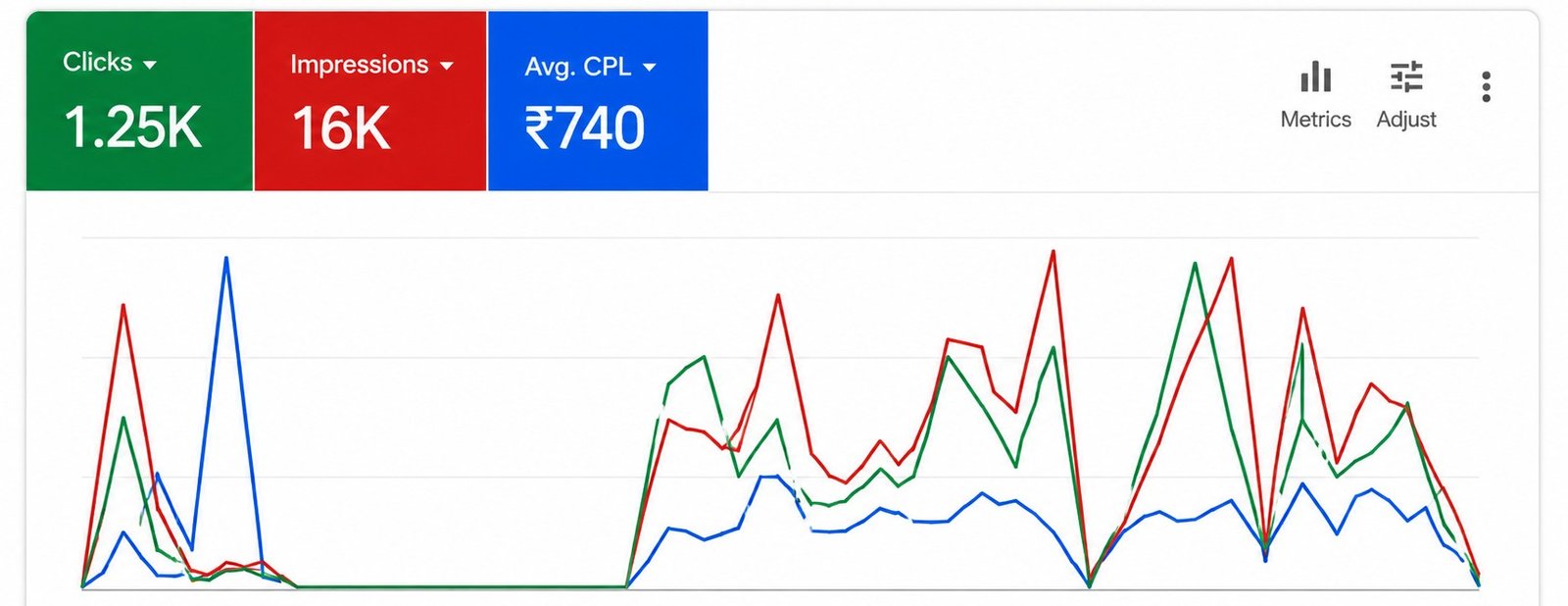
“ What changed how our leadership thinks about marketing wasn't the lead count it was being able to trace a booked flat back to the campaign that started it. We could finally have a real conversation about budget instead of guessing. That's why we've already committed more spend to the next launch. Head of Sales |
Conclusion
If Your Leads Aren’t Turning Into Site Visits, the Gap Is Usually Between the Ad and the Form
Arihant Global runs PPC Services for real estate developers who want a pipeline they can actually trust not a lead count that doesn’t connect to the sales team’s reality. If your next launch is coming up and the current setup isn’t producing visits, it’s worth finding out why before the project goes live, not during it. Start with a free audit of your current account.
No pitch. No slide deck. Just a straight read of what your account is doing and what’s costing you visits.
Disclaimer
Client information has been anonymized to maintain confidentiality. The strategies and outcomes described are specific to this engagement and may differ for other businesses or marketing campaigns.