Introduction
Most businesses that eventually bring in dedicated CRO services have already spent heavily on driving more traffic, only to watch conversion rate stay flat regardless of how many new visitors arrive. That’s usually not because the traffic was low quality. It’s that the site itself was never actually tested or optimized to convert the visitors it was already getting, which is exactly the gap this engagement was brought in to close.
Client Snapshot: What CRO Services Actually Walked Into
The client was a direct-to-consumer skincare brand generating around 85,000 monthly sessions through a healthy mix of paid and organic traffic, but converting at just 1.1% well below category benchmarks. Marketing had been treated as the lever to pull whenever revenue needed to grow, with the website itself largely left untouched since its last redesign. Here’s the thing about CRO services done properly the work goes well beyond swapping button colors. It involves analyzing real user behavior, running structured A/B tests, fixing friction in the conversion funnel, and tracking whether changes actually move revenue, not just a single metric in isolation.
CRO services that meaningfully move conversion rate have little patience for guesswork dressed up as optimization. Going in, this client didn’t need another traffic campaign. it needed the existing traffic converting at a rate that matched what it was already paying to acquire.
Conversion Funnel Depends on Understanding Real User Behavior First
Conversion funnel performance can’t improve through isolated page tweaks if nobody has actually diagnosed where visitors are dropping off and why. The initial analysis turned up exactly that kind of missing diagnostic layer.
- Heatmaps across key landing pages revealed visitors weren’t scrolling past the first screen on mobile, missing critical product information and trust signals entirely
- Session recordings showed repeated confusion around the product selection process, with visitors clicking back and forth between similar products without completing a choice
- Funnel analysis identified a 43% drop-off between adding a product to cart and beginning checkout, a stage that had never previously been isolated or investigated
- User behavior data showed a significant share of mobile visitors abandoning during a multi-step checkout that hadn’t been reviewed since launch
Jumping straight to testing headline variations without this behavioral diagnosis would have meant testing changes disconnected from where visitors were actually struggling.
A/B Testing Built Around Verified Friction Points
A/B testing for this client needed to be grounded specifically in the friction points the behavioral research had surfaced, rather than testing based on general best practices or internal opinion.
- Product page layout was tested against a version prioritizing key trust signals and product benefits above the fold on mobile, where the scroll data had shown the biggest drop-off
- Checkout flow was tested as a condensed single-page version against the original multi-step process, directly targeting the abandonment point the funnel analysis had identified
- Product selection was tested with a simplified comparison layout against the original grid, addressing the back-and-forth confusion the session recordings had revealed
- Each test ran to statistical significance before a winner was declared, rather than calling results early based on early, unreliable trends
The CRO Services Process Table
| Service Area | What Got Done | Impact on Conversion |
| Behavioral analysis | Heatmaps, session recordings, funnel diagnostics | Identified exactly where and why visitors dropped off |
| A/B testing | Structured tests on product, checkout, and comparison pages | Validated which changes actually improved conversion |
| Checkout optimization | Condensing multi-step checkout into a single page | Directly reduced cart-to-checkout abandonment |
| UX optimization | Mobile-first redesign of key landing pages | Addressed the scroll and engagement gap on mobile |
| CTA optimization | Testing placement, copy, and visibility of key actions | Improved click-through at critical funnel decision points |
| Ongoing monitoring | Continuous testing and performance tracking | Sustained gains as traffic and behavior shifted over time |
Checkout Optimization: The Highest-Leverage Fix in This Engagement
Checkout optimization ended up being the single highest-leverage area of this project, precisely because the original multi-step process had never been reviewed since the site’s last redesign years earlier.
- The checkout was condensed from four steps to one, removing redundant fields and consolidating shipping and payment information onto a single screen
- Guest checkout was made the default path, removing an account-creation requirement that had been quietly filtering out a meaningful share of first-time buyers
- Trust signals security badges, return policy, and shipping timelines were added directly within the checkout flow, addressing hesitation the session recordings had shown at that exact stage
- Auto-fill and address validation were implemented, reducing manual entry errors that had been causing failed submissions on mobile specifically
User Experience and Call-to-Action Optimization Across the Funnel
User experience improvements extended beyond checkout into the broader site, paired closely with call-to-action optimization at each key decision point in the buyer journey.
- Mobile-first redesign prioritized the product benefits and trust signals that heatmap data had shown were being missed entirely below the fold
- CTA copy and placement were tested across product and cart pages, moving primary buttons higher and clarifying next-step language that had previously been vague
- Product comparison simplification reduced the number of near-identical options shown simultaneously, directly addressing the indecision the session recordings had revealed
Improvements made without this kind of behavioral grounding tend to look reasonable in isolation but rarely address the actual friction losing conversions.
Results Over Four Months
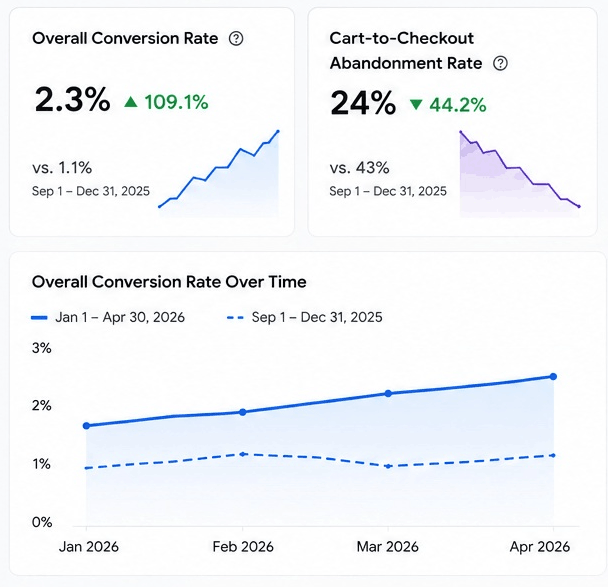
Overall site conversion rate grew from 1.1% to 2.3%, more than doubling without any increase in traffic spend and Cart-to-checkout abandonment dropped from 43% to 24% following the condensed checkout implementation
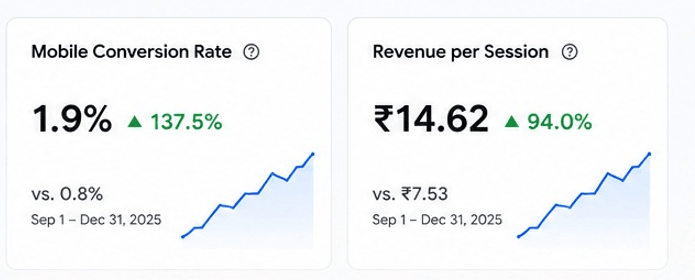
Mobile conversion rate specifically improved from 0.8% to 1.9%, closing much of the gap with desktop performance
Revenue per session increased by approximately 94%, directly reflecting the conversion rate improvement across the same traffic volume
Why Ongoing CRO Services Delivered More Than a One-Time Redesign Would Have
What made ongoing CRO services worth more than a single redesign here wasn’t just the initial fixes. it’s that conversion optimization compounds through continuous testing rather than one large overhaul. A one-time redesign would have addressed a snapshot in time, based on assumptions rather than validated behavior. the ongoing testing structure kept surfacing new friction points as earlier ones were resolved, which is largely why conversion rate kept climbing rather than plateauing after the initial checkout fix.
Common Mistakes This Engagement Avoided
- Running tests based on internal opinion or general best practices, without first diagnosing actual user behavior on the site
- Focusing exclusively on the homepage while ignoring checkout, where the largest single drop-off was actually occurring
- Calling test results early based on initial trends, rather than waiting for statistical significance
- Treating desktop and mobile as equally optimized, despite mobile behavior data showing a meaningfully different experience
- Measuring success by conversion rate alone without connecting it back to actual revenue per session
Conclusion
If your traffic keeps growing but conversion rate stays flat, that gap usually comes down to specific friction points that haven’t been diagnosed or tested yet. Arihant Global works with ecommerce and DTC brands to run ongoing CRO services that turn existing traffic into meaningfully more revenue, without requiring additional ad spend. Reach out and let’s find out what’s currently costing you conversions.
Disclaimer
Results shown are from a specific client campaign and may not be typical. Outcomes vary based on industry, competition, budget, audience, and execution. Past performance does not guarantee future results.