Executive Summary
There’s a moment a lot of growing brands hit where the math just stops working the way it used to. You’re still spending, still making sales, but the cost of winning each new customer keeps climbing faster than revenue can keep pace with. That’s basically where this client was a D2C brand running paid campaigns across multiple platforms, decent revenue on the surface, but a customer acquisition cost that had crept up so quietly it was eating margins nobody had properly flagged yet.
We came in through a full Performance Marketing Services engagement, and the goal wasn’t “spend more to grow faster.” It was the harder, less flashy version of growth get more return out of every rupee already going out the door, and bring the cost of each customer down at the same time. Both things happened, and honestly, they happened together, which is the part that really changed how the client thought about marketing going forward.
Results Snapshot
86% Increase in overall ROI

37% Reduction in customer acquisition cost

2.6x Improvement in ROAS across paid channels

41% Increase in repeat purchase revenue
Background and Context
The client had been running ads across Meta, Google, and a couple of smaller platforms for a while, and each one was basically managed in its own bubble. Meta had a team looking at Meta’s numbers. Google Ads had someone else staring at a completely different dashboard. Nobody was really looking at the whole picture how a customer actually moved across channels before buying, or which platform was doing the real work versus which one just happened to show up at the end and take credit for a sale that had already been decided somewhere else.
It’s an easy trap to fall into, honestly, because every platform’s own reporting is more than happy to tell you it’s the hero of the story. Without a real attribution model tying everything together, you end up making budget calls based on a version of events that isn’t quite true.
The Challenges
Once we started pulling the data apart, a few things became obvious pretty quickly. There was no real attribution model in place, so budget decisions were being made off last-click data that overstated some channels and completely undersold others that were actually doing the heavy lifting earlier in the funnel. Creative had gone stale across nearly every campaign the same handful of ad variations had been running for months, and performance was sliding in a way that looked exactly like audience fatigue, because that’s exactly what it was. Landing pages weren’t built to convert, with slow load times and a checkout flow carrying more friction than it needed. And there was almost no retention or repeat-purchase play running at all, which meant the business was paying full acquisition cost for basically every single sale, over and over, instead of squeezing more value out of customers it had already won.
Approach and Strategy
Phase 1: Building an Attribution Model That Actually Told the Truth (Days 1–15)
Before touching a single campaign, we needed to understand what was really driving purchases versus what was just claiming credit for them. We built a proper multi-touch attribution model across the client’s channels, which meant a fair amount of untangling messy tracking setups and reconciling numbers between platforms that don’t naturally play well together. Honestly, this one step alone changed how the client thought about their entire budget almost overnight.
Phase 2: Moving Budget to Where It Actually Belonged (Days 12–25)
With better attribution running, it became pretty clear that a couple of channels being treated as top performers were mostly riding on demand generated elsewhere, while some underfunded channels were quietly doing more real acquisition work than anyone had ever given them credit for. We shifted budget to reflect that, and honestly, ROI started moving in the right direction before we’d even touched creative or landing pages.
Phase 3: Refreshing Creative Before It Died Completely (Days 20–45, overlapping)
Stale creative was dragging performance down across almost every campaign, so we built out a proper testing rhythm new angles, new messaging, new concepts instead of letting the same tired ads run until they stopped working entirely. This is where a lot of accounts quietly bleed money, if we’re being honest. Creative fatigue is invisible right up until you go looking for it.
Phase 4: Cleaning Up the Path From Click to Purchase (Days 30–55)
Traffic hitting the site doesn’t mean much if the site is losing people along the way. We worked through page speed, trimmed down checkout to fewer steps, and cleaned up the friction points that were quietly costing sales the ads had already paid for.
Phase 5: Building an Actual Retention Strategy (Days 45–70)
Since winning a new customer almost always costs more than getting an existing one to buy again, we built email and retargeting flows aimed specifically at repeat purchases, along with post-purchase campaigns designed to bring people back instead of treating every sale like a one-off event. This is really where CAC started dropping in a way that stuck, because a growing chunk of revenue stopped needing fresh acquisition spend at all.
Phase 6: Not Stopping Once Things Started Working (Ongoing from Day 60)
We kept refining bids, testing new audiences, and shifting budget weekly based on what the attribution data was actually saying, rather than sticking with a plan set once and left to run on its own.
Results
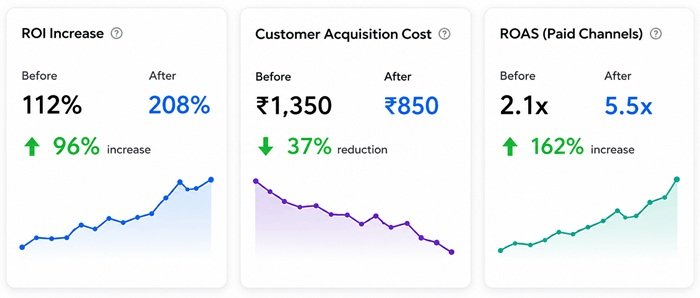
We Increased Overall ROI by 86% and Reduced Customer Acquisition Cost by 37%
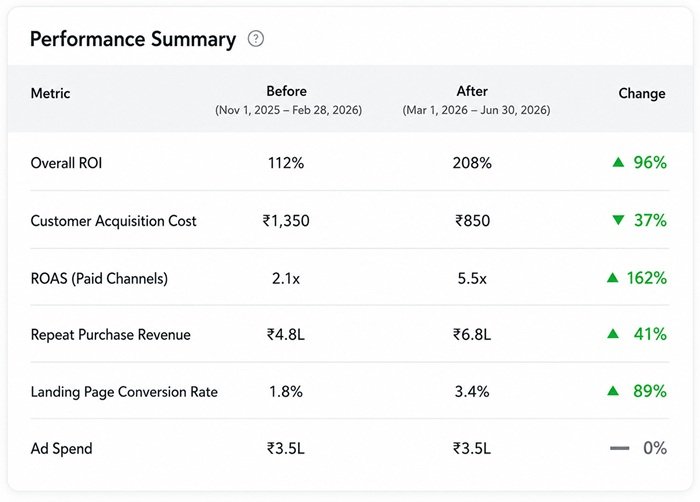
We Increased Repeat Purchase Revenue by 41% and conversion rate by 89%
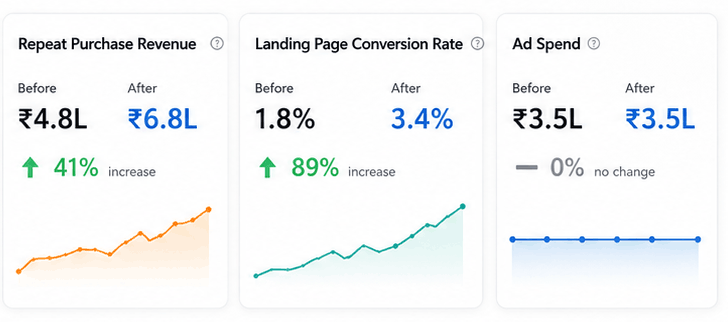
What really shifted things for the client wasn’t any one number here it was seeing ROI climb and CAC drop at the same time, without spend itself changing at all. That’s a hard result to argue with in a budget meeting, because it’s not “we spent more and got more.” It’s “we got more out of exactly what we were already spending,” which is a very different conversation when you’re the one holding the purse strings.
Conclusion
This one really comes down to a simple idea that’s easy to overlook growth doesn’t always mean spending more, sometimes it just means finally understanding what you’re already spending on well enough to stop wasting half of it. Fixing attribution so decisions were based on what was genuinely working, refreshing creative before fatigue quietly tanked it, cleaning up the gap between an ad click and an actual purchase, and building real retention instead of treating every customer like a one-time transaction that’s the combination that let ROI go up and CAC come down together. That doesn’t happen by accident.
Want your performance marketing getting more efficient instead of just more expensive?
Talk to Arihant Global about a Performance Marketing strategy built around real ROI and lower CAC, not bigger budgets.
Why Businesses Choose Arihant Global
Plenty of paid media services will happily spend your budget and hand you a dashboard full of impressions. Arihant Global cares about the numbers that actually matter to the business ROI, ROAS, and customer acquisition cost that genuinely moves in the right direction. Whether that means building a proper attribution model from scratch, setting up a creative testing rhythm so ads don’t go stale, or finally building retention so every sale isn’t treated as a first sale, the goal stays the same: growth marketing that shows up in your margins, not just your traffic reports.
Disclaimer
Results reflect this client’s specific market and circumstances. Marketing outcomes vary based on competition, industry, budget, and execution, and past performance doesn’t guarantee similar results for other businesses.