
A test-prep and skills-training brand came to us right before what should have been their busiest enrollment window, already nervous. Two of their four upcoming batches were sitting well below minimum enrollment with barely a month left, the kind of situation where a coaching center starts wondering whether to cancel a batch entirely and refund the handful of students who did sign up.
Client: Withheld at client's request Sector: Education (Test Preparation & Professional Skills Training)

Engagement: 4 months

Service: Education Marketing Services (Paid + Organic)
Key Measurable Outcomes
Background
The brand runs test-prep programs alongside a smaller set of professional certification courses, mostly offline classroom batches with a modest online component added over the previous year. They’d built a decent reputation over about six years, largely through word of mouth among students who’d taken a batch and told friends preparing for the same exam. That had worked well enough when they were running one or two batches at a time.
The trouble started once they expanded to four concurrent batches across two program types. Word of mouth simply couldn’t fill that much capacity on its own, especially not on the timeline a batch schedule demands, since a coaching batch either fills by its start date or it doesn’t run at all. There’s no gradual ramp-up the way there might be for an ongoing service. When they came to us, two batches were tracking toward cancellation, which would have meant refunding early enrollees and damaging trust with exactly the students they most wanted to keep.
What was actually happening
Education Marketing had been running as an afterthought, a Facebook page that posted occasionally, some WhatsApp broadcasts to an old contact list, and a small Google Ads budget that had never really been reviewed since it was first set up over a year earlier. Nobody owned the enrollment number as their specific responsibility, which meant nobody was tracking it closely enough to notice the shortfall until it was almost too late.
The old Google Ads campaign was still bidding on keywords from a program they’d discontinued, quietly wasting a chunk of budget every month on searches that led to a page for a course that no longer existed. Nobody had checked.
There was also no urgency built into anything. Batch start dates existed only on an internal spreadsheet, nowhere on the website, nowhere in any ad, which meant a prospective student had no reason to enquire this week rather than next month, even though seats were genuinely limited and the deadline was real.
Content, such as it existed, talked about the brand in general terms rather than addressing the specific anxiety a prospective student actually has close to enrollment: will this batch timing work with my schedule, how much personal attention will I actually get in a room with thirty other students, what’s the realistic outcome if I join this batch versus waiting for the next one.
And there was no retargeting at all for the sizable number of people who’d visited the website or messaged on WhatsApp without enrolling, which given how the batch deadline was approaching meant a lot of warm interest was just being left on the table.
What we changed
The first move was purely defensive: we killed the wasted spend on the discontinued program’s keywords immediately and redirected that budget toward the two batches actually at risk. Small fix, but it freed up real money within the first week without asking for a bigger budget.
We then built urgency directly into the campaigns and the website, actual seat counts where accurate, countdown messaging tied to real batch start dates, and a visible distinction between “enrolling now” and “next batch” so visitors understood exactly what timeline they were dealing with. This isn’t a trick when the scarcity is genuine, and here it was, seats were actually limited and the date was actually approaching.
Landing pages got rebuilt per batch rather than per program broadly, so someone looking at the upcoming weekday batch saw information specific to that schedule, that instructor, that start date, rather than generic brand messaging that could have applied to any batch at any time.
We added short video content featuring the actual instructors for the batches struggling to fill, a few minutes of them explaining what the first two weeks would cover and answering the scheduling and attention-level questions we knew prospective students were quietly worried about. This performed better than any static ad we tested, likely because it let a hesitant student see the actual person they’d be learning from before committing.
WhatsApp, already a channel the brand’s audience was comfortable with, became the primary follow-up tool. Anyone who enquired but hadn’t enrolled got a short, non-pushy sequence over the following days, answering common questions and providing a direct link to secure a seat, timed around the actual closing date rather than an arbitrary schedule.
What it produced
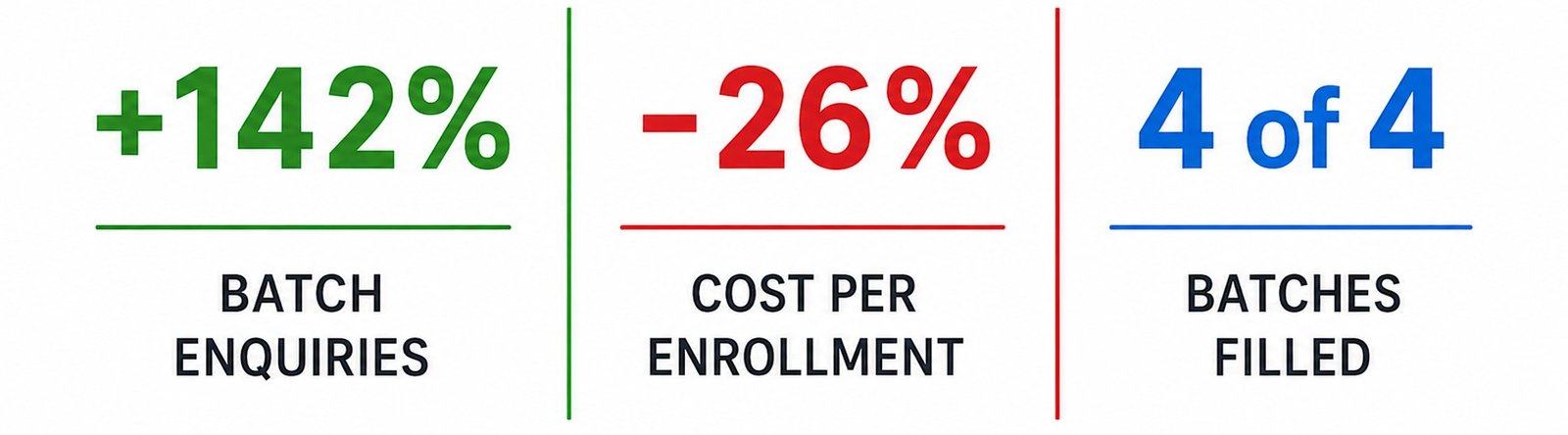
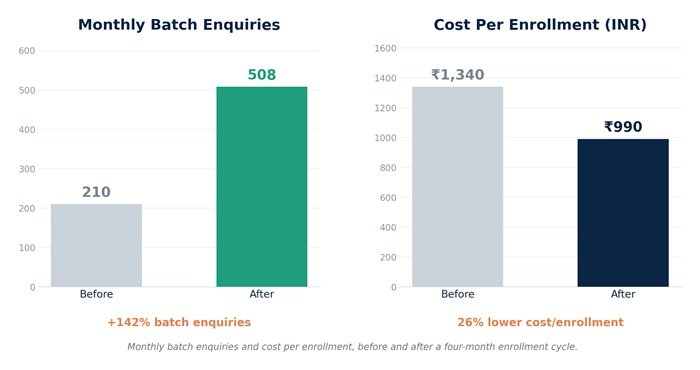
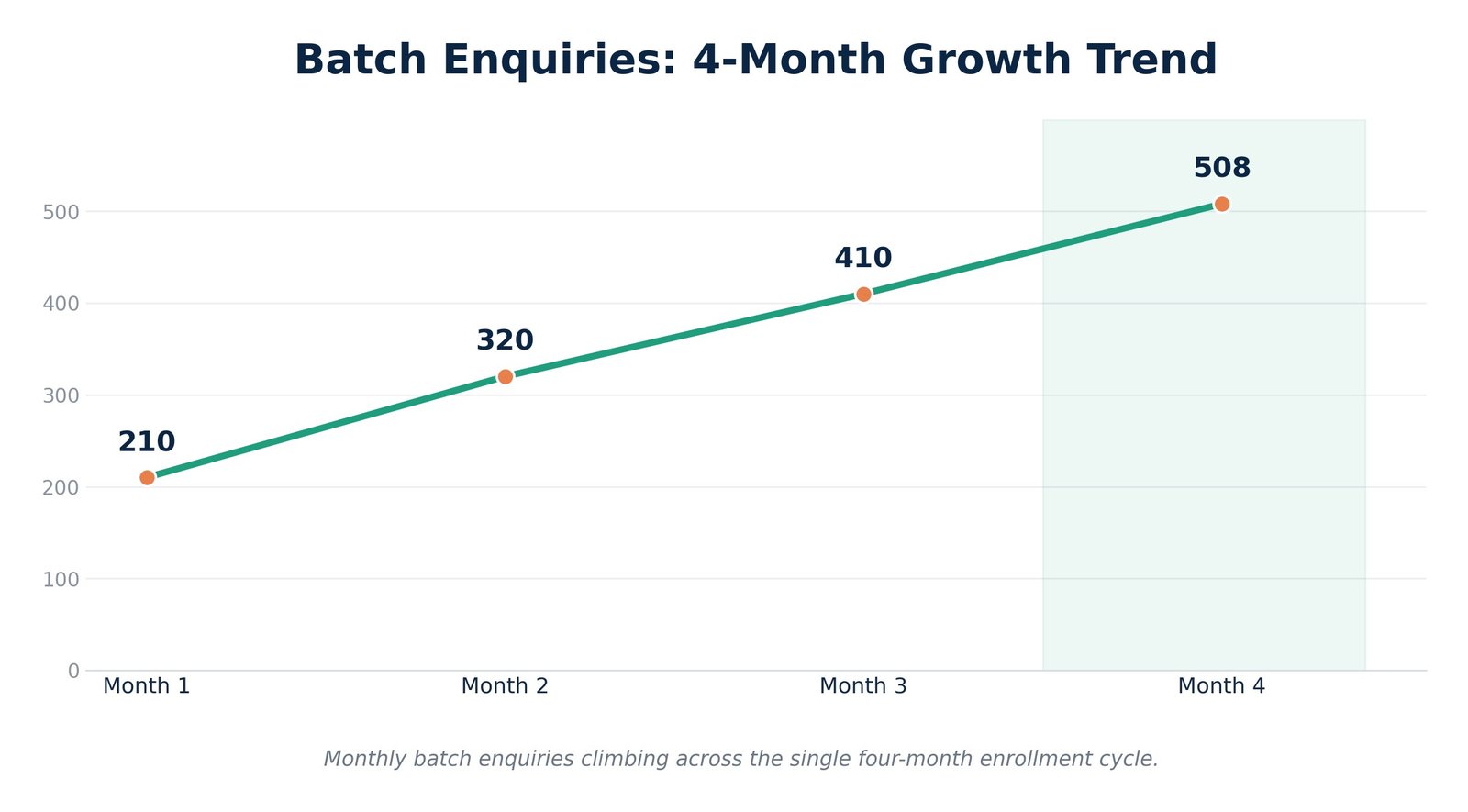
Over four months, spanning the single enrollment cycle the two struggling batches needed to fill, batch enquiries rose 142 percent, and all four batches reached minimum enrollment before their start dates, including both that had been tracking toward cancellation. Cost per enrollment dropped 26 percent, largely from cutting the wasted ad spend and from landing pages that finally spoke to the specific batch someone was actually considering.
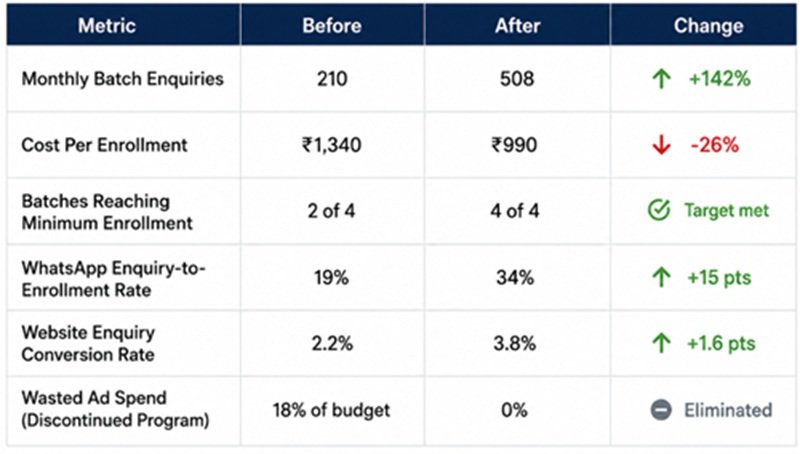
Cost per enrollment dropped 26 percent
The instructor videos ended up being reused well beyond this cycle, the brand kept them running as evergreen content for the next enrollment period, since they’d clearly done more to settle a hesitant student’s nerves than any brochure copy had managed in years.
"We were genuinely close to cancelling one of those batches and refunding students who'd already paid, which is about the worst position a coaching center can be in with its own enrolled students watching. Filling it changed the mood in the office more than any single number could really capture." Director, client institute (name withheld)
Why this worked
The brand’s programs weren’t the problem, students who completed a batch generally did well and said so. What was missing was any real infrastructure treating enrollment as something that had to be actively driven toward a hard deadline, rather than something that would sort itself out through reputation alone. Building real urgency around real scarcity, letting instructors speak for themselves on video, and following up through a channel students already trusted did most of the work, none of it required reinventing what the brand actually was.
If this sounds familiar
We’ll review your current enrollment marketing for free, no changes made, just an honest look at whether your campaigns are actually built around your real batch deadlines or just running in the background.
Ask us for a free education marketing audit →
Why education brands tend to stick with Arihant global
Arihant global build urgency around real deadlines, not manufactured scarcity that erodes trust over time. Instructors and real classroom content do the persuading, not generic brand copy. Follow-up happens on the channel your students already use, not one you’re hoping they’ll switch to. And we treat batch-fill as the actual goal, not enquiry volume that looks fine in a report but doesn’t fill a single seat.
Disclaimer
This case study is based on a real client engagement. Client identity has been withheld for confidentiality, and individual results may vary depending on market conditions, competition, budget, and implementation.