Client Industry: Fitness & Wellness - Home Workout Equipment & Supplements (D2C Ecommerce)
Primary Challenge:
Good following, good products, traffic wasn’t the issue at all. The problem was quieter than that every single purchase was just costing more than it used to, month after month, and nobody could quite say why. They kept spending more to hit the same number, and at some point that stops looking like growth and starts looking like treading water.
Arihant Global’s Solution:
We took over their Performance Marketing and went straight at cost per purchase. Not by throwing more money at it by actually finding where the money was leaking, across targeting, creative, and everything sitting between someone clicking an ad and actually finishing checkout.
Key Measurable Outcomes:
Results Snapshot (After 4 Months)

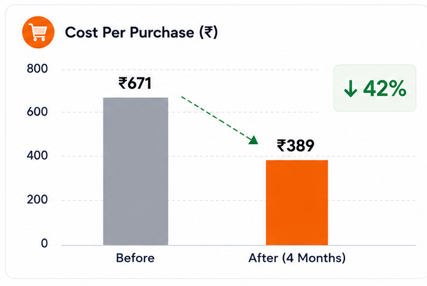
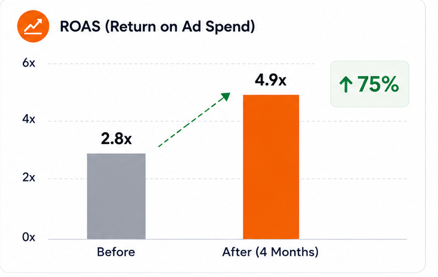
Four months in, cost per purchase was down 42%, purchases were up 78% on basically the same budget, and ROAS had nearly doubled.
Background & Context
A fitness brand selling home workout gear resistance bands, adjustable dumbbells, a couple of solid supplement lines through their own site. About three years in, decent name in the home fitness space, genuinely engaged Instagram following, not a brand-awareness problem at all. Spend had been climbing steadily for a year just to keep hitting the same sales targets, and cost per purchase had quietly gone up right alongside it the whole time.
Challenges
Went through the account and the site together, and honestly, the leaks weren’t hard to find at all:
- Cost per purchase had been climbing for three quarters straight. Spend kept going up to hit the same revenue number, and everyone had just sort of absorbed that as “the cost of staying competitive” without really questioning whether the money was even being spent well in the first place.
- A lot of the targeting was reaching people who were never going to buy anything. Interest audiences hadn’t been touched in months. A growing share of clicks were coming from people who’d engage with an ad out of curiosity, nothing more.
- The ad said one thing, the landing page said another. An ad would promise, say, a bundle deal, and click through would land on a plain generic product page with no mention of it. People noticed. People left.
- Checkout had friction nobody had bothered fixing. An extra address confirmation step that didn’t need to exist, plus a slower payment gateway sitting as the default. Both quietly bleeding conversions, especially on mobile.
- Creative had gone stale, and nobody caught it in time. A small handful of ads had been running for months basically unchanged. Performance slid slowly enough that it never really set off any alarms.
- New customers and repeat buyers were seeing the exact same ad. No difference at all in messaging whether someone had never bought before or was already on their third order.
Approach, Strategy & Solution
We spread this over four months and kept the budget more or less flat the entire time, on purpose that way, whatever changed, changed because of efficiency, not because more money went in.
Month 1 (Weeks 1–2)
Clean up targeting before touching anything else. Rebuilt lookalike audiences off actual recent buyers instead of a list that hadn’t been refreshed in ages, and tightened interest targeting so reach wasn’t going out to people who were never close to buying. Total reach dropped a bit. What came in was a lot more worth having.
Month 1 (Weeks 2–3)
Make the ad and the page actually agree with each other. Went through every live campaign one at a time and matched what the ad promised to a page that actually reflected it, instead of dumping every click onto the same generic product page regardless of what was said in the ad.
Month 1–2 (Weeks 3–5)
Fix what was slowing checkout down. Worked with their developer, dropped the pointless address confirmation step, swapped the default payment option for something that loaded faster. Small, unglamorous fixes. Completion rate moved within two weeks anyway.
Month 2 (Weeks 4–6)
Get creative back on a real rotation. Brought in a rolling set of new material short workout clips, real customer testimonials, some before-and-afters refreshed every couple of weeks instead of letting the same few ads sit there indefinitely.
Month 2–3 (Weeks 5–8)
Stop treating new and repeat customers the same. Built separate audiences and separate messaging for first-timers versus people who’d already bought, using purchase history so returning customers actually saw restock reminders and upsells instead of the same generic “try us” ad.
Month 3–4 (Ongoing)
Put the money where it was clearly working. Once there was enough clean data, spend moved away from the weaker ad sets and got concentrated behind whatever combination of audience and creative was actually producing purchases at the lowest cost instead of just splitting everything evenly because that’s how it had always been done.
Results
By month four, cost per purchase had genuinely turned around moving in the direction that makes the same budget do more, instead of needing more budget every quarter just to stand still.
Cost per purchase went from ₹671 down to ₹389 a 42% drop.
Volume & Reach Purchases grew 75% while the budget stayed roughly where it was — that came almost entirely from sharper targeting and less drop-off at checkout, not from spending more.
ROAS climbed from 2.8x to 4.9x over the same window.
Conversion Behavior Click-through rate went from 1.1% to 2.4%, mostly thanks to the fresh creative. Checkout completion improved from 44% to 61% once the friction actually got cleared out.

Customer Mix Return customers went from about 17% of total purchases to 31%, once they finally started seeing something built for them instead of the same acquisition pitch as a total stranger.
Every number here was checked against the brand’s own order records, not just what Meta reported on its side, so this is real orders that actually came through, not just a dashboard number that looks nice.
Conclusion: How Arihant Global Can Help You Drive Digital Growth
A rising cost per purchase is basically never one big dramatic thing. It’s a handful of small things quietly piling up targeting gone stale, an ad and a page that don’t quite match, one extra step at checkout, creative nobody’s swapped out in months. None of it looks like an emergency on its own. Together, it’s exactly the kind of slow bleed that convinces a brand the only fix left is a bigger budget.
If your cost per purchase keeps creeping up and spending more feels like the only lever left to pull, there’s a real chance the actual fix is sitting somewhere inside the funnel not in the size of the spend.
Ready to Bring Your Cost Per Purchase Down?
If your spend keeps climbing just to hold the same purchase numbers, it’s worth actually looking at what’s happening between the click and the finished order. We’ll run a free audit across your targeting, creative, and checkout, and show you exactly where the cost is really coming from.
Get Your Free Performance Marketing Audit – See Where Your Purchase Cost Is Actually Coming From.
Disclaimer
Results are based on a real client campaign and are shared for educational purposes. Individual marketing performance depends on multiple factors and may differ from the outcomes presented.