
Executive Summary
Client Industry - Financial Technology Digital Lending and Payment Solutions
Primary Challenge
The fintech company was generating a reasonable volume of leads through its existing digital marketing efforts but the quality was the consistent problem. The sales team was spending most of their time on leads that were not remotely close to converting and the cost of acquiring a genuinely qualified prospect kept going up with no clear plan to bring it down.
Arihant Global’s Solution Developed a full funnel digital marketing strategy covering paid search, content marketing and marketing automation, rebuilt the conversion funnel around qualified lead signals, introduced CRM integration to track leads through the entire customer journey and implemented a lead nurturing sequence that moved prospects from initial interest to sales readiness before they ever reached the sales team.
Key Measurable Outcomes
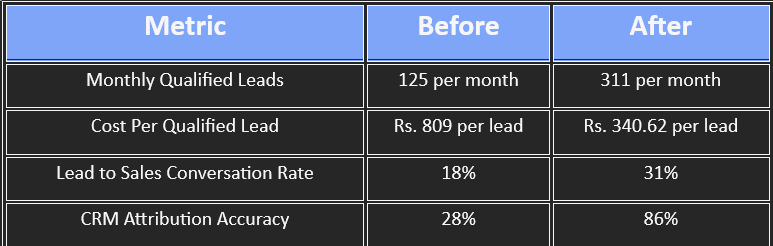
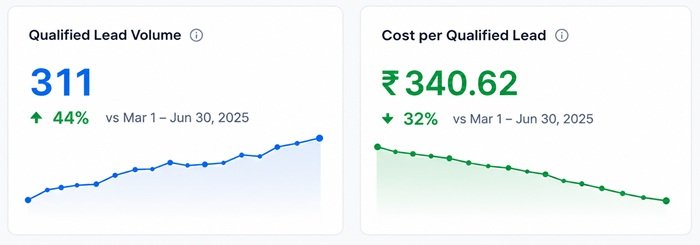
Qualified lead volume increased by 44% within 4 months

Cost per qualified lead reduced by 32%

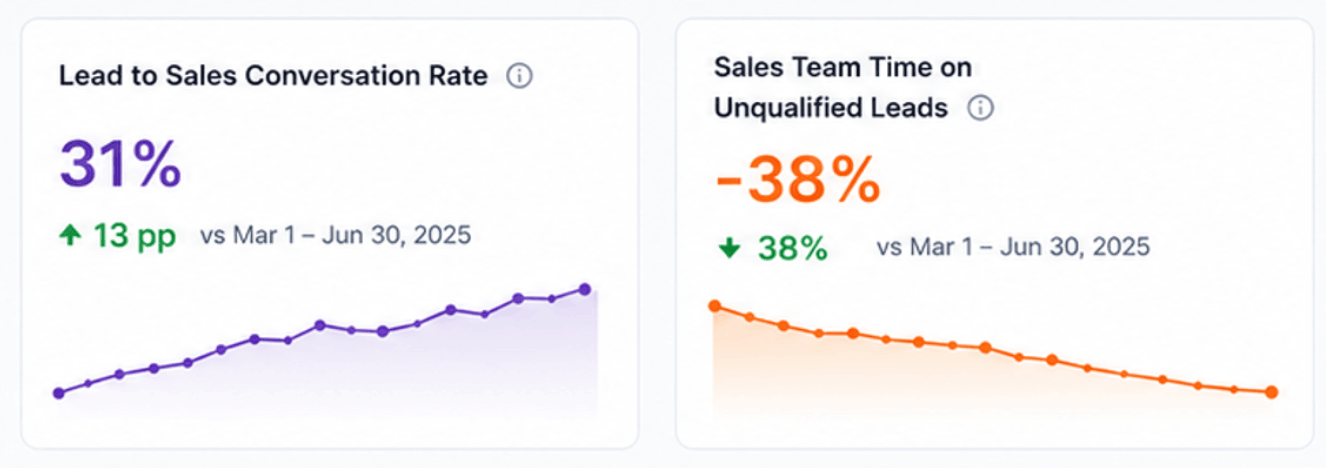
Lead to sales conversation conversion rate improved from 18% to 31%

Marketing automation reduced sales team time on unqualified leads by 38%
Background and Context
The client is a fintech company that had been operating for just over four years offering digital lending solutions and payment products to small and medium businesses. The founding team had deep product knowledge and a sales team that closed well once they were in front of the right prospect. Digital marketing had been running in some form since the early days a mix of Google Ads, some LinkedIn activity and occasional content but it had never been built around a coherent strategy. Leads came in through various channels with no clear picture of which ones were actually producing sales ready prospects. The sales team picked up whatever came in and worked through it but the ratio of time spent to deals closed had been getting worse for months. Management wanted better leads, not necessarily more of them.
Challenges
- Digital marketing activity was scattered across channels with no unified strategy or shared conversion goal connecting them
- Lead forms were collecting basic contact details but nothing that helped the sales team quickly assess whether a prospect was worth pursuing
- No lead nurturing existed anyone who showed interest but was not immediately ready to buy was never followed up with in any structured way
- CRM integration was incomplete which meant leads from different channels were landing in different places and the sales team had no single view of where a prospect had come from or what they had engaged with
- Google Ads campaigns were targeting broad financial services keywords that attracted researchers and students alongside genuine business decision makers
- Content existed on the website but was not structured around the customer journey there was no logical progression from awareness to consideration to decision
- Marketing attribution was patchy at best management could not reliably connect any specific marketing activity to a closed deal
Approach, Strategy and Solution
The work followed a structured 4 month rollout, each phase addressing a specific gap in the fintech company’s digital marketing and lead quality problem.
Month 1 – Audit, Strategy and CRM Integration
Every active digital marketing channel was audited Google Ads search term reports, website content, lead form structure, CRM setup and whatever attribution data existed. The picture that came back was messy but clear too many channels operating independently, no shared definition of what a qualified lead actually looked like and a CRM that was receiving data from some channels but not others. A unified qualification framework was defined based on the characteristics of the company’s best existing customers business size, revenue range, product need and decision making timeline. CRM integration was rebuilt to pull leads from every channel into a single pipeline with source attribution tracked from first touch.
Month 2 – Paid Search Rebuild and Lead Form Optimization
Google Ads campaigns were rebuilt around the search terms that genuine business decision makers were running rather than broad financial services queries. Negative keyword lists were extended significantly to cut out researchers, students and irrelevant traffic. Lead forms were restructured to include qualifying questions around business type, monthly transaction volume and current pain point enough information for the sales team to immediately assess seriousness without making the form long enough to put real prospects off completing it.
Month 3 – Content Strategy and Lead Nurturing
A content structure was built around the three stages of the fintech buyer journey awareness content addressing the business pain points the product solved, consideration content comparing solution approaches and decision stage content covering product specifics, integration details and customer outcomes. A lead nurturing email sequence was built for prospects who had shown interest but were not yet sales ready a five touch sequence over fourteen days that moved them through the consideration and decision stages before handing them to sales.
Month 4 – Automation, Optimization and Performance Review
Marketing automation was configured to score leads based on behaviour pages visited, content downloaded, emails opened and form interactions all contributed to a lead score that triggered different follow up actions. High scoring leads were routed directly to the sales team with a full activity summary. Lower scoring leads stayed in the nurturing sequence until they hit the threshold. Four months of attribution data was reviewed and budget was reallocated toward the channels and content pieces that were producing the highest quality leads at the lowest cost.
Results
The shift showed up first in what the sales team was spending their time on within six weeks of the new qualification framework going live the ratio of useful conversations to dead end follow ups had changed noticeably.
We increased monthly qualified leads volume and decreased CPL
We increased Coversiona rate 18% to 31%
Conclusion
The fintech company did not have a lead volume problem it had a lead quality problem and a marketing structure that was making it worse every month. Arihant Global rebuilt the digital marketing approach around what a qualified prospect actually looked like, connected the channels that had been operating independently and introduced the nurturing and automation that moved serious prospects to the sales team ready to have a real conversation. Qualified leads grew by 44%, cost per qualified lead dropped by 32% and the sales team went from spending most of their time on dead ends to spending it on conversations that were actually worth having. If your fintech business is generating leads that your sales team cannot close, the problem is upstream and that is exactly where Arihant Global starts.
If your sales team is spending more time filtering out bad leads than closing good ones, the marketing funnel needs to change. Share your current lead generation setup with Arihant Global and we will show you exactly where qualified prospects are being lost and what a properly built fintech marketing strategy would look like for your product and sales cycle.
Why Businesses Choose Arihant Global
Fintech companies come to Arihant Global for digital marketing services because in financial services, lead quality matters far more than lead volume. A sales team chasing unqualified prospects is an expensive problem that compounds every month. We build digital marketing strategies around the specific characteristics of a client’s best customers the right channels, the right qualification criteria, the right nurturing sequences and the CRM integration that gives the sales team a clear picture of every prospect before they pick up the phone.
Disclaimer
Results reflect outcomes achieved for a specific client based on their market and product conditions. Individual results may vary depending on industry, sales cycle length and implementation timeline.