Industry: D2C Skincare and Personal Care

Services Delivered: Meta Ads Management · Google Shopping · Full-Funnel Campaign Architecture · Creative Strategy · Attribution Setup

Engagement Duration: 3 Months
The Client
The client is a D2C skincare brand selling a range of 14 face care and body care products directly through their website and on Nykaa and Amazon. Founded by a cosmetic chemist and a marketing professional in 2021, the brand had built a genuine product quality reputation and a loyal customer base through organic Instagram content in its first 18 months.
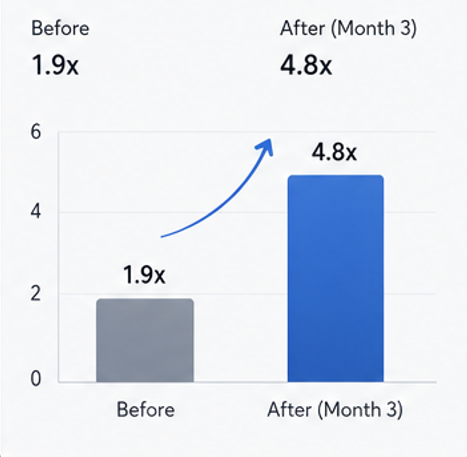
By mid-2023, organic growth had plateaued and the founders had begun investing in paid advertising primarily Meta Ads to drive new customer acquisition. After seven months of managing campaigns internally, their Meta ROAS had settled at a stubborn 1.9× and their blended Performance marketing ROI was estimated at 68%. They knew the product could scale; they were not confident they had the paid media infrastructure to make it happen.
The Challenge
A Single Bottom-Funnel Campaign Carrying All Paid Spend
The brand’s entire Meta Ads budget was concentrated in two conversion campaigns both targeting Purchase events and both running nearly identical broad targeting with no audience segmentation. There was no top-of-funnel awareness investment, no mid-funnel consideration layer, and no retargeting campaigns for the significant volume of website visitors and Instagram engagers who had not yet purchased. New cold audiences were being asked to convert on first contact a creative and funnel mismatch that consistently produces poor ROAS at meaningful scale.
Creative Fatigue That Nobody Had Noticed
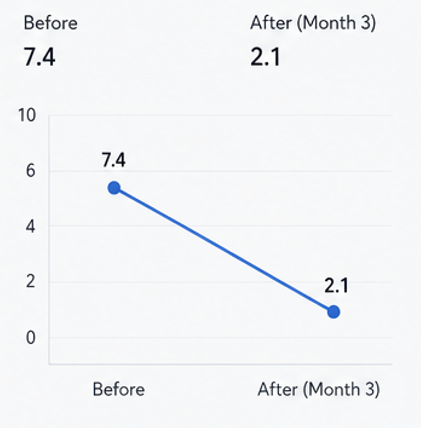
The same three creative assets had been running in Meta campaigns for 19 weeks without rotation. Meta’s delivery data showed that frequency on the primary conversion campaign had reached 7.4 across a 30-day window the average user in the target audience had seen the same ad more than seven times. Creative fatigue at this level does not just reduce ROAS; it actively trains the algorithm to serve ads to less and less engaged users as it exhausts the responsive segment.
Google Shopping Was Absent
The brand had a Google Merchant Centre account that had been set up at launch but never properly configured. The product feed had 14 products listed, all with generic titles (the product name only, no descriptive keywords), no GTINs, and placeholder images that did not meet Google’s image quality requirements. The account had been disapproved for 6 of 14 products at some point and the disapprovals had never been addressed. The brand was entirely absent from Google Shopping the highest purchase-intent paid channel for skincare products while competitors were consistently appearing for every relevant query.
No Attribution Model Below Last Click
All performance reporting was based on platform-reported conversions Meta’s own attribution window and Google’s last-click model. With both channels running simultaneously but with no cross-channel attribution, the founders had no accurate picture of which channel was contributing to which purchase, whether customers were seeing Meta ads and then converting via Google, or how to allocate budget between channels based on real business outcomes.
The Approach
Phase 1 Month 1 Attribution Fix and Google Shopping Launch
The first priority was building a measurement foundation before spending another rupee on campaigns without reliable data. GA4 was audited and reconfigured with purchase and add-to-cart events properly tagged. Meta’s Conversions API was implemented server-side to recover conversions being lost to iOS tracking restrictions this immediately increased Meta’s reported conversion volume by 22% without changing actual sales, revealing that the previous ROAS of 1.9× had been understated. Google Shopping was rebuilt from scratch: product titles were rewritten to keyword-lead format, GTINs were sourced and added for all 14 products, images were replaced with clean white-background hero shots, and the 6 disapproved products were fixed and resubmitted. Google Shopping campaigns were launched in week three with a ₹30,000 test budget.
Phase 2 Month 2 Full-Funnel Meta Architecture and Creative Reset
The existing Meta conversion campaigns were restructured into a three-stage funnel. Top of funnel: a video view and engagement campaign reaching a broad lookalike audience of the brand’s best customers budget 20% of total Meta spend. Middle of funnel: a traffic and engagement campaign retargeting users who had watched 50%+ of the awareness video or visited the website in the past 30 days budget 15% of total Meta spend.
Bottom of funnel: two conversion campaigns, one for cold prospecting (Advantage+ Shopping) and one for warm retargeting with dynamic product ads budget 65% of total Meta spend. An urgent creative brief was issued: 8 new assets across three formats (UGC-style testimonial video, ingredient explainer Reels, and a before/after static carousel) were produced and rotated in within 10 days.
Phase 3 Month 3 Scaling and Budget Reallocation
By week 10, Meta ROAS was tracking at 3.9× blended and Google Shopping ROAS was at 5.1× ahead of Meta on a per-channel basis because Shopping captures users further down the purchase funnel. Total monthly revenue had moved from ₹8.4 lakh to ₹19.2 lakh by end of month two. In month three, the Google Shopping budget was increased from ₹30,000 to ₹85,000 based on demonstrated ROAS. A Performance Max campaign was tested with the product feed as the primary asset. The top-of-funnel Meta investment from month two began showing measurable impact on branded search volume a 34% increase in branded Google searches was attributed to the awareness campaign reach.
The Results
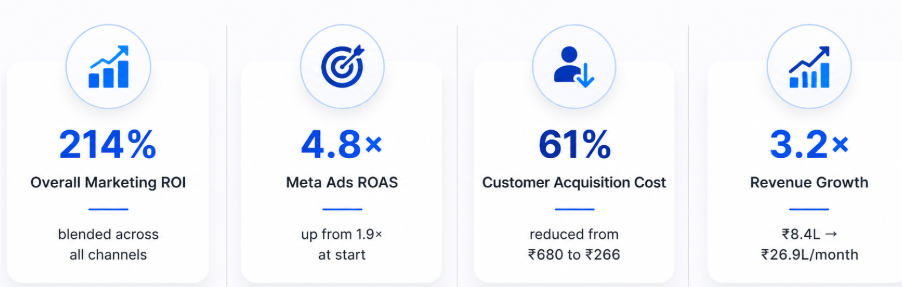
| Metric | Before | After (Month 3) | Change |
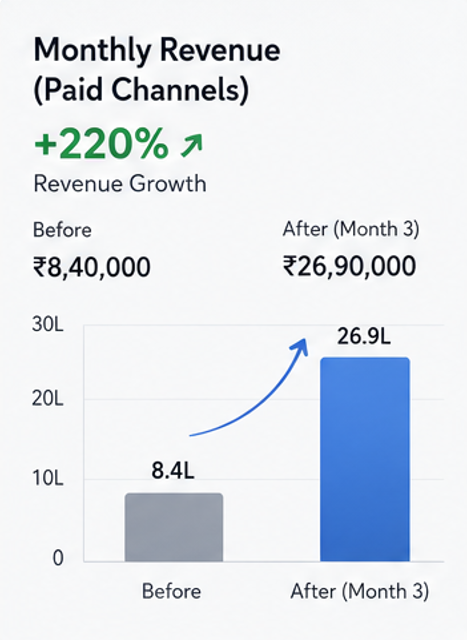
| Monthly Revenue (Paid Channels) | ₹8,40,000 | ₹26,90,000 | +220% |
| Blended Marketing ROI | 68% | 214% | +146 pts |
| Meta Ads ROAS | 1.9× | 4.8× | +2.9× |
| Google Shopping ROAS | Not running | 5.1× | New channel |
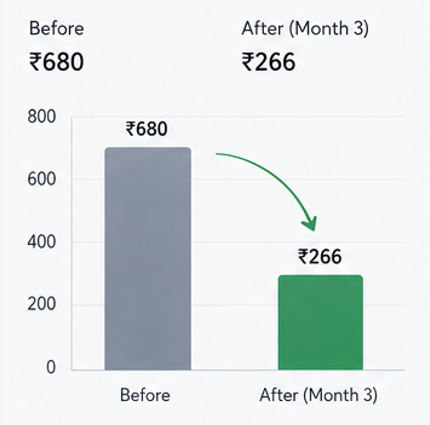
| Customer Acquisition Cost | ₹680 | ₹266 | −61% |
| Meta Frequency (30-day) | 7.4 | 2.1 | −72% |
| Creative Assets Active | 3 | 11 | +8 assets |
| Conv. API Recovery Gain | — | +22% | More accurate data |
We increased Monthly Revenue by 220%
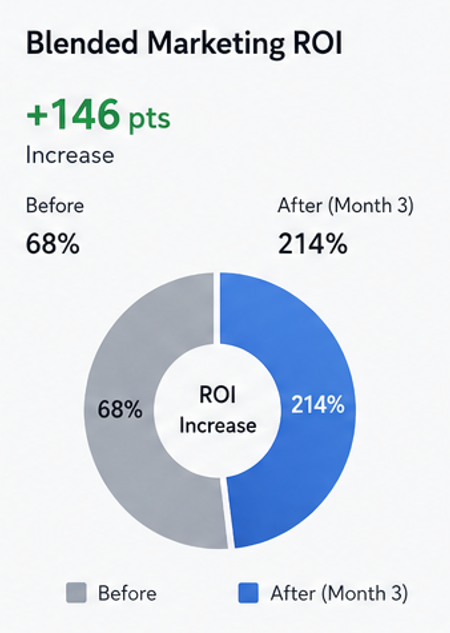
2.9x Increment in Meta Ads ROAS Meta Frequency reduced
We reduced Customer Acquisition Cost -61%
Conclusion
Sustainable growth happens when every marketing channel works together. By combining Meta Ads, Google Shopping, accurate attribution, and full-funnel campaign optimization, Arihant Global transformed paid marketing into a scalable revenue engine. If you want higher ROI, lower acquisition costs, and profitable growth, partner with Arihant Global for performance marketing strategies built around measurable business results.
Disclaimer
Results are based on one client’s campaign performance and specific market conditions. Outcomes differ based on product category, competition, advertising budget, creative quality, and customer demand.